 Save
Fiction note: The following is an original fictional story. It uses general public information about written contracts, small claims, and judgment collection only as background, not as legal advice.
1. The Drawer That Would Not Close
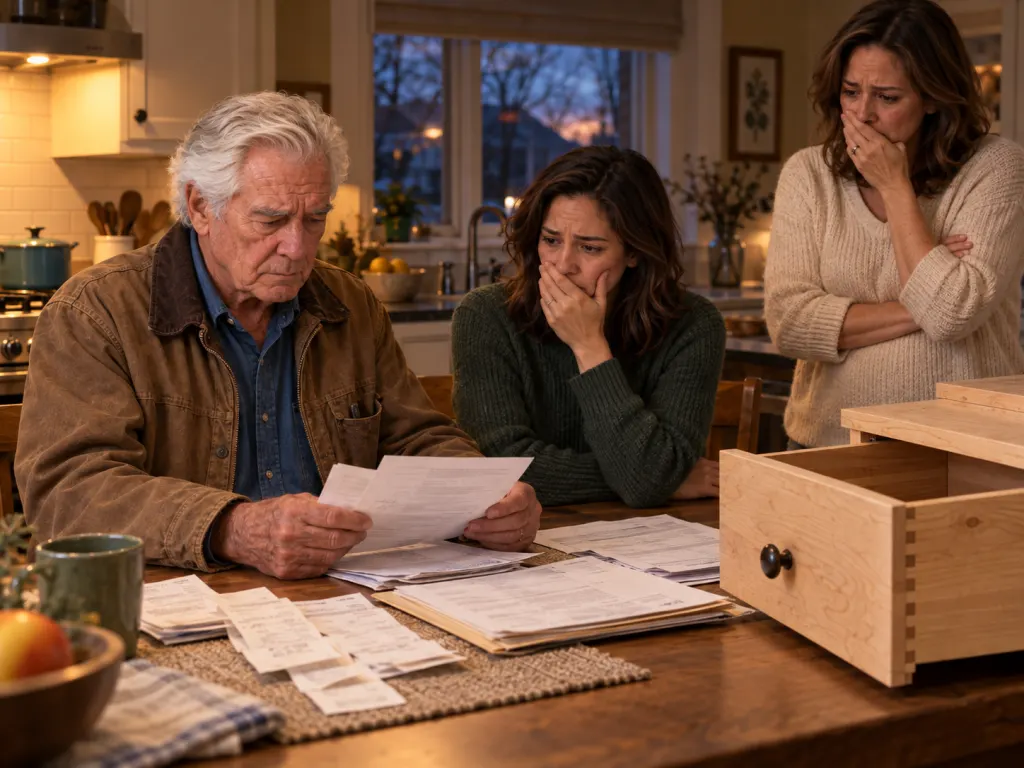
The drawer stuck on a Tuesday evening, and that was how I knew my grandfather was angry.
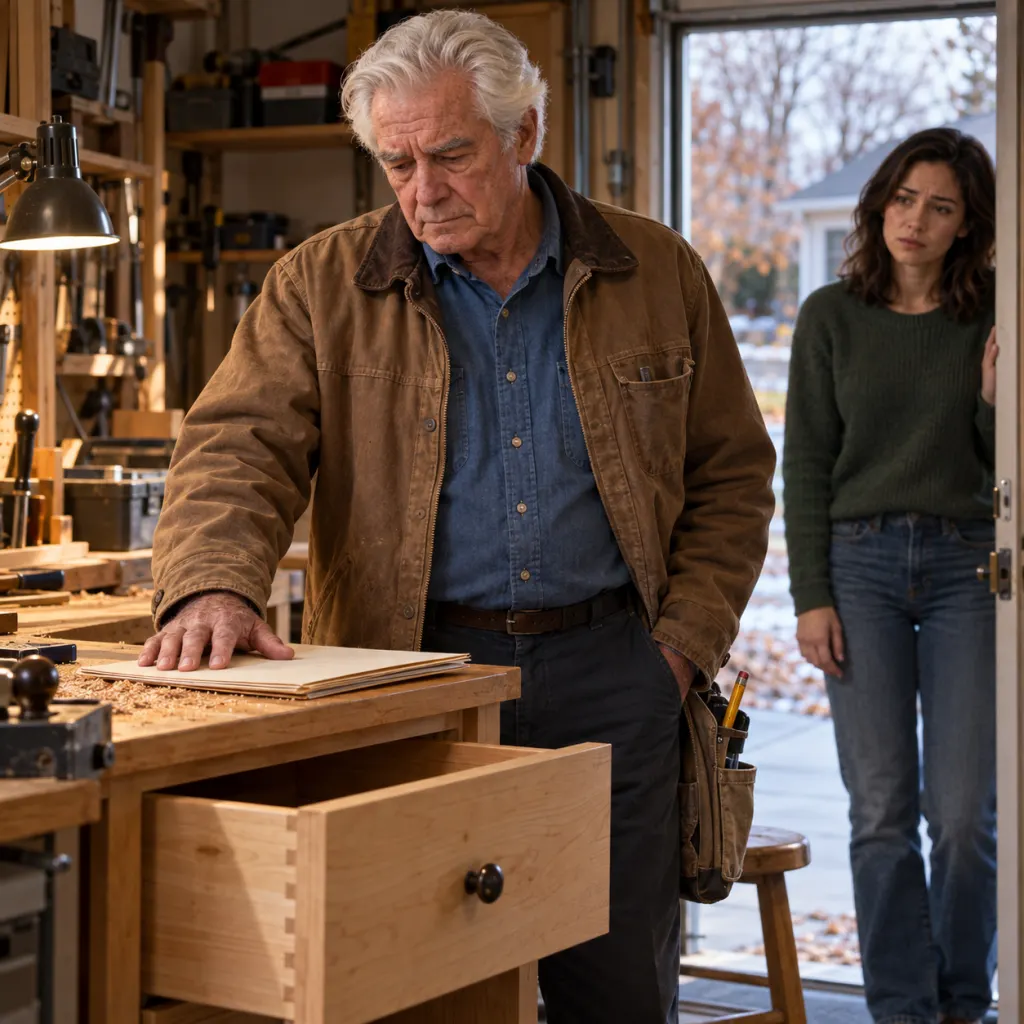
Not because he slammed it. Frank Bell never slammed anything he intended to fix. He stood in my mother’s kitchen with his shoulders rounded from fifty years of measuring other people’s mistakes, one hand on the brass pull, and eased the drawer open again with the care of a man disarming a trap. The drawer had always had a habit of catching when the weather turned damp. Everyone else tugged harder. Grandpa listened.
He slid it out, turned it over, and ran his thumb along the worn wooden runner. Sawdust clung to the cuff of his work shirt. There was a crescent of dried glue near his wrist, a pencil behind his ear, and a folded envelope in his shirt pocket that he had not stopped touching since he walked in.
"They paid you?" my mother asked from the stove.
The question sat in the room like a plate set down too hard.
Grandpa took the pencil from behind his ear and laid it beside the drawer. He did not look at either of us. "Most of it."
I was twenty-seven, old enough to understand that most of it could mean many things and young enough to think outrage was a useful tool. "How much is most?"
He rubbed the runner with a square of wax paper from Mom’s baking drawer. "They held back sixty-two hundred."
The spoon in Mom’s hand stopped moving. Outside, the neighbor’s sprinkler ticked against the fence in a bright, brainless rhythm.
"For what?" I asked.
Grandpa slid the drawer back in. It moved cleanly, silently, as if it had never caused anyone trouble. That was his curse and his gift. He could make broken things behave without making a performance of it.
"For being the sort of people who think money makes gravity optional," he said.
He tried to smile afterward, but it didn’t hold. He sat at the table and took the envelope from his pocket. Inside were copies: contract pages, change orders, receipts, dated photos, text messages printed in neat black ink. He had paper-clipped them by week. The clips were color-coded.
My grandfather’s hands were broad, scarred, and square-nailed. They looked clumsy until you saw him work. Then you realized they had a second language. They could find the crown in a board, the swell in a wall, the apology hidden inside a bad hinge.
"Tell us," Mom said.
He looked toward the repaired drawer, not because it mattered, but because it was easier than looking at us.
"They said everything was already installed," he said. "So I couldn’t take it back."
2. The House on Briar Hill
The house on Briar Hill had gates that opened before you reached them, as if even metal had learned to anticipate wealth. Grandpa had been working there for seven weeks, building custom cabinets along the downstairs wall, floor-to-ceiling shelves around a stone fireplace, and a window bench under three tall panes of glass that faced a lawn too green to be honest.
The owners were named Vivian and Alden Cross. They were not old money, Grandpa said, but they had studied it. Vivian wore cream-colored sweaters that never collected lint. Alden had the habit of resting his palm on another man’s shoulder when he wanted him to feel small.
At first, Grandpa liked the job. He liked hard rooms. He liked walls that bowed, floors that sloped, corners that refused to square. A plain box bored him. A difficult room asked questions.
"Old houses tell on themselves," he told me one Saturday when I brought him coffee. "New expensive houses lie."
The Cross house lied beautifully. The plaster looked smooth until a level touched it. The fireplace was off-center by nearly an inch. One window had been framed higher than the others and disguised with trim. Grandpa showed me without complaint, pointing with the same patience he used when I was ten and he taught me how to hold a nail without surrendering a thumbnail.
"You work with what’s there," he said. "Then you make it look like it meant to be that way."
The Crosses changed their minds often. First they wanted dark walnut stain, then pale oak, then a custom mix Vivian called mushroom-gray, though it looked to me like wet newspaper. They approved brushed brass pulls, then black iron, then brass again. Alden decided one shelf should sit higher because he had bought a sculpture he wanted to display. Vivian wanted the window bench cushion deeper after the base had already been built.
Each time, Grandpa wrote it down. Each time, they signed.
He had learned this habit the slow way. Years before, a restaurant owner had sworn he never approved extra shelving until Grandpa found the napkin sketch tucked in a folder, the man’s initials sitting beside the measurements in blue ink. Since then, Grandpa treated paperwork like another tool. Saw. Plane. Level. Contract.
The Federal Trade Commission’s public guidance for home improvement projects advises written estimates, careful contracts, and keeping notes and copies when disputes arise; Grandpa did not need the internet to tell him that, but it would have approved of his folders. Reference: https://consumer.ftc.gov/articles/how-avoid-home-improvement-scam
By the final week, the downstairs had transformed. The cabinets ran smooth and even along the far wall. The shelves made the fireplace look intentional. The window bench caught the afternoon light and held it there, warm as bread.
Vivian walked through taking pictures. Alden opened and closed the cabinet doors with a satisfied little nod.
"Frank," Vivian said, "this is exquisite."
Grandpa lowered his eyes, embarrassed by praise but not immune to it. "It’ll serve you well."
That was how he spoke about his work. Not beautiful. Not impressive. Useful. Built to hold.
Then Alden folded his arms and said they would not be paying the remaining $6,200.
"We’ve gone over budget," he said, as if the budget were weather.
Grandpa thought he had misheard him. "That balance includes the signed changes."
"We understand what it includes."
Vivian stood near the window bench, running one hand along the new cushion base. She did not look embarrassed. She looked mildly inconvenienced, like someone watching a server bring the wrong wine.
"You’re one man," Alden said. "What are you really going to do?"
Grandpa told us later that the room went very quiet then. Not peaceful. Hollow.
Vivian added, "Everything’s installed. It isn’t as though you can take it back."
Grandpa did not answer. He packed his pencil, folded his drop cloth, and left without raising his voice.
3. The Thing He Refused to Carry
For three days after that, Grandpa did what proud people do when shame has been handed to them by someone else: he tried to carry it privately.
He came to dinner. He fixed Mom’s drawer. He sharpened a plane blade in his garage until the edge could shave a curl from maple thin enough to see through. But he moved as if the $6,200 were not money at all. It was a hand on his shoulder. It was Alden’s voice saying, You are small.
I found him on Friday morning in the garage, sitting on an upturned bucket between two sawhorses. The radio was off. That frightened me more than anything. Grandpa believed silence was for churches, libraries, and measuring twice.
"You should send them a letter," I said.
"I did."
"Certified?"
He glanced up. "Who raised you?"
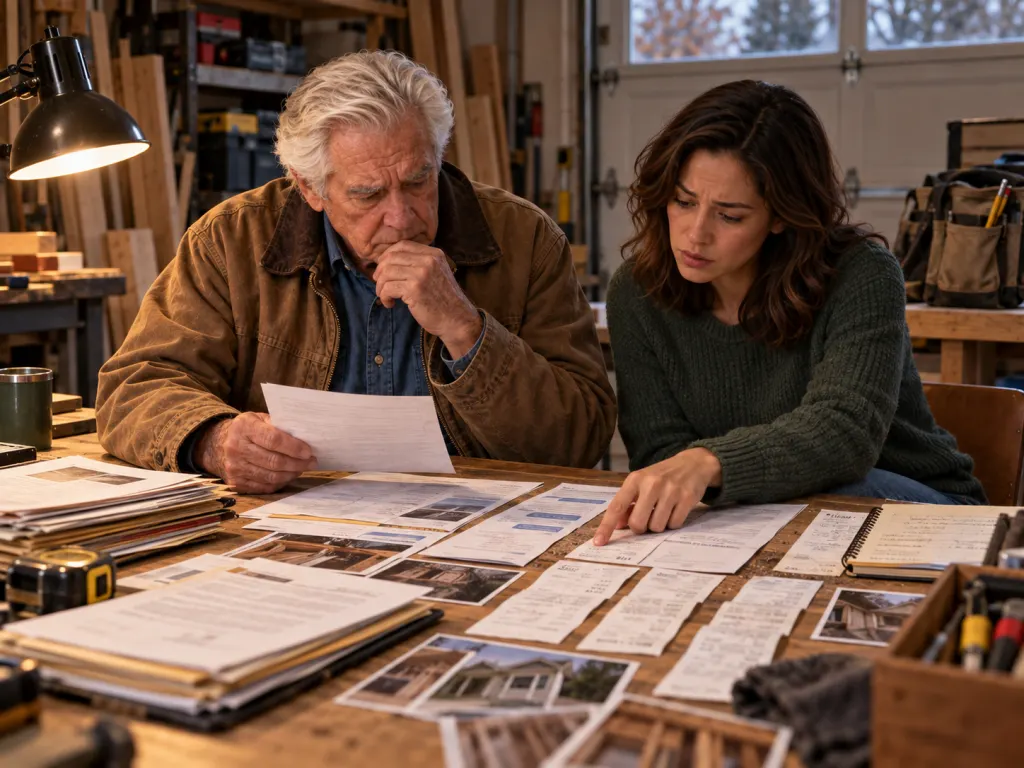
I sat on the other bucket. The air smelled of cedar, mineral spirits, and coffee gone cold. On the bench lay the folder from Briar Hill, its label written in block letters: CROSS DOWNSTAIRS BUILT-INS.
"Then court," I said.
His mouth tightened. "I’m not a court man."
"You’re a records man."
That landed. He looked at the folder.
"They counted on you being tired," I said.
"I am tired."
"I know."
He rubbed his thumb over a small scar near his knuckle. He got that scar before I was born, installing trim in a house where the owner followed him room to room with a stopwatch. Grandpa finished the job anyway. When I asked why years later, he said, "Because my name was on it."
"This is your name too," I said.
He gave a short laugh. "You sound like your grandmother."
That was the highest compliment in our family. Grandma Ellie had been gone six years, but her standards still lived in the house like good light. She had been small, practical, and impossible to intimidate. When a cashier once tried to shortchange her by four dollars, she stood aside and counted the drawer tape aloud with such calm that the manager apologized twice.
Grandpa opened the Cross folder. On the inside cover he had taped a photograph of the finished room. The shelves glowed in afternoon sun. No one looking at that image would see the hours inside it: the sanding, the fitting, the return trips for altered hardware, the knees aching at midnight.
"I keep thinking," he said, "maybe I should have made them pay before the final install."
"Maybe," I said. "But that doesn’t make stealing your work acceptable."
He looked at me sharply. "Careful with words."
"Fine. Withholding agreed payment."
"Better."
Even wounded, he would not let me become sloppy.
We spent the afternoon building the kind of timeline that does not shout because it does not need to. Date of original contract. Deposit received. First change order. Second change order. Material receipts. Text approval. Photo of completed cabinets. Photo of completed shelves. Photo of window bench. Final invoice. Certified letter.
New York Courts’ public self-help page explains that a person seeking money in court is the plaintiff, that the person sued is the defendant, and that venue can include the county where a contract was made or broken. Reference: https://www.nycourts.gov/help/problems-money/when-someone-owe-you-money-creditor
Grandpa read that line twice, then checked the county on the Cross contract.
"I don’t want drama," he said.
"Then don’t bring drama. Bring paper."
He smiled for real then, just a little.
"Your grandmother definitely raised you," he said.
4. The Letter That Came Back Signed
The certified letter came back signed by someone named V. Cross. Grandpa set the green receipt on the table as if it were a fragile tile.
His letter had been simple. He thanked them for the opportunity to complete the Briar Hill built-ins. He listed the unpaid balance. He attached copies of the signed change orders and final invoice. He asked for payment within ten business days or a written explanation of any disputed charge.
The reply arrived by email at 11:42 p.m. on a Sunday.
Alden wrote that while the work was "generally acceptable," they had experienced "disappointment with the overall process" and had decided the withheld amount was a "reasonable adjustment." There were no specific defects listed. No photographs. No measurements. No complaint raised before final invoice.
Grandpa printed the email and slid it into the folder.
"Generally acceptable," Mom read over his shoulder. Her voice had the dangerous softness she used when someone had insulted a person she loved. "They photographed every inch of that room like they were about to submit it to a magazine."
"They can call it what they like," Grandpa said. "The paper says what it says."
But later I saw him at the sink, washing one coffee mug for a long time.
There are injuries money does not measure well. The unpaid balance mattered. Grandpa had property taxes due. His truck needed work. He had been saving to replace the garage heater before winter. But the sharper wound was that the Crosses had looked at a lifetime of skill and assumed he would absorb the insult quietly because quiet people often do.
Quiet is mistaken for weakness by people who have never had to depend on strength.
We filed in small claims the next week. Grandpa wore his good jacket, the brown one with worn elbows, and carried the folder in a canvas tool bag because he said briefcases looked like they were pretending to know more than they did.
The courthouse smelled of floor wax and damp wool. People sat on benches holding papers, children, coffee cups, grudges. A man in a paint-spattered hoodie rehearsed sentences under his breath. A woman with silver hoop earrings organized receipts in a shoebox. Nobody looked like television court. Everybody looked like they had lost sleep.
At the clerk’s window, Grandpa gave his name. His voice stayed steady until the clerk asked for the amount.
"Six thousand two hundred dollars," he said.
The clerk stamped the forms. The sound startled him. It made the matter official in a way anger had not.
On the walk back to the truck, he stopped beside a planter full of tired municipal flowers.
"Your grandmother would have brought snacks," he said.
"For court?"
"For waiting."
"She would have brought snacks and judged everyone’s posture."
He laughed, and the laugh loosened something in both of us.
That night, I made a binder. Grandpa objected to the binder because it was too shiny. I told him justice could survive a glossy cover. We made tabs anyway: Contract, Payments, Changes, Materials, Messages, Photos, Invoice, Letter.
For each tab, Grandpa knew the story. He did not embellish. He did not need to. The truth had joints and fasteners. It could stand.
5. The Waiting Room
The hearing was scheduled for a rainy Thursday in November.
Grandpa arrived forty minutes early. He wore a clean blue shirt, dark slacks, and work boots polished so thoroughly that I knew he had sat on the porch the night before with a rag and a tin of wax, calming himself through repetition. His hair, white and stubborn, had been combed back with water. In the fluorescent courthouse light, he looked both smaller and more formidable than usual.
Vivian and Alden Cross arrived eight minutes before the hour.
They looked expensive in a way that made the room briefly aware of itself. Vivian wore a camel coat over black clothes and held a leather folder thin enough to suggest confidence. Alden wore a navy suit and no tie. He glanced at Grandpa, then at me, then at the canvas tool bag between Grandpa’s boots.
"Frank," Alden said, as if they had met at a charity breakfast.
Grandpa nodded. "Mr. Cross."
Vivian gave a small smile. "This really wasn’t necessary."
I felt heat climb my neck. Grandpa put one hand on my forearm without looking at me.
"I agree," he said. "It wasn’t."
That ended the conversation.
We sat. Rain ticked against the high windows. A bailiff called names. Cases rose and fell around us in fragments: a damaged fence, a borrowed car, a security deposit, a catering bill. Each one contained a private world compressed into minutes.
Grandpa opened the binder and checked the tabs again.
"Stop fussing," I whispered.
"I am not fussing. I am confirming."
"That is what you call fussing when you respect it."
He almost smiled.
The Crosses whispered to each other. Alden looked bored. Vivian looked faintly irritated, as if the room’s chairs had personally failed her.
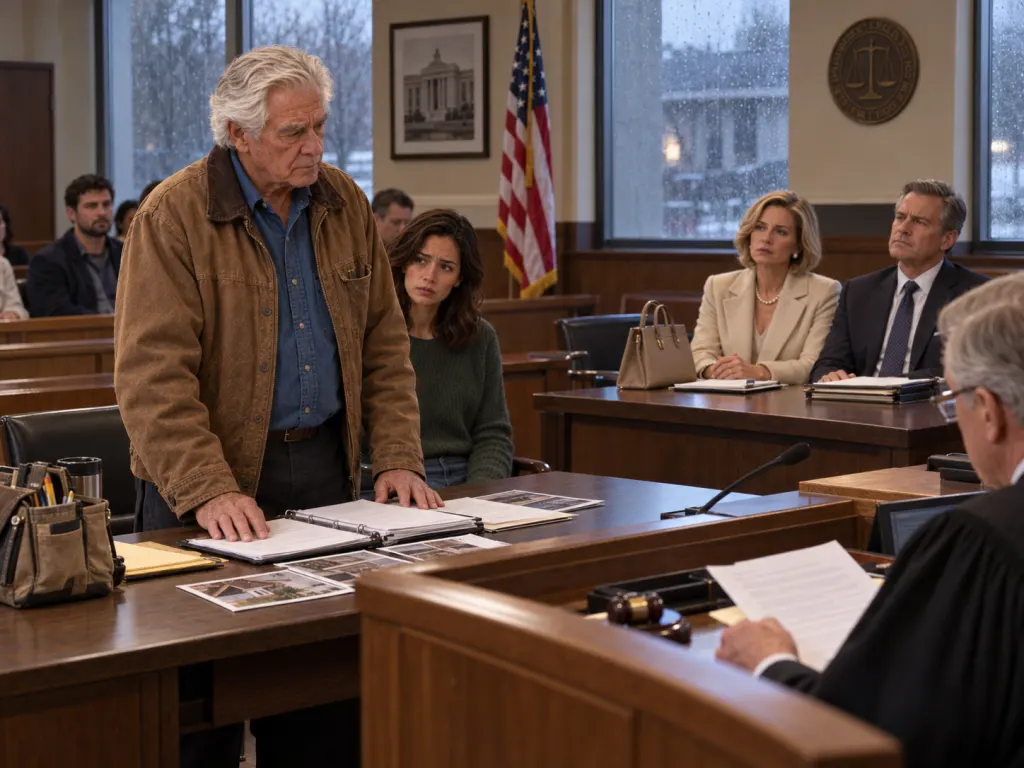
When our case was called, Grandpa stood slowly. Not dramatically. Carefully, because his left knee hated rain. We walked to the front.
The judge was a woman with reading glasses low on her nose and an expression that suggested she had heard every possible version of people disappointing each other. She asked both sides to state their names. She explained the order of speaking. She asked if anyone wished to settle before proceeding.
Alden said, "We’re prepared to resolve this for one thousand dollars as a courtesy."
Grandpa’s face did not change.
"No, thank you," he said.
The judge looked at him over her glasses. "You understand you may receive less, more, or nothing depending on the evidence?"
"Yes, Your Honor."
"Then begin."
6. What the Paper Said
Grandpa did not give a speech. That was the first thing that surprised me, though it should not have.
He laid out the contract. He showed the original price. He showed the payments received. He explained each change order in the same voice he used to explain why pine moves more than maple.
"This one moved the shelf height by three inches," he said. "This one changed the stain after materials had been purchased. This one changed the window bench depth. Each was signed here."
The judge followed along. Alden shifted once. Vivian crossed and uncrossed her legs.
"Did they complain about the quality of the work before the final payment was due?" the judge asked.
"No, Your Honor."
"Did they identify defects in response to your demand letter?"
"No, Your Honor. They described disappointment with the process."
The judge’s pen paused. "The process of changing their minds?"
Alden sat forward. "Your Honor, custom work requires collaboration. We felt Mr. Bell nickel-and-dimed us for normal adjustments."
Grandpa looked down at his hands.
The judge turned to Alden. "Did you sign these adjustments?"
"We signed paperwork, yes, but under the understanding that Frank was being flexible."
"Flexible does not usually mean free."
Vivian spoke then. "The room is lovely. That isn’t the issue. The issue is that the project became more expensive than we expected."
The judge waited.
Vivian added, "We felt a reduction was fair."
"Did Mr. Bell agree to that reduction?"
"Not explicitly."
Grandpa’s mouth twitched at the word explicitly, but he said nothing.
Alden opened his folder. He had printed photographs too, but they were the wrong kind for his argument. They showed the built-ins glowing in finished beauty. One picture caught Vivian seated on the window bench, smiling down at her phone. Another showed Alden with one cabinet door open, giving a thumbs-up to someone outside the frame.
The judge studied them. "These appear to show completed work."
"Yes," Alden said. "But completion isn’t the only standard."
"No," the judge said. "Evidence is another."
I looked at Grandpa. His ears had turned red, the way they did when he was trying not to feel too much in public.
The Crosses claimed inconvenience. Grandpa showed dates. They claimed frustration. Grandpa showed signed approvals. They claimed the final amount surprised them. Grandpa showed invoices sent after each change.
At one point, Alden leaned back and said, "We simply didn’t believe this should have escalated over six thousand dollars."
The judge looked up. "Then why didn’t you pay it?"
The room went still.
Alden opened his mouth. Closed it.
Grandpa kept his eyes on the table.
In that silence, I understood something I had missed. Grandpa had not come to court to punish them. He had come because the alternative was accepting the story they had tried to give him: that a working man’s patience was permission, that his age made him easier to dismiss, that installed work belonged only to whoever had the biggest house around it.
The judge asked a few more questions. Then she said she would issue her decision after reviewing the documents.
We stepped back from the table. Grandpa gathered the binder, aligning the edges of the pages by instinct.
Vivian passed close enough that I smelled her perfume, cool and floral.
"This has been unpleasant," she said.
Grandpa looked at her, not unkindly.
"Yes," he said. "It has."
7. Thirty-One Days
The decision came by mail nine days later.
Mom called me before I had finished reading the first sentence. Her voice broke on the word awarded. Grandpa had won the full $6,200 plus filing costs.
I drove over after work and found him in the garage, not celebrating, exactly. He had the decision on the bench beside a half-finished maple drawer box. He was sanding with the calm fury of someone trying to make happiness manageable.
"You won," I said.
"The judge agreed," he said.
"That is what winning is called when you’re allergic to joy."
He brushed dust from the board. "We’ll see if they pay."
They did not pay.
Ten days passed. Then twenty. Grandpa mailed a copy of the judgment with a polite request for payment. No response. Alden’s silence felt different now. Before court, it had been arrogance. Afterward, it became strategy.
Public court guidance often reminds successful claimants that a judgment is not always the same thing as money in hand. New York City’s small claims information, for example, describes judgment creditors, judgment debtors, and possible collection steps when payment does not arrive. Reference: https://www.nycourts.gov/new-york-city-small-claims-court/nyc-small-claims-court-collecting-judgment
Grandpa read the court’s collection page at my kitchen table with his glasses low on his nose.
"They make you climb the hill twice," he said.
"Sometimes," I said.
He folded the paper. "Then we climb."
We filled out the next forms. We asked questions at the clerk’s office. We learned which steps belonged to us and which required an enforcement officer. Grandpa disliked every minute of it. He believed work should end with payment, not paperwork, and he was right in the moral sense. In the practical sense, the paperwork had become the work.
On the thirty-first day, before we filed the next request, an envelope arrived at Grandpa’s house.
Inside was a cashier’s check for $6,327.
No note.
No apology.
The amount included the judgment and costs. The check was drawn from a bank with a branch near Briar Hill.
Grandpa held it under the porch light and read it three times. Mom cried. I did not, which I mention only because I did later in the car where nobody could accuse me of making a scene.
"You should frame it," I said.
"I should deposit it."
"After you take a picture."
He considered this. "Fine. One picture."
The next morning, he went to the bank in his work clothes. The teller congratulated him because Mom had told the story to half the neighborhood and the other half had inferred it from her volume. Grandpa accepted the congratulations with visible discomfort.
Afterward, he took me to the diner where he and Grandma used to eat on Fridays. He ordered eggs, rye toast, and coffee. He added a slice of pie even though it was 9:30 in the morning.
"Victory pie," I said.
"Breakfast pie," he corrected.
"That is not a category."
"It is now."
He ate slowly. Outside, rainwater shone on the street. A delivery truck hissed past. The world did not know that something had been restored, but we did.

8. What Stayed Built
Grandpa never worked for the Crosses again, though Vivian called once the following spring.
He let it go to voicemail. She said they were considering built-ins for the upstairs office and wondered whether he might be available. Her tone was bright, airy, almost amused, as if the unpleasantness had been a misunderstanding from which everyone had matured.
Grandpa played the message at the dinner table. Mom looked ready to answer it herself using language Grandma would not have approved of in front of children but might have admired in private.
Grandpa deleted the voicemail.
"That’s it?" I asked.
"That’s it."
"You don’t want to tell her why?"
He took a bite of pot roast. "She knows why."
There was power in that too. Not every insult deserves a closing argument. Sometimes the answer is a silence that belongs to you.
The $6,200 did practical things first. It fixed the truck. It paid the property taxes. It bought the new garage heater, which Grandpa pretended was nothing special until the first freezing morning when he walked into a warm shop and stood there with his eyes closed.
But the money also did something quieter. It returned weight to his name.
For weeks after the check cleared, people called. A neighbor needed a banister repaired. A church friend wanted shelves. A young couple had bought a crooked little house and needed advice more than carpentry. Grandpa took some jobs and refused others. He began asking for clearer deposits. He updated his contract. He made a printed change-order form with boxes large enough for people to write legibly.
"I’ve become modern," he told me, holding up the form.
"Grandpa, it’s paper."
"Modern paper."
In December, he asked me to help clean the garage. This was not cleaning in the ordinary sense. It was excavation. We found coffee cans full of screws sorted by type, three broken levels he insisted could donate parts, a box of cabinet pulls from 1998, and one envelope marked ELLIE - HOUSE IDEAS.
He sat down when he saw it.
Inside were magazine clippings Grandma had saved: kitchen shelves, mudroom benches, a breakfast nook with drawers underneath. On one scrap she had written in her tight, slanted hand: Frank can build better.
He pressed the paper flat on his knee.
"She always thought I could," he said.
"She was usually right."
"Usually?"
"I’m leaving room for family debate."
He laughed, but his eyes stayed wet.
That winter, Grandpa built a bench for our kitchen. Not for a client. For us. Maple, with three drawers underneath and a back angled just enough to make you want to sit there longer than you planned. He let me sand one side and then sanded it again when I left, which I pretended not to notice.
On Christmas Eve, after everyone had gone home and the kitchen had collapsed into crumbs, wrapping paper, and half-empty mugs, I found him sitting on the bench alone.
"Testing your work?" I asked.
"Listening to it."
I sat beside him. The house hummed softly: refrigerator, old pipes, wind against the back door. The bench did not creak.
"Do you still think about what Alden said?" I asked.
Grandpa looked at his hands. "Sometimes."
"What part?"
"What are you really going to do about it?"
He said it without bitterness now, almost with curiosity, as if the sentence had become a piece of warped wood he had finally learned how to plane.
"And?"
He leaned back against the maple. "I suppose I answered him."
He had. Not loudly. Not cruelly. He answered with copies, dates, receipts, signatures, and the stubborn refusal to confuse peace with surrender. He answered by letting his work remain beautiful without letting beauty become a trap. He answered by teaching me that dignity is not the same as silence, though it may speak softly.
The wealthy couple had thought everything was already installed, so nothing could be taken back.
They were wrong.
Grandpa took back his name.
Reflection
Some victories arrive without applause. A check clears. A heater warms a garage. A family sits on a bench built by hands that refused to be dismissed. What remains is not revenge, but steadiness: the knowledge that careful work matters, that records can protect the quiet, and that a person does not become small because someone richer tries to measure them that way.
Wrap-Up
In this fictional family courtroom story, an aging carpenter is denied the final $6,200 owed for custom work by wealthy clients who assume he will do nothing. With careful records and quiet resolve, he takes the dispute to court, wins, collects, and recovers something more important than money: the authority of his own name.
Frequently Asked Questions
- → Is this story based on a verified real event?
No. This is an original fictional story inspired by a general premise about unpaid work and family loyalty.
- → Does the story give legal advice?
No. The court details are fictionalized and general. Anyone facing a payment dispute should check local court rules or speak with a qualified professional in their area.
References
This content was developed and refined using reliable sources.
- https://consumer.ftc.gov/articles/how-avoid-home-improvement-scam
- https://www.nycourts.gov/help/problems-money/when-someone-owe-you-money-creditor
- https://www.nycourts.gov/new-york-city-small-claims-court/nyc-small-claims-court-collecting-judgment
- https://www.cslb.ca.gov/consumers/legal_issues_for_consumers/small_claims_court.aspx