 Save
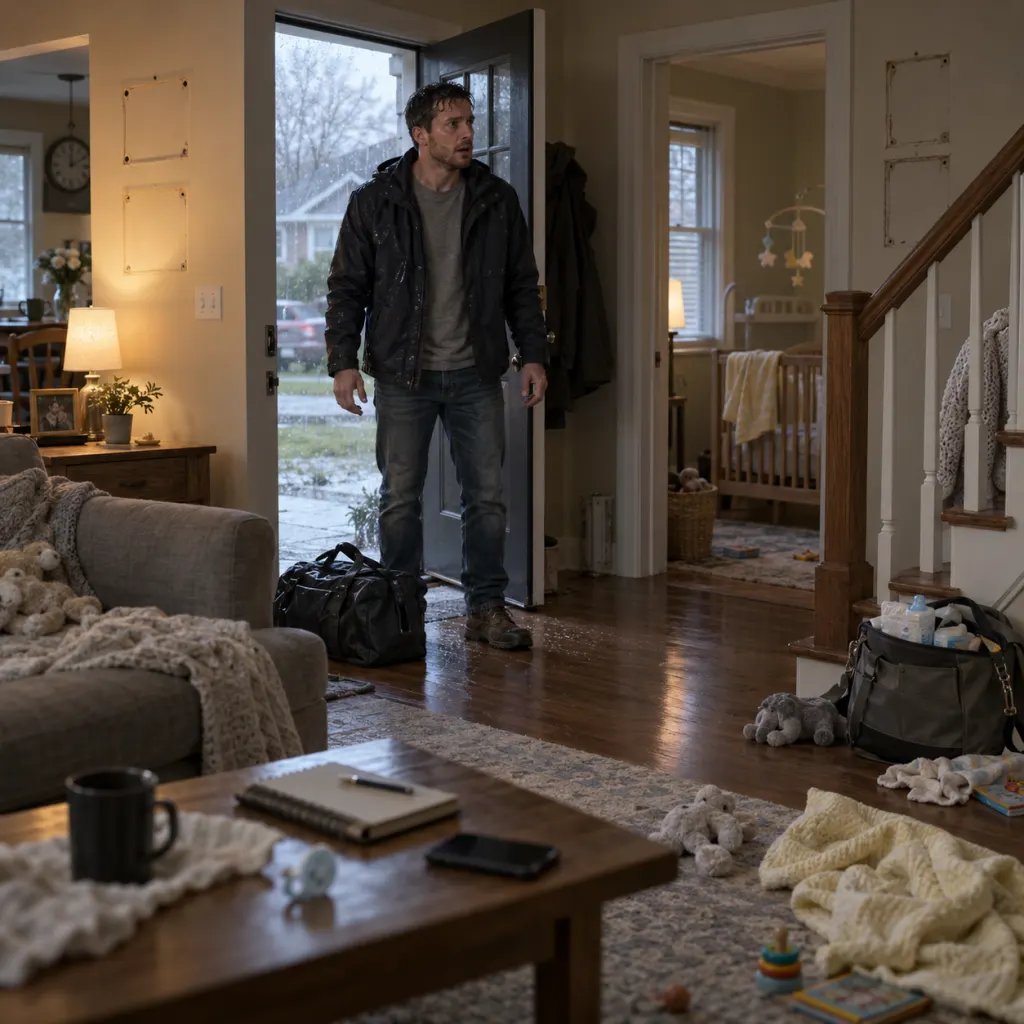
I thought coming home early would feel like mercy. Instead, I opened the door and heard my own key scrape through a silence so complete it seemed to have swallowed the house.
1. The House Was Too Quiet
The first thing I noticed was not the empty space where the television had been, or the pale rectangles on the walls where picture frames had hung for three years. It was the quiet. Our house had never been quiet since Noah was born. Even asleep, our son made tiny animal sounds in his bassinet, sighs and grunts and startled little breaths that kept both of us listening from opposite sides of the bed.
That afternoon, the house gave me nothing back. No kettle clicking off in the kitchen. No soft music from the nursery. No Olivia calling from upstairs, asking why I was home before Friday. I stood in the entryway with my duffel bag still hooked over my shoulder, rain dripping from my coat onto the mat she had bought because it said welcome in letters that looked hand-painted.
I had been away for four days on a warehouse contract outside the city, the kind of job I hated but took because bills had started arriving in pairs. I had planned to come back the next morning. Then the supervisor cut the week short, and I drove through three hours of rain imagining Olivia’s face when I walked in. I imagined her tired smile. I imagined placing a takeout bag on the table like an offering. I imagined taking Noah from her arms so she could shower without hurrying.
I did not imagine our living room half-empty.
The sofa was there, but the lamp beside it was gone. The little oak table Olivia used as a landing pad for burp cloths, mugs, and unopened mail was missing too. The rug had been rolled up or taken, leaving faint dust lines on the floorboards. In the kitchen, two cabinet doors hung open. A drawer had been pulled out crookedly, its contents scattered: spoons, bottle rings, a cracked measuring cup, one blue pacifier resting in the corner as if it had been dropped during an escape.
I said Olivia’s name once. Then again, louder.
From upstairs came a sound so small I almost missed it. Not a cry. A breath breaking.
I dropped the duffel and ran.
2. Olivia on the Nursery Floor
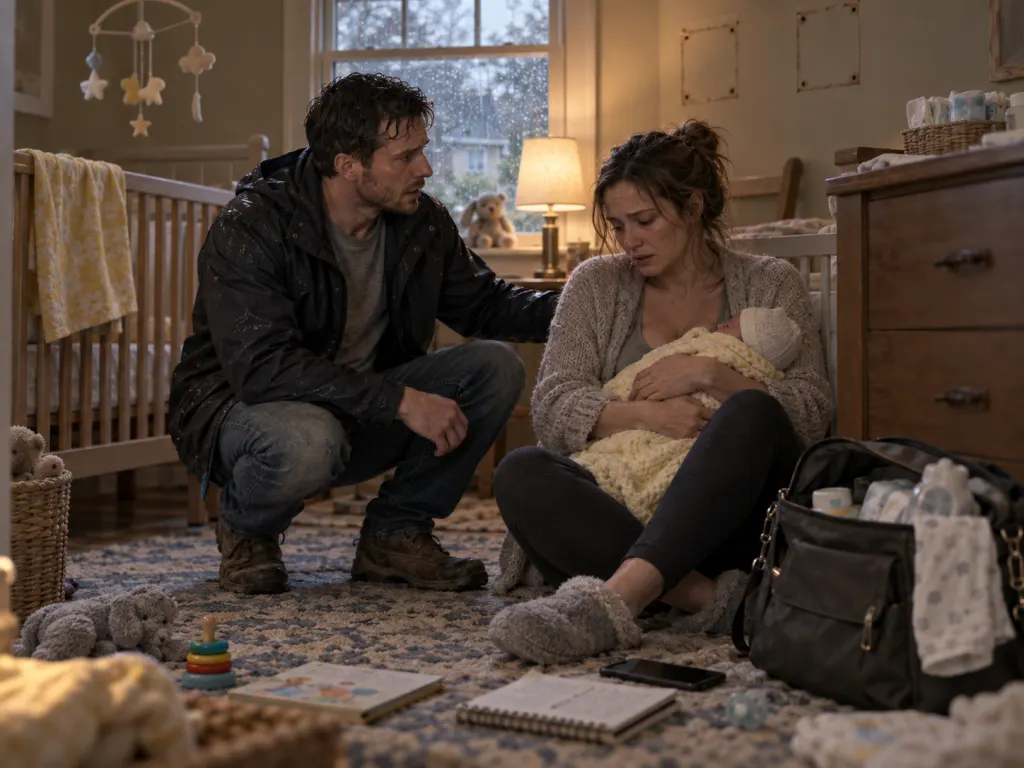
She was sitting on the nursery floor between the crib and the changing table, her back against the wall, Noah bundled against her chest in the yellow blanket her mother had mailed from across the state. Olivia’s hair was pulled into a loose knot that had collapsed on one side. Her eyes looked too large for her face, not because she was angry or surprised, but because she had been awake inside something I had not known was happening.
For one second, neither of us moved.
Then Noah made a thin, offended sound, and she tightened her arms around him.
“It’s me,” I said, though of course she knew. My voice came out wrong, too sharp from the stairs, too full of panic. “What happened? Liv, what happened to the house?”
She looked down at Noah as if the answer might be written on his sleeping face. “I thought you weren’t coming until tomorrow.”
“They ended early. I called.”
“My phone is dead.”
That was when I noticed the phone beside her knee, dark screen up, no charger anywhere near it. Beside it sat a diaper bag, overstuffed and zipped only halfway. A grocery bag held two folded onesies, a bottle, wipes, and a jar of coins from our dresser. Her shoes were on. Noah’s tiny knit hat was crooked over one ear.
The room had been searched. Not robbed, exactly. Searched with the nervous impatience of someone looking for things they believed belonged to them. The rocking chair was dragged toward the door. A stack of baby books lay open-faced on the floor. The framed print above the crib hung at an angle.
My mouth filled with the copper taste of fear. “Were you leaving?”
Olivia closed her eyes.
I wished at once that I had asked it differently, or not at all. The question hung between us like an accusation, and I saw her hear it that way. After everything visible around me, after finding her on the floor with our eight-day-old son, I had still reached first for my own fear of being left.
“I didn’t know where else to go,” she said.
I crouched in front of her, slow now, like any sudden movement might break the room further. Noah squirmed, his fist pressing briefly against the blanket. His face was red and wrinkled with the deep seriousness newborns carry, as if they have arrived from a place with better information than ours.
“Tell me,” I said. “Please.”
3. The Note on the Counter
She would not hand Noah to me right away. That hurt, but I understood enough not to reach. I sat on the floor across from her with my wet coat still on, water cooling down my sleeves.
Olivia spoke in pieces. My brother had come by that morning. That was what she said first, and I felt the floor tilt.
Marcus had a key because I had given him one two summers ago, when Olivia and I drove to the coast and asked him to water the basil on the back step. He was my older brother by fourteen months, which had somehow been enough time for him to believe he understood life before I did. He could be generous, funny, impossible, and careless with other people’s boundaries when he decided his intentions were good.
He had arrived while Olivia was feeding Noah. He said he needed to collect a few things from the garage, tools he claimed I had borrowed. Then he came inside. Then he started talking about money.
“What money?” I asked.
Olivia’s gaze moved to the window. Rain trembled on the glass. “He said you owed him.”
In the silence that followed, I heard Noah swallow.
I had owed Marcus money once. Not recently, not like that, and not in a way that could explain the stripped walls downstairs. Before Noah was born, when overtime disappeared and the hospital invoices began arriving, I borrowed from Marcus to keep our mortgage current. I told Olivia it was handled. That had been my phrase for everything I was too ashamed to explain.
Handled meant hidden.
Marcus had taken the television, the rug, the oak table, two lamps, the framed photographs from the hall, and the small speaker Olivia played while cooking. He told her I had promised him he could take whatever covered part of the debt. When she told him to stop, he told her to call me. When she said her phone was almost dead and she needed the charger from the bedroom, he went upstairs first.
“He didn’t touch me,” she said quickly, seeing my face. “He didn’t. But he was loud. Noah woke up screaming. I kept asking him to leave.”
“Why didn’t you call the police?”
She flinched. Not dramatically. Just a small tightening around the mouth. It was enough.
“Because he’s your brother,” she said. “Because I didn’t know what you had agreed to. Because every time money came up, you told me not to worry.”
There it was. The blade under the story.
I stood because I could not bear sitting still. Downstairs, on the kitchen counter, Olivia had left the note Marcus had written on the back of an envelope. It was not a confession. It was worse, because it was casual. A list of items. A number. My name at the bottom, as if I had signed with absence.
I read it twice. The kitchen smelled faintly of cold coffee and baby formula. Beside the sink, one of Noah’s bottles stood half-washed, the brush still inside it. The whole room looked interrupted, as if our life had been lifted by one edge and shaken.
I had come home to find my wife and newborn abandoned, but not by strangers. Not by fate. By the cowardice that had grown in the spaces where I had refused to speak plainly.
4. The Call I Did Not Want to Make
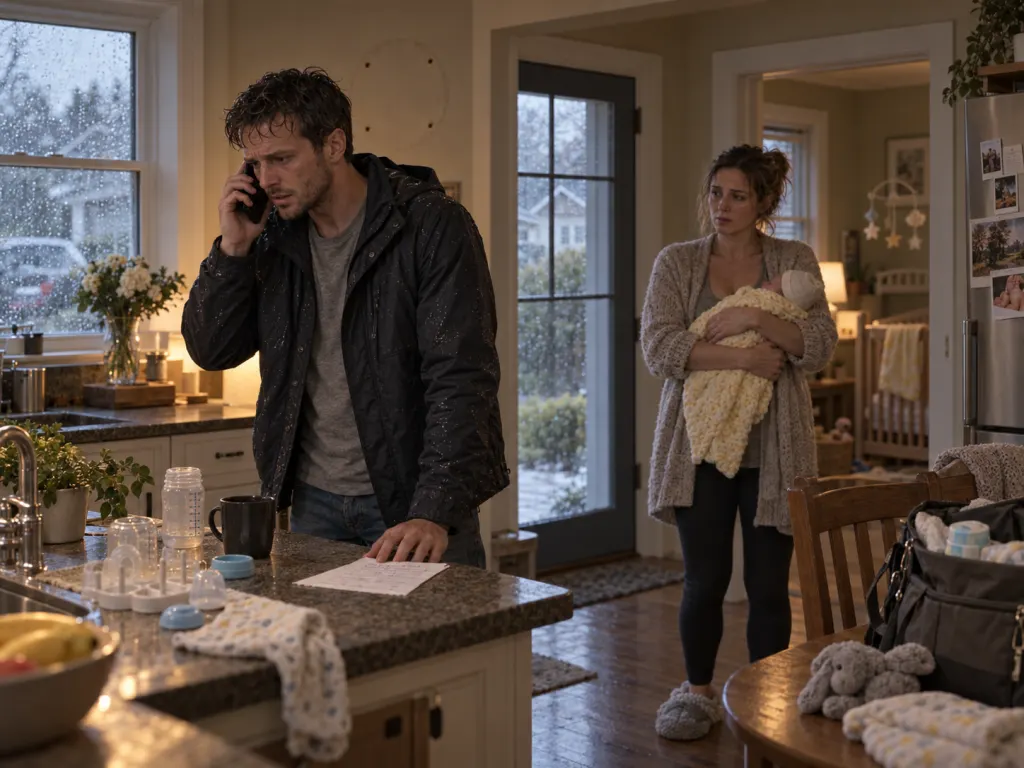
I called Marcus from the kitchen with one hand braced on the counter and Olivia listening from the doorway. Noah had finally settled against her shoulder, his mouth slack, his cheek pressed into the blanket.
Marcus answered on the fourth ring. “You back already?”
His voice was easy. That made my anger cleaner.
“Bring everything back.”
He laughed once, like I had opened with a joke and failed to land it. “You saw the note.”
“I saw what you did to my house.”
“Your house?” he said. “That’s rich, Daniel. You borrowed money from me, then stopped answering when I asked about it.”
I could feel Olivia watching me. There were a hundred ways to defend myself and almost all of them would make me smaller. I had taken his calls at first. Then I delayed. Then I let them go to voicemail because every conversation with Marcus became a courtroom where he was judge, witness, and injured party all at once.
“You scared my wife,” I said.
“I told her what you should have told her.”
“You took things out of a house with a newborn in it.”
“Don’t dress this up. You made promises.”
Behind me, Olivia shifted. I turned and saw her eyes not on me, but on the missing space where the kitchen clock had been. Marcus had taken that too. The absurdity of it struck me so hard I nearly laughed. A clock. As if time could be collected against a debt.
“You have one hour,” I said. “Then I report the theft.”
The line went quiet. For the first time, Marcus heard something in me he could not push past with volume.
“You’d do that to family?” he asked.
I looked at Olivia holding our son in the half-empty kitchen. Her face was pale with exhaustion, but she did not look away from me.
“I’m doing it for family,” I said.
After I hung up, the house seemed to exhale and then draw in a sharper breath. I wanted Olivia to say something that would let me believe I had repaired even a small corner of what had happened. She did not. She walked past me to the sink, balanced Noah in one arm, and began rinsing the bottle brush with her free hand.
“Let me do that,” I said.
“I have it.”
Three words. Calm, tired, impenetrable.
5. What I Had Called Protection
While we waited, I made tea neither of us drank. I changed out of my wet clothes. I put my duffel in the bedroom and found the closet door open, one of my shirts pulled halfway off its hanger. Marcus had searched there too. The sight of it made me want to drive to his apartment and drag our life back piece by piece.
Instead, I went to the nursery.
Olivia sat in the rocking chair now, moving in small arcs over the bare floor. Noah slept against her, his little body folded into trust. The rain had softened. Somewhere outside, a car moved through the wet street with a low hiss.
“I’m sorry,” I said.
She kept rocking.
“I should have told you about the loan.”
“Yes.”
The word did not crack open into forgiveness. It simply landed.
I leaned against the crib, careful not to crowd her. “I thought I was protecting you.”
That made her look up.
“From what?” she asked. Her voice was soft, but the softness had a tired edge. “From numbers? From bills? From the fact that we are adults who live in the same house?”
I had no answer good enough.
“Every time I asked,” she said, “you told me we were fine. You smiled like I was worrying for sport. I thought maybe I was losing my grip. I thought maybe motherhood had made me afraid of everything.”
Her eyes filled, and she blinked hard, refusing to let the tears become my comfort.
“Then your brother walked in and started carrying out pieces of our home while I stood there holding Noah. Do you understand what that felt like? I didn’t know if I was allowed to stop him. I didn’t know what you had promised. I didn’t even know if this was the first time someone had come for something.”
Each sentence found a place in me I had been avoiding.
I had mistaken secrecy for strength because secrecy let me feel useful without having to be known. I had worn stress like a private uniform. I had let Olivia become a guest in the truth of her own life.
“I was ashamed,” I said.
Her expression changed, not softening exactly, but focusing.
“I know,” she said. “That is the problem. Your shame got a vote. I didn’t.”
Noah stirred then, his face crumpling. Olivia adjusted the blanket, and I saw her wince from the soreness and fatigue of new motherhood. I wanted to offer help again, but this time I understood that help was not the same as repair.
“Tell me what you need right now,” I said. “Not forever. Just right now.”
She looked around the nursery, at the crooked picture, the dragged chair, the open drawer. “I need the house to feel locked.”
So I changed the locks.
6. The Hour Stretched Long
The hardware store was ten minutes away. I drove there with my hands tight on the wheel and my phone on speaker in the cup holder, connected to Olivia’s borrowed charger at home so she could call me if Marcus returned. The errand felt both practical and enormous. A lock was a small metal promise. It could not fix a marriage. It could only give the next conversation a door.
When I came back, Olivia had moved downstairs. Noah slept in the bassinet beside the sofa, one fist raised near his cheek. She had taken the list from the counter and placed it on the table we still had, the scarred pine one where we ate most of our dinners.
“I wrote down what I remember him taking,” she said.
The handwriting was uneven. Television. Table. Rug. Hall photos. Kitchen clock. Speaker. Two lamps. Tool box from garage. She had added question marks beside items she was unsure about, as if trying to be fair to the man who had frightened her.
I read the list, then sat across from her. For the first time that day, we looked like ourselves at the table, except the room around us had gaps in it and the baby between us had turned every silence into a responsibility.
“How much?” she asked.
I knew what she meant.
I told her.
There was no drama in the number once spoken. It was smaller than my dread and larger than my pride. Olivia closed her eyes for a moment, doing math behind her face.
“Anything else?”
I told her about the late mortgage payment from spring. The credit card balance. The reduced hours at work before I found the contract jobs. I told her about the nights I had sat in the driveway before coming in, trying to look cheerful enough not to be questioned.
She listened without interrupting. That was mercy, but not the gentle kind. It made me hear myself fully.
When I finished, Noah woke and began to fuss. Olivia stood, then paused. “You can take him.”
It was not forgiveness. It was a bridge laid across one narrow place.
I lifted my son carefully, supporting his head the way the nurse had shown me. He was warm and astonishingly light, all need and breath and curled fingers. His crying slowed when I tucked him against my chest. I walked him through the damaged living room, past the places where things were missing, and for the first time that day I felt something other than anger. I felt responsible in a way that had nothing to do with being heroic.
The doorbell rang forty-seven minutes after my call to Marcus.
7. Everything Comes Back Changed
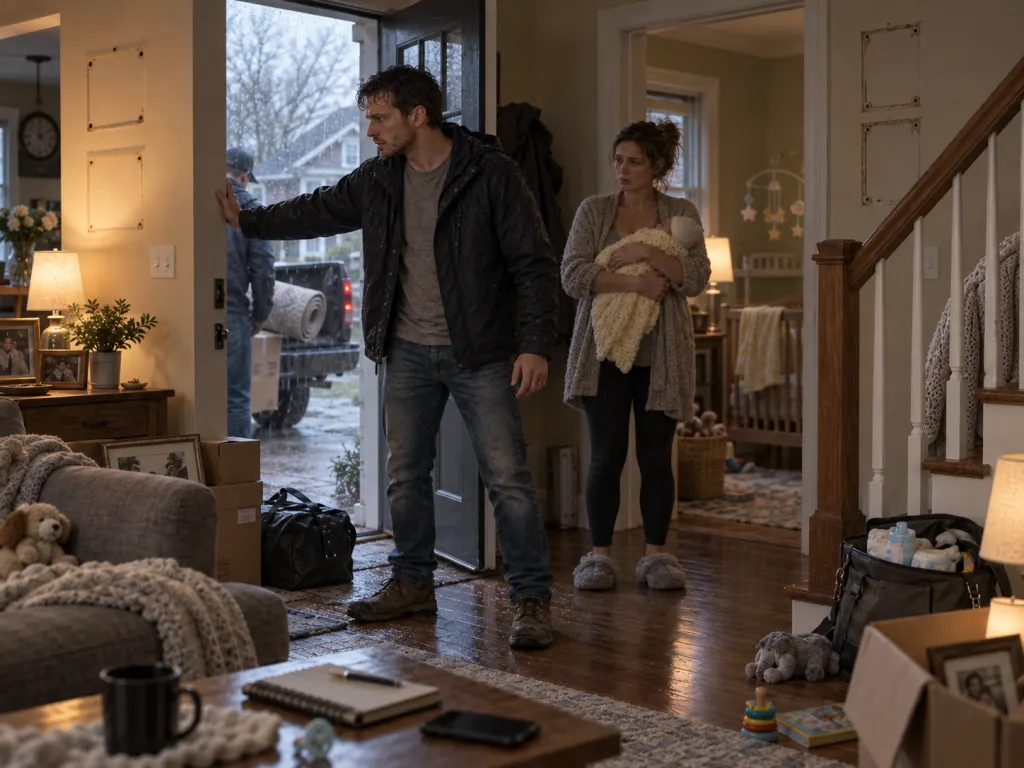
Marcus stood on the porch in a black rain jacket, hair damp, jaw set. Behind him, his pickup waited at the curb with our rug rolled in the back and the oak table wedged beside it. Two lamps lay across the seat, their shades tilted like injured hats.
For a strange second, I remembered him at nineteen teaching me how to drive stick shift in an empty school parking lot. I remembered us laughing so hard I stalled the car three times. Memory can be cruel that way, offering the person someone had been just as you face the damage they have done.
“I brought it,” he said.
“All of it?”
His eyes moved past me into the house. “Where’s Olivia?”
“Inside.”
“I should talk to her.”
“No.”
The word surprised both of us with its steadiness.
Marcus gave a sharp little nod, the one he used when deciding someone else was being unreasonable. “You’re making me the villain because you don’t want to admit you put me in this position.”
“I put you in the position of being owed money,” I said. “You chose the rest.”
Rain ticked against the porch rail. Behind me, I heard the floor creak. Olivia had come into the hall, Noah in her arms. She did not step closer.
Marcus saw her and straightened. For a moment he looked embarrassed, which made me angrier than if he had looked defiant. Embarrassment was too small for what he had done. It belonged to spilled coffee, forgotten birthdays, a joke landing badly. Not this.
“Liv,” he said, “I didn’t mean to scare you.”
She did not answer right away. Noah made a tiny sound, and she rested her cheek briefly against his hat.
“But you did,” she said.
Marcus opened his mouth, then closed it. He looked from her to me, searching for the old family route out of discomfort: a shrug, a laugh, a complaint about overreaction. None of us gave it to him.
We unloaded the truck in silence. The rug came in damp at one corner. The television had a scratch near the base. The kitchen clock was wrapped in one of our own bath towels. The hall photographs were stacked face down in a cardboard box.
When everything was inside, Marcus stood by the door with his hands in his pockets. “I still need the money.”
“We’ll set a payment plan in writing,” I said. “You won’t come inside this house again without asking both of us.”
His face hardened at both of us, and for a moment I thought he would argue. Then Noah cried, a sudden bright sound that cut through the room.
Marcus looked at the baby. Something in his expression shifted, not enough to redeem him, but enough to show he understood at last that this was not a dispute between brothers. There were more people in the room now. Smaller people. People who would inherit the weather we made.
“Fine,” he said.
After he left, I locked the new deadbolt and stood with my palm against the door.
8. The Night We Stayed
That evening, we did not put the house back the way it had been. We were too tired, and some part of me understood that pretending restoration had happened would be another kind of lie. The rug stayed rolled near the sofa. The framed photographs remained in their box. The oak table leaned against the wall, leaving the living room oddly open.
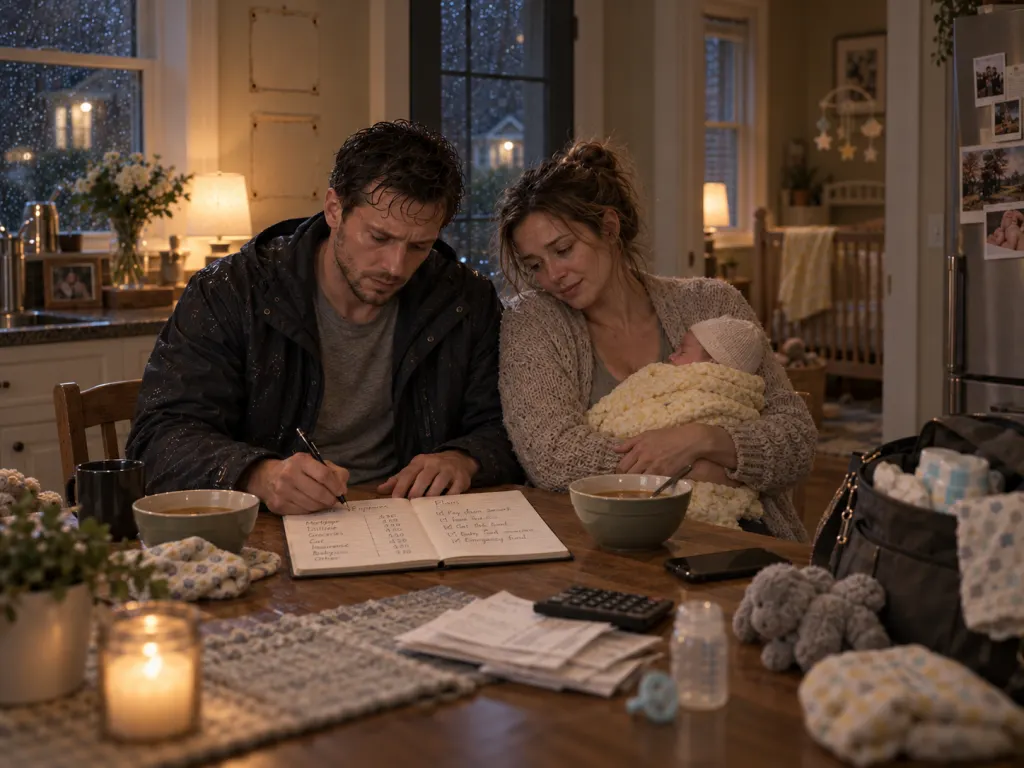
I ordered soup and bread from the place on Maple, because cooking felt too far away and Olivia needed to eat something warm. We sat at the kitchen table under the blank circle where the clock had hung. Noah slept between us in his bassinet, his mouth moving now and then as if he were dreaming of milk.
“I almost called my sister,” Olivia said.
I looked up from the container I was opening. “You should have.”
She studied me, checking whether I meant it.
“I mean it,” I said. “If you ever feel unsafe or unsure here, call whoever you need.”
“Even if it makes you look bad?”
The question was not cruel. It was exact.
“Especially then,” I said.
She nodded, but did not rush to comfort me. I was beginning to see how often I had expected her to make my honesty easy. That night she let it be awkward. She let it be earned.
After we ate, I found a notebook in the junk drawer and wrote three headings across a page: what we owe, what we have, what we decide together. Olivia sat beside me with Noah against her shoulder, and we filled the page slowly. The numbers were not friendly, but they were real. We made a list of calls for Monday. We wrote Marcus’s name under payment plan. We wrote change all spare keys under home.
At midnight, Noah woke hungry. Olivia fed him in the nursery while I sat on the floor assembling the night-light Marcus had knocked loose from the outlet. The room glowed amber when I plugged it in, softening the edges of the crib and the rocking chair.
“When I was upstairs today,” Olivia said, “I kept thinking, if Daniel walks in right now, I don’t know whether I’ll be relieved or furious.”
I looked down at the screwdriver in my hand.
“What were you?”
She gave a tired, almost-smile. “Both.”
It was the most honest answer either of us could have survived.
9. The Shape of Home
In the morning, the house looked less ruined and more unfinished. Sunlight showed what rain and panic had hidden: dust where furniture had been moved, scratches on the floor, fingerprints on the window glass. Noah slept through the early light with the serene arrogance of someone who had kept two adults awake and felt no need to apologize.
Olivia and I moved slowly. We rehung the hallway photographs, but not in the same order. Our wedding picture went lower, where we could see it without pretending the people in it had known everything they would need to know. Above it, we placed the first photo of Noah in the hospital bassinet, his face wrinkled with outrage, one hand free from the blanket.
The kitchen clock went back on the wall. It had stopped at 11:18, probably when Marcus took it down. I changed the battery and watched the hands jump forward, small and mechanical and indifferent. Time had not stopped for our fear. It had only waited for us to notice what we were doing with it.
That afternoon, Olivia called her sister and told her the whole story. I stayed in the kitchen while she spoke, not hovering, not correcting, not trying to manage my role in the telling. I heard my name a few times. I heard Marcus’s. I heard Olivia cry once, briefly, then laugh at something her sister said. The laugh loosened something in my chest and hurt at the same time.
Later, I called Marcus again. Not to fight. To set the payment plan. I put him on speaker with Olivia beside me, the notebook open between us. He disliked that. I could hear it in the clipped way he answered. But he agreed to written amounts and dates. He agreed to return the spare key he still had. He agreed, after a long pause, to apologize to Olivia in a letter instead of arriving at our door.
When the call ended, Olivia reached for my hand. Only for a second. Her fingers touched mine, squeezed once, and let go. It was not a sweeping reconciliation. It was better. It was true.
Weeks later, people would ask how we were adjusting to life with a newborn, and I would say the usual things. Tired. Happy. Learning. All of that was true. But beneath it was another truth I did not offer casually: we were learning the difference between a house that looks whole and a home where no one has to stand alone with the facts.
I came home early expecting to surprise my wife. Instead, I found the cost of every silence I had mistaken for protection. The furniture came back. The photographs went back on the wall. The money became a plan. Trust did not return in one dramatic moment; it returned the way morning enters a damaged room, first as a line of light, then slowly enough that you can see what still needs mending.
Sometimes I still think of Olivia on the nursery floor, Noah held close, her shoes already on because she did not know whether staying was safe. That image has become a kind of promise in me. Not a promise that I will never be afraid, or ashamed, or wrong. A better promise than that: when fear enters our house again, as it enters every house eventually, I will not make her meet it alone.
Wrap-Up
This story follows Daniel as he returns home early to find his wife Olivia and their newborn Noah shaken after his brother removes belongings from their house over a hidden debt. The crisis forces Daniel to face the harm caused by secrecy, rebuild safety with practical action, and begin repairing trust through honesty rather than pride.