 Save
This is an original work of fiction. It uses the idea of empathy as a thematic backdrop, in the ordinary sense of trying to understand another person's frame of reference, a concept described by the APA Dictionary of Psychology. Research on prosocial choices in couples has also explored how deliberate supportive behavior can shape everyday interactions, as discussed in Scientific Reports. No real people are depicted.
Chapter 1: The Last Crumb
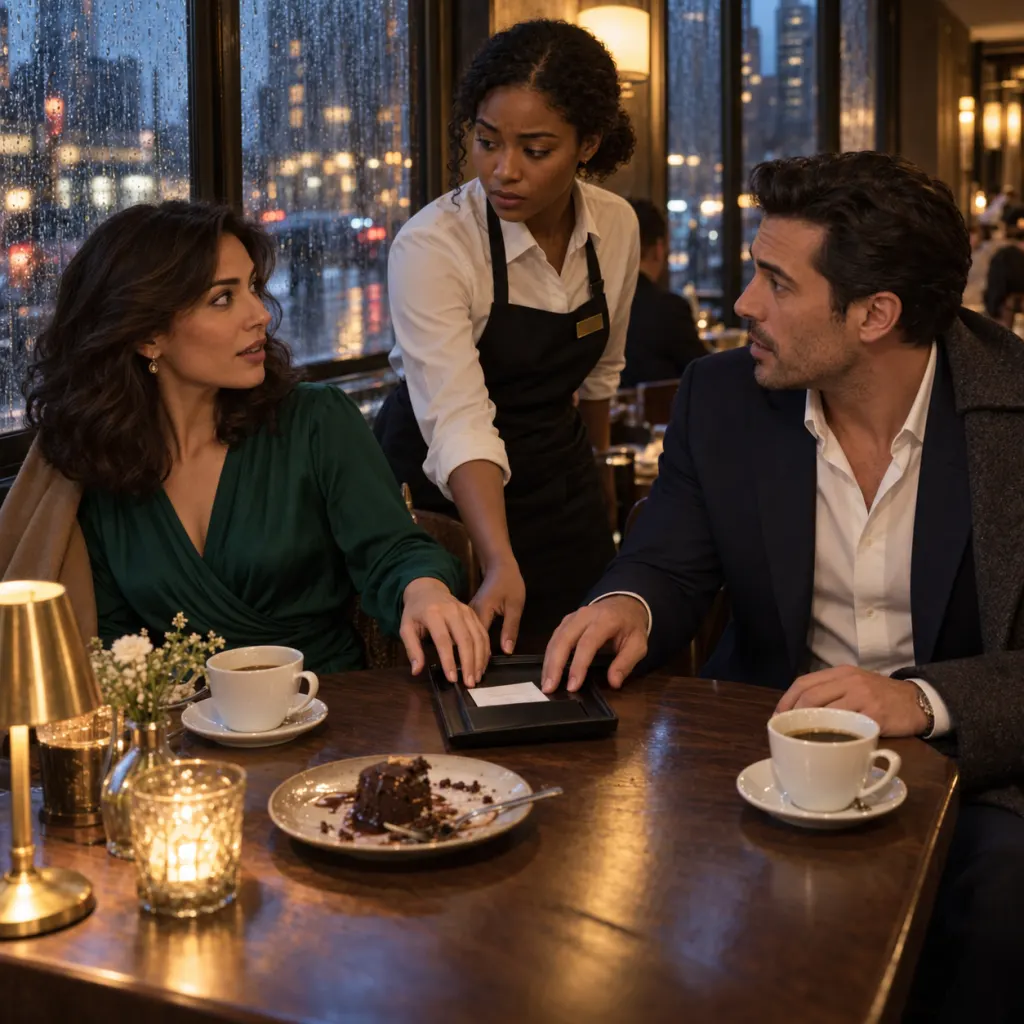
The check arrived on a small black tray between the last crumb of chocolate torte and the cooling silver pot of coffee, and Lena Hart felt the air around their table change.
Until then, the evening had held itself together with the unlikely grace of something rehearsed by nobody. Rain stitched bright lines down the restaurant windows. The room glowed in amber pools: brass lamps, polished walnut, wine glasses catching light like little bells. Across from her, Marcus Vale was smiling at a story she had not expected to tell on a first date, the one about getting locked in the school greenhouse at twelve and pretending, for twenty dramatic minutes, that she had chosen exile.
He had laughed with his whole face. That mattered. Lena had become suspicious of people who laughed only from the mouth.
She reached for the tray at the same moment he did. Their fingertips touched the leather edge, and both pulled back with the sudden politeness of strangers who had already admitted too much.
"I asked you here," Marcus said.
"You suggested coffee," Lena said. "I upgraded us to dessert. That was a strategic escalation."
"Then I should pay for dinner and you can accept responsibility for the torte."
"It was very good torte."
"Dangerously persuasive torte."
They were still smiling when their server came back.
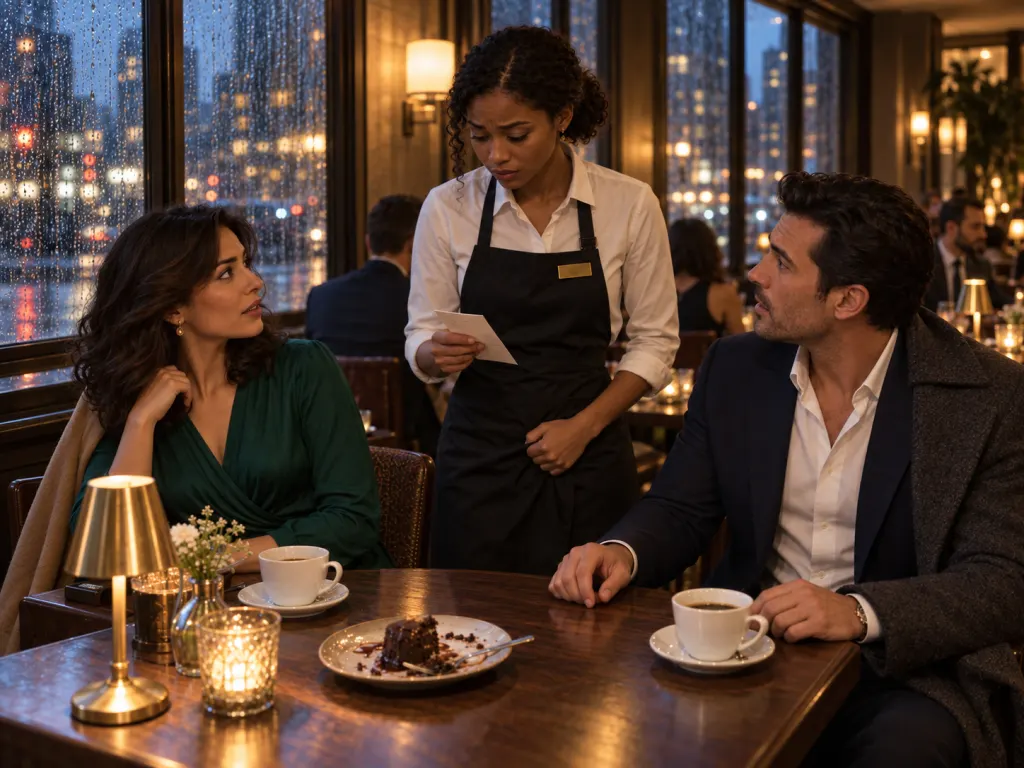
Her name was Nia, printed in white script on a narrow brass badge. She had been quick all evening without making them feel hurried, refilling water before the glasses emptied, appearing with bread when their conversation drifted into childhood and staying away when it deepened into divorce, grief, and the strange loneliness of being competent at work. Now she stood beside the table with one hand closed around the corner of her apron.
"I'm so sorry," Nia said. "There was a mistake at the host stand. This check has the wrong table number. I just need to fix it."
Her voice was steady. Her eyes were not.
Chapter 2: A Small Tremor
Lena saw the tremor first because she had learned to look for hands. Her mother, before the illness that stole the shape of ordinary days, had hidden bad news in her fingers. A mug gripped too tightly. A napkin shredded into soft white strips. A wedding ring turned and turned until the skin beneath it reddened.
Nia's knuckles had gone pale against her apron.
Marcus noticed a beat later. His posture changed, not dramatically, but enough. He sat back from the check, his attention moving from the bill to the young woman holding herself upright by will alone.
"No rush," he said. "We're fine."
Nia gave a quick nod, the kind meant to end a conversation before concern could enter it. Behind her, near the service station, another server was speaking urgently to the manager. A phone lay faceup beside a stack of menus, buzzing again and again. Nia glanced toward it as if each vibration pulled a thread from her sleeve.
"I'm sorry," she repeated.
"You said that already," Lena said gently. "You don't have to spend another one on us."
The sentence landed harder than Lena expected. Nia blinked, and for a second her professional expression loosened. Not collapsed. Loosened, like a curtain stirred by wind.
"My sitter keeps calling," she said, then seemed startled by her own honesty. "It's not your problem. I'll be right back."
She walked away quickly.
Lena looked down at the wrong bill. Table twelve. Four entrees. Two bottles of wine. A number at the bottom that would have changed her grocery plan for the week back when she was twenty-seven and pretending freelance work was the same as stability.
Marcus did not make a joke. She liked him more for that.
"I think something is wrong," he said.
"Yes."
"Do we ask?"
Lena watched Nia at the service station, shoulders squared while the manager frowned over a tablet. "I don't know."
Chapter 3: Rules for Not Interfering
Lena had rules for first dates. No trauma inventory before appetizers. No performing cleverness like a parlor trick. No forgiving rudeness to staff, ever. The last rule had ended three promising evenings and one brief relationship with a man who tipped in coins because he thought it was funny.
Marcus had passed that test before the wine arrived. He had looked Nia in the eye, said please without decoration, and asked whether the kitchen could leave the walnuts off Lena's salad without making the request sound like a referendum on civilization.
Still, kindness in a restaurant could be cheap. People were generous with thank-yous when the stakes were water glasses and timing.
"My sister used to serve tables," Marcus said, almost to himself. "She could carry six plates and a private emergency at the same time. Made it look like balance."
"Was it?"
"No. It was debt, mostly."
Lena looked at him. There it was again, the sense she had been feeling all evening: Marcus did not rush to make his experiences charming. He allowed them their plain edges.
"We can leave a little extra," she said.
"We can."
He did not reach for his wallet. Neither did she. The hesitation was not stinginess. It was the awkwardness of deciding whether money was help or intrusion, whether concern from strangers was comfort or embarrassment.
At the host stand, Nia answered the buzzing phone. She turned away from the dining room, one hand cupped over her ear. Lena could not hear the words. She saw only the result: Nia's chin lifting, her eyes closing, the body making itself into a wall.
Then the manager took the phone from her.
"Oh," Lena said.
Marcus folded his napkin once, carefully. "That looked bad."
"Yes."
"I don't want to be the kind of man who makes a spectacle of helping."
"Good," Lena said. "I don't want to be the kind of woman who mistakes minding my business for mercy."

Chapter 4: The Bill Beneath the Bill
Nia returned with the corrected check. Her face had been arranged again, but the arrangement was imperfect. One corner of her mouth kept failing.
"Thank you for waiting," she said. "Here you are."
The right bill was smaller, though not small. Lena reached for it, but Marcus placed his card on the tray first.
"I have this," he said.
Lena opened her mouth with her practiced answer ready. I prefer to split it. I don't like feeling purchased. I like clarity. Instead she saw Nia's eyes flick toward the door, where the manager stood with her phone in his hand, speaking in a low voice.
"Nia," Marcus said, not loudly. "Do you need to leave?"
There are questions that open a room.
The server froze. Lena felt the tables around them continue with their private worlds: forks against plates, a birthday toast in the corner, the hiss of the espresso machine. And at their small table, a question sat down like a third guest.
"I'm sorry?" Nia said.
Marcus did not soften the question by pretending he had not asked it. "It seems like something urgent is happening. If you need to go, maybe your manager can close us out."
Nia's eyes shone. She looked furious about it.
"My son has asthma," she said. "The sitter says he's coughing hard. She called my sister, but my sister's across town. I can't leave in the middle of service unless someone covers my tables. I already asked."
She stopped there. No plea. No performance. Just the facts she had allowed to escape.
Lena felt the old tug of her mother's sickroom, the math families do in emergencies: distance, money, weather, who has keys, who can drive, who is allowed to fall apart. She also felt the fragile architecture of the date around her, the evening they had been building with jokes and careful revelations. To act now would change it. To do nothing would change it too.
Marcus looked toward the manager. "Would it help if your remaining tables were covered?"
Nia's expression hardened with embarrassment. "That's not something guests can fix."
"Maybe not," Lena said. "But people can sometimes make room."
Chapter 5: What Kindness Costs
The manager's name was Owen. He wore the exhausted patience of someone who had spent a decade being blamed for weather, traffic, steak temperatures, and other people's anniversaries. When Marcus asked to speak with him, Owen arrived ready to apologize for a billing error.
"No complaint," Marcus said. "We wanted to ask whether Nia can leave if her open tables are handled."
Owen's gaze shifted from Marcus to Lena to Nia, who had followed despite clearly wishing the floor would open in some dignified hospitality-professional way.
"We're short tonight," Owen said.
"I understand," Lena said. "What would make it workable?"
Owen rubbed the bridge of his nose. "Two tables need dessert. One is waiting on entrees. Side work after close."
"We'll cover the desserts," Marcus said.
Lena turned to him.
He flushed. "I mean, their desserts. If that helps keep the kitchen from losing timing. And we'll pay our bill now."
"I can stay and roll silverware," Lena heard herself say.
All three of them looked at her.
She lifted one shoulder. "I rolled silverware in college. Badly, but with sincerity."
For the first time since the phone call, Nia made a sound that almost became a laugh.
Owen studied them, suspicious of generosity because generosity often arrived with hidden invoices. "You don't have to do that."
"We know," Marcus said.
That was what made the sentence work.
In the end, the solution was smaller than the feeling around it. Owen reassigned one table to the bartender, took the entree table himself, and accepted Marcus's offer to pay for two desserts that had not yet been ordered. Lena did not roll silverware. Health codes, Owen said dryly, still existed. But she did carry Nia's coat from the staff hook when the manager waved her toward the back.
Nia stood by the service door, one arm in her sleeve, looking at them as if she could not decide whether to thank them or vanish.
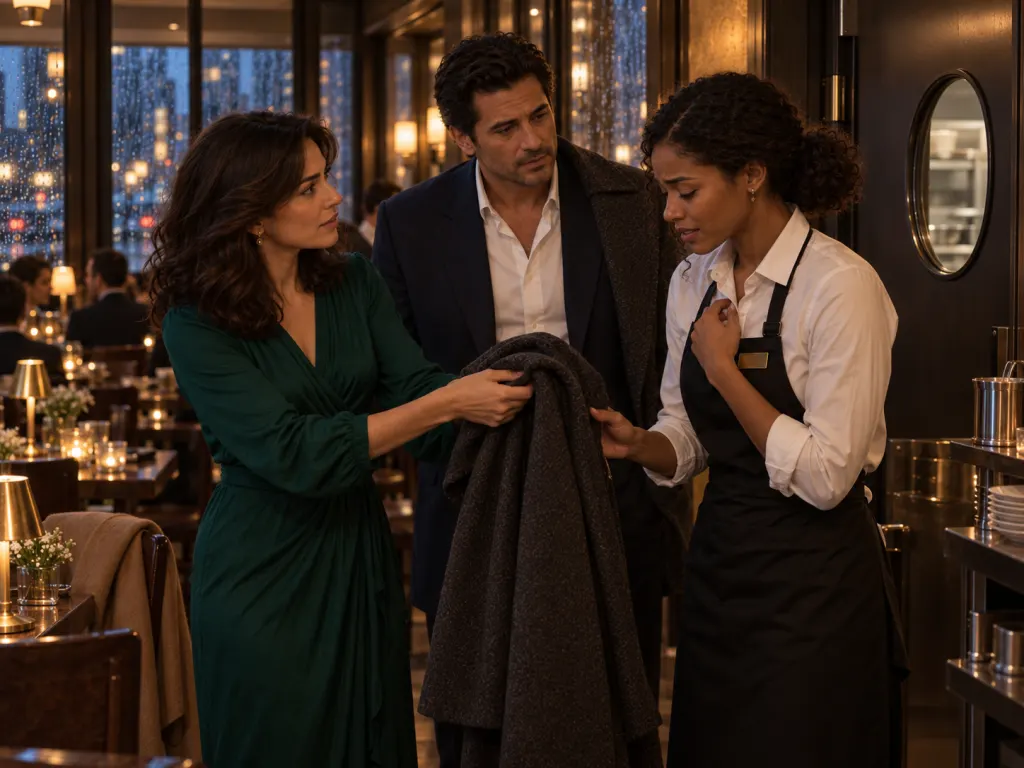
"I don't know what to say," Nia said.
"Then don't spend time saying it," Lena replied. "Go."
Nia went.
The door closed behind her. The room resumed its ordinary noise, but Lena felt altered, as if the evening had tilted and revealed its underside: wires, beams, the labor required to keep beauty lit.
Marcus signed the bill. His hand was steady. The tip he added was large enough that Lena looked away, not from judgment but from privacy.
"You didn't have to do all that," she said.
"Neither did you."
"I offered illegal silverware labor."
"Heroic in spirit."
She laughed, then stopped because the laugh had too much feeling in it.
Chapter 6: Rain Check
Outside, the rain had thinned to mist. The restaurant's awning dripped in patient intervals. Cars moved along the avenue with wet tires whispering against the street, and the city smelled of pavement, coffee, and late spring leaves bruised by weather.
Marcus stood beside Lena on the curb, hands in the pockets of his charcoal coat.
"This is usually the part where I ask whether you'd like to do this again," he said.
"Usually?"
"In my imagination I was smoother."
"Were you?"
"Considerably. I had a whole walk planned. There was a bookstore window involved."
Lena smiled. "Ambitious."
"I was going to point at a novel I hadn't read and pretend restraint."
She looked down the street. A cab passed, its yellow body smeared by the rain. Somewhere beyond the traffic, Nia was trying to reach her son. The thought pressed on Lena with surprising force.
"My mother used to say you learn people at the edges," she said.
Marcus turned toward her. "The edges?"
"When the plan breaks. When someone is tired, or embarrassed, or has power over someone who can't answer back. The center is easy. Dinner, good lighting, best stories. The edges are where the truth leaks out."
He considered that. "What did tonight leak?"
Lena felt shy then, which annoyed her. She was thirty-eight years old. She negotiated vendor contracts with men who began emails with her name misspelled. She could say a true thing on a sidewalk.
"That you are careful," she said. "But not cold."
Marcus looked at the awning fringe, then back at her. "I was afraid you'd think I was showing off."
"I was afraid you'd think I was testing you."
"Were you?"
"A little. Not on purpose. But everyone is information on a first date."
"And what am I?"
The question had flirtation in it, but also risk.
"Incomplete," Lena said. "In a promising way."
His smile returned slowly. "That may be the kindest review I've ever received."
Chapter 7: The Message
They did not kiss that night. Later, Lena would be grateful for that. Not because she did not want to, but because the evening had gathered too much weight for one more ceremony. Instead, Marcus walked her to the corner where the rideshares picked up, held the umbrella so carefully that his shoulder darkened with rain, and waited until her car arrived.
At home, she took off her earrings at the bathroom sink and stared at herself in the mirror. Her lipstick had faded unevenly. Her hair, smooth when she left, had curled at the temples. She looked like a woman who had gone to dinner and found a door instead.
Her phone buzzed.
Marcus: Nia's manager just called. Her son is stable and home with her sister. Owen thought we would want to know.
Lena sat on the edge of the tub.
She read the message twice, then a third time, and felt something in her chest release. Not joy exactly. Relief with humility inside it. Their small intervention had not fixed a life. It had bought time. Sometimes time was the only miracle people were authorized to offer.
She typed, erased, typed again.
Lena: Thank you for telling me. Also, how did Owen have your number?
The reply came quickly.
Marcus: I left it in case the dessert charge confused accounting. This is the least romantic sentence I have ever sent.
She laughed alone in her bathroom, the sound bouncing off tile.
Lena: I don't know. Responsible follow-through has its charms.
For three minutes, there was no reply. Lena imagined him smiling at his phone. Then:
Marcus: Bookstore window tomorrow?
She should have paused. She should have maintained some elegant interval, let anticipation breathe, consulted whatever code governed adult dating now. Instead she answered with the clean certainty of a match struck in a dark room.
Lena: Yes.

Chapter 8: A Date to Remember
Years later, people would ask about their first date as if every lasting relationship must begin with a cinematic sign. Lena and Marcus would look at each other across dinner tables, hospital waiting rooms, airport gates, borrowed picnic blankets, and the long familiar chaos of their own kitchen, and decide how much of the story to tell.
Sometimes Marcus kept it simple. "We had dessert," he would say. "I behaved well enough to get a second chance."
Sometimes Lena told the longer version, especially to friends discouraged by the theater of modern romance. She would describe the rain and the wrong check and the server whose emergency made the evening honest. She would explain that the memorable part was not generosity itself, not the money, not the managerial logistics of two desserts and a reassigned table. The memorable part was the pause before action, when both of them understood that whatever they chose next would reveal them.
On the first anniversary of that dinner, they went back to the restaurant. Owen was still there, thinner, more silver at the temples, and pleased to see them in the vague way managers are pleased by returning evidence that a room has mattered. Nia was not working that night. She had moved, Owen said, to a daytime position at a hotel so she could be home for evenings. Her son was doing well. He liked dinosaurs. He hated peas. He had recently bitten a classmate, though Owen delivered this news with the solemn neutrality of a man accustomed to reporting complications.
Lena listened with her hand under the table, fingers laced through Marcus's.
They ordered the chocolate torte again. It was still dangerously persuasive.
When the check came, Marcus reached for it. Lena reached too. Their fingertips met on the black tray, just as they had the first time.
"I invited you," he said.
"You married me," she said. "That was a strategic escalation."
He laughed with his whole face, and she felt again the old recognition, steadier now but no less bright. Love, she had learned, was not proven by flawless evenings. It was proven by what people protected when the evening stopped being easy.
Outside, rain began again, soft against the glass. Inside, the lamps warmed the table, the coffee cooled, and the bill waited quietly between them, no longer an interruption but a reminder: the smallest tray can carry the weight of a life turning.
Reflection
The date became unforgettable because it asked for more than charm. It asked two strangers to notice a person at the edge of their perfect evening and decide that tenderness was worth the awkwardness. Some beginnings announce themselves with music. Others arrive as a corrected check, a shaking hand, and the chance to become someone trustworthy before anyone has promised to stay.
Wrap-Up
A first date between Lena and Marcus changes when their server receives an urgent call about her child. Their small act of practical kindness breaks the polished surface of the evening and reveals the deeper character both had been trying to see.
Frequently Asked Questions
- → Is A Date to Remember based on a true story?
No. This is an original fictional story created for an offline CMS draft. No real people or verified events are depicted.
- → What is the main theme of the story?
The story explores how character often appears when a plan breaks, especially in the small choices people make when another person's need interrupts their comfort.