 Save
The following is an original fictional courtroom story about privilege, restraint, and the difference between fear of punishment and respect for other people.
1. The Laugh in the Marble Room
The courtroom smelled faintly of floor polish, paper, and the rain that had followed everyone in from the courthouse steps. Water darkened the hems of coats. Umbrellas leaned like tired canes beside the benches. Above the judge’s chair, the state seal caught a pale strip of morning light and held it there, bright and cold.
Lila Voss arrived eight minutes late.
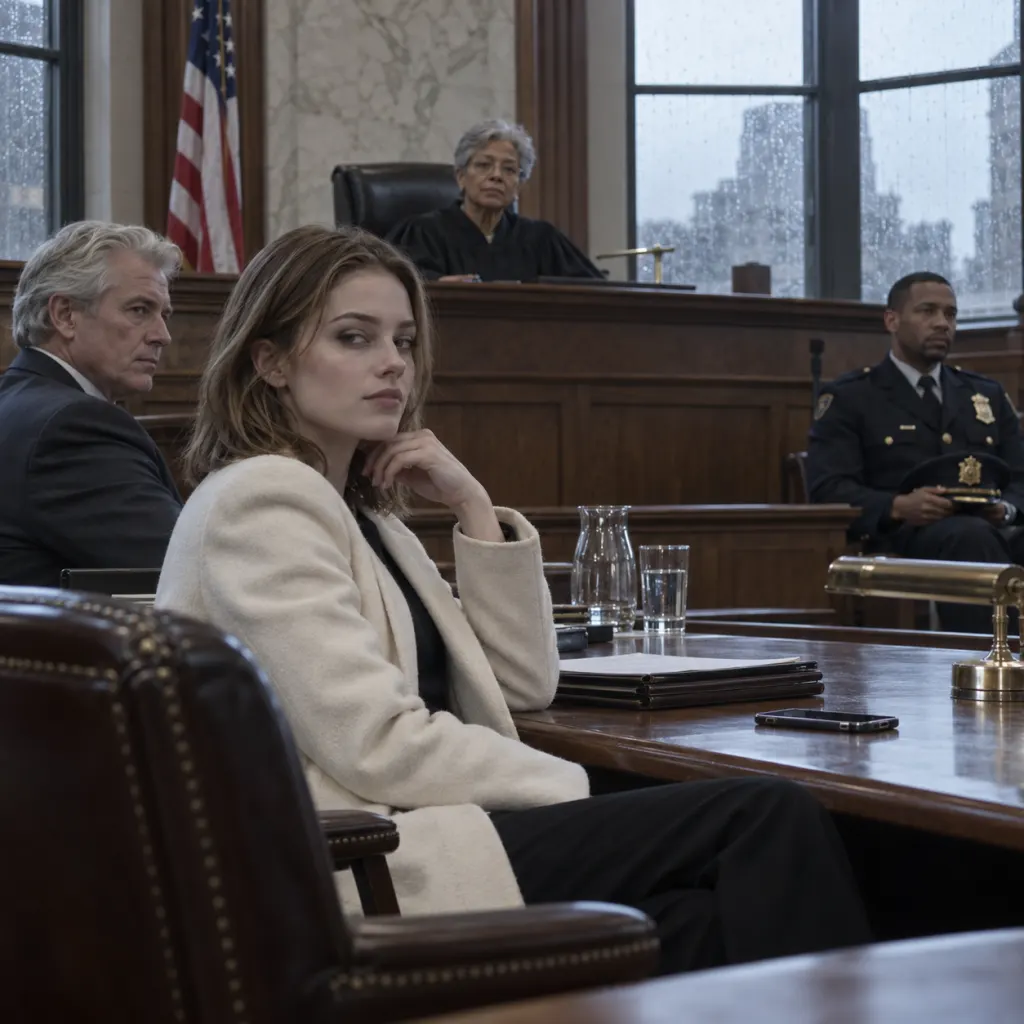
She did not hurry. Her heels struck the marble aisle with a clean little rhythm, the sound of someone accustomed to making rooms wait. A cream coat hung over her shoulders without her arms in the sleeves. Her phone glowed in one hand. Her father’s attorney, a narrow man with silver glasses, rose halfway from the defense table as if to pull her into place by force of posture alone.
Lila gave him a smile that did not reach her eyes. She slid into the chair beside him, crossed one knee over the other, and looked around the courtroom as though she had been seated badly at a restaurant.
Officer Jonah Bell sat two rows behind the prosecutor. He had worn his dress uniform because the summons said he might testify. His cap rested on his lap. He kept both hands on it. He had been called names before. He had been filmed before. He had learned, over nineteen years, the discipline of keeping his face still while another person tried to turn his uniform into a target. But even he felt the air shift when Lila lifted her phone, angled it toward the bench, and whispered, just loudly enough for the nearest row to hear, “This place is adorable.”
The bailiff glanced over. The attorney touched Lila’s sleeve. She moved her arm away.
Judge Althea Rowan entered without ceremony. She was small, straight-backed, and gray-haired, with the unhurried walk of a person who trusted silence to do its work. Everyone stood. Lila stood last. Not in open refusal, not enough to make a clean issue of it. She rose with a theatrical sigh and smoothed her coat as if the law itself had wrinkled it.
“Be seated,” Judge Rowan said.
The benches creaked. Rain ticked against the tall windows. The clerk called the matter. The prosecutor gathered her file. The defense attorney adjusted his glasses and whispered something urgent to Lila.
Lila laughed.
It was not loud. That made it worse. It was a soft, bright sound, the kind people make when a waiter drops a fork. The judge looked up from the file.
“Ms. Voss,” she said, “is something amusing?”
Lila tilted her head. “No, Your Honor. I’m just surprised this is taking so seriously.”
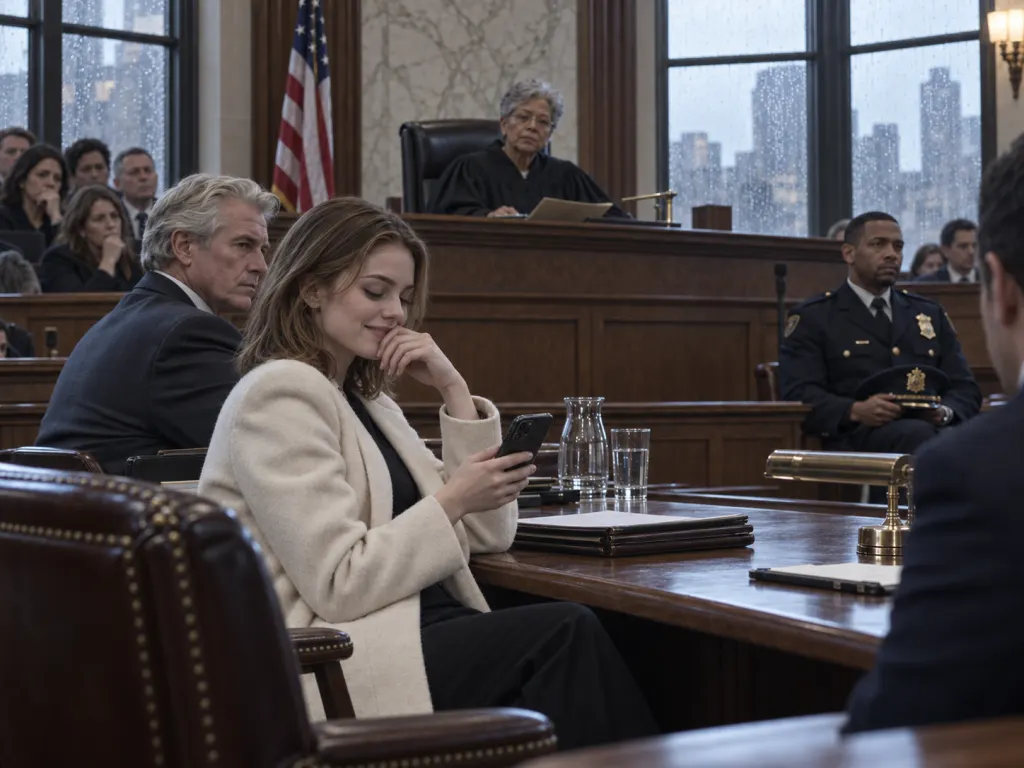
The words landed hard, not because they were shouted, but because they were careless. Somewhere in the back row, a woman closed her eyes. Officer Bell’s fingers tightened around the brim of his cap.
Judge Rowan folded her hands. “We will proceed carefully, then.”
2. The Street Where Children Counted Cars
Three months earlier, on a warm afternoon, the neighborhood had been full of ordinary noise. A delivery truck coughed at the curb. A boy in a green backpack dragged one sneaker along the sidewalk, drawing an invisible line only he could see. Two women stood outside a corner market comparing peaches, pressing thumbs gently against the fruit. A bus sighed at the stop, doors folding open.
The black coupe came through that ordinary noise like a thrown stone.
It moved too fast for the street. It made the parked cars seem suddenly fragile, the crosswalk suddenly foolish, the boy’s green backpack too bright and too small. Tires snapped over a dip in the road. A horn blared. Someone yelled from the market door.
Officer Bell saw the car before he saw the driver. He was waiting at the light on Carson Avenue, one hand on the wheel of his patrol car, thinking about whether he had enough time after shift to buy lightbulbs. Then the coupe ran the red light. It missed the front bumper of a turning van by less than a second.
Bell hit the siren.
The pursuit lasted only four blocks, though later it stretched in his memory: the blur of taillights, the flash of a stroller being pulled back from a curb, his own voice on the radio staying calmer than his pulse. The coupe finally stopped in front of a florist whose sidewalk buckets were filled with white chrysanthemums.
Bell approached on the driver’s side. The window lowered with theatrical slowness.
Lila Voss sat behind the wheel wearing sunglasses large enough to hide half her face. Music spilled from the car and then cut off when she tapped the screen. The scent of expensive leather and sharp perfume floated out.
“Afternoon,” Bell said. “Do you know why I stopped you?”
She looked past him to the patrol car, then back at his badge. “Do you know who owns the buildings on this block?”
Bell had heard variations of that question for years. Do you know who I am. Do you know who I work for. Do you know who I can call. Every version meant the same thing: I want you to become smaller.
“License, registration, and proof of insurance,” he said.
She smiled as if he had misunderstood the first rule of the game. “My father could buy this whole department lunch and still have change for your retirement party.”
Bell did not answer the insult. He looked toward the corner, where the boy with the green backpack had stopped walking. The child stared at the car with the solemn amazement of someone who had just learned that grown-ups could be dangerous for no reason at all.
“You ran a red light,” Bell said. “You were well over the limit. You crossed the center line. People were in the crosswalk.”
Lila pushed her sunglasses onto her head. Her eyes were dry and bright. “And yet everyone appears alive.”
For the first time, Bell let a pause sit between them. Not anger. Not contempt. A pause large enough for the sentence to show itself.
Then Lila lifted her phone and began recording.
3. What Money Could Smooth
The Voss house sat behind iron gates on a hill above the river, all glass, limestone, and disciplined hedges. At night it glowed with the calm authority of a museum after closing. Lila had grown up inside rooms where broken things disappeared before morning. A cracked vase, a dented fender, a cruel message sent at midnight, a school complaint, a party that ended with neighbors calling twice. There was always someone to tidy the evidence, soften the language, pay the invoice, call the board, change the subject.
Her father, Conrad Voss, called this protection.
Her mother, before she left for a quieter life in another city, had called it weatherproofing a house with no foundation.
Lila learned early that apologies could be performed without surrender. She learned which adults were paid to look patient, which ones wanted invitations, which ones could be made nervous by a last name. She learned that charm worked best when offered late, after the damage had already been done.
When the citations arrived, Conrad’s staff treated them like a scheduling nuisance. The attorney took the folder. A public relations consultant suggested silence. Lila posted anyway.
She did not post the worst moments. She posted Officer Bell standing beside her window, his face composed, his voice level. She added captions that made him look humorless and small. She used a song people recognized. She cut the video so her friends could laugh without seeing the crosswalk, the stroller, the boy with the green backpack.
By nightfall, people she had never met were repeating her words back to her with laughing faces underneath. Some praised her nerve. Some told her she was awful. She answered both kinds of attention the same way, with little flashes of mockery that made the thread grow.
Officer Bell did not watch the video until his sister sent it to him with a single question mark.
He sat at his kitchen table, still in uniform pants and an undershirt, and watched himself become an object for strangers. His daughter, Maya, came in to get a glass of water and saw enough before he turned the screen down.
“Is that you?” she asked.
“It’s nothing,” he said.
She was sixteen. Old enough to recognize a lie told gently. “People at school saw it.”
Bell rubbed a hand over his face. “I did my job.”
“I know,” Maya said. Her voice was fierce in the way of children who hate seeing a parent made vulnerable. “But they don’t.”
That was what stayed with him. Not Lila’s threat. Not the comments. His daughter standing barefoot in the kitchen, learning that dignity could be filmed from the wrong angle and sold as a joke.
4. The Courtroom Learns Her Name
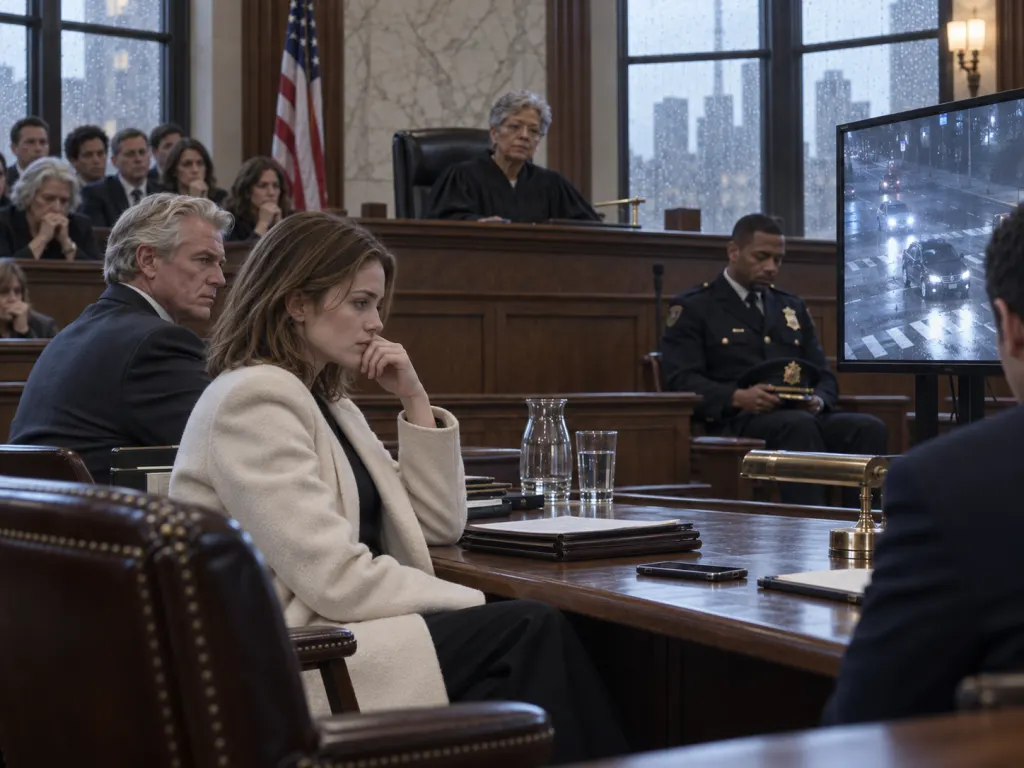
Back in Judge Rowan’s courtroom, the prosecutor did not dramatize the case. She did not need to. She played the traffic camera footage once. The black coupe entered the frame too quickly, a streak of polished metal against brick storefronts and afternoon pedestrians. The courtroom watched the stroller jerk back from the curb. It watched the van brake hard. It watched Officer Bell’s patrol car follow with lights flashing.
Lila stared at the screen with visible boredom until the stroller appeared. Then, for half a second, her expression changed. It did not soften. It narrowed, as if the footage had betrayed her by showing too much.
The prosecutor introduced the posts. The clerk displayed still images on a monitor. The captions had been printed in the file, stripped of music and motion, plain black words on white paper. Without the sparkle of the platform, they looked smaller and meaner.
The defense attorney rose. “Your Honor, my client is young. She made immature comments online. She has no serious prior record. She comes from a family prepared to support community service, driver education, and any reasonable financial penalties the court sees fit.”
Judge Rowan made a note. “Prepared to support,” she repeated quietly.
The attorney continued, careful now. “Ms. Voss recognizes that her tone after the stop was inappropriate.”
“Does she?” the judge asked.
The attorney turned toward Lila with the tense hope of a man offering a rope to someone already waist-deep in water.
Lila uncrossed her legs. She looked at the judge, then at the monitor, then at the benches behind her. Her father sat in the second row, jaw tight, one hand closed around the other. He had removed his watch before entering the courtroom, perhaps thinking modesty could be assembled from small gestures.
“I recognize,” Lila said, “that people are acting like I committed some enormous tragedy when nothing actually happened.”
The attorney shut his eyes.
Judge Rowan’s face did not change. “You may continue.”
“I mean, I’m sorry people got upset,” Lila said. “But this has been completely exaggerated because of who my father is. If anyone else had done it, they’d pay a fine and leave.”
Officer Bell looked down at his cap. The woman from the back row, the one who had closed her eyes earlier, leaned forward. She was the grandmother who had pulled the stroller back from the curb. Her statement was in the file, written in careful block letters.
Judge Rowan turned one page. “Ms. Voss, this is your opportunity to address the court before sentencing. You may use it to accept responsibility, clarify facts, or say nothing. Choose with care.”
Lila gave a small shrug. “With respect, Your Honor, I think this court is enjoying making an example of me.”
5. The Sound of Restraint Breaking
No one spoke. The silence that followed was not empty. It had weight, corners, a temperature of its own.
Judge Rowan leaned back. For the first time that morning, she removed her glasses. She set them on the bench with both hands, aligning one temple with the edge of the blotter. It was a tiny, deliberate motion. Everyone in the room seemed to understand that something had ended.
“Ms. Voss,” she said, “there are many misunderstandings about mercy. People sometimes mistake it for softness. They imagine mercy means the court looks away. It does not. Mercy begins with seeing clearly.”
Lila’s mouth tightened, but she did not interrupt.
“I have reviewed the traffic footage, the officer’s report, the witness statements, the posts entered into evidence, and your conduct in this courtroom today. I have also reviewed the sentencing options available to me.”
The defense attorney rose slightly. “Your Honor, if I may, ”
“You may sit, counsel.”
He sat.
Judge Rowan looked at Lila directly. “You keep returning to the fact that no one died, as though the absence of the worst possible outcome is proof of innocence. It is not. It is luck. Luck is not character. Luck is not judgment. Luck is not a legal defense.”
The words did not rise in volume. They did not need to. The judge’s steadiness made them impossible to dismiss as temper.
Lila glanced toward her father. Conrad’s face had gone pale. In boardrooms, he could control temperature, timing, seating, the first offer, the final language. Here he could control nothing. Not the judge. Not the footage. Not his daughter’s refusal to stop turning the knife against herself.
“The court also considers contemptuous behavior,” Judge Rowan continued, “not because a judge’s feelings require protection, but because contempt for the process often mirrors contempt for the people harmed by the conduct. You have shown this court that your first concern is embarrassment. Not danger. Not public trust. Not the officer you tried to humiliate for doing his work. Not the families using that street.”
At the word families, the grandmother in the back row pressed a tissue to her mouth. Lila saw it and looked away.
That look away was the first honest thing she had done all morning. It lasted less than a second, but it was there: the instinctive retreat from a face that would not become an abstraction.
6. Maximum
The sentence itself took less than a minute to say.
Judge Rowan imposed the maximum penalty permitted for the combined violations before her in that proceeding: the longest license suspension available, the highest allowable fines, mandatory service hours in a city traffic safety program, completion of a court-approved driving responsibility course, and a custodial term within the statutory limit, with part of it structured under supervised conditions. She added restrictions on public commentary about the officer and witnesses while the related civil complaint remained pending, not as punishment for embarrassment, but as a boundary against further harassment.
The words entered the record one by one. Suspension. Fine. Service. Course. Custody. Supervision.
Lila sat frozen. People later said she looked shocked, but that was not exactly true. Shock suggests surprise at the event. What moved across Lila’s face was more specific: the stunned insult of a person discovering that reality had failed to negotiate.
“Your Honor,” her attorney said, rising fully now, “we would ask the court to stay execution pending appeal.”
Judge Rowan listened. She granted what procedure required and denied what it did not. Her rulings were brisk, exact, and unadorned.
Lila finally spoke. “This is ridiculous.”
The bailiff shifted his stance.
Judge Rowan looked at her. “Ms. Voss, I strongly advise you to let your counsel speak.”
For once, Lila did.
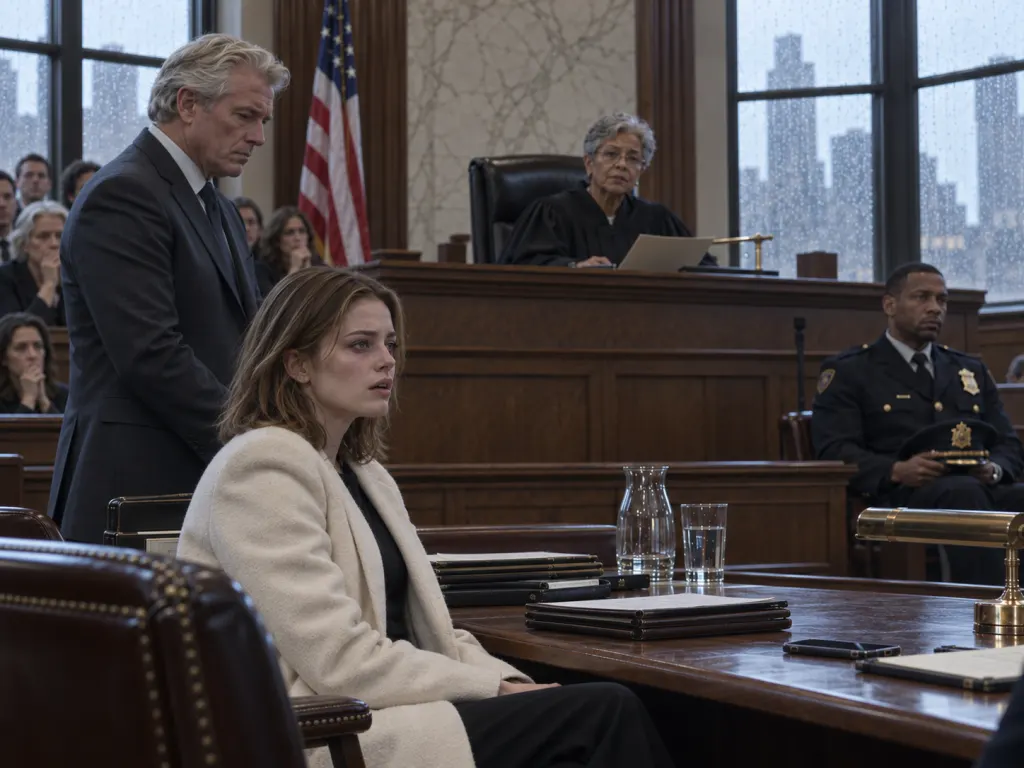
Conrad Voss stood behind her as if he could shield her with the force of his name. But names have limits. Money has limits. Even love, when practiced as rescue from every consequence, reaches a wall it cannot buy through.
Officer Bell felt no triumph. That surprised him. He had imagined, against his better nature, that if the court took the matter seriously he might feel the clean snap of vindication. Instead he felt tired. He thought of the boy with the green backpack. He thought of his daughter in the kitchen. He thought of all the times restraint had looked, from the outside, like weakness.
When the hearing ended, he stood, tucked his cap beneath his arm, and waited for the aisle to clear.
7. The Hallway After
The courthouse hallway was louder than the courtroom. Doors opened and shut. Shoes squeaked on wet tile. A clerk rolled a cart stacked with files. Reporters waited near the security line, not inside the courtroom but close enough to catch faces as they emerged.
Lila walked between her attorney and her father. Without the bench in front of her, she looked younger. Not innocent. Younger. Her coat had slipped properly onto her shoulders now, one sleeve twisted at the cuff. She held her phone but did not look at it.
Officer Bell came out behind the prosecutor. He intended to pass without speaking. Conrad saw him and stepped forward.
“Officer,” Conrad said.
Bell stopped.
For a second, Conrad seemed to search a dozen versions of himself and find none that fit the hallway. The executive would be too polished. The father too raw. The public man too watched. He settled for the simplest one.
“I’m sorry,” Conrad said.
Bell looked at Lila, not unkindly. “I wasn’t the only one on that street.”
Lila’s eyes moved toward him. Her face still held resistance, but something else had entered it now, a thin crack of bewilderment. Perhaps she was only afraid. Perhaps she was angry that fear had found her in public. Perhaps, beneath both, a more difficult understanding had begun its slow work.
The grandmother from the courtroom came into the hallway pushing the same stroller from the footage. Inside it, a small child slept through the noise with one hand open against a blanket. Lila saw the stroller. She saw the woman. She saw, at last, that the video had not captured a prop in the background. It had captured a life continuing by a margin no one had earned.
“I didn’t see you,” Lila said.
The grandmother’s expression did not soften. “That was the problem.”
No one improved the sentence by speaking after it. The words stood there, plain and complete.
8. What the Record Keeps
In the weeks that followed, the story moved through the city in fragments. Some people spoke of the sentence as too harsh. Others said it was overdue. Many used Lila’s name as shorthand for a kind of arrogance they had seen in smaller forms everywhere: the double-parked luxury car, the threat to call someone important, the laugh that turns another person’s fear into entertainment.
But the record kept more than the spectacle. It kept the officer’s measured report. It kept the witness statements written by hands that still shook when they remembered the sound of tires. It kept the footage without captions. It kept the judge’s reasoning, which was not that wealth deserved punishment, but that wealth could not be allowed to erase responsibility.
Lila’s service began on a gray Saturday morning in a municipal building that smelled of coffee and old carpet. She arrived without cameras. The room held people sent there for different reasons: speeding, reckless turns, impatient choices made in rain, anger, distraction, vanity. On the wall was a map of the city marked with colored pins where serious crashes had occurred.
At first Lila looked at the pins as decoration. Then the instructor, a quiet man with a stack of folders, handed out statements from families who had asked that their words be used in the program. Lila read one. Then another. The room did not transform her in a single morning. People rarely change in clean scenes. Pride bargains. Shame hides. Fear pretends to be boredom.
Yet when she reached the statement from the grandmother at the courthouse, Lila stopped moving. The page was short. It described the weight of the stroller handle under her palms, the noise of the engine, the way her body pulled back before her mind understood why.
Lila set the paper down. She looked at her hands.
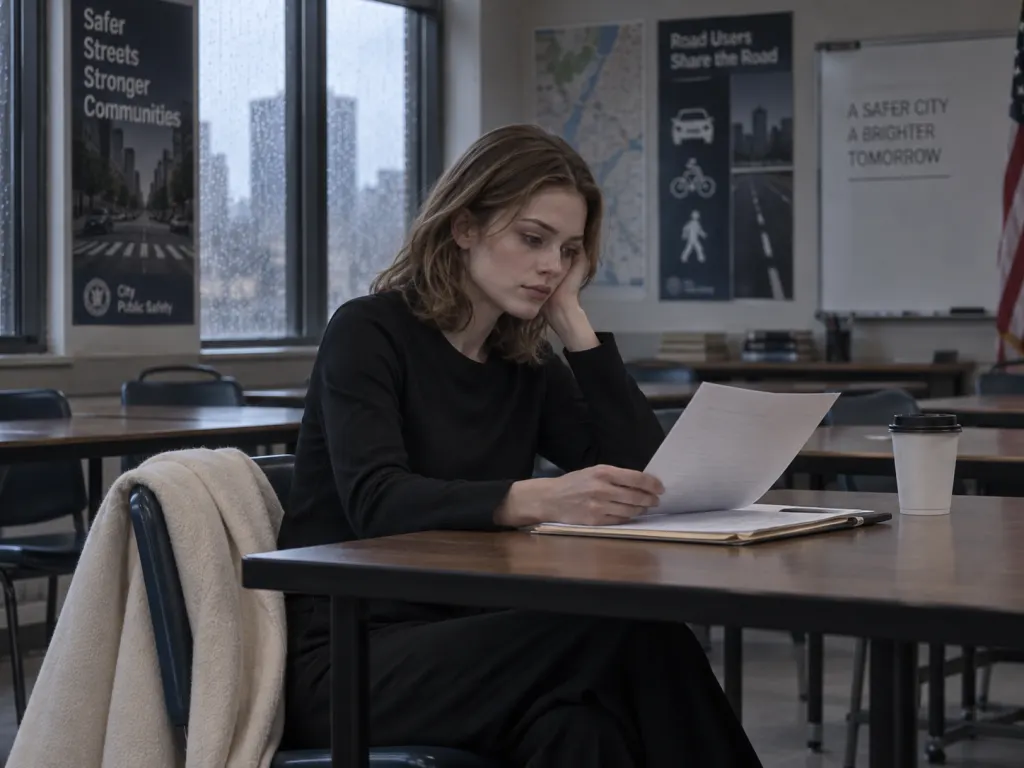
That was not redemption. Not yet. It was only contact. But contact is sometimes the first honest punishment arrogance receives: the forced awareness that other people are real even when they are inconvenient.
Judge Rowan never commented on the case outside the record. Officer Bell went back to work. Maya stopped hearing jokes about the video after a while, though she did not forget the kitchen table or her father’s tired face. Conrad Voss learned that some phone calls end before power enters the room.
And Lila, who had once believed consequences were for people without better options, began the long, humiliating education of having no shortcut. The maximum sentence did not make her wise. Courts cannot do that. It did something narrower and more necessary: it interrupted her certainty.
Years later, if anyone asked what changed her, Lila would not speak first about the judge, though the judge had been the one to close the door. She would remember the hallway. The sleeping child. The grandmother’s sentence, quieter than any ruling and harder to appeal.
I didn’t see you.
That was the problem.
Some lessons arrive as mercy. Some arrive as limits. The rare ones arrive as both, and leave a person standing in the life they made, finally able to see who else has been standing there all along.
Wrap-Up
A fictional courtroom drama about a wealthy young woman who mistakes status for immunity, then learns through a stern judge, a steady officer, and the people she endangered that accountability is not a performance. The story closes on the harder beginning: seeing others clearly.