 Save
The direct answer is simple: the cup you choose in a viral “which fills first” puzzle does not reveal whether you are a narcissist. At most, it may reveal how quickly you scan a picture, whether you notice blocked channels, and how much weight you give to your first impression. The stronger lesson is about media literacy. Viral personality captions often borrow serious psychological language to make ordinary puzzles feel intimate, urgent, or shareable. That does not make the claim valid. Narcissism, especially narcissistic personality disorder, involves patterns across relationships, self-image, behavior, and functioning, not a single guess about coffee, water, or pipes.
That does not mean the puzzle is useless. It can still be a good prompt for slowing down. When a post says your answer exposes your character, pause before accepting the frame. Ask whether the image has a factual answer, whether the personality interpretation was tested, and whether the word being used has a clinical meaning. Those three questions turn a clickbait-style puzzle into a useful practice run for evaluating bigger claims online.
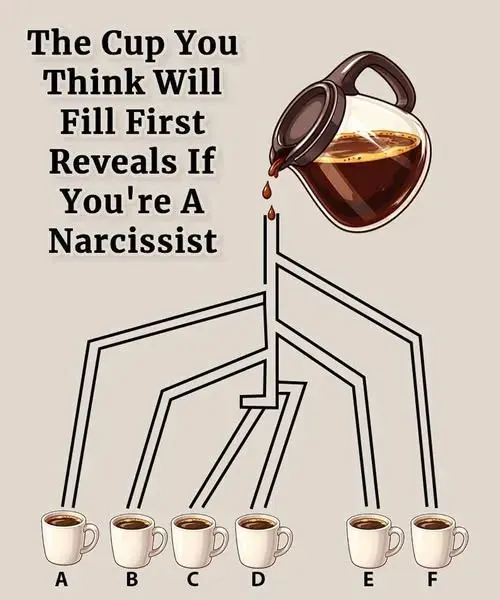
Tracing the six-cup picture: B is the first open low outlet
In the supplied A–F drawing, follow the central pipe down instead of following the longest branch. The path toward A is blocked where it meets the central wall. C and D are cut off at the closed lower junction. The opening to B sits below the open routes toward E and F, so B is the expected first destination under the usual puzzle assumption of a slow steady pour and unobstructed open pipes. Flow rate, pipe size and the already-drawn liquid levels are not specified, so this is the intended diagram reading rather than a real plumbing simulation. It says nothing about narcissism.
The Direct Answer
A cup puzzle can be a logic puzzle, a visual-attention test, or a conversation starter. It is not a psychological assessment. If the image shows a container pouring liquid through several channels, the first cup to fill depends on the drawn path: open passages, blocked pipes, gravity, and where the liquid can actually travel. Your answer may be wrong because you missed a barrier, not because your personality has been exposed. Your answer may be right because you inspected the picture carefully, not because you have a special character type.
The personality claim is where the post overreaches. A serious assessment of narcissistic traits would need a defined construct, reliable measurement, valid interpretation, and appropriate professional context. The American Psychological Association explains that psychological testing and assessment draw on multiple sources of information to help reach a specific understanding, rather than functioning like a casual pass-or-fail quiz https://www.apa.org/topics/psychological-testing-assessment. A viral cup graphic does not meet that standard.
Why This Kind Of Claim Travels So Easily
The hook works because it combines three things people naturally like: a quick challenge, a hidden answer, and a promise of self-knowledge. A plain puzzle asks, “Can you solve this?” A personality caption raises the stakes: “This says something about who you are.” That shift can make readers linger, comment, defend their choice, and share the post with friends. The stronger the label, the more likely people are to react.
Words like “narcissist” also carry social charge. In everyday speech, people may use the word loosely for someone who seems self-centered. In psychology, the terms are more specific. The APA Dictionary of Psychology describes narcissistic personality disorder as a long-standing pattern involving grandiose self-importance, a need for admiration, responses to criticism, and interpersonal disturbances https://dictionary.apa.org/narcissistic-personality-disorder?trk=public_post_comment-text. That gap between casual use and professional meaning is exactly what makes viral labels risky: they feel familiar, but they may not be used carefully.
What The Puzzle Can Actually Show
Used modestly, the cup puzzle can show how visual reasoning works under pressure. Many versions rely on blocked pipes, hidden stops, misleading slopes, or paths that appear connected until you trace them carefully. The most useful question is not “What type of person am I?” but “What did I notice first, and what did I miss?”
- First-glance guessing: You may choose the most visually obvious cup before checking the entire route.
- Detail scanning: You may trace each channel and eliminate cups whose pipes are blocked.
- Assumption checking: You may notice that the puzzle depends on drawn constraints, not on what a real liquid system would necessarily do.
- Social influence: You may change your answer after reading comments, especially if many people sound confident.
Those are ordinary thinking patterns. They can be useful to notice, but they do not map neatly onto moral worth, empathy, or a mental health label.
What Narcissism Means Outside A Meme
Narcissism is not the same thing as confidence, liking attention, taking a selfie, or answering a puzzle too quickly. Cleveland Clinic describes narcissistic personality disorder as a mental health condition that affects how a person views themselves and relates to others, and notes that diagnosis involves a qualified provider asking about life and interactions with others https://my.clevelandclinic.org/health/diseases/9742-narcissistic-personality-disorder. That is a much broader picture than one response to one image.
The National Institute of Mental Health summarizes personality disorders as enduring patterns of inner experience and behavior that differ markedly from cultural expectations and tend to be consistent across situations, with distress or impairment https://www.nimh.nih.gov/health/statistics/personality-disorders. That matters because a single online choice lacks the core ingredients: duration, context, impairment, and a careful look at real-life patterns.
What A Valid Assessment Needs
For a psychological measure to be useful, it needs evidence that the score means what people claim it means. APA’s PsycTests methodology glossary defines test validity as the extent to which evidence and theory support interpretations of test scores for the proposed use https://www.apa.org/pubs/databases/training/psyctests-method-values. That last phrase, “for the proposed use,” is important. A tool might be useful for classroom discussion, research screening, or self-reflection, but that does not automatically make it valid for labeling an individual.
A viral cup puzzle usually provides no scoring manual, no sample data, no reliability information, no explanation of how answers were linked to traits, and no boundaries for interpretation. It also does not control for visual acuity, phone screen size, image cropping, prior exposure to the puzzle, or whether someone simply misread a pipe. Without that evidence, the personality conclusion is decoration added after the puzzle, not a supported result.
How Confirmation Bias Can Sneak In
Once a post tells you what your answer “means,” it becomes easy to search your memory for examples that fit. NIST defines confirmation bias as a tendency to search for, collect, perceive, or interpret information in a way that supports preconceptions, expectations, or desires https://www.nist.gov/glossary-term/36676. In this setting, the expectation may be planted by the caption itself.
For example, if the post says one cup choice means you crave attention, you may suddenly remember a time you enjoyed praise. If it says another choice means you are unusually logical, you may remember a moment when you solved a problem calmly. Both memories might be true, but they do not prove the label. Most people can find examples of confidence, insecurity, generosity, impatience, empathy, and self-protection in their own lives. A vague interpretation can feel accurate because it gives you a broad basket to fill.
A Better Way To Read The Cup Puzzle
If you want to enjoy the puzzle without overreading it, separate the mechanical answer from the personality story. First, trace the liquid path from the source. Look for blocked openings, disconnected pipes, channels that slope the wrong way, and cups that cannot receive liquid at all. Second, check whether the image is internally consistent. Some viral versions are drawn ambiguously or cropped in ways that make a definitive answer impossible. Third, treat the personality interpretation as entertainment unless it provides real evidence.
A practical checklist helps:
- Can I explain the answer from the image alone? If not, the puzzle may be ambiguous.
- Does the personality claim cite a validated measure? If not, it is not an assessment.
- Is the label unusually dramatic? Strong labels often serve engagement more than accuracy.
- Would I apply this label to someone I care about based on one puzzle? If the answer is no, do not apply it to yourself either.
If The Result Feels Uncomfortably Personal
Sometimes a silly quiz lands on a tender spot. Maybe you worry that you talk too much about yourself, struggle with criticism, or have been told you come across as dismissive. A viral puzzle still cannot answer that concern, but the feeling it brings up may be worth reflecting on gently. A better question is not “Which cup did I choose?” It is “What patterns do people close to me describe, and do I want to understand them better?”
Self-reflection is healthiest when it stays specific. Instead of asking whether you are a fixed type of person, ask about behaviors you can observe: Do I interrupt? Do I apologize clearly? Do I notice when someone else is uncomfortable? Do I become defensive before I understand the feedback? Those questions are more useful than a label because they point toward real conversations and real choices.
A Calmer Takeaway
The cup puzzle is best understood as a tiny lesson in attention and online framing. The picture may have a correct mechanical answer, depending on the exact version. The caption claiming to reveal narcissism does not have the same support. It borrows the authority of psychological language without doing the work that responsible assessment requires.
So enjoy the puzzle if you like puzzles. Trace the pipes, compare answers, and laugh at how easily a blocked line can fool the eye. Just keep the conclusion proportionate. Your answer may say something about where you looked first. It does not define your empathy, your relationships, or your character. The more useful skill is learning to notice when a post turns a simple choice into an oversized judgment.
Wrap-Up
A viral cup puzzle can be entertaining, but it cannot reveal whether someone is a narcissist. The factual part of the puzzle is visual: which route is open, which pipe is blocked, and which cup can receive liquid first. The personality claim is separate and unsupported unless it comes from a validated assessment used in an appropriate context. Narcissism is a serious psychological term when used clinically, and personality patterns require careful evaluation across real situations. The smartest response is to solve the puzzle if it is solvable, question the dramatic caption, and avoid using one online answer as a label for yourself or anyone else.
Frequently Asked Questions
- → Can the cup I choose in the puzzle diagnose narcissism?
No. A cup choice is not a diagnosis or a valid psychological assessment. It may show how you interpreted a drawing, but it cannot establish a personality pattern.
- → Why do these puzzles feel so accurate sometimes?
They often use broad descriptions that many people can recognize in themselves. Once you read the explanation, confirmation bias can make fitting examples easier to remember.
- → Is narcissism the same as being confident?
No. Confidence can be healthy and ordinary. Clinical use of narcissistic personality disorder refers to broader, persistent patterns involving self-image, relationships, and functioning.
- → What should I do if a puzzle result bothers me?
Use the feeling as a prompt for calm reflection, not as a verdict. Think about specific behaviors, feedback from trusted people, and whether a qualified professional could help you understand your concerns.
- → How can I spot an unreliable viral personality test?
Be cautious when a post uses dramatic labels, gives no evidence for its scoring, cites no validated measure, or claims that one quick answer reveals a complex trait.
References
This content was developed and refined using reliable sources.
- https://www.apa.org/topics/psychological-testing-assessment
- https://dictionary.apa.org/narcissistic-personality-disorder?trk=public_post_comment-text
- https://my.clevelandclinic.org/health/diseases/9742-narcissistic-personality-disorder
- https://www.nimh.nih.gov/health/statistics/personality-disorders
- https://www.apa.org/pubs/databases/training/psyctests-method-values
- https://www.nist.gov/glossary-term/36676