 Save
The quickest answer: a spot the difference puzzle is best solved by comparing the two pictures in small zones instead of staring at the whole scene. Start in one corner, move across in a steady row, then repeat through the middle and bottom. The puzzle feels tricky because visual attention is selective. Even when two pictures are side by side, a tiny change can hide if it does not create a strong contrast, interrupt a pattern, or appear in the place you are already checking. Research on change blindness describes how people can miss changes in scenes, photographs, and real interactions when the change is not clearly signaled https://pubmed.ncbi.nlm.nih.gov/21223921/.
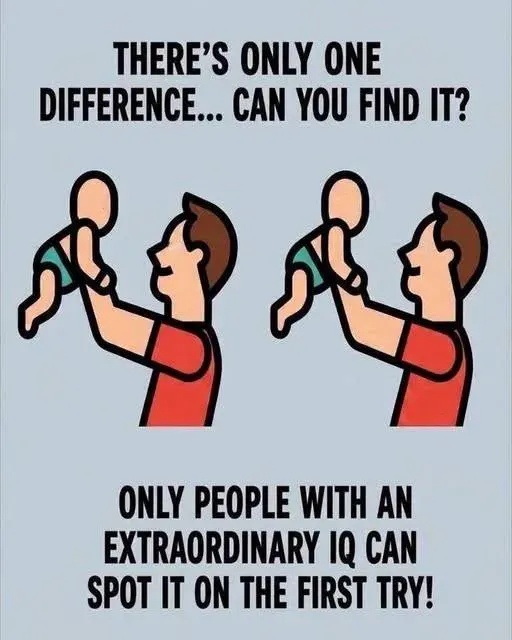
The man-and-baby drawing shown here
The supplied image repeats a man in a red shirt lifting a baby in green clothing. The post promises exactly one difference and links success to extraordinary IQ. We have not verified a reliable answer key for this low-resolution version, so this article does not invent a missing finger, facial feature or other reveal. Compare the baby’s outline, the supporting hands, the man’s face and the shirt contours. Minor compression and scaling differences are not necessarily the intended puzzle answer. This is a casual visual game, not an IQ assessment.
Why the Difference Hides in Plain Sight
At first, a spot the difference puzzle looks like a simple test of eyesight. The two images are visible, the answer is somewhere on the page, and nothing seems mysterious. The challenge is that seeing a scene is not the same as comparing every object inside it. Researchers use the term change blindness for failures to notice a change between one view and another. In a classic review, Simons and Levin described how people often miss changes unless the change creates a clear local signal that draws attention to its position https://pubmed.ncbi.nlm.nih.gov/21223921/. A puzzle removes that obvious signal. Nothing moves. No sound points to the altered area. Both pictures sit quietly beside each other, asking the viewer to build the comparison deliberately.
That is why the most confident first glance is often wrong. The overall layout matches, the main objects match, and the colors may be close enough that the scene reads as one familiar whole. The missing detail might be a shortened line, a flipped handle, a tiny extra spot, a changed shadow, or one object that is shifted by only a few pixels. The viewer may feel as if the entire picture has been checked, but attention has actually visited only selected parts of it. A puzzle designer counts on that gap between the feeling of completeness and the slower reality of detailed comparison.
- Check outlines before textures; changed silhouettes often reveal the answer.
- Compare repeated objects such as buttons, windows, leaves, dots, tiles, or stripes.
- Look for direction changes, including flipped arrows, tilted handles, reversed shadows, or turned faces.
- Scan negative space, because a missing gap can be easier to overlook than a missing object.
- Return to the center after checking the edges; puzzle solvers often overcorrect and miss central details.
The Science Behind the Trick
Change blindness research is useful here because it explains the puzzle without making it mystical. In laboratory work, a brief interruption between two versions of an image can make even a meaningful change difficult to detect. Peter Tse explains that detecting a new or changed element depends on attention being allocated to the location of that change; unattended locations are less likely to be compared successfully https://pmc.ncbi.nlm.nih.gov/articles/PMC2536742/. A printed or digital spot the difference puzzle is gentler than a laboratory flicker display, but the central problem is similar: the solver must choose where to compare, and attention cannot be everywhere with equal detail at the same time.
Visual search research adds a second piece. Jeremy Wolfe's review of visual search describes how people direct attention toward promising objects and locations instead of processing everything in a scene at once https://pmc.ncbi.nlm.nih.gov/articles/PMC9879335/. Search is guided by features such as color, size, motion, previous experience, scene structure, and the viewer's current goal. In a puzzle, that guidance can help or hinder. If the difference is a bright red flower among pale leaves, it may pop out quickly. If the difference is a small missing petal among many similar petals, the same scene structure can mislead the viewer into assuming all petals are alike.
Why a Systematic Scan Works Better
A systematic scan reduces guessing. Instead of asking the mind to remember both whole pictures, it turns the puzzle into a sequence of small comparisons. Compare the top-left corner in picture A with the top-left corner in picture B. Then move right. After one row is complete, drop down and repeat. This sounds slower, but it often saves time because it prevents the loop many solvers fall into: bouncing between the largest objects, feeling stuck, then rechecking the same obvious areas. The method also lowers the burden on visual working memory. In a Nature study indexed by PubMed, Luck and Vogel found that visual working memory is limited in how many colors or orientations can be retained at one time, while object-based groupings matter for what can be held temporarily https://pubmed.ncbi.nlm.nih.gov/9384378/. For puzzle solving, the practical lesson is simple: compare nearby matching details now rather than trying to store the whole image for later.
What to Look For When You Are Stuck
When the obvious objects match, switch from object names to visual properties. Do not ask only whether both pictures have the same cup, tree, window, or chair. Ask whether the cup rim is the same curve, whether the tree branch points the same way, whether the window has the same number of panes, and whether the chair leg touches the floor at the same angle. Spot the difference puzzles often hide the answer by changing a property without changing the identity of the object. The thing is still a cup, a branch, or a chair, so a meaning-based scan passes over it too quickly.
Another useful shift is to inspect quiet areas. Many solvers spend most of their time on the central character or largest object because it feels important. But puzzle makers often place the difference near a border, in a background pattern, or inside a repeated element where the viewer expects sameness. Check corners, shadows, small accessories, reflected shapes, and spaces between objects. If the puzzle has a crowd, shelves, tiles, foliage, food pieces, or fabric patterns, count repeated parts in groups rather than one by one. For example, compare three leaves at a time, then the next three. This keeps the search organized without becoming mechanical.
A Calm Method for Solving One
Begin by deciding on a path. A left-to-right, top-to-bottom grid works for most images, but any consistent route is fine. Covering part of the image with a finger, a bookmark, or the edge of a sheet of paper can help isolate one band at a time. If the images are on a screen, zooming in slightly may make small differences easier to compare, but too much zoom can remove the overall alignment that keeps both pictures matched. Work in short passes. First check big outlines, then repeated objects, then color and shading, then tiny gaps. Each pass has a purpose, which is better than simply staring longer.
If you are solving with someone else, divide the work. One person can compare the top half while the other checks the bottom half, or one person can call out objects while the other confirms matching details. This turns the puzzle into a shared search rather than a race. It also catches assumptions: one viewer may say both mugs match, while another notices that the handle opening is slightly different. The best puzzle conversations are specific. Instead of saying, "the table looks wrong," say, "the left table leg reaches the floor in one image but stops above the shadow in the other." Specific language helps direct attention to a location and a property at the same time.
Common Places the Difference Appears
Although every puzzle is different, certain hiding places come up often. Edges are popular because they receive less attention than faces and central objects. Repeated designs are popular because the viewer expects the next item to match the last one. Shadows are popular because people treat them as background rather than objects. Small direction changes are popular because the object keeps the same label even when its orientation changes. If the puzzle shows a kitchen, compare utensil handles, cabinet knobs, steam curls, plate rims, fruit stems, chair legs, and tile lines. If it shows a garden, compare leaves, flower centers, fence gaps, clouds, stones, and branch tips. If it shows a room, compare picture frames, cushions, books, lamp pulls, rug patterns, and reflections.
Be careful with color-only differences. Screens, lighting, compression, and printing can make two truly identical areas look slightly different. A valid puzzle difference is usually deliberate and local: one object is a different color, one stripe is missing, one small mark appears only once, or one shape has changed. If the entire left image looks warmer than the right, that is probably display variation rather than the intended answer. A good rule is to ask whether the suspected change has a clear boundary. A changed button, missing leaf, or altered line has a boundary; a general color cast across the whole image does not.
How Designers Make the Puzzle Feel Fair
A fair spot the difference puzzle hides the answer without making it arbitrary. The changed detail should be visible at the intended size, belong naturally to the scene, and be confirmable once found. If the answer is so tiny that it depends on screen resolution, the puzzle becomes frustrating rather than satisfying. If the change is too central or too bright, it becomes a quick reaction test rather than a search. The sweet spot is a difference that a patient viewer can find by using a reasonable method. That is why many effective puzzles alter medium-level details: a missing stripe on a scarf, a shorter spoon handle, a shifted clock hand, a changed window shape, or an extra seed on a pastry.
Why the Reveal Feels Obvious Afterward
Once someone points out the difference, it can feel impossible that you missed it. That reaction is part of the charm. After the answer is known, attention locks onto the changed location and the two versions become easy to compare. The puzzle has not changed; your search target has. This is also why hints work best when they narrow the location without giving away the object. A hint such as "look near the upper right" preserves the search, while "check the missing button" ends it. If you are sharing a puzzle with friends, start with location hints, then feature hints, then the full answer.
The larger lesson is not that viewers are careless. Spot the difference puzzles are entertaining because they make a normal feature of perception visible. Attention is selective, search is guided, and small details compete with the rest of the scene. A steady method gives attention a route to follow. When you divide the image into zones, compare like with like, and change your question from "what is this object?" to "what exact property changed?" the tiny detail has far fewer places to hide.
Wrap-Up
A spot the difference puzzle rewards patient comparison more than speed. The most reliable approach is to scan in a fixed pattern, compare matching zones, and look for property changes such as altered outlines, missing repeated parts, direction shifts, color changes, and small gaps. Research on change blindness, visual search, and visual working memory explains why the answer can be visible yet unnoticed: attention selects only part of the scene at a time, and whole-picture impressions are not the same as detailed comparison.
Frequently Asked Questions
- → What is the best first move in a spot the difference puzzle?
Start with a fixed scanning path instead of looking randomly. Compare the same small area in both pictures, then move to the next area. Corners, borders, repeated patterns, shadows, and small accessories are worth checking early because they are easy to skip.
- → Why do I miss the answer when it is clearly visible?
A visible detail is not always an attended detail. Research on change blindness and visual search shows that people do not compare every part of a scene at once. If the changed detail is small, expected, or outside the area you are checking, it can remain unnoticed until attention lands on it.
- → Are spot the difference puzzles just memory tests?
Not exactly. Memory matters because you briefly hold details from one image while comparing them with the other, but the task also depends on attention, search strategy, pattern comparison, and noticing small visual properties such as shape, color, position, and direction.
- → What details should I compare when I am stuck?
Switch from naming objects to comparing properties. Check whether outlines, sizes, angles, shadows, repeated marks, gaps, and colors match. A cup may still be a cup in both pictures, but its handle, rim, reflection, or shadow may have changed.
- → How can I give someone a hint without spoiling the puzzle?
Give hints in stages. First name a general area, such as the upper left or lower center. If needed, mention a feature type, such as a line, shadow, or repeated object. Save the exact object or changed detail for the final reveal.