 Save
Your date of birth can be used in numerology as a symbolic starting point, but it should not be treated as a fixed verdict about who you are. In popular karma numerology, the numbers in a birth date are reduced into a life path number, and certain intermediate numbers, especially 13, 14, 16, and 19, are read as karmic themes. A careful reading treats those themes as reflective language, not as proof, fate, or a substitute for personal judgment. The idea sits at the crossroads of number symbolism, modern esoteric practice, and older religious uses of the word karma.
That distinction matters because the words around this topic can sound more certain than the evidence allows. Pythagorean traditions gave number an important philosophical role in antiquity, but modern birth-date numerology is a later interpretive practice rather than a scientific measurement. The Stanford Encyclopedia of Philosophy describes how ancient Pythagorean thought connected number, harmony, and knowledge, while also noting scholarly caution about what can confidently be attributed to early Pythagoreans. A useful article on karma numerology therefore needs two layers at once: how the system is commonly used, and how to keep its claims in proportion.
What Birth-Date Numerology Is Trying to Do
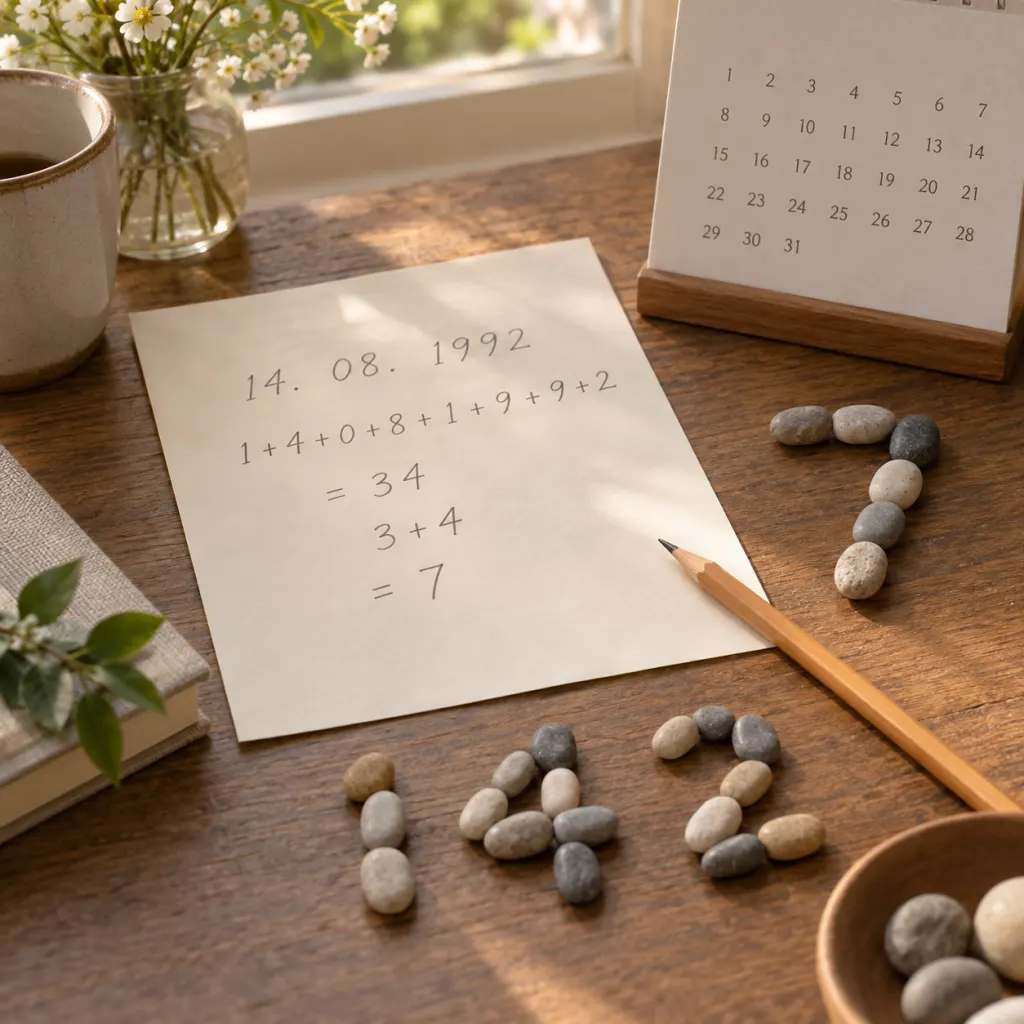
Birth-date numerology starts with a simple observation: a calendar date already has numbers, and numbers are easy to turn into patterns. Someone born on May 27, 1991, for example, can write the date as 5, 27, and 1991, then reduce the digits by addition. In many contemporary systems, the result is called a life path number. Some readers also look at the day of birth by itself, repeated digits, and intermediate totals that appear before the final reduction.
The practice is not mainly about arithmetic difficulty. The arithmetic is intentionally easy. The meaning comes from the symbolic vocabulary assigned to numbers. One reader may associate 1 with independence, 2 with cooperation, 3 with expression, and so on. Another may use a slightly different set of meanings. That flexibility is part of the appeal, but it is also the reason the method should be approached as interpretation rather than demonstration.
Where Number Symbolism Gets Its Weight
Numbers have carried meaning in many traditions because they are both practical and suggestive. They count objects, organize calendars, structure music, and appear in architecture, astronomy, literature, and ritual. In Greek philosophical history, Pythagorean traditions are especially important because they gave number a role beyond ordinary counting. The Stanford account of Pythagoreanism notes that Aristotle described Pythagoreans as treating numbers and numerical principles as deeply connected with reality, while modern scholars continue to debate exactly how those reports should be understood.
That history does not prove modern numerology, but it explains why number symbolism can feel culturally familiar. When a person reduces a date of birth and then reads meaning into the result, they are participating in a long habit of using number as a bridge between order and meaning. A recent University of Bristol thesis record on numerology in Chaucer studies notes both historical evidence for numerological practice in medieval contexts and the risk of false positives, where a pattern can be read as intentional even when it may not be. That warning is useful far beyond literary analysis: humans are talented pattern-finders, and not every pattern deserves the same level of trust.
How the Common Birth-Date Calculation Works
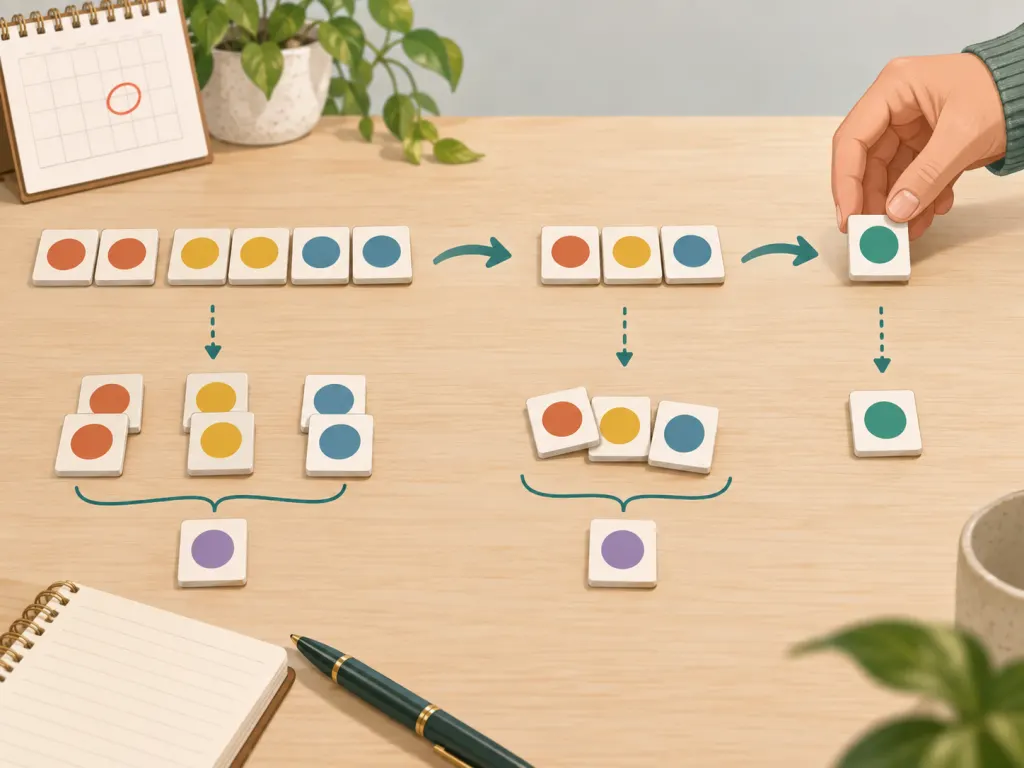
The most familiar calculation is the life path number. Different numerology schools vary, but the common method adds every digit in the date of birth until the result becomes a single digit, sometimes preserving special intermediate numbers. If a person was born on April 4, 1955, one common calculation is 4 + 4 + 1 + 9 + 5 + 5 = 28, then 2 + 8 = 10, then 1 + 0 = 1. The final number would be 1 in that system.
Some readers calculate month, day, and year separately before combining them. Others preserve so-called master numbers such as 11, 22, or 33. Karma numerology discussions often pay special attention to 13, 14, 16, and 19 when they appear as a day of birth or as an intermediate total before reduction. The exact rules should be stated clearly before any interpretation begins, because changing the rule can change the result.
- Write the birth date in numbers: use a consistent format so the same date is not calculated two different ways.
- Add the digits: combine the month, day, and year digits according to the chosen system.
- Reduce carefully: continue adding until a single digit appears, unless the chosen system preserves a special number.
- Notice intermediate totals: if 13, 14, 16, or 19 appears, many karma numerology readers treat it as a theme to examine.
- Keep interpretation separate from fact: the number can be a journaling prompt without becoming a life sentence.
What Karmic Debt Numbers Usually Mean
In popular numerology, the numbers 13, 14, 16, and 19 are often called karmic debt numbers. The phrase can sound severe, but a balanced interpretation avoids shame and fatalism. These numbers are usually presented as lessons or recurring themes: 13 is often linked with patient effort, 14 with moderation and freedom, 16 with humility and inner honesty, and 19 with independence balanced by consideration for others. Those meanings are not universal doctrines. They are conventions within a modern esoteric vocabulary.
A thoughtful reader can translate each number into a practical question. For 13: where do I avoid steady effort because I want quick results? For 14: where do I confuse freedom with scattered choices? For 16: where has pride made learning harder than it needs to be? For 19: where do I need both self-reliance and generosity? Framed this way, the number is not an accusation. It becomes a compact way to ask about habits, values, and blind spots.
Karma and Numerology Are Not the Same Tradition
The word karma deserves care. In everyday English it is often used casually to mean payback, luck, or consequences. In South Asian philosophical and religious contexts, it has a much richer history. The Internet Encyclopedia of Philosophy explains that karma literally means action and, in Hindu philosophical discussion, can refer to moral, psychological, spiritual, and physical consequences of morally significant choices. It also notes that belief in karma is shared across several Indian traditions, including Buddhism and Jainism, and is not a simple marker of one single tradition.
Modern karma numerology borrows the language of karma but does not reproduce the full religious and philosophical frameworks in which karma has historically been discussed. That does not mean every modern use is disrespectful, but it does mean readers should avoid flattening karma into a dramatic label for personal inconvenience. If a numerology reading uses the word karmic, the clearest interpretation is usually symbolic: the number points to a theme the reader may want to revisit with honesty, not to a documented spiritual debt.

How Astrology Enters the Conversation
Many articles and social posts mix date-of-birth numerology with astrology, especially lunar nodes, zodiac signs, or charts. The overlap is understandable because both practices start with birth data and both use symbolic systems. Still, they are different systems. Numerology reduces dates into numbers; astrology interprets positions of celestial bodies and signs. NASA’s Space Place explains that astronomy is the scientific study of objects in outer space, while astrology is a belief system that links positions of stars and planets with personality or future events, and NASA states that those claims are not based on scientific evidence.
It can still be culturally interesting to understand why birth timing matters in astrology. A NASA page on the ecliptic explains how the Sun appears to move around the zodiac over the year, which is part of the astronomical background behind zodiac language. That background should not be confused with proof of astrological interpretation. For a careful reader, the best boundary is simple: astronomy can describe sky positions; astrology and numerology offer symbolic readings of meaning.
A Balanced Way to Read Your Own Numbers
The healthiest way to use karma numerology is as a reflective exercise with room for disagreement. Start by calculating the number, then write down the interpretation in plain language. Next, ask whether the theme actually describes a pattern in your life. If it does, look for ordinary explanations too: family habits, choices, responsibilities, personality, culture, opportunity, and chance. If the number does not fit, there is no need to force it.
Good reflection produces agency rather than fear. A person who receives a 14 theme, for example, might decide to examine where they overcommit, chase novelty, or resist structure. Another person might read the same number and find nothing useful. Both responses are valid. A number system earns its practical value only when it helps someone think more clearly, act more kindly, or make more deliberate choices.
Common Mistakes to Avoid
The first mistake is treating a reading as a fixed identity. People change across time, and a birth date cannot contain the full complexity of a person’s character. The second mistake is using a karmic label to judge another person. Even within numerology, these numbers are usually framed as personal lessons, not tools for ranking people. The third mistake is mixing systems without saying so. A life path number, a zodiac sign, a lunar node, and a matrix-style chart may all be interesting, but they come from different rule sets.
The fourth mistake is confirmation bias. Once a person is told that a number means independence, they may notice every independent choice and ignore every cooperative one. This is the same pattern problem that scholars warn about in other contexts of numerological interpretation: a pattern can be meaningful, accidental, or selectively noticed. The practical safeguard is to ask, what would count as evidence against this reading? If the answer is nothing, the reading is probably more poetic than analytical.
Using the Numbers as Journal Prompts
One useful way to keep karma numerology grounded is to turn each number into a question rather than a claim. Instead of saying, “I am a 16, so pride is my problem,” try, “Where might I be protecting my pride when openness would help?” Instead of saying, “My life path is 1, so I must do everything alone,” try, “Where is independence useful, and where would support make me wiser?” This shift changes the reading from a label into a conversation.
A short practice can be enough. Write the number, the traditional keyword, and three examples from your actual life. Then write one counterexample. The counterexample matters because it keeps the exercise honest. If the number is about perseverance, name a place where you already persevere well. If it is about moderation, name a place where your choices are already balanced. The goal is not to prove the system right. The goal is to think with more precision.
What a Careful Reader Can Take Away
Date-of-birth karma numerology is most useful when it is modest. It can provide language for reflection, a ritual for pausing, and a memorable way to ask questions about effort, freedom, humility, independence, and responsibility. It is less useful when it becomes a prediction machine or a source of pressure. The same date can be read through many systems, and the same person will live through many stages that no single number can summarize.
For readers who enjoy symbolic practices, the best question is not “What does my birth date prove?” but “What does this interpretation help me notice?” That question keeps curiosity alive while leaving room for evidence, culture, and personal choice. A number can be a mirror, a metaphor, or a prompt. It should not become a cage.
Wrap-Up
Date-of-birth karma numerology combines simple arithmetic with symbolic interpretation. The common method reduces the digits in a birth date to a life path number, while some readers watch for karmic debt numbers such as 13, 14, 16, and 19. Historically, number symbolism has deep roots, and the word karma belongs to rich South Asian philosophical and religious traditions. Modern karma numerology should therefore be read carefully: it can be meaningful as reflection, but it should not be presented as scientific proof, fate, or a complete account of a person. The most grounded use is to turn each number into a question about habits, values, and choices.
Frequently Asked Questions
- → Is karma numerology the same as traditional karma?
No. Traditional discussions of karma belong to South Asian religious and philosophical contexts and involve action, consequence, moral life, and rebirth in different ways across traditions. Karma numerology uses the word karmic more loosely, usually to describe a symbolic life theme shown by a number.
- → What are the main karmic debt numbers in numerology?
In many popular numerology systems, the karmic debt numbers are 13, 14, 16, and 19. They are commonly interpreted as themes involving effort, moderation, humility, and independence. These meanings are conventions within numerology, not established facts about a person.
- → Can my date of birth predict my future?
A birth date can be used in symbolic systems, but it should not be treated as a reliable prediction tool. A more grounded approach is to use the number as a prompt for reflection, then compare the idea with real experience, choices, relationships, and context.
- → Why do different calculators give different numerology results?
Different calculators may reduce the date in different ways. Some add every digit at once, some reduce the month, day, and year separately, and some preserve master numbers or karmic debt numbers before reducing. The rule set should be clear before interpretation begins.
- → How should I use a reading if it feels accurate?
Treat accuracy as an invitation to reflect, not as final proof. Write down the part that fits, look for ordinary examples from your life, and also name a counterexample. That keeps the reading balanced and turns it into a practical self-inquiry exercise.