 Save
Fiction notice: The people and events in this story are fictional. The emotional stakes are domestic and ordinary: what happens when one partner keeps treating tomorrow as a place where love can always be repaired.
Continuing the same anniversary story
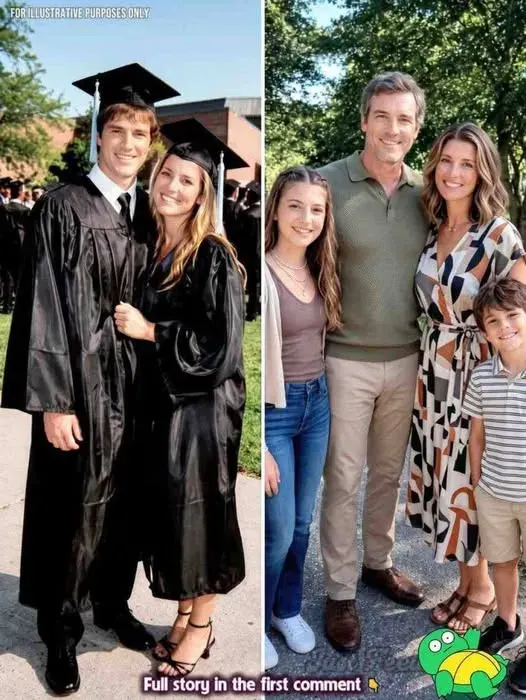
The narrator and Austin have been married for fifteen years and have two children, Emma and Noah. She reserved Rosewood Grill, where he once proposed. He chose a soccer semifinal with Mark instead. The story below returns to that evening and reveals what Austin found on the dining table.
Chapter 1: The Empty Chair
The waiter removed the second wineglass at 7:25.
He did it gently, as if the glass were sleeping. One hand around the stem, one palm beneath the bowl, his eyes trained somewhere just over my shoulder so neither of us had to admit what it meant. The table looked wider after that. The white cloth stretched between me and the empty chair like snow over a field where someone had promised to meet me and then forgotten the road.
I sat in my navy dress with my phone facedown beside the candle. I had chosen the dress because Austin once told me it made me look like myself before the world started needing things from me. That had been years ago, before school permission slips and mortgage notices and his late meetings and my mother calling every Thursday to ask if I was eating enough. Fifteen years had thinned certain parts of us and strengthened others. At least, that was what I had believed.
Rosewood Grill was still the same narrow, amber-lit restaurant where Austin had first said he loved me. The brick wall behind the bar still had a crack shaped like a river. The booths still smelled faintly of lemon oil and warm bread. In the corner, a woman laughed at something her husband said and leaned across the table to steal a fry from his plate. I watched her hand return to her napkin, quick and unthinking. A small theft made possible by closeness.
I checked my phone again. No message.
At 7:30, I called him.
The restaurant sounds rushed into the receiver first: plates, low music, ice shaken behind the bar. Then came the roar of men in the background, the kind of roar that belongs to a room watching a ball travel toward a net.
"Mara?" Austin said. He sounded distracted, not guilty.
I closed my eyes. "Where are you?"
There was a pause, then a laugh from someone near him. "At Mark's. I told you the match was tonight."
"You told me last week there might be a match tonight. You also told me you would meet me here."
"I know, I know. Listen, it's almost halftime. I can't just leave now."
The candle trembled in its little glass cup. My hand was steady, which frightened me more than shaking would have.
"Austin," I said, "it is our fifteenth anniversary."
He sighed, and in that sigh I heard every small dismissal I had taught myself to forgive. "You’ll still be here tomorrow. The game is only tonight."
For a second, I could not breathe. Not because he had said something cruel in a dramatic way. Because he had said something ordinary in a careless way, and ordinary carelessness is sometimes the sharpest blade in a house.
"No," I said quietly. "I suppose I have not been."
"What does that mean?"
Another cheer exploded behind him.
I looked at the empty chair, at the menu folded over his plate, at the tiny silver anniversary card I had bought and written in during my lunch break. I had written: Fifteen years, and I would still choose you. I stared at those words until they blurred.
"Enjoy the game," I said, and ended the call.
Chapter 2: The List
I paid for the appetizer I had not touched and the sparkling water I had ordered to look less abandoned. The waiter offered to box the bread. His kindness nearly undid me.
"No, thank you," I said, and heard my own voice come out bright and polite, the voice women use when their hearts have cracked in public and they still have to sign a receipt.
Outside, rain polished the sidewalk. I stood under the green awning and watched cars slide past, their headlights long and silver in the street. My phone buzzed once. A message from our daughter, Emma: How's dinner? Did Dad cry when he saw you?
I typed, Dinner ended early. Love you. Then I erased it. I typed, Everything is fine. Then I erased that too.
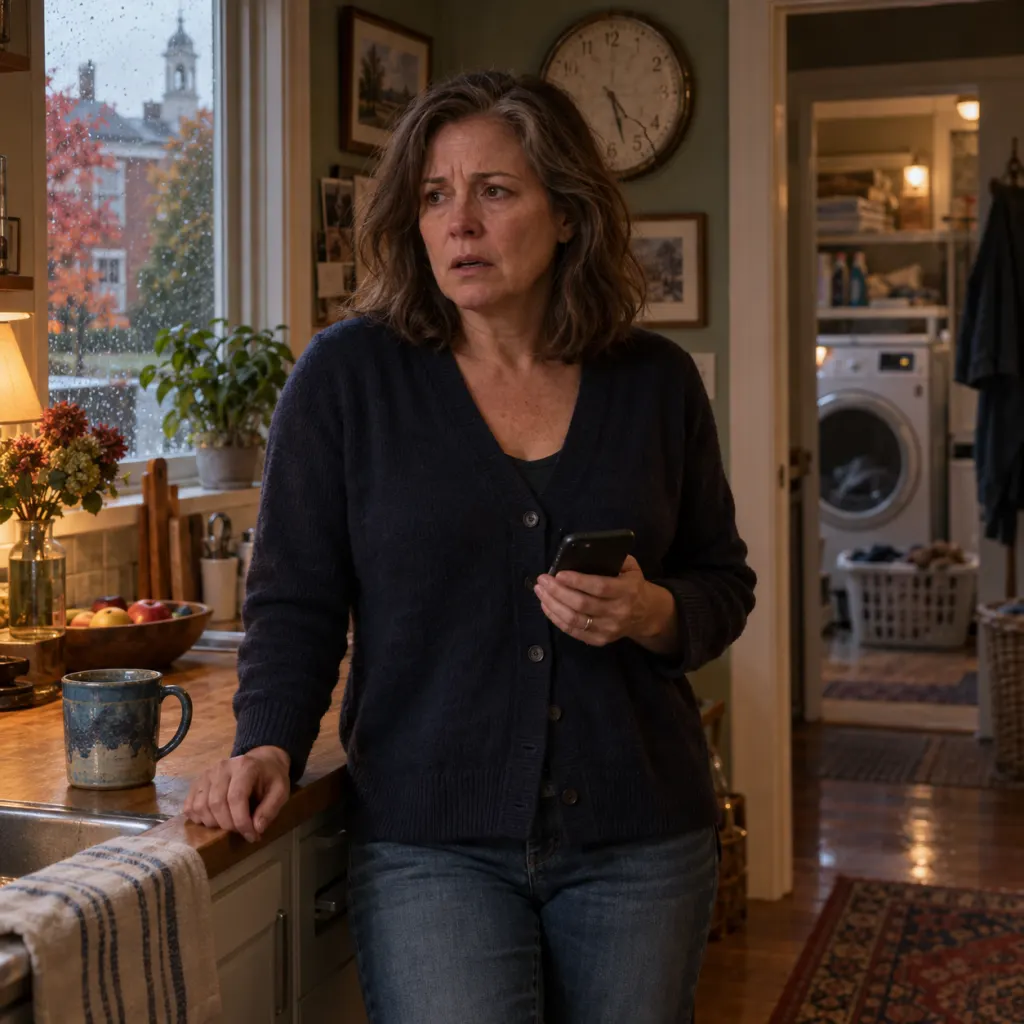
At home, the porch light was on because I had left it that way for him. The house smelled like laundry soap and the cinnamon candle Emma had lit after school. Noah's cleats were still by the stairs, one lace knotted like a small, stubborn problem. The dishwasher hummed in the kitchen. Life had continued making its soft mechanical noises without caring that something in me had stopped.
I took off my shoes in the entryway and stood there in my stocking feet, holding my purse, unsure what a woman does after realizing she has been mistaken for furniture.
Then I walked to the dining room.
The room had become our family warehouse over the years. Homework folders, unopened mail, a charger cord, a roll of tape, a soccer schedule, a stack of library books. I cleared everything from the table and carried it to the sideboard. I wiped the surface clean. I found the linen runner we used at Christmas and laid it down the center.
From the closet under the stairs, I brought out the blue memory box where I kept the things Austin called sentimental clutter. Ticket stubs. Hospital bracelets from the children's births. The program from his sister's wedding, where he had cried during the father-daughter dance and pretended he had allergies. The cork from the cheap champagne we drank the night we closed on the house.
I placed fifteen items on the table, one for each year. Not as a shrine. As evidence.
Year one: a photograph from our first apartment, Austin painting the wall the wrong shade of yellow while I laughed from the doorway.
Year two: the receipt from the diner where we ate pancakes at midnight after finding out Emma was coming.
Year three: the red mitten Noah wore home from the hospital, impossibly small.
Year four: the note Austin tucked into my laptop bag before my first big presentation: Knock them flat, Mar.
I kept going. Year seven was a drawing Emma made of the four of us with stick arms reaching into the same sun. Year nine was the key tag from the minivan Austin swore we would never need and then loved because the cup holders were, in his words, heroic. Year eleven was the little paper crown from Noah's birthday, the year Austin missed the cake because he was stuck at work and came home devastated, holding a grocery-store cupcake with a single candle.
By year fifteen, the table had become a map of devotion. Messy, tender, unphotogenic devotion. I stood at the end of it and knew, with sudden clarity, that I did not want to punish him.
I wanted him to see the room he had been walking through with his eyes half closed.
Chapter 3: What He Found
Emma came downstairs at 10:04 in flannel pants and an old debate-club sweatshirt. She was fourteen and had recently perfected the art of pretending not to notice anything while noticing everything.
"Mom?" she asked from the doorway.
I turned. My makeup had surrendered under my eyes. My hair had fallen from its pins. I was still wearing the navy dress.
Her face changed.
"Dad didn't go," she said.
It was not a question.
I shook my head once.
She crossed the room and wrapped her arms around me with the awkward fierceness of a child old enough to understand pain but too young to know where to put it. I held her and tried not to lean too hard.
"I'm okay," I lied.
"You do that," she whispered into my shoulder.
"Do what?"
"Say you're okay when you're making that face."
I laughed once, but it broke in the middle. Noah appeared behind her, twelve years old, hair flattened on one side from sleep. He looked at the table, then at me.
"Is Dad in trouble?"
"Your dad and I need to talk," I said.
Noah frowned. "That means yes."
I almost smiled. "It means your dad and I need to talk."
The children stood there, both of them suddenly too tall, too aware. I understood then that I had not been hiding as much as I thought. Children live in the weather of a house. They know when the air pressure changes.
At 11:38, Austin came home.
I heard his key, then the careful pause before the door opened, as if he had remembered late that guilt should have a posture. His shoes squeaked on the mat. He called my name softly.
I was sitting at the dining table with a cup of tea gone cold. Emma and Noah had gone back upstairs after I promised them no one was leaving tonight. That had been true. It was also not the same as promising nothing would change.
Austin entered the dining room and stopped.
His cheeks were flushed from beer and rain. His jacket was dark at the shoulders. One hand still held his phone, where a group chat lit up with laughing messages. He looked from the yellowed photograph to the tiny mitten to the paper crown to the anniversary card lying unopened beside the candle.
For once, he did not speak first.
I let the silence sit down between us.
"Mara," he said finally.
"Don't apologize yet."
He swallowed.
"If you apologize now," I said, "you will apologize for missing dinner. That is too small."
His eyes moved to my face. Something in him shifted, not enough to fix anything, but enough for him to understand he had entered a room larger than the mistake he had expected.
"Then tell me," he said. "Tell me what I did."
Chapter 4: The Room Larger Than Dinner
I had imagined this conversation before. Not this exact one, but versions of it. In my angriest private drafts, I was magnificent. I spoke in complete sentences. I named every wound. Austin understood instantly. The children overheard just enough to respect me forever. Then I walked upstairs with the calm dignity of a queen in sensible pajamas.
Real life gave me a cold cup of tea, mascara under one eye, and a husband staring at a red mitten as if it might accuse him.
"You missed dinner," I said. "But before that, you missed the planning. You missed me telling you why the restaurant mattered. You missed Emma asking whether you were bringing flowers. You missed Noah ironing his own shirt because he wanted to look nice when we took pictures after. You missed the way I stood in front of the mirror trying to remember if you still noticed me."
Austin flinched.
"I notice you," he said.
"No," I said. "You recognize me. That is different."
He lowered himself into the empty chair. The same chair he had left empty at the restaurant. There was no poetry in that, only furniture finally doing its job.
"I didn't think it would hurt you this much," he said.
"That is the problem."
He rubbed his palms over his face. "It was the semifinal. Mark had everyone over. We have watched every round together. I thought we could just move dinner."
"You thought I could be moved."
The sentence landed harder than I intended. Or maybe exactly as hard as it needed to.
He looked down.
I pointed to the table. "Fifteen years are not one grand romance. They are this. Showing up when the calendar says something matters. Showing up when it doesn't. Remembering that your wife is not a background condition of your life."
"I know," he whispered.
"I don't think you do."
He reached for the paper crown from Noah's birthday and stopped before touching it. "I have been tired," he said.
"So have I."
"Work has been awful."
"Mine has not been a spa."
A small, helpless laugh left him. It died quickly.
"I didn't mean to make you feel invisible," he said.
"Intentions do not cook dinner," I said. "They do not answer texts. They do not sit across from your wife at a table."
His eyes reddened. I looked away because I did not want his tears to become the main event. I had spent too many years comforting him for hurting me.
"What do you want me to do?" he asked.
It was the question I had been waiting for and dreading.
"I want you to stop asking for instructions after the damage is done."
He nodded, slowly, as though each word had weight.
"And tonight?"
"Tonight," I said, "you sleep in the guest room. Tomorrow we talk while the children are at my sister's. Not for ten minutes. Not between errands. We talk until we have said the true things."
Austin looked toward the stairs, then back at me. "Are we ending?"
The fear in his voice touched me. I hated that it touched me.
"I don't know," I said honestly. "But we are finished pretending nothing is wrong."
Chapter 5: The Morning After
In the morning, Austin made breakfast badly.
He burned the first batch of toast, undercooked the second, and sliced strawberries with the grave concentration of a man defusing a device. The children watched him with open suspicion. Emma accepted a plate without smiling. Noah asked if this meant Dad was becoming a morning person, and Austin said, "Let's not get carried away."
No one laughed much, but no one ran from the table either.
After my sister picked up the children, the house became enormous. Austin and I sat in the living room, not touching. Rain tapped the windows. The soccer schedule still hung on the refrigerator under a magnet shaped like a lemon.
"I called Rosewood," he said.
"Why?"
"To apologize for the table."
"The restaurant was fine."
"I know. I still wanted to do it."
It was a small thing, almost nothing. But small things had built the hurt. Maybe small things would have to begin whatever came next.
He had also written something down. Not a speech, he said quickly when he saw my expression. A list.
"I know lists don't fix this," he said. "But I needed to start with what I can name."
He read from the page. He had missed three parent meetings in the past year and assumed I would summarize them. He had stopped asking about my work unless I sounded upset. He had made our shared calendar into something I maintained and he consulted. He had treated weekends as recovery for himself and logistics for me. He had let romance become a memory we praised instead of a practice we protected.
I sat very still.
"Did Emma tell you these?" I asked.
"No."
"Your mother?"
"Mara." He folded the paper once. "I am capable of noticing when I decide to look."
That was the first sentence that hurt in a useful way.
We talked for four hours.
Sometimes we were careful. Sometimes we were not. I said I was lonely inside a marriage full of people. He said he felt useless at home and had begun choosing places where competence came easily: work, the soccer group, anything with rules and a whistle and a score. I told him he could not outsource intimacy to my patience. He told me he was ashamed of how relieved he felt when I handled everything.
That confession changed the room.
"Relieved," I repeated.
He nodded, eyes fixed on the carpet. "If you did it, then I couldn't fail at it."
"So I became proof you were safe from failing."
"Yes."
"And what did I become to myself?"
He had no answer. I appreciated that he did not invent one.
By late afternoon, we had three pages of changes. Not promises with violins behind them. Specifics. Austin would own school communication for Noah for the semester. He would plan one evening a month without asking me to decide where, when, and how. We would sit together every Sunday for twenty minutes to talk about the week before it swallowed us. We would each name what we were avoiding before resentment made it dramatic.
Then I added one more thing.
"If you forget," I said, "I will not chase you into remembering. I will choose what protects my peace."
He looked at me for a long moment. "That scares me."
"Good," I said. "It scares me too."
Chapter 6: The First Test
The first test came ten days later, which felt rude of the universe but efficient.
Mark texted Austin during dinner. I saw the name flash on his phone beside the salad bowl. Austin looked at it, then turned the screen facedown.
"You can answer," I said.
"I know."
"I am not setting traps."
"I know that too."
The phone buzzed again.
Noah looked between us with the alertness of a courtroom sketch artist. Emma pushed a tomato around her plate.
Austin picked up the phone, read the message, and said, "Mark wants everyone over Saturday for the derby."
There it was, ordinary and loaded.
Saturday was the day we had planned to take the kids to the lake trail and finally replace the family photo in the hallway, the one where Noah still had baby teeth and Emma looked like she was plotting escape from childhood.
Austin cleared his throat. "I am telling him I can't come until later, if at all."
No trumpet sounded. The ceiling did not open. He simply typed the message and put the phone away.
Emma stared at him. "Because of the picture?"
"Because of the picture," he said. "And because I said I would be there."
She nodded like a judge allowing a point.
On Saturday, Austin was ready before the rest of us. He had packed water bottles, sunscreen, and the camera. He wore the blue sweater I liked without announcing that he had remembered. At the lake, the wind kept throwing my hair across my face, and every photo came out imperfect. In the best one, Noah was laughing at something Emma had said, Austin's hand was on my shoulder, and I was looking not at the camera but at him.
When we got home, he printed it immediately.
The old photograph came down. The new one went up. The hallway looked startled by the present.
Chapter 7: The Dinner He Planned
A month after the missed anniversary, Austin asked me to be ready by seven.
I did not ask where we were going. Not because I was above curiosity, but because part of me needed to see whether he could carry an evening from idea to execution without handing me the invisible clipboard.
At 6:40, Emma appeared in my bedroom doorway holding a lipstick I had not worn in years.
"Dad asked if you still liked this color," she said.
"Did he now?"
"He was very weird about it."
"That sounds like your father."
She sat on the edge of the bed while I put in earrings. "Are you guys okay?"
I met her eyes in the mirror. I wanted to give her a simple answer. Children deserve simple answers more often than life permits.
"We are working," I said. "And your dad is showing up for the work."
"Are you mad still?"
"Sometimes."
She nodded. "Good."
I turned. "Good?"
"Not good that you're mad. Good that you don't have to pretend you're not."
After she left, I sat for a moment with the lipstick uncapped in my hand, humbled by the sharp mercy of daughters.
Austin took me to Rosewood Grill.
My chest tightened when I saw the awning. He noticed.
"We can leave," he said immediately. "I made a second reservation somewhere else in case this felt wrong."
There was no flourish in his voice, no demand for credit. Just readiness to adjust because my comfort mattered more than his redemption scene.
"No," I said. "Let's go in."
The same waiter recognized me. His face flickered with concern, then professionalism. Austin stepped forward.
"I am the husband who failed to appear," he said quietly. "Thank you for taking care of my wife that night."
The waiter blinked. Then he nodded once. "Welcome back."
Our table was near the window, but not the same one. I was grateful for that.
Austin had not ordered flowers. Instead, there was a small envelope on my plate. Inside was a copy of the note he had written years ago before my presentation: Knock them flat, Mar. Beneath it, a new note.
I have been proud of your strength when I should have been protecting your softness too.
I read it twice.
Across from me, Austin waited. He did not rush to explain it. He did not reach for my hand until I offered it.
Chapter 8: Tomorrow
We did not become new people because of one ruined anniversary. That would be too easy, and easy stories do not survive contact with laundry.
Austin still forgot things. I still sometimes turned silence into armor. There were evenings when the old pattern waited at the edge of the kitchen like a coat we could both slip into without thinking. The difference was that we began to notice our hands reaching for it.
When Austin drifted, I said so before my hurt grew teeth. When I took over tasks out of habit, he stepped in before resentment made me noble and furious. Some Sundays, our twenty-minute talks were clumsy. Some were boring. A few saved us from fights we would once have called inevitable.
One night, months later, Noah asked whether Dad still watched soccer with Mark.
"Of course," Austin said. "Mark would collapse without my expert commentary."
"Your commentary is yelling," Emma said.
"Expert yelling."
I laughed, and Austin looked across the table at me with an expression I had missed more than I knew: not gratitude, not guilt, but delight. The simple delight of finding me in the room.
That was what I had wanted at Rosewood Grill. Not perfection. Not a husband who never chose friends, never made mistakes, never needed space to be himself. I had wanted to be chosen with intention. I had wanted him to understand that love is not proven by assuming someone will stay. It is proven by refusing to make their staying lonely.
On our sixteenth anniversary, we went back to Rosewood Grill again. Austin arrived early. I know because when I walked in, he was already there, standing when he saw me, one hand resting on the back of my chair.
The second wineglass was waiting.
So was he.
Short Reflection
For years, I thought the opposite of love was leaving. I know better now. Sometimes the opposite of love is assuming the person beside you can be postponed without consequence. That night, Austin chose a game. I chose not to disappear quietly inside the choice. What came after was not a perfect victory. It was harder and better than that: two people learning, late but not too late, that tomorrow is not a storage room for the tenderness we refuse to give today.
Wrap-Up
A missed anniversary dinner forces Mara and Austin to confront the quiet imbalance in their marriage. What begins as one careless choice becomes a reckoning about attention, effort, and whether love can be repaired without pretending the hurt was small.
Frequently Asked Questions
- → What does the original image establish?
Fiction notice: The people and events in this story are fictional. The emotional stakes are domestic and ordinary: what happens when one partner keeps treating tomorrow as a place where love can always be repaired.