 Save
Fiction note: This original story uses fictional people and events. For factual context, the CDC describes Down syndrome as a genetic condition involving an extra copy of chromosome 21, and the U.S. Department of Education explains that IDEA includes access to a free appropriate public education in the least restrictive environment. Sources: CDC and U.S. Department of Education IDEA.
1. The Corsage at the Door
My mother locked my bedroom door on prom night, and the little click of the latch sounded louder than the rain ticking against the windows.
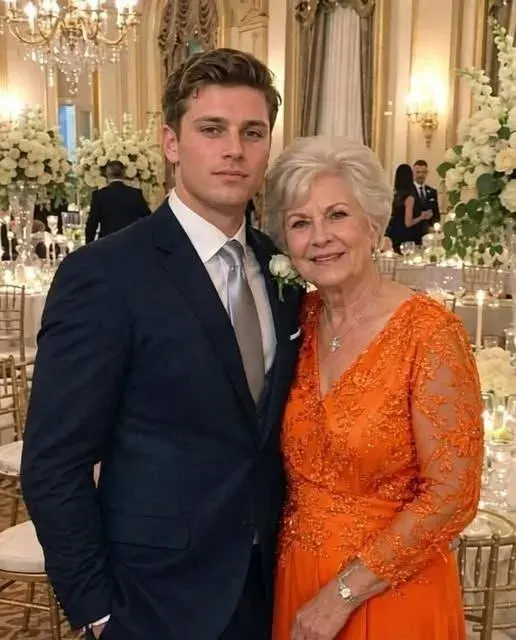
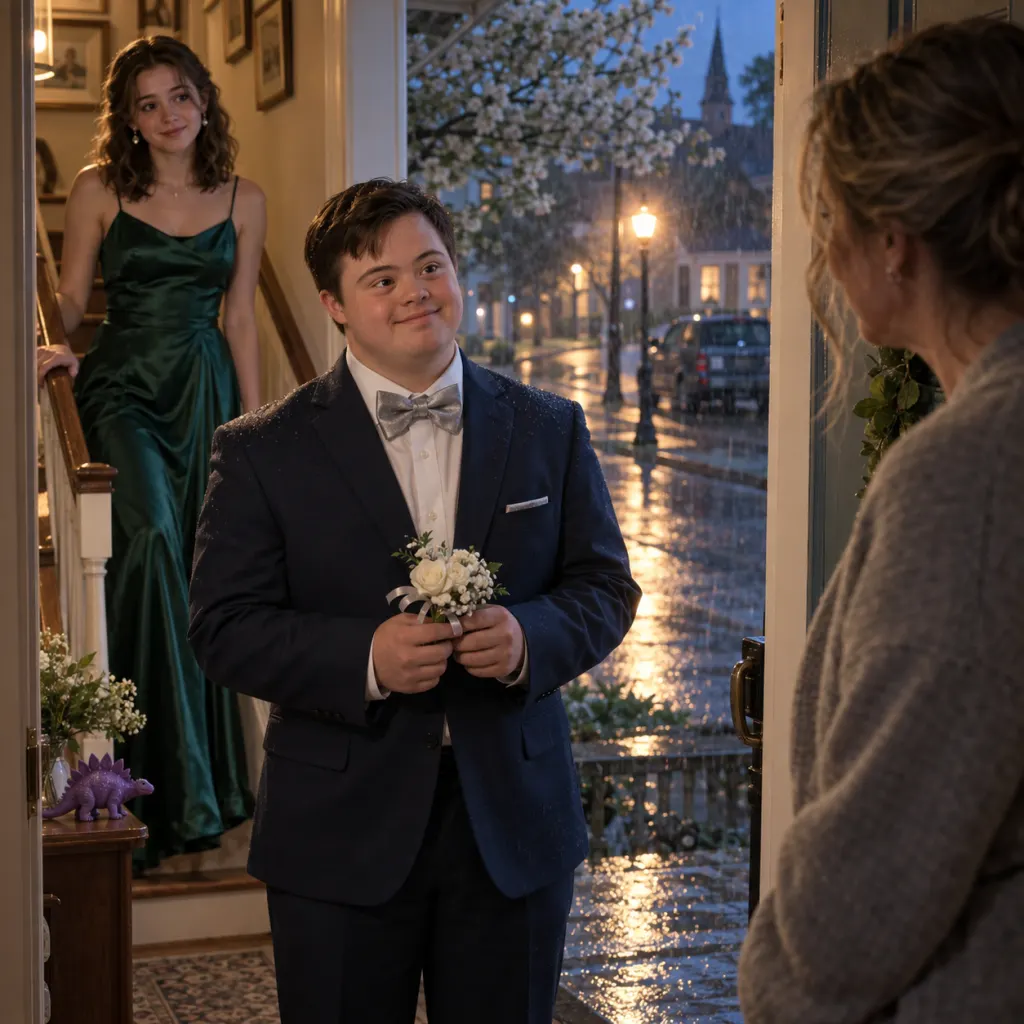
Downstairs, Noah waited in our entryway in a navy suit, a crooked silver bow tie, and shoes polished so brightly he had shown them to me twice through FaceTime before he even left his house. He was holding a white corsage in both hands as if it were a glass bird. When I had opened the door fifteen minutes earlier, he had grinned so hard that the nerves in my own stomach loosened. "Lily Anne Mercer," he had said, using my full name because he believed formal occasions deserved formal announcements, "your carriage is a minivan, but I brought flowers."
Then Mom saw him.
It was not the look I expected. Not the wet-eyed sweetness she gave graduation photos or birthday candles. Her face went still. The smile stayed on her mouth for one second after it had left her eyes. She told Noah I was almost ready, asked if he wanted lemonade, and then climbed the stairs so quickly that one of her slippers slapped loose on the landing.
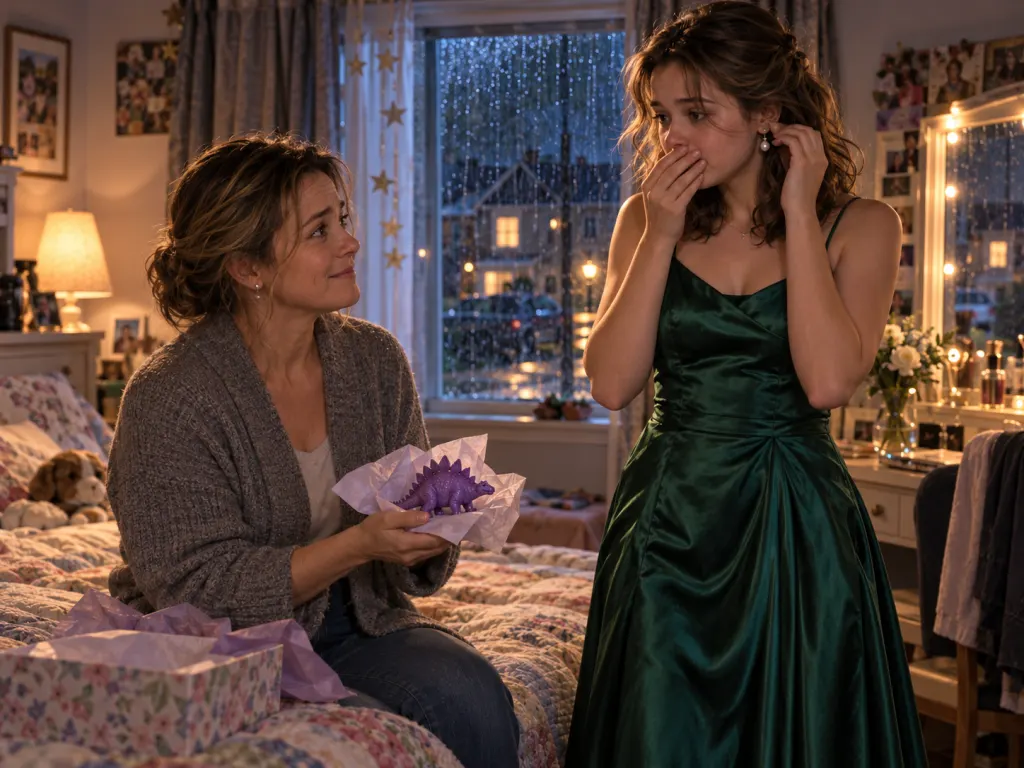
Now she stood between me and the door, her hand still on the lock. I was eighteen, zipped into a green dress that made my shoulders look braver than I felt, one earring in, one earring on the dresser. My phone buzzed on the bed with messages from Jenna: Where are you? The photographer is here. Do not let Noah forget his sunglasses.
"Mom," I said carefully, "he is waiting."
She closed her eyes. When she opened them, they had the red, awake look of someone who had been arguing with herself for years and losing. "You can go with Noah," she said, "but only on one condition."
I laughed once because I thought she must be joking. Curfew, pictures, no after-party in somebody's basement, text me when you leave the gym. The usual rules would have been a relief.
But she did not smile. She looked at my dress, then at the corsage box on my desk, then back at me. "Before you walk out that door, you have to hear the truth I should have told you a long time ago."
2. The Promise with the Purple Crayon
Noah and I became best friends because of raisins and dinosaurs.
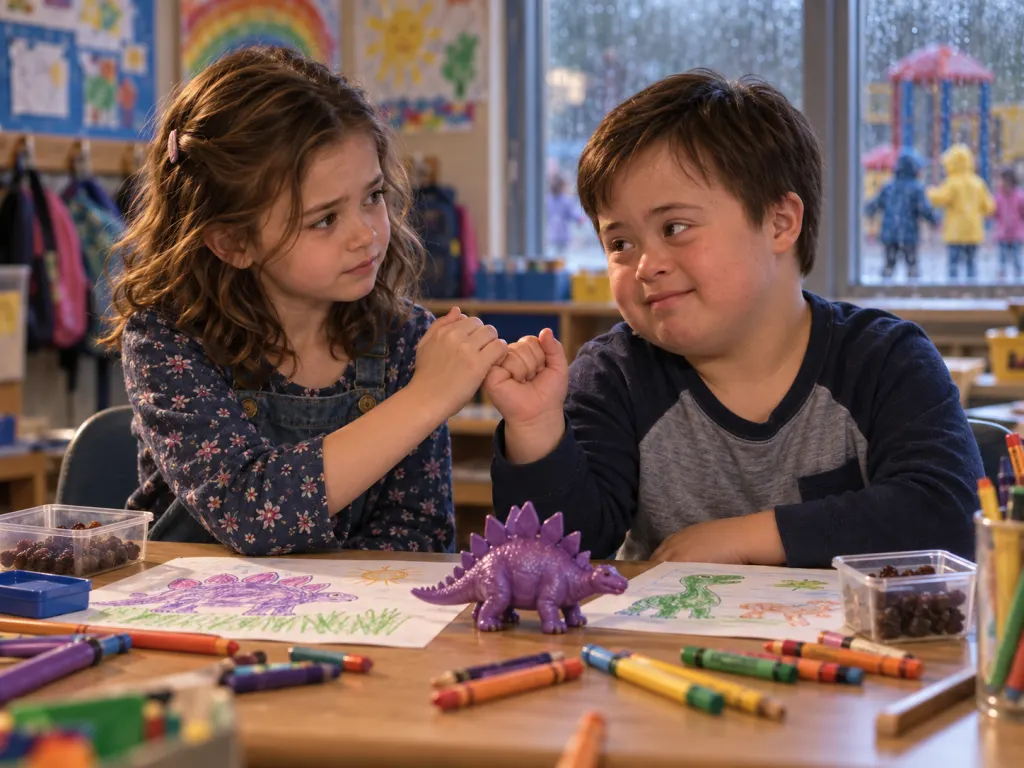
In first grade, Mrs. Alvarez gave our table tiny boxes of raisins for snack, and I pushed mine away like she had handed me beetles. Across from me, Noah made the same face, wrinkling his nose until his glasses slid down. He tapped my box with one finger and whispered, "They are grapes that gave up."
I laughed so hard I dropped my purple crayon. He picked it up, inspected my drawing, and said, "Your stegosaurus looks like a potato with plates."
"Your T. rex has chicken feet," I said.
He considered this, nodded once, and moved his paper beside mine. "We should make a museum."
That was how it started: not with pity, not with anyone arranging a kindness project, not with the grown-up whisper that sometimes moved around Noah like fog. It started because he was funny and stubborn and had opinions about prehistoric creatures that he defended with the intensity of a judge. He had Down syndrome, which adults mentioned in lowered voices when they forgot we could hear them. But to me he was mostly the person who remembered my lunch order, corrected me when I called an ankylosaurus a triceratops, and told the truth in ways that landed sharp and clean.
The prom promise happened in April, during a rainy indoor recess. Mrs. Alvarez had announced that she was getting married, and our class spent twenty minutes debating cake flavors with the seriousness of a town council. Noah declared that his wedding would have chocolate cake, baseball napkins, and "no slow, boring songs."
A boy named Carter looked up from a pile of blocks. "Who's going to marry you? Nobody will."
Noah's smile vanished so fast that I still remember the room changing around it. The lights seemed too bright. The rain scraped at the windows. Mrs. Alvarez was helping two kids negotiate custody of a glue stick and did not hear.
"That's stupid," I snapped. I was six, furious, and small enough that fury filled my whole body. "Somebody will love Noah."
Noah looked at me with the grave attention he usually reserved for dinosaur facts. "Would you?"
I did not know what marriage meant, not really. I knew brides had veils and grown-ups cried and people danced in shoes that hurt. I knew I did not want anyone to make Noah's face look like that again.
"Maybe," I said. "But first we have to go to prom."
"What's prom?"
"A dance when we're almost grown-ups."
He held out his pinkie. His hand was warm and sticky from orange slices. "Promise?"
I wrapped my pinkie around his. "Promise."
3. Ordinary Years
The thing about childhood promises is that adults hear them as cute, but children sometimes store them like law.
Noah remembered. He remembered the exact corner of the classroom, the rain, the purple crayon, and the fact that I had been missing one front tooth. He remembered even after we were moved into different reading groups, then different math classes, then different schedules that overlapped only at lunch and art and the narrow minutes before buses groaned at the curb.
He remembered through my parents' divorce, when I spent half of fifth grade pretending not to hear them argue through walls. On the first day I came to school with my hair unbrushed and my sweatshirt inside out, Noah put a carton of chocolate milk beside my tray and said, "Your dad is being a thundercloud. You need protein."
"Milk is not protein," I muttered.
"It has some," he said, offended enough that I forgot to cry.
He remembered in middle school, when people became sudden experts at ranking one another. Noah was folded into the school in complicated ways. Some kids loved him loudly in the hall and ignored him at lunch. Some teachers talked over him in a cheerful voice that made his jaw go tight. Some days he was patient. Some days he was not. He hated being rushed. He hated when people touched his backpack without asking. He loved the baseball statistics printed on the backs of old cards and could recall scores from games played before we were born.
I learned his signals. The hard blink before frustration. The way his left hand tapped his thigh when noise became too much. The pause that meant he was searching for words and needed everyone else to stop filling the silence for him. He learned mine too. He knew when I was lying about being fine because I arranged my fries by length. He knew when I liked someone before I admitted it because I became mean about their haircut.
In sophomore year, when Evan Davies broke up with me by text between second and third period, Noah found me behind the auditorium with a vending machine ice cream sandwich softening in his hand.
"I told you he was an idiot," he said.
"You told me his eyebrows looked dishonest."
"Same thing."
By senior year, prom was no longer a hazy grown-up word. It was posters in the hallway, ticket tables, girls comparing dress photos under desks, boys pretending not to care and caring desperately. Noah brought it up in October while we were labeling cell diagrams in biology.
"Green," he said.
"Mitochondria are not green."
"Your dress. You should wear green. Like the one from your aunt's wedding but less itchy."
I looked at him over the worksheet. "You still want to go?"
His pencil stopped. "We promised."
There was no pleading in his voice. No performance. Just fact.
"Then we go," I said.
4. The Truth Behind the Door
In my bedroom on prom night, Mom sat on the edge of my bed without asking. That frightened me more than anything. My mother asked before sitting on beds, before moving bags, before touching hair. She believed privacy was a kind of oxygen.
"When you were in eighth grade," she said, "Noah came to me after the winter concert."
The hallway noise downstairs softened. I pictured Noah standing near our umbrella bucket, probably counting the floor tiles to keep from knocking again.
"Why didn't you tell me?"
"Because he asked me not to." Mom folded her hands so tightly her knuckles paled. "He wanted to know if promises could change."
I stared at her.
"He said he knew you were his best friend. He said he also knew people laughed when he talked about prom. He asked me if going with you would make you stuck."
The room tilted in a small, private way. My dress suddenly felt too tight under the arms.
"What did you say?"
"I said people are not stuck when they choose with their whole heart. Then I asked him whether he wanted me to talk to you." Her mouth trembled. "He said no. He said you would feel bad and make your face weird."
Against myself, I almost smiled. Noah hated pity-face. He could spot it faster than a substitute teacher.
"That is not the whole truth," Mom said.
I stopped breathing the way people do in movies, except it was not graceful. It hurt.
"Your father called me that same week," she said. "He had heard from someone that you and Noah were still talking about prom. He said I should put a stop to it before you embarrassed yourself. Before Noah misunderstood. Before people made assumptions."
Heat rushed up my neck. Dad had moved two states away after the divorce and built a second family out of Christmas cards and late birthday checks. Still, his disapproval had an old key to me.
"And did you?" I asked.
Mom looked at the floor. "For one week, I tried. I told you to sit with other people. I signed you up for debate on the same afternoon as Noah's rec center baseball league. I told myself I was protecting both of you."
The memory came back in pieces: a week of Mom's tight voice, Noah waiting by the bike rack, my own anger so hot I refused to speak during dinner. Then Mom had driven me to Noah's game after all, parking at the far end of the lot and crying behind sunglasses while he waved at us from second base.
"What changed?" I asked.
"Noah did." She reached into the drawer of my nightstand and pulled out something wrapped in tissue. I knew before she opened it. A small plastic stegosaurus, purple, one plate missing. "He gave this to me after that game. He said, 'Lily keeps promises, but she gets to pick them again when she is older.'"
My throat closed.
"I kept it because I was ashamed," Mom said. "And grateful. He understood something I had not. A promise is not a chain. It has to stay alive by being chosen again."
"So what's the condition?" My voice sounded younger than eighteen.
Mom stood. "Before you go to the gym, you ask him what tonight means to him now. Not what it meant when you were six. Not what it means to you. You ask, and you listen. If you cannot do that, you are not ready to keep the promise."
5. Ask Him
Noah was standing exactly where I had left him, beside the umbrella bucket, holding the corsage like a diploma.
He looked up when I came down. "Your mom offered lemonade, but she forgot the lemonade."
"She does that when she's upset."
"Is she upset because my bow tie is crooked? Because I know."
I stopped on the bottom stair. Mom stood behind me, not close enough to rescue me, not far enough to pretend this was not her doing. The purple stegosaurus was in my palm, its plastic edges pressing into my skin.
"Noah," I said, "can we talk before pictures?"
His smile changed. Not disappeared, exactly. It folded itself carefully and waited. "Am I in trouble?"
"No. I might be."
We stepped onto the porch. Rain had thinned into mist, and the street shone black under the lamps. Across the road, Mrs. Klein pretended not to watch from behind her curtains. Noah set the corsage box on the railing and rubbed his palms against his trousers.
"My mom told me you asked her once if promises could change," I said.
He took a long breath through his nose. "I told her not to tell."
"I know. I'm sorry."
"Are you making pity-face?"
"I'm trying not to."
"You are making almost-pity-face."
That broke something open. I laughed, then cried once, an ugly little sound that made him glance toward the door as if he might call for backup.
"I need to ask you what tonight means to you," I said. "Not because Mom said so. Well, partly because Mom said so. But because I should have asked before."
Noah looked out at the rain. He did not answer quickly. That was one thing people got wrong about him. They thought his directness meant simplicity. It did not. His thoughts sometimes took the scenic route, but they arrived carrying luggage.
"When we were little," he said, "I thought prom meant you picked me and then nobody could laugh."
I nodded, afraid to move too much.
"Then I got older and knew people laugh anyway. Also prom is not marriage. Also you snore on buses and steal fries."
"I do not snore."
"You breathe like an old vacuum."
I covered my face with both hands.
"Tonight means," he continued, slower now, "I get to go with my best friend. I get one slow dance if you do not step on me. I get pictures where I look very handsome. I get to leave if the music hurts my head. And I get to decide those things. Not your dad. Not Carter from first grade. Not people with phones."
I lowered my hands. "People with phones?"
He grimaced. "Jenna said Madison wants to film us walking in. She said it will be sweet."
There it was: the word that could turn a person into a scene. Sweet.
"Do you want that?" I asked.
"No," he said immediately. "I want sunglasses for two pictures. Then no phones in my face."
"Then that's what happens."
He studied me. "You still want to go?"
I held up the stegosaurus. "I pick it again."
His smile returned, not the huge doorway grin, but something steadier. "Good. Because I rented the suit."
6. The Gym Lights
Prom was held in the high school gym because our class treasurer had underestimated the price of hotel ballrooms and overestimated our enthusiasm for car washes. The decorating committee had disguised the basketball hoops with silver fabric, and someone had hung paper stars from fishing line so they turned slowly in the air-conditioning. The whole room smelled like hairspray, damp coats, and frosted cupcakes.
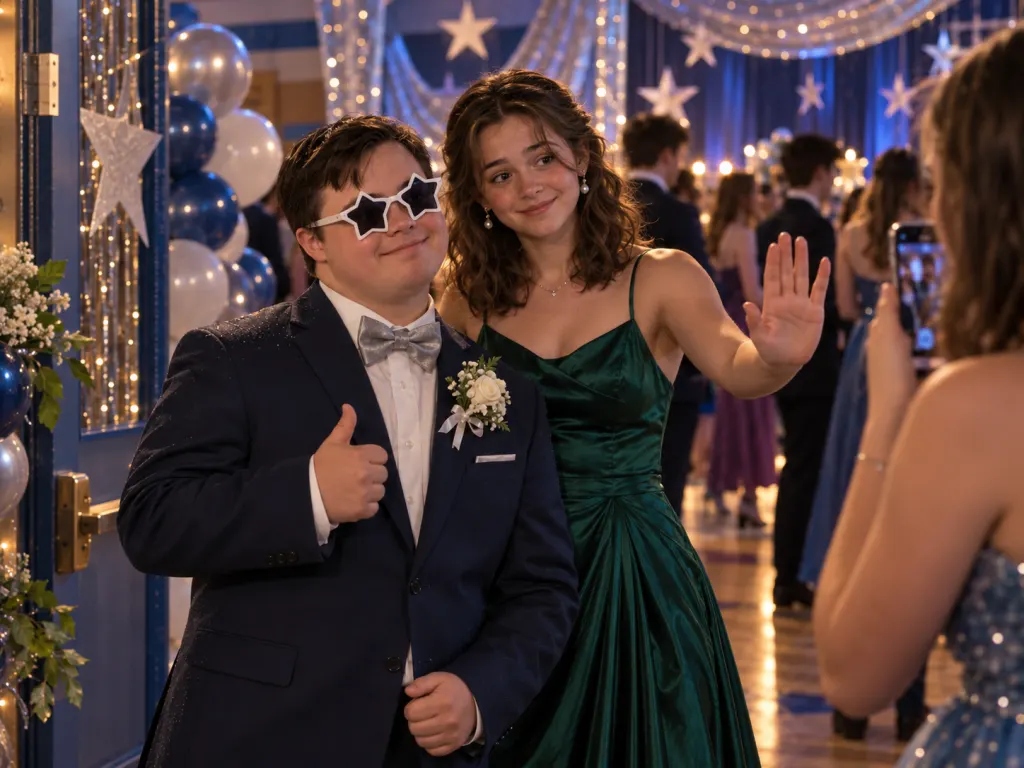
When Noah and I walked in, Madison lifted her phone.
I stepped between the camera and Noah before I had time to be diplomatic. "Put it down."
Madison blinked. She was dressed in blue sequins and surprise. "I was just getting a cute video."
"He said no phones in his face."
Behind me, Noah cleared his throat. "Two sunglasses pictures are allowed."
Jenna, bless her, appeared with the sunglasses already in hand. They were ridiculous, white plastic frames shaped like stars. Noah put them on and struck a pose so severe that the photographer lowered his camera to laugh.
"Two," Noah reminded him.
The photographer took two. Noah removed the glasses and handed them to me with ceremony. "Now I am normal handsome."
"Extremely," I said.
At first, the night felt almost easy. We found our table. Noah placed his napkin in his lap with exaggerated elegance. Jenna complimented his bow tie, and he told her that her shoes were brave but unwise. She agreed and took them off under the table before dinner.
Then Carter walked by.
I had not thought about him in years, which seemed unfair considering how long his sentence had lived in my memory. He was taller now, with a rented tux jacket too short in the sleeves. He glanced at Noah, then at me, and for half a second I saw the first-grade table between us: raisins, rain, a smile disappearing.
"Hey," Carter said. "You two actually did it."
His tone was not cruel. That made it harder. People grow. People forget the exact harm they leave behind. The harmed do not always get that luxury.
Noah looked at him. "Yes."
Carter shifted. "Cool. Have a good night."
He walked away.
I waited for Noah to say something sharp. Instead, he reached for his water glass and missed by an inch. His fingers shook once, barely.
"Do you want air?" I asked.
He nodded.
7. The Slow Song
We stood in the hallway outside the gym, where the music became a pulse through concrete. Noah leaned against the trophy case. Reflections of old basketball teams hovered behind him like witnesses.
"I hate that he forgot," he said.
"Maybe he didn't."
"He did. His face was empty."
I did not know what to say. Apologies on behalf of other people usually sound like counterfeit money.
Noah pressed his thumb and forefinger together, a small motion I had seen since middle school. "I remembered because it was about me. He forgot because it was just Tuesday."
The sentence landed so cleanly that I felt it in my ribs.
"I'm sorry," I said.
"You yelled."
"Not enough."
"You were six."
"Still."
He looked at me then, really looked, and I understood that the night was asking me to stop making every hurt into a test I could pass if I performed hard enough. Some things were not mine to fix. Some things were mine to witness without running away.
Inside the gym, the song changed. The bass softened. A girl's voice floated through the walls, singing about staying when the lights went out.
Noah straightened. "Slow dance."
"Are you sure?"
"I said one. This is one."
We went back in. The dance floor had filled with couples swaying in uneven circles. Noah held out his hand like a gentleman in an old movie. I took it, and for the first few seconds we were terrible. My heel caught his shoe. He counted under his breath. I tried not to laugh. Then we found the smallest rhythm: left, pause, right, breathe.
His hand rested lightly at my shoulder blade. Mine rested on his sleeve. Around us, people blurred into color and perfume and whispered jokes. Nobody cheered. Nobody clapped. Nobody made a lesson out of us. We were simply two people in a gym under paper stars, keeping time.
"Lily," he said.
"Yeah?"
"I am not going to marry you."
I swallowed a laugh. "Good to know."
"You steal blankets. Also I want a wife who likes baseball more."
"Reasonable."
"But you can be my best woman if I get married."
"Best woman?"
"Like best man, but you. You have to give a speech and not cry too much."
My eyes burned. "I'll practice."
"You are already failing."
I laughed then, and he laughed too, and the sound loosened the last hard knot of the evening. The promise had changed shape again. It was not a bridge to romance, not a shield against cruelty, not a debt. It was a doorway we had walked through together, and on the other side we were still ourselves.
8. French Fries After Midnight
We left prom before the final song because the lights began to bother Noah and because Jenna texted that the after-party had already produced one broken lamp and a speech from Madison about destiny.
Mom picked us up in the minivan. She did not ask for a full report. She looked at Noah in the rearview mirror and said, "How was it?"
"Loud," he said. "Good. Carter forgot being mean. Madison tried to make content. Lily stopped her. The cupcakes were dry."
Mom nodded as if accepting minutes from a meeting. "Thank you for the thorough review."
"We need fries," he added.
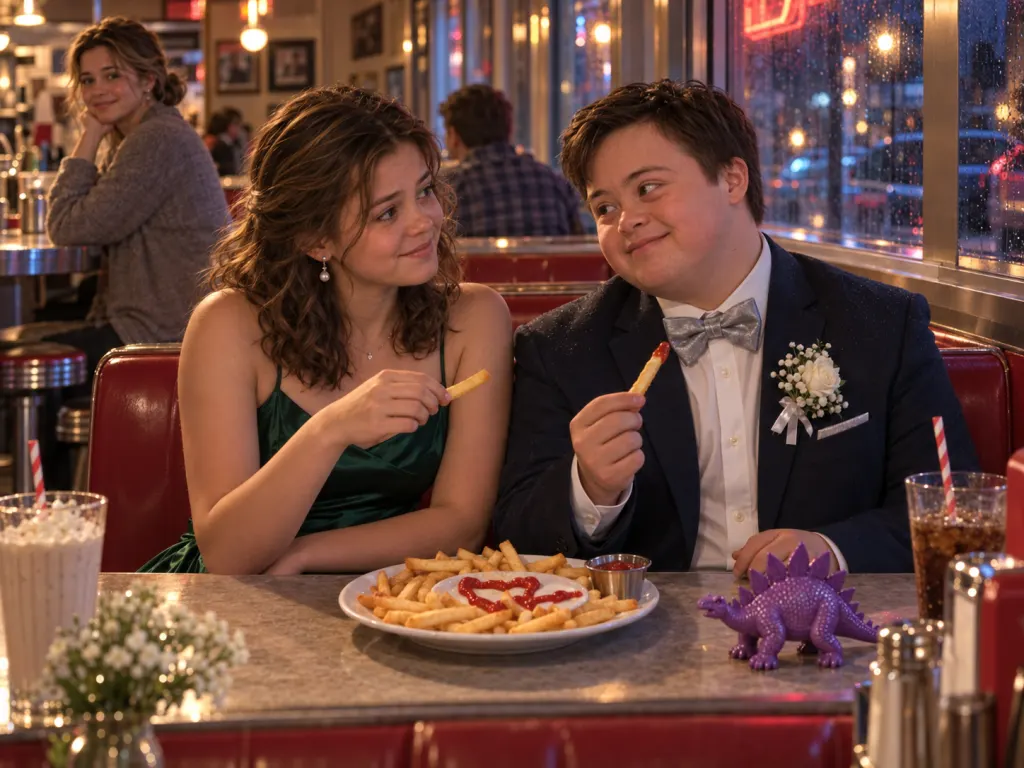
So we went to the only diner open after midnight, the one with cracked red booths and a neon sign that buzzed like an insect. Mom sat at the counter to give us privacy but stayed close enough that I could see her shoulders finally drop.
Noah poured ketchup onto his plate in the shape of what he claimed was Ohio. I told him it looked like a melted mitten. He stole one of my fries in revenge.
"Your mom told you the stegosaurus thing?" he asked.
"Yes."
"I wondered where it went."
"You gave it to her."
"I know. But sometimes adults put important things in junk drawers."
I looked toward the counter. Mom was stirring coffee she would not drink. "Sometimes they put them in nightstands."
Noah considered this acceptable. "Are you mad she told?"
"No. Are you?"
He dipped a fry into the edge of Ohio. "A little. But also no. It made you ask."
"I should have asked anyway."
"Yes," he said, because he had never been interested in making me comfortable at the expense of being honest.
We ate quietly for a while. Outside, rain gathered on the glass and turned the parking lot lights into long golden lines. A group of students from another school came in wearing wrinkled dresses and untied bow ties. One girl cried into a milkshake. One boy carried three pairs of heels. The whole world seemed briefly made of people trying to be grown and still needing rides home.
9. What a Promise Becomes
Years later, when people ask about my prom, they expect a simple story.
They want to hear that I kept a childhood promise to my best friend with Down syndrome, and then they want to tilt their heads in that familiar way, ready to be warmed by the shape of it. I understand the temptation. It sounds lovely if you sand off the edges. Two children, one promise, a corsage, a dance. It could fit neatly under a photo with a caption about kindness.
But the truth was better than lovely. It was harder, and therefore more useful.
The truth was that Noah did not need me to rescue him from being unloved. He needed me to respect him enough to ask what he wanted. The truth was that I had mistaken loyalty for certainty, when real loyalty sometimes pauses on a porch in the rain and risks an awkward conversation. The truth was that my mother, who had made mistakes out of fear, loved us enough to tell on herself.
Noah and I did not become inseparable forever in the storybook way. After graduation, I went to a college two hours away. He started a supported work program at the stadium downtown and became insufferable about having better access to baseball gossip than I did. We texted often, then sometimes, then in bursts. Our friendship stretched, thinned, changed, and held.
On my twenty-third birthday, a package arrived with no card, only a purple plastic stegosaurus inside. The missing plate had been repaired with a dot of silver paint.
I called him immediately.
"You fixed it," I said.
"No," Noah replied. "I made it fancy."
I keep it on my desk now. Not because it reminds me that I am a good person. That would be the wrong lesson, and Noah would hate it. I keep it because it reminds me that promises are living things. They need honesty. They need room. They need both people to keep choosing, not from guilt or fear or the memory of who they were at six, but from the truth of who they are today.
That night, under paper stars in a high school gym, Noah and I did go to prom together. We danced one slow song. We ate bad cupcakes and better fries. We let an old promise grow up without breaking it.
And when I think of him at my front door, holding the corsage like something precious, I no longer hear the lock turning upstairs. I hear his voice on the porch, steady in the rain, telling me exactly what he wanted. I hear myself finally listening.
Wrap-Up
Lily keeps the prom promise she made to Noah in first grade, but only after her mother reveals that Noah once worried the promise might trap them both. The night becomes less about public sweetness and more about consent, honesty, dignity, and the changing shape of lifelong friendship.