 Save
This is an original work of fiction. The school privacy and emergency-contact details are used only as general background, supported by public sources; the characters, campus, and events are invented.
1. The Call
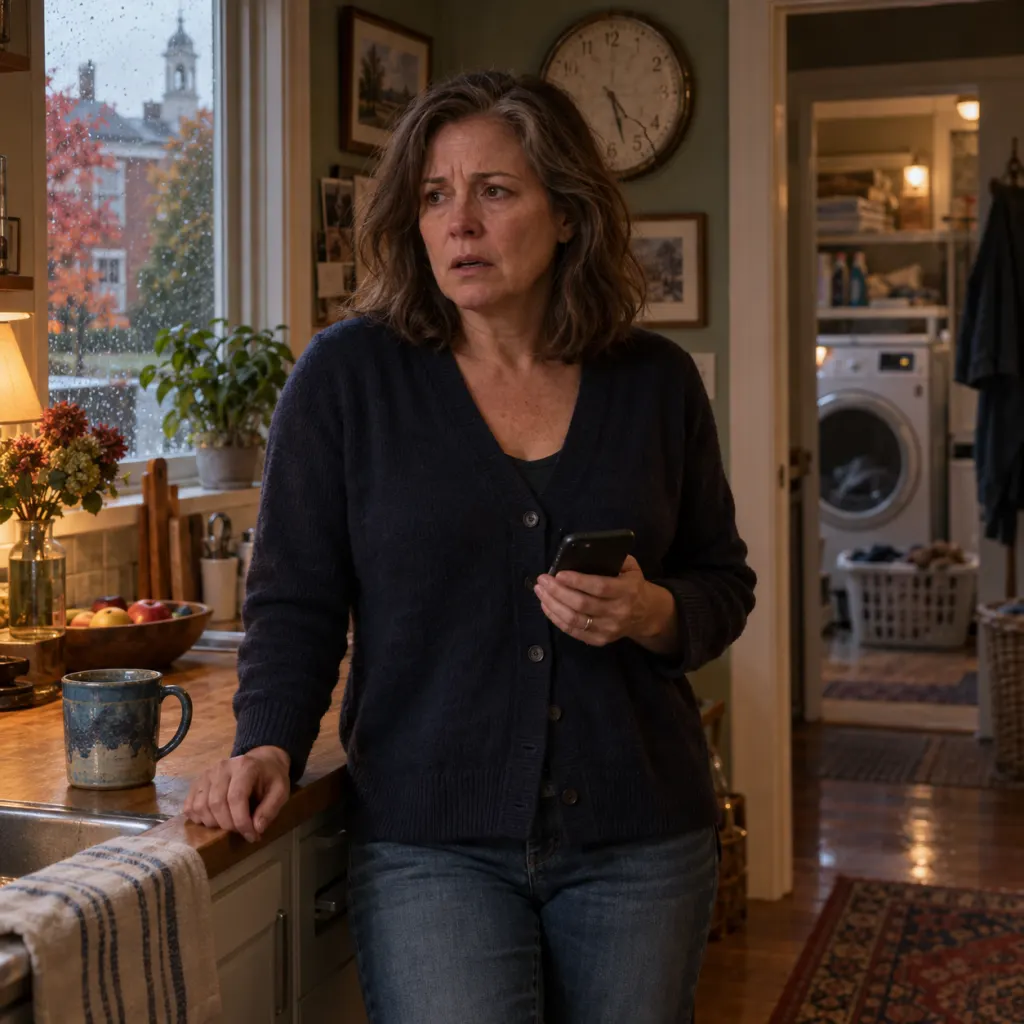
The dryer had begun its uneven thumping again, the way it did when a towel balled itself around a bedsheet and turned the whole machine into a small, trapped storm. Eleanor Hart stood in the laundry room with one hand on the warm metal lid, waiting for the rhythm to settle. Outside the narrow window, late afternoon light slid over the fence and caught in the ragged tops of the basil she had forgotten to water.
Her phone rang on the kitchen counter.
She almost let it go. At fifty-six, Eleanor had learned to distrust calls that came during chores. They were usually reminders, wrong numbers, or her sister June asking for the name of a paint color Eleanor had used twelve years ago. But the ringtone was the one she had set for Ben, back when he was sixteen and had insisted he was too old for custom ringtones while secretly smiling because she had chosen the opening bars of a song they both loved.
She wiped her damp hands on her jeans and hurried into the kitchen. His name glowed on the screen.
"Hey, honey," she said, already turning toward the sink, already imagining the usual list: a lost debit card, a question about insurance, a request for the recipe for skillet potatoes he never quite made the same way twice.
For a second, she heard only wind.
Then Ben said, "Mom?"
One word, and the room changed shape.
He sounded older than twenty-one and younger than ten. Not frightened exactly. Not crying. Just careful, as if his voice were carrying something breakable and he did not trust his hands.
"I'm here," Eleanor said. "What's wrong?"
There was another breath of wind, a faraway rushing that might have been traffic, might have been trees. Ben said, "Nothing. I just wanted to say... I love you."
She stood very still. The dryer thumped behind her, one dull beat after another.
"I love you too," she said. "Ben, where are you?"
But the line had already gone silent.
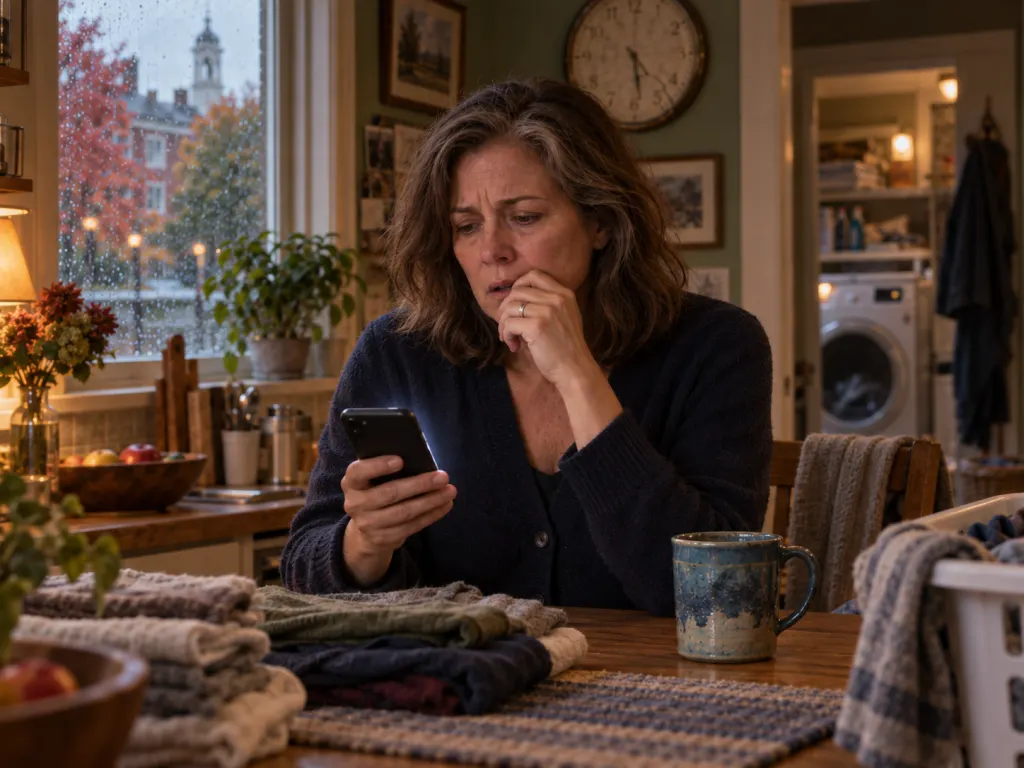
Eleanor lowered the phone from her ear and stared at the darkened screen. She called back at once. The call rang twice, then went to voicemail. She tried again, then again, each time listening to the cheerful recording Ben had made during his first week at North Bell College: You know what to do. The phrase had amused her then. Now it felt like a locked door.
2. The Sound Beneath the Words
For ten minutes, Eleanor did all the ordinary things people do when they are trying not to admit they are afraid. She folded a towel badly. She opened the refrigerator and closed it. She sent a text: Call me when you can. Then another: Are you okay? Then a third she erased before sending because it sounded too much like accusation.
Ben had always been affectionate in practical ways. He filled her gas tank when he borrowed the car. He carried heavy bags without being asked. When he was little, he used to leave drawings under her pillow: robots, moons, houses with impossible staircases. But spoken tenderness embarrassed him. He gave it in small coins. Night, Mom. Thanks. Text me when you get home.
"I love you" from Ben was not impossible. It was simply rare enough to have weight.
Eleanor sat at the kitchen table, beneath the clock with the cracked glass, and pressed the phone to her palm as if warmth could pull him back through it. The house around her was full of leftover motherhood: a chipped blue mug Ben had made in seventh-grade art, a baseball cap on the mudroom hook, the dent in the pantry door from the year he and his father had tried to move a freezer without measuring first.
Daniel had laughed about that dent every Thanksgiving until the year he did not come home from work. A heart event, the doctor had said in a calm voice Eleanor hated for months. Sudden. Nothing anyone could have done.
After Daniel died, Ben stopped drawing houses.
Eleanor had tried to be two parents without becoming twice as loud. She signed forms, paid bills, attended games, learned the names of college application portals, and kept smiling when Ben said he wanted a school three hours away because he needed room. She gave him room. She was proud of that. She was lonely because of it.
Her phone buzzed. Not Ben. A campus-wide alert from North Bell, forwarded from a parent group she rarely checked: Power outage affecting west campus. Residence halls secure. Updates to follow.
West campus. Ben's dorm was on west campus.
Eleanor stood so quickly the chair scraped the floor. She opened her laptop, fingers clumsy on the keys, and searched the college website. She remembered reading, during move-in, that once students were adults, schools could not simply hand parents whatever information they wanted. Later, she would learn that federal student privacy rules generally transfer rights to the student at eighteen or when the student enters college, with limited exceptions. In that moment, all she knew was that the woman at the front desk might tell her nothing, and nothing was exactly what she could not bear.
She found the number for campus safety and called.
3. The Voice on the Other End
The dispatcher who answered sounded young but steady. "North Bell Campus Safety. This line is recorded. How can I help you?"
Eleanor gripped the counter. "My son called me and the call dropped. There's an outage. I need someone to check on him."
"What is your son's name?"
"Benjamin Hart. Ben. He's in Mercer Hall, room 412. Or he was. I think. He might be out. I don't know."
"Is there an immediate danger you're aware of?"
That was the question. Eleanor could hear the lawful shape of it, the trained caution. She could hear every sensible person she had ever known telling her not to make more of a phone call than it was. Children grew up. Phones died. Towers failed. Young men said odd things sometimes because they were learning how to be tender.
"I don't know," she said. "He told me he loved me and then the line dropped. He sounded wrong."
The dispatcher did not laugh. That mercy nearly undid her.
"We'll send someone to Mercer Hall," the dispatcher said. "Do you have a number where you can be reached?"
Eleanor gave it. The dispatcher told her to keep her phone nearby and call back if Ben contacted her. She also said, gently, that if Eleanor believed there was a true emergency in her own location, she should call 911, but for a welfare check on a campus in another city, the local campus safety number was the right place to start.
After they hung up, Eleanor stood in the kitchen with both hands flat on the counter. Somewhere in the house, the dryer stopped. The sudden silence was enormous.
She called June.
"I'm coming over," June said after Eleanor explained.
"You don't have to."
"I know. That's why you should believe me."
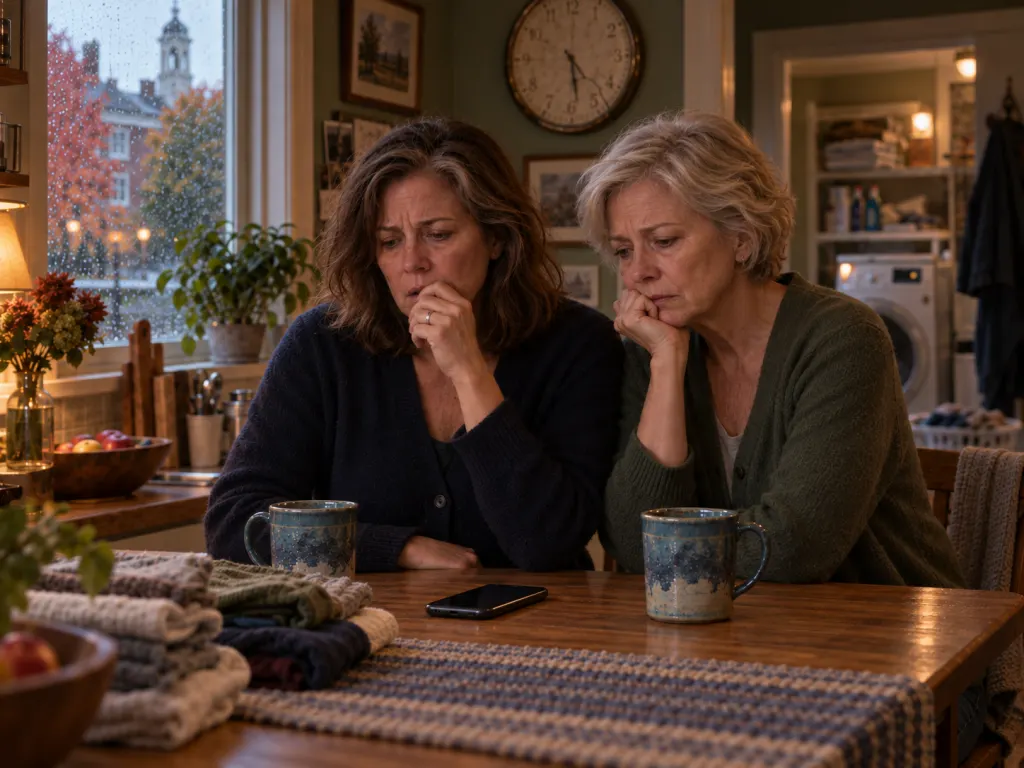
June arrived twelve minutes later in gardening clogs and a cardigan buttoned wrong. She took one look at Eleanor's face and put the kettle on without asking. June believed tea solved nothing, but she also believed hands needed tasks when the heart had too many.
"What exactly did he say?" June asked.
"He said he loved me."
"That's good."
"No," Eleanor said. "It was goodbye-shaped."
June's face softened, but she did not argue. The sisters sat together in the kitchen where Eleanor had once fed Ben mashed bananas, then alphabet soup, then towering plates of pasta after cross-country practice. The clock ticked. The kettle hissed. The phone remained stubbornly blank.
4. What Parents Are Not Told
The call from campus safety came at 5:42 p.m.
"Mrs. Hart? This is Officer Alvarez with North Bell Campus Safety. We checked Mercer Hall. Your son wasn't in his room, but his roommate said he left about twenty minutes ago. We are looking around west campus now."
"Did his roommate say where he went?"
"Toward the old observatory trail."
Eleanor closed her eyes. The observatory was where Ben had taken her during family weekend. A stone building on a hill, no longer used for astronomy classes, surrounded by oaks and a view of the town lights. He had pretended not to care about the place and then talked for twenty minutes about the way the roof still rotated if you pushed hard enough.
"I'm coming," she said.
June stood. "I'm driving."
"I can drive."
"You can sit there and grip your phone like it's keeping the planet together."
They left the tea untouched.
The highway unfurled gray and wet beneath a sky that could not decide whether to rain. Eleanor watched exit signs pass in a blur. She called Ben every fifteen minutes. Voicemail. Texts went undelivered, then delivered, then unanswered. Each tiny status change lifted her and dropped her again.
June kept both hands on the wheel. "Tell me something ordinary about him," she said.
"What?"
"Your mind is running toward every terrible thing. Give it another road."
Eleanor swallowed. "He eats cereal out of mixing bowls because he says regular bowls are a structural insult."
June nodded. "Good. Another."
"He alphabetizes his hot sauces but not his textbooks."
"Another."
"When he was six, he cried because he thought the moon followed lonely people home."
June's mouth trembled. "Daniel told him the moon was doing security patrol."
"And Ben saluted it for a month."
They laughed then, a small frightened laugh that broke open into silence. Eleanor looked out at the shoulder of the road, where weeds bowed under the weight of dust and rain. She thought of all the years she had mistaken quiet for wellness, competence for ease, distance for independence. She had loved Ben with calendars and casseroles and tuition payments. She had loved him by not asking too much. But perhaps not asking could become its own kind of absence.
The campus appeared just after dusk, brick buildings glowing through a light mist. Students moved in clusters under umbrellas, their faces lit by phones. Life continued with brutal innocence. Eleanor wanted to shout at them, to ask how they could carry coffee and backpacks while her son was missing inside the same square mile.
5. The Hill
Officer Alvarez met them outside Mercer Hall. He was broad-shouldered, with rain shining on his jacket and a radio murmuring at his shoulder. He did not waste time.
"We found his backpack near the observatory path," he said. "His phone was inside it. We're checking the trail."
Eleanor's knees loosened. June caught her elbow.
"Can I go?" Eleanor asked.
Alvarez hesitated. "Stay with me. The path is slick."
They climbed together past the last residence hall, past a bike rack crowded with dripping frames, past a sign warning that the observatory trail closed at sunset. The air smelled of wet leaves and old stone. Eleanor's shoes slipped twice. Each time June steadied her from behind.
Halfway up, a beam of light moved between the trees.
"Ben!" Eleanor called.
No answer. Only rain ticking through leaves.
Then a voice from above: "Mom?"
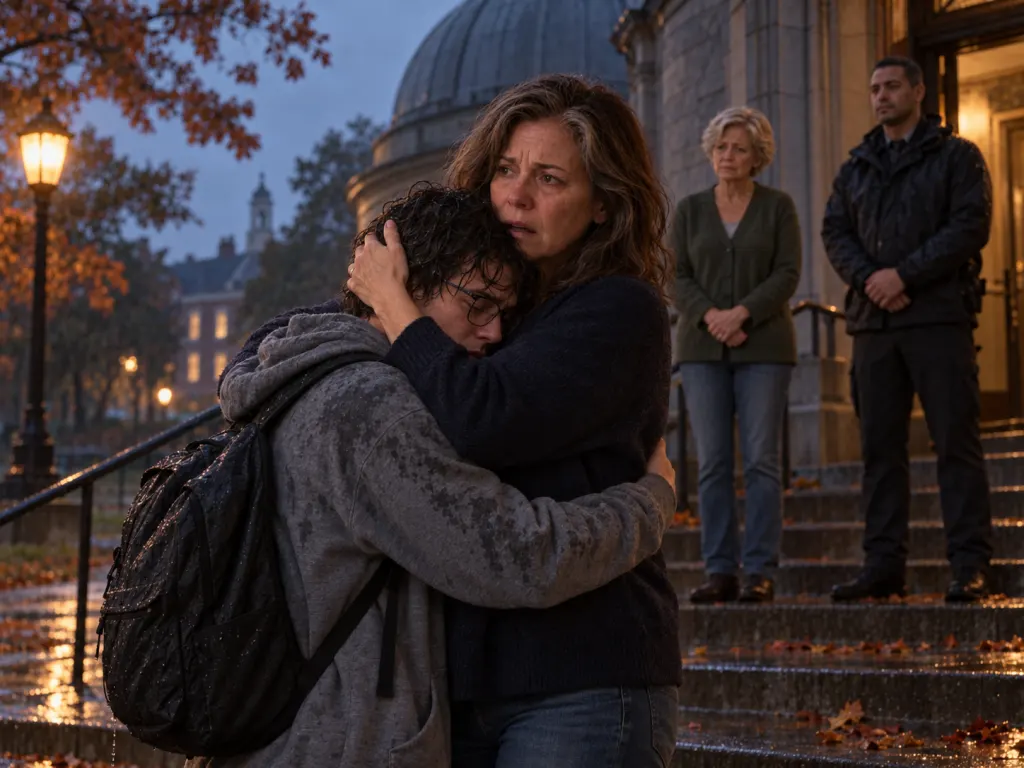
He was sitting on the observatory steps with his arms wrapped around his knees, hair plastered to his forehead, glasses fogged at the edges. He looked soaked and furious and ashamed. Alive.
Eleanor reached him before anyone could tell her not to run. She dropped to the wet stone and pulled him against her. For one stunned second, Ben stayed rigid. Then his shoulders folded inward, and he held on.
"I'm sorry," he said into her coat. "I'm sorry. I didn't mean to scare you."
"Then don't ever do that again," she said, and hated herself for how sharp it came out. She softened her grip. "No. Wait. I'm sorry. I'm here. I'm here."
Officer Alvarez stepped back and spoke quietly into his radio. June stood a few feet away, crying openly and pretending the rain gave her cover.
Ben pulled away first. "I just needed to think."
"Without your phone?"
"I didn't want anyone to find me."
The words landed harder than the rain.
6. The Things He Had Hidden
They did not have the real conversation on the hill. Officer Alvarez walked them down, kind enough to keep his flashlight low. In the lobby of Mercer Hall, Ben signed a clipboard confirming he had been located. The officer asked him a few direct safety questions in a voice that was neither cold nor sentimental. Ben answered them, embarrassed but clear. Then Alvarez gave Eleanor a card with the campus safety number printed on it.
"Keep this," he said. "And update every emergency contact the school lets you update. It matters when minutes feel long."
Eleanor thanked him because anything more would have made her cry again.
Ben refused to go to the dining hall, so June bought three sandwiches from a shop near campus and they sat in Eleanor's parked car while rain blurred the windshield. Ben held the wrapped sandwich in both hands and did not eat.
"I failed two classes," he said at last.
Eleanor waited. She felt June glance at her, warning her with sisterly telepathy not to rush in with solutions.
"I stopped going to physics in March," Ben said. "Then I got behind in everything else. I told myself I could fix it. Then I told myself I could hide it until I fixed it. Then there was nothing left to fix."
His voice stayed flat, which hurt worse than sobbing might have.
"Why didn't you tell me?" Eleanor asked.
Ben laughed once, without humor. "Because you kept saying how proud Dad would be."
The car seemed to shrink around them.
"I meant that as love," she said.
"I know." He rubbed at the paper seam of the sandwich until it tore. "That's what made it heavy."
There it was, the thing neither of them had named. Daniel had become, over time, not only a missing person but a measurement. Eleanor had invoked him at graduations, birthdays, move-in day, every milestone. She had thought she was keeping him present. She had not seen how presence could harden into expectation.
"Ben," she said, carefully, because this was a bridge and every word was a plank, "your father loved you before you did anything impressive."
His face twisted. "I don't remember his voice anymore unless I watch videos."
Eleanor covered her mouth.
"Everyone tells me I look like him," Ben said. "They tell me I'm good with numbers like him, quiet like him, steady like him. But I don't feel steady. I feel like I'm acting in a play where everybody else has the script."
June stared straight ahead, giving them the privacy of not looking.
Eleanor thought of the phone call. I love you. Not a goodbye, perhaps. A flare.
"I heard something in your voice," she said. "I didn't know what it was. I only knew I had to come."
Ben looked down. "I wanted to tell you before you found out from the school or a bill or whatever happens next. Then I couldn't say the rest."
"Say it now."
He shook his head. "You'll be disappointed."
"I might be scared. I might need a minute. But disappointment is too small for this."
Ben finally looked at her. Rain shadows moved across his face. "I don't want to be an engineer."
7. After the Truth
Eleanor had imagined many possible disasters during the drive. She had not imagined this simple sentence. For a moment, she saw money, paperwork, the scholarship tied to his major, Daniel's old drafting table in the garage, relatives who would have opinions sharp enough to cut fruit. She saw all of it because she was practical, and practicality had carried her through widowhood like a cane.
Then she saw Ben at eight, building elaborate cardboard theaters for his action figures. Ben at thirteen, staying up late to edit videos for school projects no one had assigned. Ben at seventeen, telling her he liked engineering because it was sensible, and Eleanor being too relieved by the word sensible to ask what else he liked.
"What do you want?" she asked.
He looked startled, as if no one had ever put the question in that order.
"I don't know," he said. "Film, maybe. Design. Something with stories. That sounds stupid when I say it out loud."
"It doesn't."
"It sounds expensive."
"That part may be true."
A faint smile moved across his face and disappeared.
They spent the night at a hotel off the interstate, two queen beds and a humming heater. June took the bed near the window and fell asleep in her cardigan. Ben showered and came out in the spare sweatshirt Eleanor had packed by instinct, the old gray one from home with paint on one sleeve. He looked younger in it, but not childish. More like someone who had put down a weight and did not yet know what to do with his hands.
Eleanor sat at the small desk and wrote a list. Not a rescue plan. A list. Registrar. Academic adviser. Financial aid. Housing. Emergency contacts. Counseling center, though she wrote it as campus support office because she did not want the word to frighten him away before morning. She added: Ask Ben what he wants before making calls. Then she underlined it twice.
At 1:16 a.m., Ben whispered from the other bed, "Are you awake?"
"Yes."
"Are you mad?"
Eleanor looked at the ceiling. The heater clicked. A truck passed outside, washing the curtains with white light.
"I'm mad at some paperwork," she said. "I'm mad at silence. I'm mad at the idea that you thought you had to be alone to be honest. But no, Ben. I am not mad that you told me the truth."
He was quiet so long she thought he had fallen asleep.
Then he said, "Dad would have known what to do."
"Maybe," Eleanor said. "Or maybe he would have pretended for ten minutes and then asked me in the pantry."
Ben laughed softly, and it was the first sound of the day that did not break her heart.
8. A Different Kind of Home
Morning made everything less dramatic and more difficult. This was one of life's less advertised cruelties. Fear could arrive like thunder, but repair came with office hours, forms, passwords, and a young adviser named Priya who listened carefully while Ben explained that he had been failing privately for months.
Eleanor sat beside him and said less than she wanted to. When the adviser asked Ben a question, Eleanor folded her hands and let him answer. When he stumbled, she waited. When he looked at her for help, she asked, "Do you want me to add anything?" Sometimes he nodded. Sometimes he did not.
No one solved his life that morning. There were consequences. There would be a meeting about academic standing. There would be a hard conversation about money. There would be a call to the landlord about summer housing and an awkward email to a professor whose patience Ben was certain he had exhausted. But there were also options. A reduced course load. A leave for one term. A change of major if he chose it with open eyes. A plan that belonged to him, not to panic.
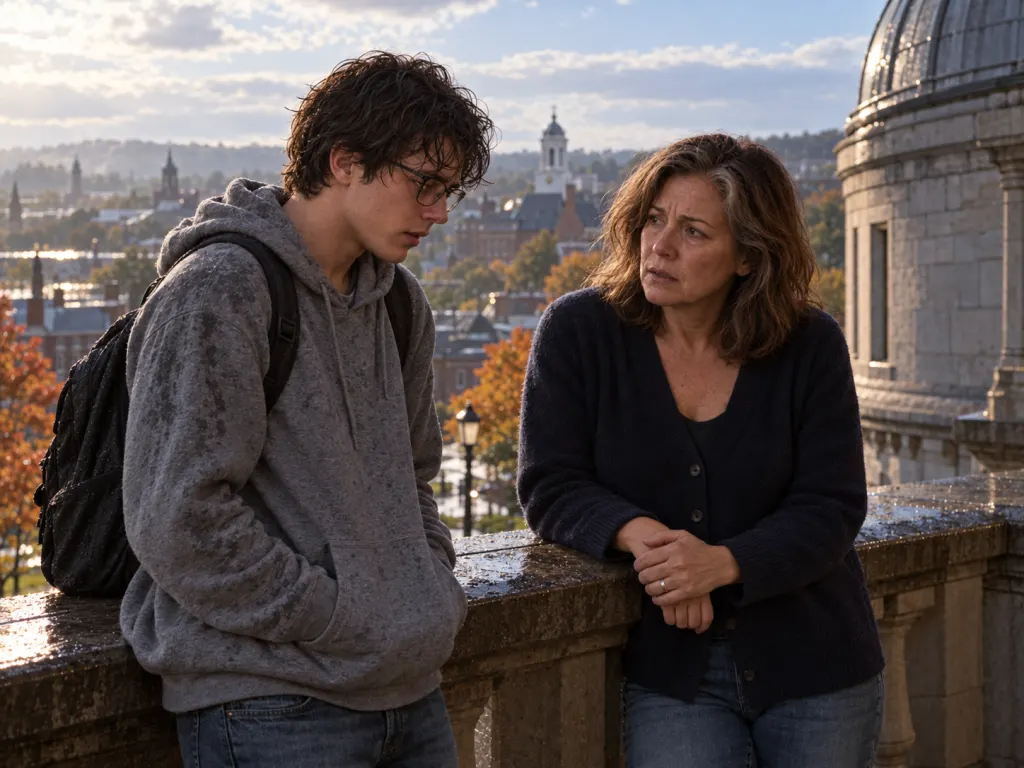
By noon, the rain had stopped. Eleanor and Ben walked to the observatory before she and June drove home. The path was muddy, and Ben carried his backpack this time, phone charged and zipped in the front pocket. At the top of the hill, the town below looked washed clean, roofs shining, streets bright with puddles.
"I used to come here after lab," Ben said. "I liked being somewhere old that nobody expected anything from."
Eleanor leaned against the stone railing. "I think I expected too quietly."
"That's not your fault."
"Some of it is mine." She watched a drop of water fall from an oak leaf to the step below. "Not as blame. As something I can carry differently."
Ben nodded. He looked tired, but the blankness had left his face. In its place was uncertainty, which Eleanor decided was not the enemy. Uncertainty had air in it. It allowed movement.
Before she left, she made him say the new agreement out loud, not because she wanted obedience but because spoken words had saved them once already.
"If I get stuck, I call," Ben said.
"Before the hill," Eleanor said.
"Before the hill."
"If I ask how you are, I have to mean more than grades."
"And I have to answer more than fine," he said.
They smiled at the awkward ceremony of it. Then Ben hugged June, who told him she would personally haunt his voicemail if he scared them like that again. He hugged Eleanor last.
"I love you," he said.
This time, the words did not sound like goodbye. They sounded unfinished in the best possible way, like a door left open because someone was coming back through it.
On the drive home, Eleanor held her phone in her lap, but she did not stare at it. June talked about soup. The sky cleared by degrees. At a rest stop, Eleanor bought coffee that tasted burned and wonderful. She texted Ben a photograph of the cup.
Proof of life, she wrote.
A minute later, three dots appeared.
Terrible coffee builds character, he replied.
Eleanor laughed so suddenly June startled. Then she cried a little, quietly, without trying to hide it. The phone call had changed everything, though not in the clean way stories sometimes promise. It had not erased grief or debt or fear. It had not turned Ben's uncertainty into a shining map. What it changed was the direction of their attention. They would listen sooner now. They would ask better questions. They would let love be more than pride, more than silence, more than the careful distance people mistake for strength.
That evening, Eleanor opened the dryer and found the towel still twisted inside the sheet, damp at the center. She shook them apart and ran the cycle again. The house sounded ordinary. The basil still needed water. The clock still ticked beneath its cracked glass.
But on the kitchen counter, beside the blue mug Ben had made years ago, she placed Officer Alvarez's card and a fresh notepad. At the top she wrote: People to call before things become emergencies.
Then she added Ben's name, June's, her own, and beneath them a blank line wide enough for the future.
Author's Note
This fictional story draws on general public guidance that families benefit from updated emergency contacts and contact plans, and on public information that school privacy rights change when a student becomes an eligible college student. In a real urgent situation, contact local emergency services or the appropriate local safety office.
Wrap-Up
A mother hears something unusual in her son's brief call and follows the fear behind it. What she finds is not the catastrophe she imagined, but a hidden burden that asks the family to love each other more honestly.
Frequently Asked Questions
- → Is this story based on a real event?
No. It is an original fictional story. Public sources were used only for general background about student privacy and emergency-contact planning.
- → Why is the call so important in the story?
The call matters because it carries a change in tone. Eleanor responds not to drama, but to the small difference between what her son says and what she hears beneath it.
- → What is the central theme?
The story is about learning that love is not only pride or protection. Sometimes love means asking the harder question before silence becomes distance.