 Save
This is an original fictional story. In real life, age-gap relationships and financial decisions deserve clear consent, separate records, and trusted support; the U.S. Census has reported that in 2025 about 7% of opposite-sex couples living together had a male partner at least 10 years older, and the CFPB maintains resources on protecting older adults from fraud and financial exploitation: Census Bureau, CFPB.
Chapter 1: The Night the Chandeliers Went Dark
The first thing I noticed about Elias Vale was not his money. It was the way he stayed seated when everyone else in the hotel ballroom began to panic.
The chandeliers above the charity auction blinked twice, then died. A hundred conversations broke apart at once. Forks stopped against china. Someone laughed too loudly. Someone else asked whether the elevators still worked. I stood near a table of silent-bid sheets, holding a clipboard I had been pretending to understand, and watched the room turn silver under the emergency lights.
Elias sat alone beside the windows, his carved cane leaning against his knee. He was seventy-seven, though I did not know that yet. He had the composed stillness of a man who expected storms to pass because most of them had. While the hotel staff hurried past with flashlights, he folded his napkin, set it precisely beside his untouched coffee, and looked at me.
"Miss," he said, "if you are in charge of the candles, I recommend haste. If you are not, I recommend looking as if you are."
I laughed before I could stop myself. That was how it began: not with romance, not exactly, but with a small moment of conspiracy. I found votives in a storage closet, arranged them along the tables, and earned a round of grateful applause from people who had mistaken competence for wealth. Elias watched me return, his eyes bright behind tortoiseshell glasses.
"You rescued the room," he said.
"I rescued the centerpieces. The room was dramatic enough to save itself."
He smiled as if I had handed him something better than a bid card. By then, I knew his name. Everyone knew his name. Vale Hotels owned half the old coastal properties tourists photographed in August and locals complained about in February. His family house sat above Gray Harbor, all cedar shingles and long windows, the sort of place I had driven past when I was twenty and angry at my bank account.
I was thirty-one when I met him. I had a rented apartment with a stove that clicked for three minutes before lighting, a resume full of near-misses, and a private terror that I was becoming someone who waited for life to choose her because she had never learned how to choose it herself.
So when Elias asked if I would join him for coffee the following week, I said yes. I told myself I was curious. I told myself he had kind eyes. Both things were true. A third thing was also true: I had seen his driver waiting outside in a black town car, and I had imagined, with embarrassing speed, a life in which overdue notices could no longer find me.

Chapter 2: The Man Who Counted Napkins
Elias did not court me the way wealthy men were supposed to court women in the stories I had collected like evidence. He sent no roses. He did not offer diamonds before dessert or speak of private islands. He invited me to breakfast at a diner where the vinyl booths had split at the seams, then spent twenty minutes discussing whether the cook had changed the pancake batter.
"You notice pancakes?" I asked.
"I notice waste," he said. "And salt. Both ruin a business if ignored."
He counted the napkins in the dispenser before we left. I thought it was eccentric until he explained that his first job had been restocking tables at the original Vale boardinghouse, the one his grandmother had opened with eight rooms and a kitchen that flooded whenever the tide ran high.
My friends were appalled when I told them his age. My older sister, Nina, stared at me across her kitchen island as if I had announced plans to marry a portrait.
"Mara, he was already middle-aged when you were born."
"That is mathematically correct and emotionally unhelpful."
"Do you love him?"
I turned my mug between both hands. Love was a word people used when they wanted to end an argument without producing receipts. Elias listened to me. He made me laugh. He never made me feel small for not knowing which fork belonged to which course, though he did gently remove a fish knife from my hand once and said, "That one is not for butter unless we are surrendering civilization."
But did I love him? I loved the quiet that surrounded him. I loved that when a bill arrived, his face did not change. I loved the imagined rooms of his house before I had ever crossed the threshold. I loved the idea that marrying him would silence every anxious voice inside me that whispered I was one month away from becoming a cautionary tale.
Elias never asked for a prettier answer than I had. That was the first sign he knew me better than I hoped.
Chapter 3: The Agreement
Three months later, he proposed in the reading room of the Gray Harbor library, beside a radiator that knocked like an impatient judge. The ring was an antique sapphire set in a thin band of gold. It was beautiful, but not enormous. I was ashamed of the tiny disappointment that moved through me before joy could arrive.
"It belonged to my grandmother," he said. "She wore it while signing payroll checks when the hotel nearly failed."
I slipped it on. The stone was dark as evening water.
"Is this the part where I cry?" I asked.
"Only if you feel moved. I dislike scheduled emotion."
I did cry, though not for the reason he deserved. I cried because the future suddenly had walls around it. A house. A name. A man who owned more certainty than anyone I had ever met.
The agreement arrived two weeks later, delivered by Elias's attorney in a gray folder. It was not called a prenup on the cover. It was called a family stewardship agreement, which sounded less romantic and more binding. Nina insisted on sitting beside me while I read it.
The document said I would not receive control of the Vale assets by marriage. It said the hotels, the house, and the investment holdings were managed through a family trust and a worker board. It said any spouse entering the family agreed to one year of observation before taking a formal role in charitable decisions. It said personal gifts remained personal gifts. It said nothing about rescue.
"This is not a marriage," Nina said. "This is an internship with dinnerware."
I wanted to be furious. Instead, I was frightened. The agreement had named the thing I had hoped nobody would name: that I had been reaching for Elias's life like a railing.
When I confronted him, he let me finish. He stood in his greenhouse among lemon trees in clay pots, his cane hooked over one arm, sunlight cutting pale bars across his navy jacket.
"You think I am marrying you for money," I said.
"No," he said. "I think you are marrying me partly because money feels like safety. That is not a crime. But it is not enough to build a home on."
"And the agreement is meant to teach me that?"
"The agreement is meant to protect everyone from pretending."
I hated how gently he said it. Anger would have given me something clean to hold. Gentleness required me to look at myself.

Chapter 4: A Wedding Gift With Teeth
Our wedding took place in September, in the old hotel ballroom where the chandeliers had once gone dark. This time they burned steadily above white linens, brass candlesticks, and bowls of pears that smelled faintly of sun. Elias wore a charcoal suit and a blue tie. I wore silk sleeves that covered my shaking hands.
His daughter, Celia, watched from the first row with the polished calm of a woman who had already decided the verdict and was waiting through ceremony as a courtesy. She was fifty, sharp-eyed, and loyal to her father's memory even while he stood alive in front of her. She had taken me to lunch once and asked, without smiling, what I intended to contribute to the Vale family besides cheekbones.
"I am still deciding," I had said.
"Decide quickly," she replied. "My father mistakes curiosity for character."
During the vows, Elias's hand trembled slightly around mine. Not dramatically. Just enough that I felt the fragile machinery of time beneath his skin. He saw me notice and squeezed my fingers.
After we were pronounced married, before the applause had fully settled, he asked the officiant for the microphone.
A ripple moved across the room. Celia closed her eyes. Nina whispered, "Oh no."
Elias turned toward me. "My wife knows I am an old man with a large house," he said, and the guests laughed politely. "She knows some of what my family built. She does not yet know what I am giving her today."
My pulse climbed. I hated myself for hoping. Even after the agreement, even after every warning, part of me still imagined a deed, an account, a door opening into permanent ease.
Celia stood and brought forward a narrow wooden box. Elias opened it. Inside lay a brass key on a faded blue ribbon and a ledger bound in cracked green leather.
"This key opens the laundry entrance at the first Vale hotel," he said. "This ledger contains the names of every employee my grandmother could remember from the first twenty years. Beside each name, she wrote what that person needed when times were hard."
I stared at the key. The ribbon had frayed almost white at the edges.
"This is my wedding gift?" I asked softly, forgetting the microphone still carried us.
The room went very still.
Elias did not rescue me from my own tone. "It is the beginning of it," he said.
I looked out at the guests, at the hotel managers, housekeepers, cousins, attorneys, old family friends, and my sister's worried face. Shame rose so quickly I could not swallow it. I had wanted a key to a mansion. He had handed me the service door.
Chapter 5: The First Locked Door
The laundry entrance smelled of rain, soap, and hot metal. I arrived the morning after our wedding in ivory flats entirely unsuited to wet pavement. Elias had suggested boots. I had chosen dignity. By ten o'clock, dignity had soaked through both shoes.
The first Vale hotel was no longer grand. Its wallpaper had faded to the color of weak tea, and the ocean wind worried at every window frame. A woman named June Alvarez met us at the back steps with a clipboard and a stare that could measure lies by weight.
"You the bride?" she asked.
"Mara," I said, offering my hand.
She glanced at my ring, then at my shoes. "You will last until lunch."
I lasted until eleven twenty.
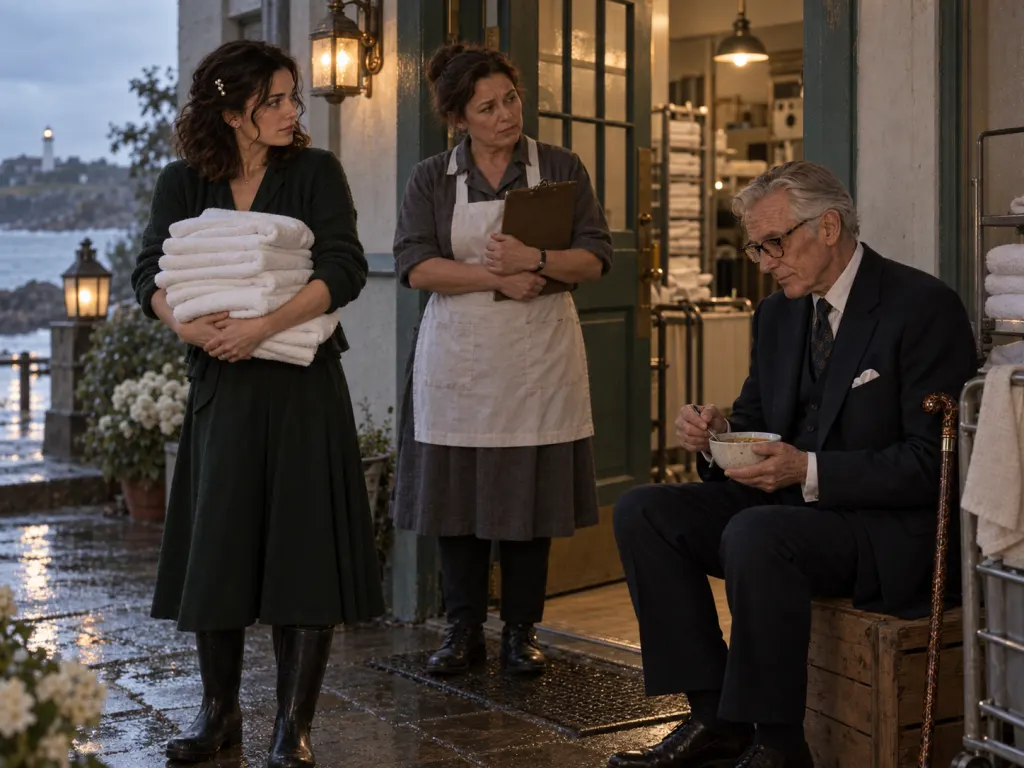
The work was not theatrical. No one asked me to make a speech. No one cared that my dress the day before had cost more than the industrial washer. June handed me towels and told me to fold them in thirds, not halves, because thirds fit the carts and halves made the shelves look lazy. I learned that fitted sheets were spiteful objects. I learned that a guest could destroy a room in twenty minutes and never picture the person who put it right.
At noon, my palms were red and my back ached. Elias sat on an overturned crate, eating soup from a paper cup. He had changed into a cardigan, as if the richest man I knew had dressed for a church basement.
"I am pleased with you."
"I quit before lunch."
"You came back after washing your hands."
That was true. I had stood in the restroom, furious and embarrassed, looking at my damp reflection. I could have called a car. I could have told Elias that the lesson was insulting. Instead, I dried my hands on my skirt because the paper towel dispenser was empty, and I returned to the laundry.
June noticed. She said nothing until the end of the day, when she handed me a pair of black rubber boots from a supply closet.
"They belonged to my niece," she said. "She moved to Denver. Don't make them sentimental."
I took them like an apology I had not earned.
Chapter 6: Helen's Ledger
The ledger became my private humiliation and then, slowly, my education. Elias's grandmother, Helen Vale, had written in a firm slanted hand. Beside Arturo Bell: son needs school coat, paid from kitchen jar. Beside Mabel Reed: husband gone west, keep room 6 vacant if she needs it. Beside Thomas Pike: proud, offer extra shift as favor to us.
At first, I read the names as history. Then June began introducing me to descendants. Arturo's granddaughter ran reservations. Mabel's great-nephew repaired the porch railing. Thomas Pike's grandson, Owen, drove the airport shuttle and kept peppermint candies in the console because children cried less when handed something sweet by a man with kind eyes.
Celia remained unconvinced. She visited the hotel every Friday with a tablet and a stack of questions. She had inherited Elias's attention to detail without his softness.
"You are making an impression," she told me one afternoon.
"Is that praise?"
"It is a weather report."
Then a winter storm closed the coast road and stranded twenty-three guests, three cooks, two desk clerks, and one furious bride from Boston whose seaside wedding had been moved indoors. Elias was at the estate with a board meeting. Celia was an hour away. June looked at me across the lobby as water crept under the front doors.
"Well," she said, "Mrs. Vale?"
I wanted to say I was not that kind of Mrs. Vale. I wanted to call someone competent. Instead, I took off my wet cardigan, asked Owen to move luggage to the second floor, sent the cooks to make soup and toast, and told the Boston bride that if she could accept candles instead of flowers, I could give her a room full of witnesses who would remember her wedding for the rest of their lives.
She cried. I thought I had failed. Then she hugged me so hard my chin hit her shoulder.
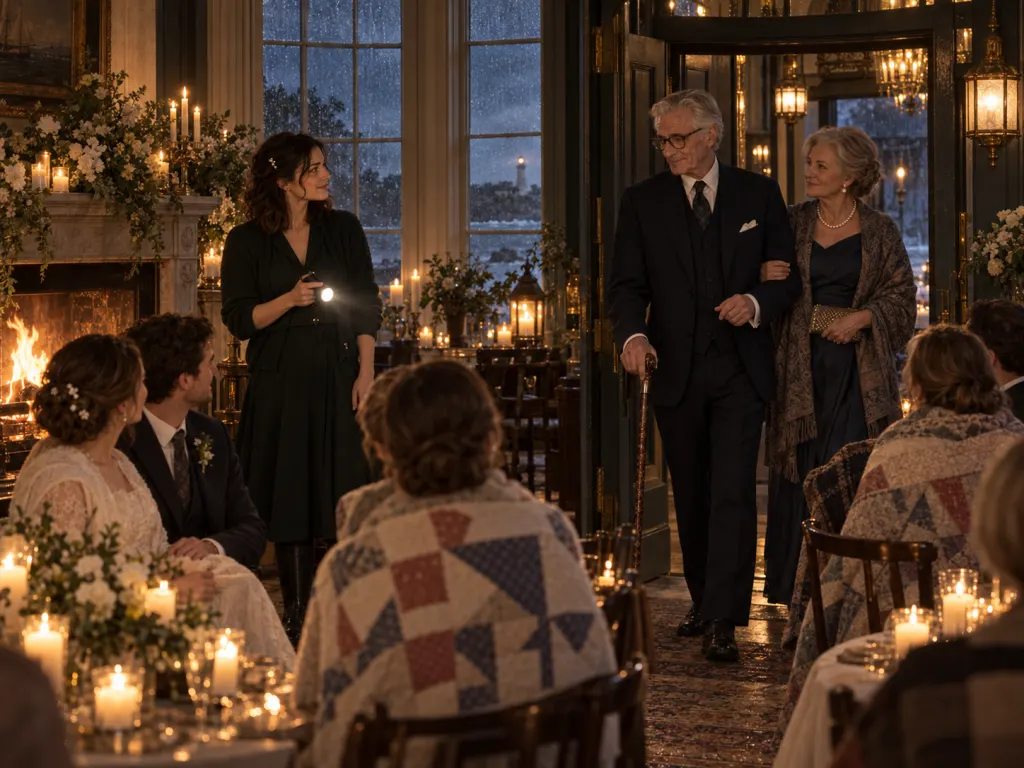
By midnight, the lobby glowed with every candle we could find. Guests sat on quilts. The bride and groom exchanged vows beside the fireplace while rain battered the glass. I held a flashlight over the officiant's notes and felt, for the first time, the strange lift of being useful without being admired.
Elias arrived after dawn. He took in the damp rugs, the sleeping guests, the empty soup pots, the bride's bouquet made from lobby greenery, and me in June's borrowed boots.
"You opened the door," he said.
"Several. Also a storage room, a pantry, and one terrifying fuse box."
His laugh was quiet. Celia, standing behind him, looked at me for a long moment and gave the smallest nod. It was not affection. It was harder won than that. It was respect beginning its work.
Chapter 7: What Money Could Not Carry
Marriage to Elias was not the rescue I had imagined. It was calendars, board packets, employee breakfasts, arguments over budgets, and the daily comedy of loving someone who stored receipts by decade. It was also tea at midnight, his hand finding mine during concerts, and the way he listened when I described the person I used to be without making her sound unforgivable.
Once, months after the storm, I asked him whether he had been disappointed in me on our wedding day.
We were in the estate kitchen, shelling peas into a blue bowl. The house around us was less a palace than a museum of practical decisions: rugs patched instead of replaced, silver polished by habit rather than vanity, portraits hung slightly crooked because Elias said perfection made ancestors smug.
"Yes," he said.
The honesty landed cleanly.
"But not surprised?"
"No."
"That is worse."
"It is kinder than surprise. Surprise would mean I had not been paying attention."
I dropped an empty pod into the bowl. "Why marry me, then?"
Elias took a long time answering. Outside, gulls circled above the harbor, their cries thin as hinges.
"Because wanting safety is not the same as being cruel," he said. "Because you laughed at yourself before anyone else could weaponize it. Because when you were ashamed, you did not leave the room every time. And because I am old enough to know that love is not found fully grown. Sometimes it is assigned a task and watched carefully."
I wanted to make a joke. Instead, I cried into the peas, which offended both of us.
In the second year of our marriage, Elias stepped back from daily decisions. Celia took the chair of the board. June became operations director of the old hotel. I managed the family fund that handled staff scholarships, emergency housing, and the small dignities no annual report knew how to describe. I learned to ask questions without turning them into performances. I learned names. I learned that generosity without attention could become vanity in a nicer coat.
Chapter 8: The Key I Kept
On our fifth anniversary, Elias gave me the mansion.
Not the deed. That stayed where it belonged, tied to the trust and the people whose labor had made the place more than scenery. He gave me the mansion in the only way that mattered: he walked me through every room and told me who had shaped it.
The cedar library had been paneled by a carpenter who sang opera off-key. The blue bedroom had belonged to an aunt who hid cash in curtain hems because she trusted fabric more than banks. The terrace had been rebuilt after a storm by employees who refused overtime pay until Helen Vale threatened to cook for them every day as punishment.
At the service entrance, Elias paused. The brass key on its faded ribbon hung from my wrist.
"Do you still wish I had given you something grander?" he asked.
I thought of the woman I had been beneath the ballroom chandeliers, counting exits from an ordinary life. I did not despise her anymore. She had been frightened, not empty. She had reached for shine because shine was visible from a distance, and no one had taught her how to recognize steadier light.
"No," I said. "But I am glad you let me want the wrong thing long enough to understand why it was wrong."
He leaned on his cane, smiling toward the harbor. "That sounds expensive."
"It was. It cost me my best fantasies."
"A fair price, then."
Years later, after Elias was gone, people asked me what it had been like to marry a wealthy older man. Some asked with envy, some with suspicion, and some with the hungry curiosity of those who believed money had a secret door they might find if someone described the handle clearly enough.
I always thought of the laundry entrance first. I thought of June's boots, Helen's ledger, Celia's reluctant nod, the Boston bride saying vows by candlelight, Elias counting napkins as if care began in the smallest inventory. I thought of the mansion on the hill and how little it had taught me compared with the back stairs.
So I told the truth, though never all at once.
I married a wealthy older man because I was afraid of being poor in every possible way. I stayed because he asked me to become rich in the one way I had never understood: rich in names, obligations, forgiven mistakes, and doors opened from the service side.
The brass key still hangs beside my desk. It is scratched, ordinary, and heavier than it looks. Every so often, when someone new arrives wanting only the glittering version of the story, I place it in their palm and let them feel its weight before I say anything at all.
Wrap-Up
Mara enters marriage hoping Elias's fortune will give her safety. Instead, his family legacy asks her to learn responsibility, humility, and the names of people she once would have overlooked.