 Save
Editor's note: This is an original work of fiction. The characters and events are invented, while the social backdrop is real: HUD reported hundreds of thousands of people experiencing homelessness on a single night in January 2025, and USDA data show that many households also face food insecurity. Those realities inform the setting, but the plot is not presented as a verified event.
Chapter 1: The Third Plate
The last thing Mara Reed heard before the casseroles cooled on the dining room table was the back door opening.
Everyone else was in the parlor, speaking softly around grief as if it were furniture they might bruise their shins against. Women from Ruth's church arranged foil-covered pans in careful rows. Mara's cousin sorted paper plates. Her stepfather, Cal, stood near the mantel in the suit he wore only for court dates and funerals, accepting condolences with both hands folded around each offered palm.
Then came the small scrape of the kitchen chair, the sigh of the back hinge, and a thread of cold air moving through the house.
Mara knew that sound. She had known it since she was fourteen and ashamed of it, since she was twenty-one and angry about it, since she was thirty-four and old enough to understand that some questions become heavier the longer a family refuses to lift them.
Her mother had always made a third plate.
Breakfast, supper, holidays, storms, layoffs, the year the pipes froze, the year Ruth sold her wedding ring to cover rent, always a third plate wrapped in a clean towel and carried through the back door. Not leftovers. Not scraps. A serving from the same pot, with butter if they had butter, salt if they had salt, and on Sundays a folded napkin tucked under the fork.
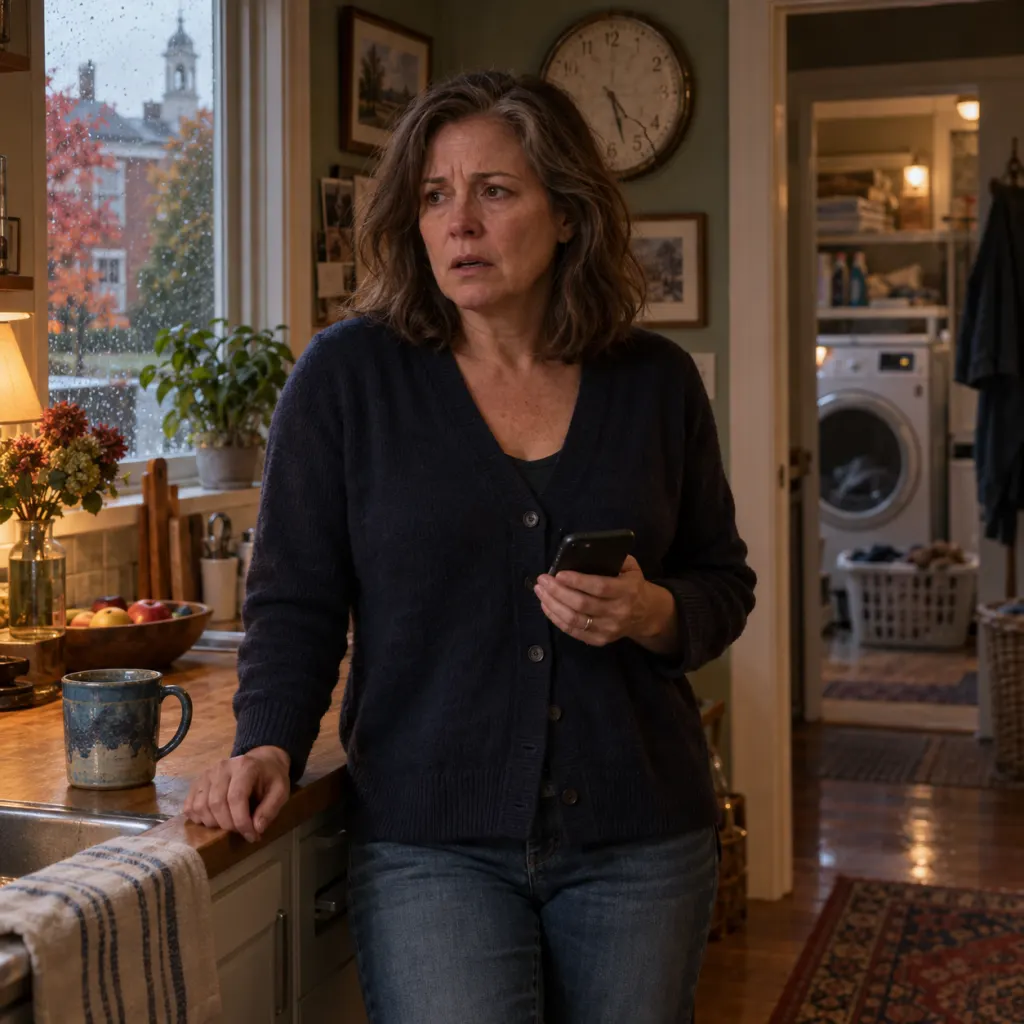
Mara left the parlor without excusing herself. In the kitchen, the counter still held Ruth's blue enamel dish, chipped near one handle. Beside it sat a plate covered with another plate, steam beading the underside. Meatloaf. Green beans. One roll. Cal stood at the sink with his back to her.
"Who made that?" Mara asked.
Cal turned. His eyes moved to the covered plate and hardened in a way grief had not managed to harden them all afternoon. "Throw it out."
Mara reached for the plate instead. The heat pressed into her fingers through the towel. "Mom asked me to take it."
"Your mother asked too much," he said.
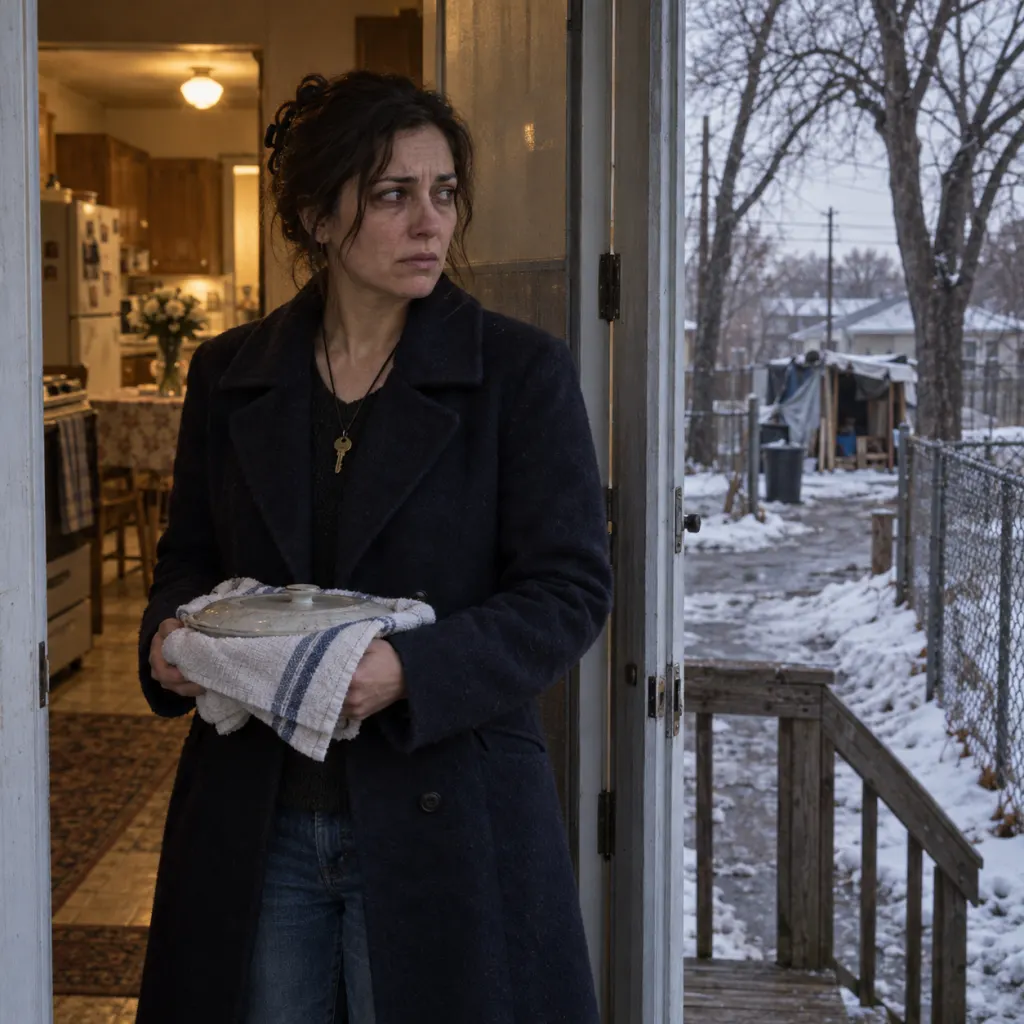
Outside, early November had stripped the two maples behind the house down to black branches. The alley was a ribbon of wet gravel between their fence and the backs of garages. Beneath the maples, where the ground dipped and the city forgot to send light, a man waited beside a shelter made of plywood, blue tarp, and patience.
He was not looking toward the house. That was his rule. Ruth had carried food to him for twenty years, and in all that time Samuel Vale had never waved through the kitchen window, never called Ruth by name where neighbors might hear, never crossed the line of the fence unless asked. He stood with his cap in both hands while Mara approached, the way a man might stand before a closed church.
"She died this morning," Mara said.
Samuel's face seemed to fold inward. He took the plate but did not uncover it. "I know."
"How could you know?"
He looked past her to the yellow square of the kitchen window. "The light stayed on all night."

Chapter 2: The Woman at the Stove
When Mara was little, she thought every house had an invisible guest.
Ruth cooked in movements so practiced they looked like music: onion under the knife, pan on the burner, coffee spoon tapped twice against the jar, thumb testing the warmth of a roll. She worked at a laundry in the mornings and cleaned offices three evenings a week, yet her hands still found time to peel apples thin as paper and cut sandwiches into triangles because Mara liked the corners.
The third plate appeared without announcement. Ruth never called it charity. She never said pity. She simply lifted a portion before anyone sat down, covered it, and set it near the door.
At seven, Mara asked if an angel was coming.
Ruth laughed, tired but real. "No, baby. Just a man who needs supper."
At twelve, Mara asked why the man did not go somewhere else.
Ruth poured gravy into a chipped bowl and said, "Some people have used up all their elsewhere."
At fifteen, when Mara's shoes had split near the toes and the girls at school noticed, the question became sharper. "We need supper too."
Her mother did not scold her. That might have been easier. Ruth only sat across from her at the table, the unpaid electric bill folded beside the salt shaker, and said, "Yes. We do. That is why I know what hunger sounds like when it tries not to speak."
Mara hated that answer because it was too gentle to fight.
Outside, Samuel repaired what broke. A stack of split maple appeared after a winter storm. The loose porch step stopped groaning. Once, after Mara left her bicycle in the yard and woke to find the back tire patched, Ruth only said, "Say thank you with your manners, even if you don't say it with your mouth."
But Mara did not say thank you. She watched Samuel from behind curtains and gave him the suspicion children learn from adults who whisper. He was the man who took food from her mother's table. He was the reason Ruth's last piece of chicken disappeared under a second plate. He was proof, Mara thought, that goodness could be careless with the people closest to it.
Years later, when public reports would put numbers beside hunger and homelessness, Mara would think of her mother's kitchen. HUD's 2025 report counted 745,652 people experiencing homelessness on a single night in January 2025, including 266,320 people living unsheltered, and USDA reported that 13.7 percent of U.S. households were food insecure at some point in 2024. Numbers could show scale, but they could not show Ruth standing over a pot, choosing dignity one plate at a time.
Chapter 3: Funeral Food
After the burial, the house filled with food from people who had not known Ruth kept anyone fed beyond her own walls.
There were potato casseroles, ham biscuits, lemon bars cut into bright squares, two pans of macaroni, and a roast wrapped in enough foil to shine like a small moon. Mara moved through it all with the numb efficiency grief sometimes lends the living. She washed forks. She labeled dishes. She accepted stories about Ruth's patience, Ruth's laugh, Ruth's habit of slipping extra coupons into neighbors' mailboxes.
Cal accepted praise as if he had helped create it.
"She was a saint," Mrs. Alvarez from next door said.
Cal bowed his head. "She tried."
The words landed wrong in Mara's ear. Tried. As if Ruth had failed some exam only Cal had graded.
By dusk, most guests had gone. Mara found Cal in Ruth's bedroom with three garbage bags open on the floor. He had already emptied the top drawer of the dresser. Ruth's scarves lay in a heap, their colors dull under the overhead bulb.
"What are you doing?" Mara asked.
"Clearing space." He did not look up. "No use making a shrine."
"She was buried six hours ago."
Cal pulled a shoebox from the closet shelf, opened it, found old tax papers, and tossed it aside. "Then help me find the blue tin."
Mara went still. She had heard of it only once, two nights before Ruth died, when her mother had gripped her wrist with a strength that did not match her thin hand.
"Mara," Ruth had whispered, breath catching between words, "if Cal asks for the blue tin, you say you never saw it. You hear me?"
"What's in it?"
"The truth, and a little mercy. He'll want one and burn the other."
In the bedroom, Cal turned at last. "Your mother kept foolish things. Letters. Old lies. You don't need to be dragged through them."
"Then why do you need them?"
His mouth tightened. For one second she saw not grief but fear, small and mean, flickering behind his eyes.
"Because dead women don't get to keep stirring trouble," he said.
Chapter 4: The Blue Tin
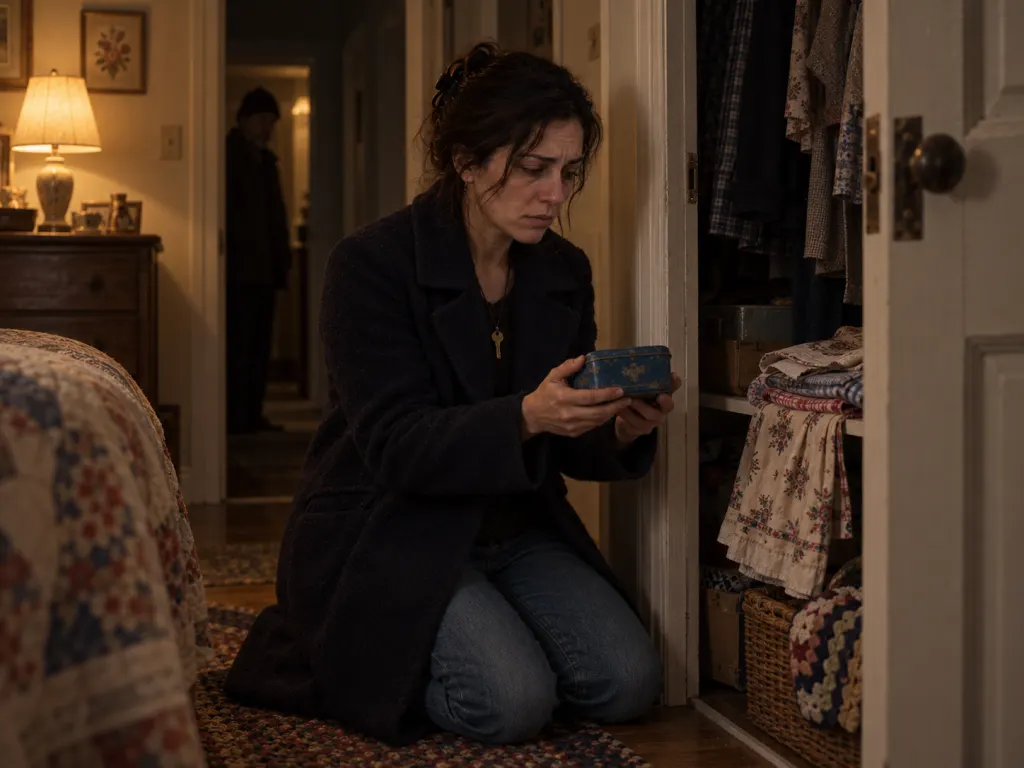
Mara waited until midnight, when Cal's truck rolled out of the driveway and the house settled into its old complaints.
She did not know where to search. Ruth had been poor in the tidy way of people who cannot afford disorder. Every drawer held its own logic. Batteries were in a mug beside the phone book. Rent receipts were clipped by year. Needles, buttons, rubber bands, twist ties, birthday candles, all sorted into jars that once held jam.
The blue tin was not in any of those places.
Mara searched the closet last because grief had made her superstitious. Ruth's dresses still hung there, soft at the shoulders from years of being worn and washed and worn again. Her aprons were folded in a milk crate on the floor. Mara lifted them one by one, each carrying a ghost of flour, soap, and lavender lotion.
Behind the crate, a panel near the baseboard sat slightly proud of the wall.
Mara pressed it. Nothing. She slid Ruth's brass key from the cord around her own neck, though she did not know why. The key had opened the back door for thirty years and now seemed too ordinary for secrets. But when she fitted its edge into the crack and pulled, the panel came loose.
The tin was the color of rain. Its lid was dented. Inside lay a bundle of letters tied with butcher's string, a black-and-white photograph of two children on a porch, a money order receipt from a decade earlier, and a small cloth pouch.
Mara opened the pouch first. A brass button rolled into her palm. Not valuable. Not pretty. Just a coat button, rubbed smooth from use.
The photograph showed Ruth at maybe nine years old, fierce-eyed and thin-kneed, standing beside a boy with one hand on her shoulder. He had Samuel's deep-set eyes.
Mara sat on the closet floor. The house seemed to lean closer.
The first letter began in Ruth's careful handwriting.
My Mara, if you are reading this, then I was braver on paper than I ever managed to be at the table. Samuel Vale is my brother. Before he was the man behind our fence, he was the boy who buttoned my coat when the house was cold and walked me to school with his hand on my backpack so I would not turn around.
Mara read the line again. Brother. The word entered the room and rearranged every memory.
Samuel was not a stranger Ruth had chosen over them. He was family Ruth had kept hidden in plain sight.
The letter did not excuse everything. It did not make twenty years simple. Ruth wrote of a home before Mara was born, of two children learning to listen for adult footsteps, of Samuel leaving young and returning years later with no steady place to sleep, ashamed to knock on any front door. She wrote that Cal had known only enough to be cruel about it and had insisted that shame was cleaner than explanation.
At the bottom of the first page, Ruth had pressed so hard with the pen the paper was scarred.
I fed him because I loved him. I hid him because I was afraid. Those are not the same thing, and I am sorry I taught you to confuse them.
Chapter 5: The Man Behind the Fence
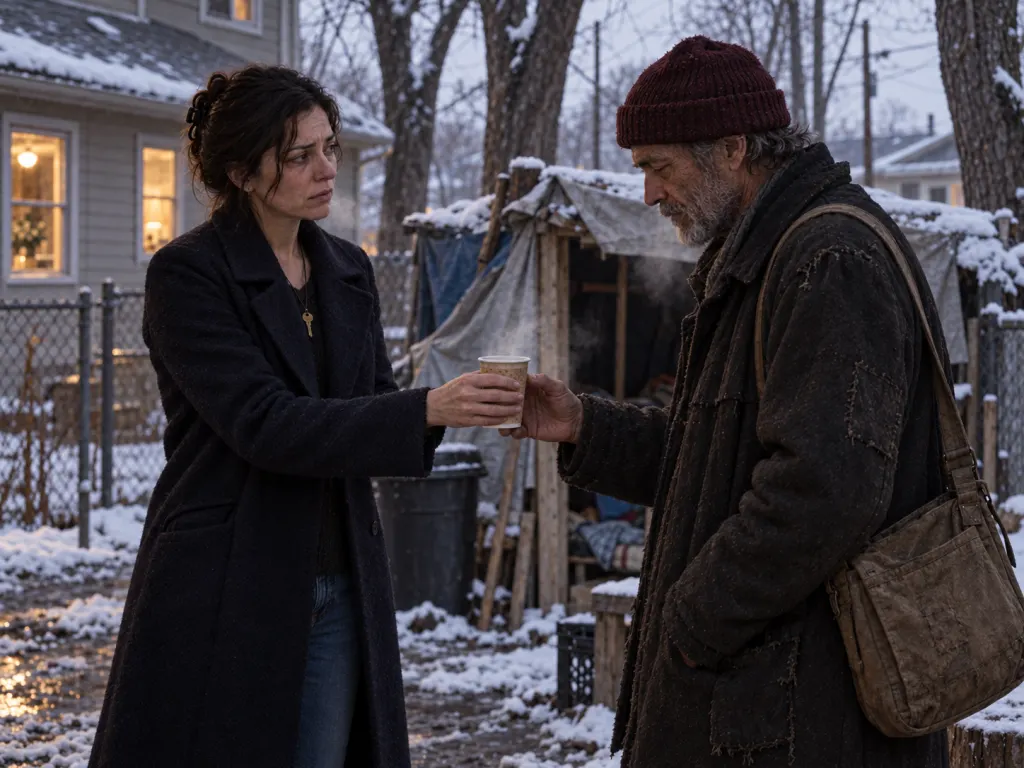
Morning came gray and cold. Mara carried coffee instead of food.
Samuel was kneeling beside his shelter, tying twine around a corner of tarp that had torn in the night. His hands were large, knuckled, red from the air. When he saw Mara, he rose too quickly and nearly lost his balance.
"You found it," he said.
Not a question.
Mara held out the coffee. "You knew what was in the tin."
He accepted the cup but did not drink. "Some of it."
"You're my uncle."
The word startled them both. Uncle. It seemed too warm for the alley, too domestic for a man whose roof was stitched to boards with rope.
Samuel looked down at the coffee lid. "I wanted to tell you when you were small. Your mother said no. She said a child should not have to carry grown sorrow before she could carry groceries."
"So you let me hate you."
His face moved, not quite a flinch. "Some burdens are lighter when they land on a stranger."
Mara wanted anger. She had saved plenty. She wanted to spend it cleanly, to hand it to someone who deserved the full weight. But Samuel stood there with Ruth's eyes in an older face, and the anger went looking for a shape it could not find.
"Why didn't you come inside?"
"Cal."
The name fell between them. A car hissed through wet leaves at the mouth of the alley.
"He told her if she brought me in, he would make sure everyone knew the parts of our childhood your mother wanted buried. Not because they were her shame. Because he knew shame is easiest to aim at the person already hurt."
Mara thought of Cal with the garbage bags, his need to erase Ruth before the sheets had cooled.
"And you stayed?" she asked.
Samuel finally drank. Steam touched his beard. "Your mother asked me to stay close enough that she could know I was alive. I asked her to let me leave. She said, 'You already did that once.'"
Chapter 6: What Cal Kept
Cal returned at noon carrying boxes from the hardware store and the authority of a man who believed possession was the same as right.
Mara had spread the letters across the kitchen table. Not all of them. Enough. Ruth's handwriting moved from young loops to cramped lines over the years. There were birthday notes never sent, apologies rehearsed and crossed out, lists of things Samuel had fixed around the house, and one envelope full of receipts.
Cal stopped in the doorway. His face lost color in a slow drain.
"You had no business," he said.
"Mom left them for me."
"Your mother was confused at the end."
"She was clearer than you counted on."
He dropped the boxes. "That man is nothing to you."
Mara put her hand on the photograph of Ruth and Samuel as children. "He is my mother's brother."
Cal laughed once, dry and sharp. "Blood makes a family now? Convenient. Where was he when the rent came due? Where was he when your mother worked double shifts?"
Mara lifted the money order receipts. Small amounts, irregular, sent over years under Samuel's name to the rental office, the electric company, a school fund Mara never knew existed. Not rescue. Not enough to change their lives. But enough, again and again, to keep a shutoff notice from becoming darkness.
"He was here," Mara said. "Quietly. Which is more than I can say for some people who slept indoors."
Cal stepped forward, and for a moment Mara saw the old household pattern trying to reassemble itself: his volume, her mother's silence, Mara's retreat. But Ruth was gone, and the silence had lost its keeper.
"Leave," Mara said.
"This is my house."
"It is rented in Mom's name through the end of the month. I checked the file. You can take your clothes. You can take the boxes you brought. You cannot take the tin."
Cal stared at her with a disbelief that might have been grief if it had known how to bow.
"You'll regret choosing him," he said.
Mara looked at the back door, at the path worn between kitchen and fence by her mother's feet. "I am not choosing him over her. I am finally choosing what she was trying to tell me."
Chapter 7: Soup Weather
The first snow came two days later, soft at dawn and mean by evening.
Mara made soup because Ruth would have made soup. Onion, carrot, potato, broth stretched with water, pepper blooming in the pot. Her knife work was clumsy. She cut one carrot too thick and another too thin. Ruth would have smiled and said no spoon ever rejected an odd vegetable, then stolen a bite from the cutting board.
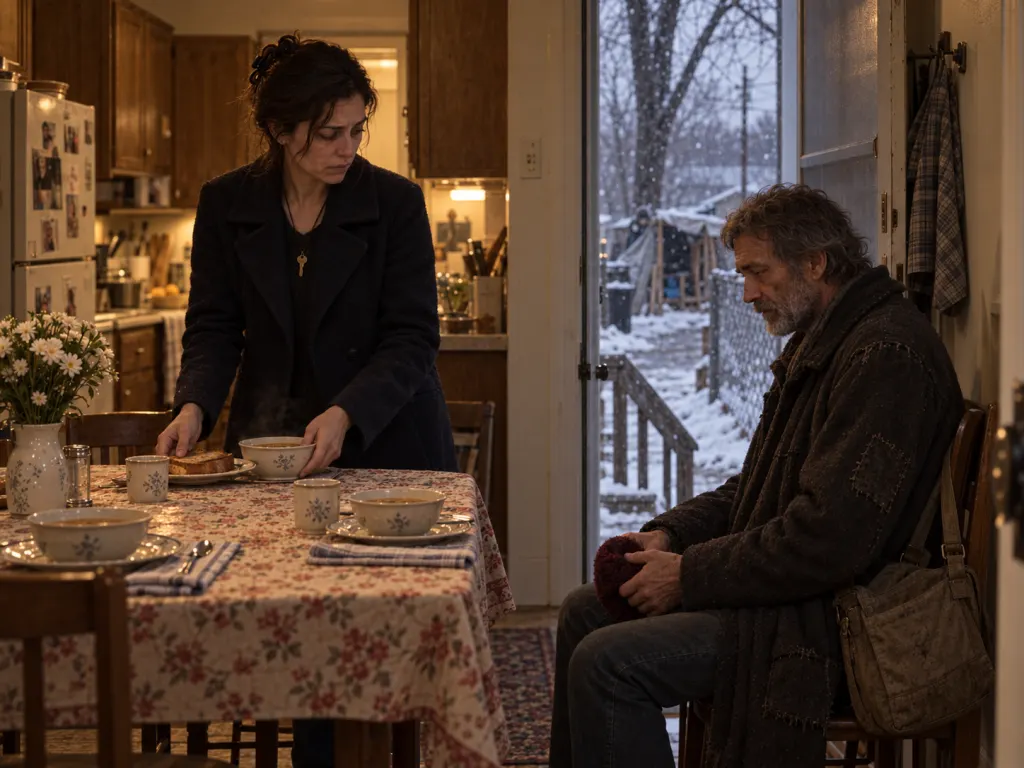
Mara set three bowls on the table before she understood what she had done.
She carried one to Samuel. He was sitting beneath the tarp with a blanket around his shoulders and a paperback open in his lap. Snow had gathered on the boards above him. The world smelled of metal, smoke, and cold earth.
"I can't keep pretending this is enough," Mara said.
Samuel closed the book around one finger. "A bowl of soup?"
"A bowl of soup. A fence. Twenty years of not saying uncle."
He looked toward the house. "Your mother did what she could with what fear left her."
"I know. I am not blaming her." Mara swallowed. "But I won't inherit the fear as if it is the only thing she left me."
The next week became a series of small humiliations and smaller victories. Mara sat on hold with city offices. She learned which churches opened warming rooms and which numbers led only to recordings. She found an outreach worker named Denise who spoke to Samuel like a person instead of a problem. She helped him replace an identification card he had lost years earlier. She made mistakes. She apologized. She learned that help offered too loudly can sound like control.
Samuel did not move inside. Not then. Trust was not a mattress someone could unfold in a day.
But he began coming to the back steps for breakfast. At first he stood. Then he sat on the lowest step. Then, one morning in December, he crossed the threshold and removed his cap in Ruth's kitchen.
Mara had made toast. The edges were dark. Samuel ate every bite.
Chapter 8: The Table Ruth Built
By spring, the alley behind the house no longer looked like a secret.
The tarp came down first. Samuel folded it carefully, as if retiring a flag. The boards went next, stacked for pickup. Beneath them, the ground was pale and flattened where shelter had pressed itself into the earth for years. Mara stood beside him with work gloves on, unsure whether to celebrate or mourn the empty space.
"Looks smaller now," she said.
Samuel nodded. "Hard places always do, once you're not sleeping in them."
He had a room by then, not far away, above a locksmith's shop that smelled of brass dust and machine oil. It was not much. A narrow bed, a sink, one window overlooking an awning. To Mara, it looked like a miracle because it had a door Samuel could lock from the inside.
On Ruth's birthday, Mara invited him for supper.
She made meatloaf because she could hear her mother teasing her about sentiment. She made green beans with too much garlic, rolls from a tube because she was not ready to attempt Ruth's dough, and apple cake from the card written in Ruth's slanted hand. The kitchen filled with warmth and the nervous smoke of a cook trying too hard.
Samuel arrived in a clean shirt and the same burgundy cap. He brought flowers bought from the grocery store, their stems wrapped in damp paper towel. For a long moment he stood in the doorway, looking at the table.
"She always set me a plate," he said.
"Tonight you set your own," Mara replied, and handed him the stack.
They ate slowly. They did not fix the past. No single supper could do that. Mara still carried years of resentment, and Samuel carried years of obedience to a silence that had protected no one completely. Ruth's absence sat with them too, not as a wound that closed, but as a chair they both kept glancing toward.
After cake, Samuel took the brass button from the blue tin and placed it in Mara's palm.
"That was from the coat I wore when I walked your mother to your grandmother's house," he said. "She kept it because she said it proved somebody had held together once."
Mara closed her fingers around it. The button was warm from his hand.
"I spent so long thinking she gave away what belonged to us," she said. "Food. Time. Attention."
Samuel watched her with Ruth's eyes.
"Maybe she was building the table bigger," Mara said.
Outside, the maple trees had begun to leaf. Their small green hands trembled in the dusk. The old path from the back door to the fence was still visible, pressed into the yard by twenty years of meals, worry, and love. Mara did not plan to let the grass erase it all at once.
Some paths are mistakes. Some are prayers. Some are the only language a person has left.
Ruth had never explained the third plate properly while she lived. Maybe she could not. Maybe shame had locked too many doors in her, and food was the one key she trusted. But Mara understood this much now: her mother had not fed a stranger for twenty years because she loved suffering or secrets. She had fed him because love, when cornered, will sometimes choose the smallest possible action and repeat it until someone mistakes repetition for weakness.
Mara washed the dishes after Samuel left. Three plates. Three forks. Three glasses catching kitchen light.
When she dried the last plate, she set it in the cupboard beside the others, not hidden, not special, simply waiting for the next meal. Then she turned off the kitchen light, locked the back door, and left the brass key on its hook where anyone invited home could find it.
Wrap-Up
Mara spends years resenting the homeless man her mother feeds behind their house. After Ruth's funeral, a hidden blue tin reveals that Samuel is not a stranger but Ruth's brother, and that the third plate was part loyalty, part fear, part unfinished family history. Mara cannot repair twenty years in one gesture, but she can stop preserving silence as if it were love.