 Save
This is an original work of fiction. The characters, dialogue, and central events are invented, with brief food-safety background drawn from public guidance where noted.
Chapter 1: The Weight of the Order
By the time Ovidiu unlocked the butcher shop, frost had softened on the inside of the display case and the hooks above the cutting table were ticking faintly in the cold. He liked that hour before the town woke fully. The first tram had not yet scraped past the square. The baker across the alley had only just opened her back door. For a few minutes every morning, before voices and coins and appetite, there was only the hum of refrigeration and the clean shine of knives laid in order.
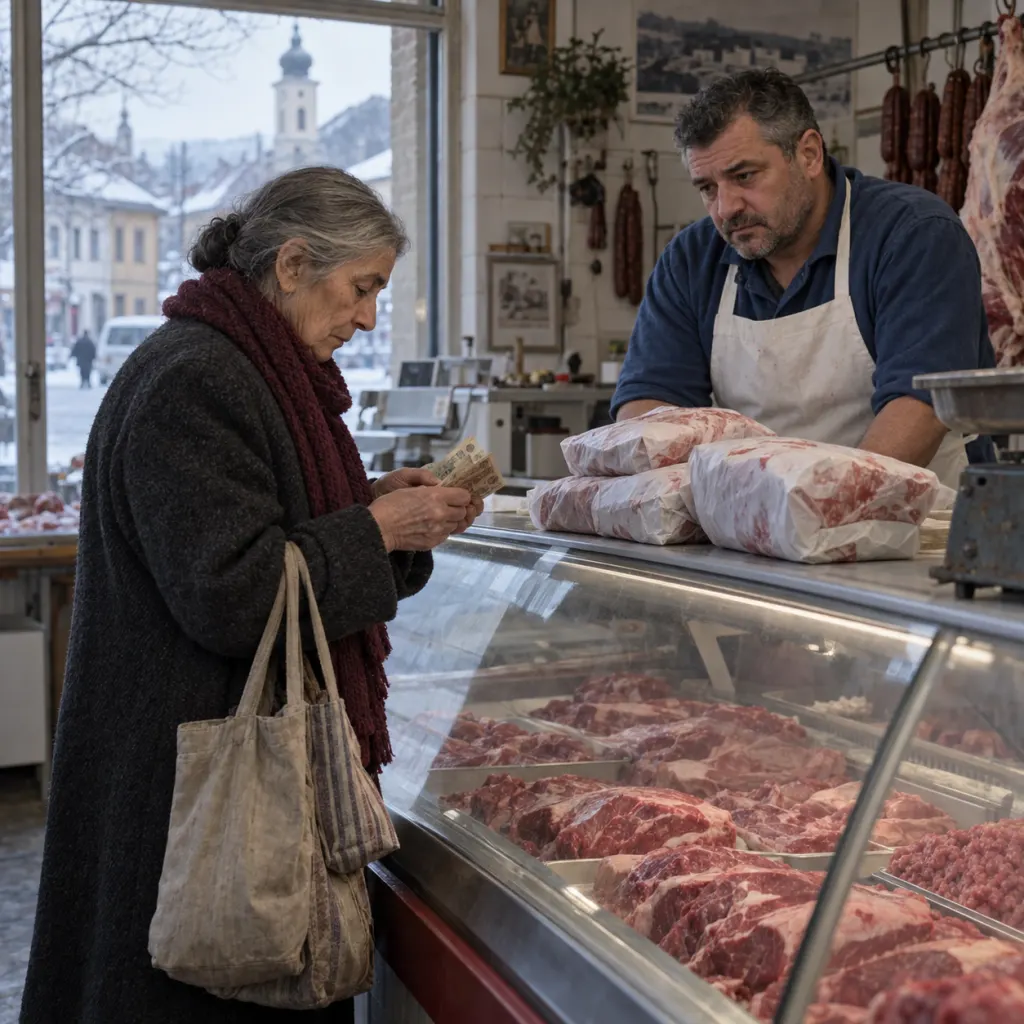
Then the bell over the door rang once, too sharply, and Lidia Marcu stepped inside carrying three empty market bags pressed flat against her coat.
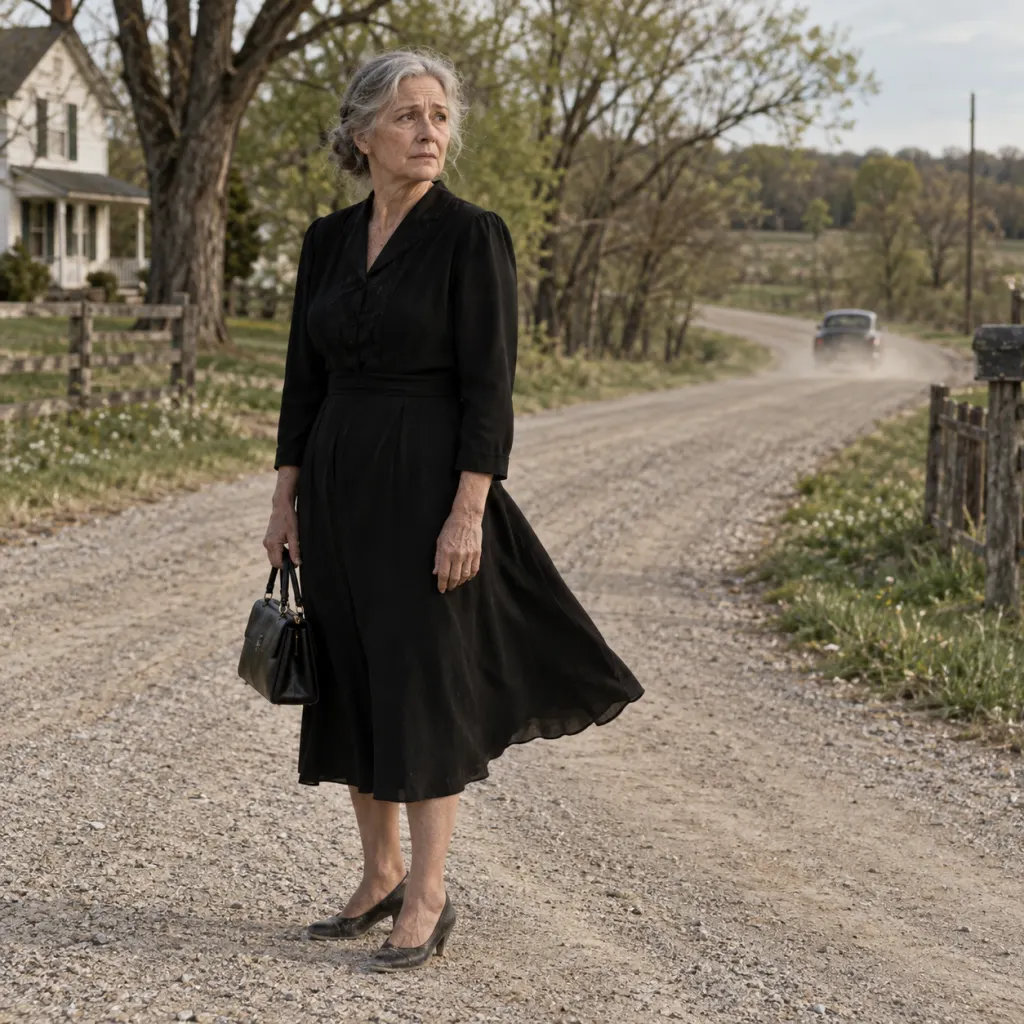
She was seventy, maybe older, though Ovidiu had known her too long to trust numbers. Some people aged in lines; Lidia aged in silence. Her face had the delicate bones of a woman who had once laughed often and then, at some point, decided laughter was expensive. She wore the same charcoal wool coat she had worn for years, a knitted burgundy scarf tucked at her throat, and black shoes shined with old discipline. Usually she bought bones for soup, a quarter kilo of minced beef, sometimes a little liver if she felt strong enough to cook for herself.
That morning, she placed both hands on the counter and said, without greeting him, "I need sixty kilos of beef."
Ovidiu did not move. His knife hovered above a trimmed roast. "Sixty?"
"Yes." She looked toward the window. "Not ground. Cuts for boiling. Whatever is fresh."
He set the knife down carefully. "Do you have a restaurant order? I can call Petre from deliveries. This is a lot for one person to carry."
"I will carry it."
"Lidia, with respect, sixty kilos is more than you weigh." He tried a smile. It landed nowhere.
She opened her purse. The notes inside were old, folded, sorted by value with a patience that made him ache. She counted them with a thumb that trembled but never lost its place. When he wrapped the meat into heavy parcels, she watched every movement, not with hunger, but with fear. Twice she turned toward the street. Once, when a delivery truck groaned past the shopfront, she flinched so violently that the purse snapped shut in her hand.
"Is someone waiting for you?" he asked.
"My son."
Her eyes rose to his, and for one moment they were steady. "He has come home. We are having lunch."
Ovidiu remembered her son as a tall boy named Stefan who used to steal crusts from the bakery and bring them to the butcher's dog. He remembered the black ribbon on Lidia's gate six years earlier. He remembered taking a plate of sausages to her house because no one should come back from a cemetery and open an empty pantry.
He could have said all that. Instead he tied another parcel and felt the morning tilt under him.
Chapter 2: What the Town Made of It
Lidia came the next day too.
She arrived before seven, scarf pulled high, market bags folded under one arm like evidence. The same order. Sixty kilos. No questions answered. No help accepted. Ovidiu, who had spent the night telling himself grief made its own calendar, wrapped the meat and watched her pass the notes across the counter.
On the third morning, he said, "You need cold storage."
"I have what I need."
"Raw beef should be kept cold. The USDA guidance says beef belongs in refrigeration at 40 degrees F or below, and large amounts need planning, not hope." He nodded toward the sign he kept near the register, a plain reminder for customers who bought for holidays, with the federal food safety page printed at the bottom: USDA FSIS beef guidance. "I am not scolding you. I am trying to keep you from losing money."
"Money is already lost," she said.
It was the first sentence she had offered that sounded like herself.
By noon, the town had done what towns do when silence leaves room. The baker said Lidia must be feeding stray dogs near the rail yard. The pharmacist believed she was being cheated by someone younger. A man who sold lottery tickets announced that old houses had cellars, and cellars had secrets, and secrets needed covering. Nobody knew anything, which did not slow anybody down.
On the fourth day, when she came in with the same order and a shallow cut across one knuckle, Ovidiu stopped pretending the matter belonged only to her.
"Lidia," he said softly, "tell me if you are in danger."
She looked past him to the hanging scale. "Please wrap it faster."
"I can call someone."
"That is what I am afraid of."
He almost missed it. Her voice had thinned to breath.
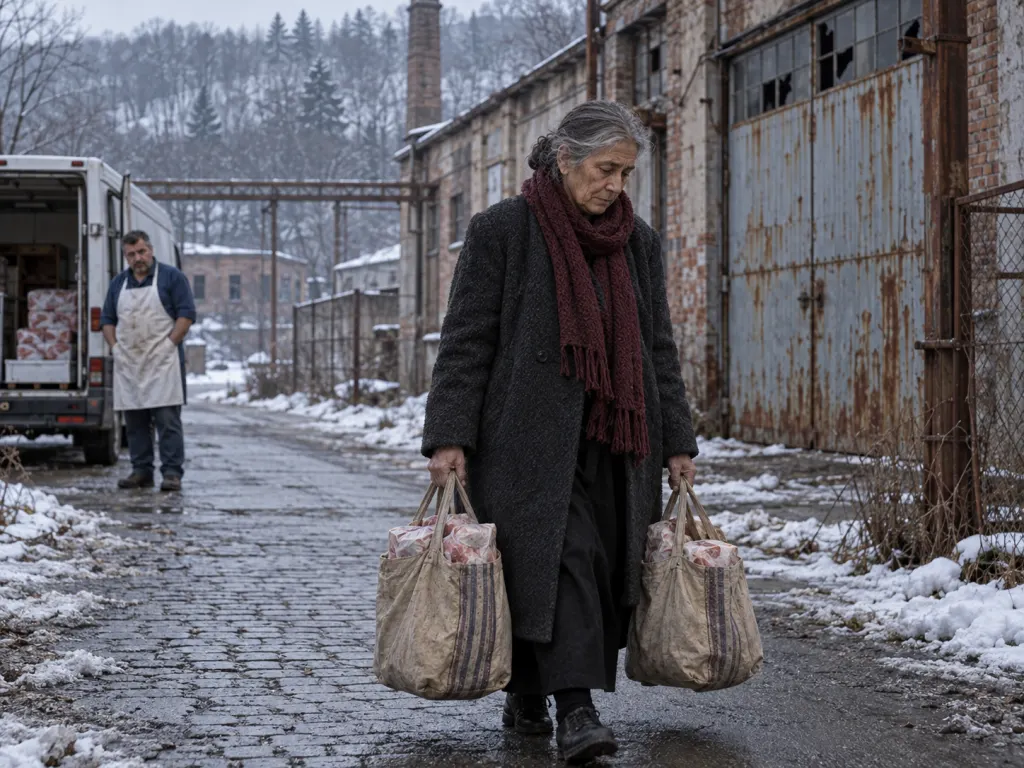
After she left, Ovidiu stood in the doorway and watched her move down the street with impossible weight dragging both hands low. He saw her refuse a taxi. He saw her turn behind the closed cinema, toward the old road that led to the abandoned cannery at the edge of the forest. He saw, or thought he saw, another figure in a gray hood follow her at a distance.
That night he washed the blocks twice, sharpened every knife, balanced the accounts, and still could not quiet the image of Lidia's hands, red at the knuckles, gripping meat meant for a banquet no living son would attend.
Chapter 3: The Officer Who Remembered Her Name
Sergeant Mara Ionescu arrived at the shop the following morning without sirens, without theater, and with a notebook already open. Ovidiu had called the non-emergency line at dawn, ashamed of himself and relieved at once. He expected someone bored. Mara was not bored.
She was thirty-eight, compact, dark-haired, and had the steady face of a person who had learned not to show surprise too early. She listened while Ovidiu described the orders, the dead son, the route toward the cannery, the possible follower. She asked the price of the beef, the type of cuts, whether Lidia smelled of drink, whether anyone waited outside the shop. Practical questions, all of them. He appreciated their plainness.
"You think someone is forcing her?" Mara asked.
"I think grief can make a person strange. I also think sixty kilos a day is not grief. It is logistics."
That almost made Mara smile. "Good distinction."
When Lidia came in, she stopped so abruptly the bell struck the door twice behind her. Her eyes moved from Ovidiu to Mara's uniform and back again.
"No," Lidia said.
Mara closed the notebook. "Good morning, Mrs. Marcu."
"I have done nothing."
"I did not say you had."
"Then leave me alone."
The shop became small around them. A strip of sunlight crossed the tile floor. Somewhere behind the wall, the compressor rattled and settled.
Mara did not step closer. "I am here because someone is worried about you."
"People are worried when they are curious and bored." Lidia's voice hardened. "They dress it as kindness."
Ovidiu looked away, stung because the arrow was partly true.
Mara said, "Sometimes. Not always."
Lidia's mouth tightened. For a moment, Ovidiu thought she might turn and flee. Instead she placed her empty bags on the counter.
"Sixty kilos," she said.
"I cannot ignore this," Mara told her.
"Then follow me like everyone else."
"Who else follows you?"
The old woman blinked. Fear passed over her face so quickly it was almost private. "No one."
Ovidiu wrapped the meat under Mara's gaze. He had never felt more like an accomplice while doing honest work. Lidia paid, lifted the first two bags, and refused Mara's offer to carry the rest. Pride can look like stubbornness from a distance. Up close, Ovidiu saw something else in it: if she let one person take the weight from her, the whole story might spill.
Chapter 4: The Road to the Cannery
The cannery had been closed for twelve years, long enough for the town to stop mourning the lost jobs and start using the place as a landmark. Past the last houses, beyond a ditch filled with bottle glass and stiff weeds, its low brick buildings sat against the forest like a memory no one wanted to repair. The old sign had lost two letters. The remaining ones spelled nothing.
Mara followed in her car while Ovidiu came behind in his delivery van, though she had told him twice to stay at the shop. "If she runs, she will not run from you," he had said. "She knows me."
"That is not the reassurance you think it is."
Still, she let him come.
Lidia moved slowly, stopping every fifty meters to lower the bags and flex her fingers. Each time, Ovidiu nearly got out. Each time, Mara lifted one hand from the steering wheel: wait. At the cannery gate, Lidia took a key from inside her glove and slipped through a gap where the chain had been cut and repaired so many times it resembled a metal scar.
The yard smelled of damp leaves, rust, and something richer beneath it. Not rot, exactly. Raw meat. Cold fat. Iron. Ovidiu knew the smell too well to mistake it.
Mara called for another unit before she entered. Then she and Ovidiu crossed the yard together, their footsteps crunching on broken glass. A strip of butcher paper had caught on a nail beside the loading dock. The ground near it was marked with reddish smears diluted by rain.
"Stay behind me," Mara said.
"Gladly," Ovidiu whispered.
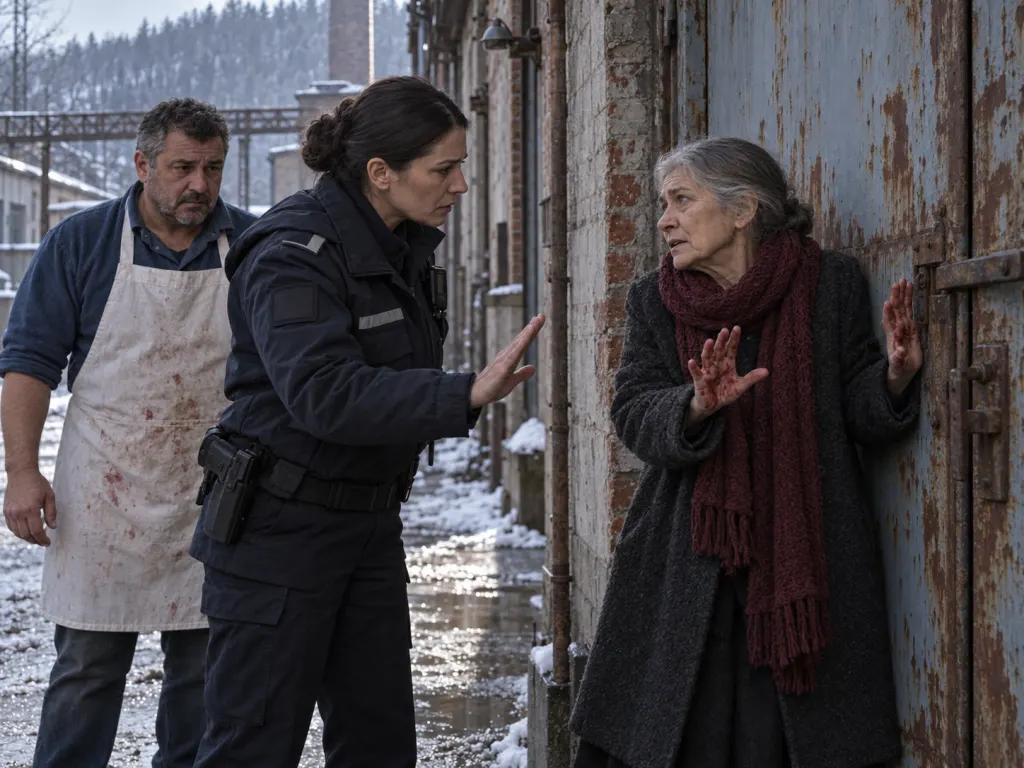
They found Lidia beside a metal door at the back of the main warehouse. Her bags were empty. Her hands were wet to the wrists. The cut on her knuckle had opened again, and blood had mixed with meat juice until Ovidiu could not tell which was which.
"Mrs. Marcu," Mara said, "step away from the door."
Lidia shook her head.
From inside came a sound.
Not a growl, not a cry, not anything the town would have enjoyed guessing. It was a human cough, muffled by metal, followed by a child's thin voice saying, "Bunica?" Grandmother?
Lidia closed her eyes as if struck.
"Please," she said. "Do not come in angry."
Chapter 5: Behind the Locked Door
The second patrol car arrived with two officers and a pry bar. Mara tried the handle first. Locked from inside. She knocked, announced herself, waited. There was a shuffling behind the door, then silence.
"I need to see who is in there," she said to Lidia.
"They will run."
"Why?"
Lidia pressed both palms to her scarf. "Because everyone runs when help wears boots."
Mara looked at the door, then at the old woman. Something in her face changed. It was not softness exactly. It was attention freed from suspicion.
"Tell them my name," Mara said. "Tell them I am not here to hurt them."
Lidia turned toward the metal and spoke through it, her voice breaking into a language of comfort older than explanation. "It is all right. Open a little. Just a little. I am here."
The bolt dragged. The door opened the width of a hand.
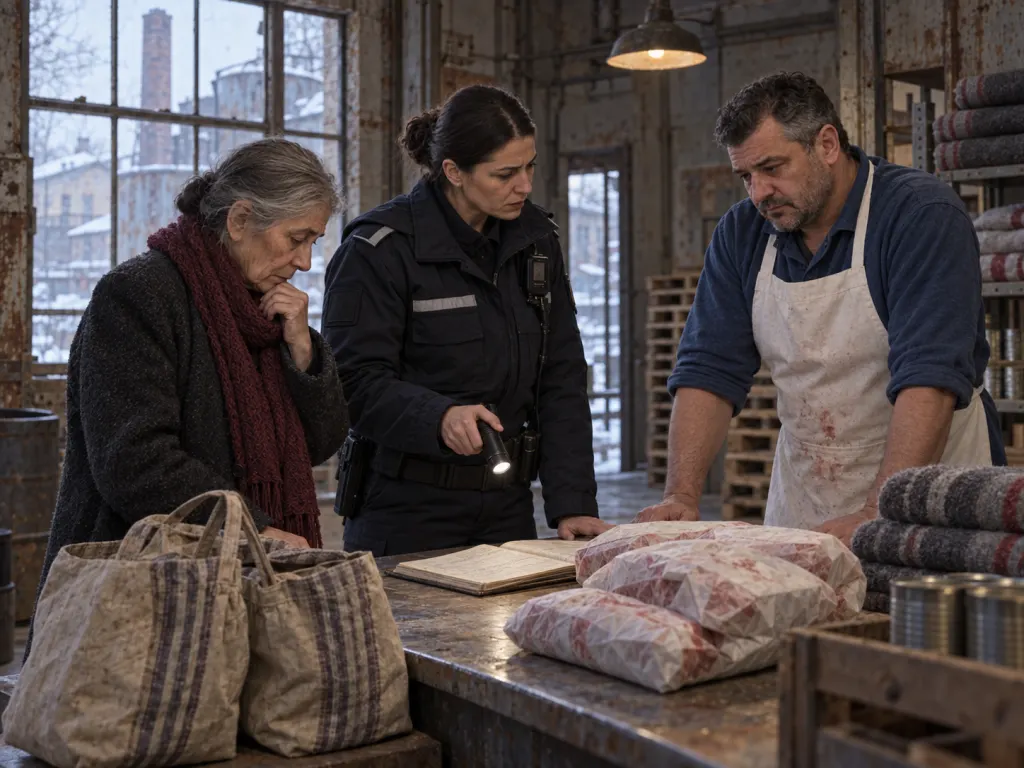
The smell rushed out first: raw beef, wet concrete, kerosene, wool coats, fear. Mara eased the door wider. Her flashlight crossed the room and found faces. Not criminals. Not a secret business. Not the nightmare gossip had built with such confidence.
There were eleven people inside the old cold room: three elderly men, two women, four teenagers, and two children wrapped in blankets near a camping stove that was not lit. Along the wall stood plastic bins packed with ice and wrapped parcels of beef. On a table, onions, carrots, salt, dented pots, and a ledger had been arranged with almost ceremonial order. The far corner held mattresses raised on wooden pallets against the damp.
No one spoke.
Ovidiu's first clear thought was absurdly practical: there was not enough ventilation for cooking. His second was worse: he had sold her meat while she carried an entire hidden household on her back.
Mara lowered her flashlight. "Is anyone hurt?"
A boy of about sixteen stepped forward. Thin face. Blue sweater too short at the wrists. "No."
"Are you being kept here?"
"No."
"Then why are you locked in?"
The boy glanced at Lidia.
She answered for him. "Because the landlord changed the locks on Stefan's building while they were at work."
The name hit Ovidiu before the meaning did. Stefan.
Lidia saw his confusion. "My son managed the old apartments on Vasile Street before he died. He promised the tenants he would fix the heating. He promised the rent would stay low. After the new owner came, the notices came too. Some had nowhere to go."
Mara's expression tightened. "Why not call social services?"
"I did." Lidia's voice went flat. "Forms. Waiting. Offices that open after hunger wakes. I am not saying this was wise. I am saying it was Tuesday, and they had eaten bread with tea for two days."
The smallest child, a girl with blunt-cut hair, lifted her blanket and whispered, "The soup is not ready."
That was when Ovidiu understood the sixty kilos. Not a banquet for the dead. Not a crime. A reckless, stubborn, hidden kitchen built out of grief and obligation.
Chapter 6: The Ledger
Mara asked everyone to sit where she could see them. She holstered her flashlight but kept the room lit by the open door. The daylight looked embarrassed to be there.
"Names," she said gently. "Ages. Any medicines, injuries, missing documents, anyone expected somewhere today."
The word "documents" made two adults go rigid. Mara noticed and did not chase it immediately. Instead she took the ledger from the table with Lidia's permission.
Inside, in columns written by a hand trained in patience, were names, portions, debts forgiven, errands assigned. Flour from Anca the baker, paid later. Potatoes from the market, donated by stall three. Blankets from Lidia's attic. Beef from Ovidiu, full price, paid in cash. At the bottom of each page, in a box, she had written one sentence: Stefan would have opened the door.
Ovidiu had to step back.
He remembered Stefan at nineteen, leaning on the butcher counter with a grin, asking for the cheapest bones because his mother made soup taste like a holiday. He remembered the funeral, Lidia standing dry-eyed while everyone else cried enough to make a performance of sympathy. He had thought her cold. Now he wondered whether her grief had simply gone underground and kept working.
Mara read three pages, then closed the ledger. "Mrs. Marcu, feeding people is not a crime. Hiding families in an unsafe building can become one very quickly, even if your reason is mercy."
Lidia flinched. "I know."
"This room has poor air. The floor is wet. You are handling large amounts of raw meat without proper equipment. Public food-safety guidance says raw meat should be kept separate and refrigerated promptly, and large quantities are especially difficult to manage outside a proper kitchen." Mara looked at Ovidiu, then back to Lidia. "The CDC says raw meat should be stored sealed and away from other foods, and cold food needs reliable refrigeration: CDC food-safety basics. I am saying this because I want everyone here to eat tonight without making things worse."
"Then let me cook," Lidia said.
"Not here."
The boy in the blue sweater stood. "You will separate us."
Mara's jaw moved once. "I will try not to."
"Try is what people say before they fail."
No one corrected him. Children learn adult disappointments before adult vocabulary.
Lidia reached for the boy's sleeve. "Andrei."
He pulled away, not cruelly, but because fear needs somewhere to put its hands.
Ovidiu heard himself say, "I have a kitchen."
Everyone turned.
"At the shop," he continued, already seeing the impossibility and the path through it at once. "Not for a crowd, but for preparation. Stainless tables. Sinks. Refrigeration. I know the church hall has burners for festivals. If Mara can make calls, if Anca has bread, if the market has vegetables that won't sell by evening, we can make stew somewhere legal enough for tonight."
Mara studied him. "Legal enough is not a category."
"Then make one."
For the first time all morning, Lidia looked at him as if he had opened a window.
Chapter 7: How a Town Changes Its Mind
Nothing became simple after that. People like stories where a door opens and truth fixes everything. In real life, truth mostly gives everyone more work.
Mara called the municipal office, then called again in a voice that made clerks sit straighter. A community worker arrived with a folder and the expression of someone who had inherited an emergency from five departments at once. The church caretaker unlocked the hall after swearing he had no authority and then producing six keys. Anca the baker sent bread in plastic crates and came herself because she did not trust anyone else to slice it evenly.
Ovidiu drove the beef back to his shop in three trips. Lidia tried to lift bags until Mara took them from her hands and said, "You have carried enough for one morning." The old woman looked ready to argue, then saw the blood dried around her nails and lowered her arms.
At the shop, Ovidiu worked as he had never worked for profit. He trimmed, cubed, labeled, chilled, washed, and washed again. He wrapped what could be saved and discarded what had warmed too long, though each lost piece made Lidia close her eyes. He did not scold her. He only explained, quietly, that federal guidance says perishable food should not sit out too long and leftovers need prompt chilling in shallow containers, the kind of rule that sounds fussy until many people depend on it: USDA FSIS leftovers and food safety.
"I thought if I kept buying fresh," Lidia said, "fresh would be enough."
"Fresh is a beginning," Ovidiu said. "It is not a plan."
She nodded, accepting the sentence like a deserved bill.
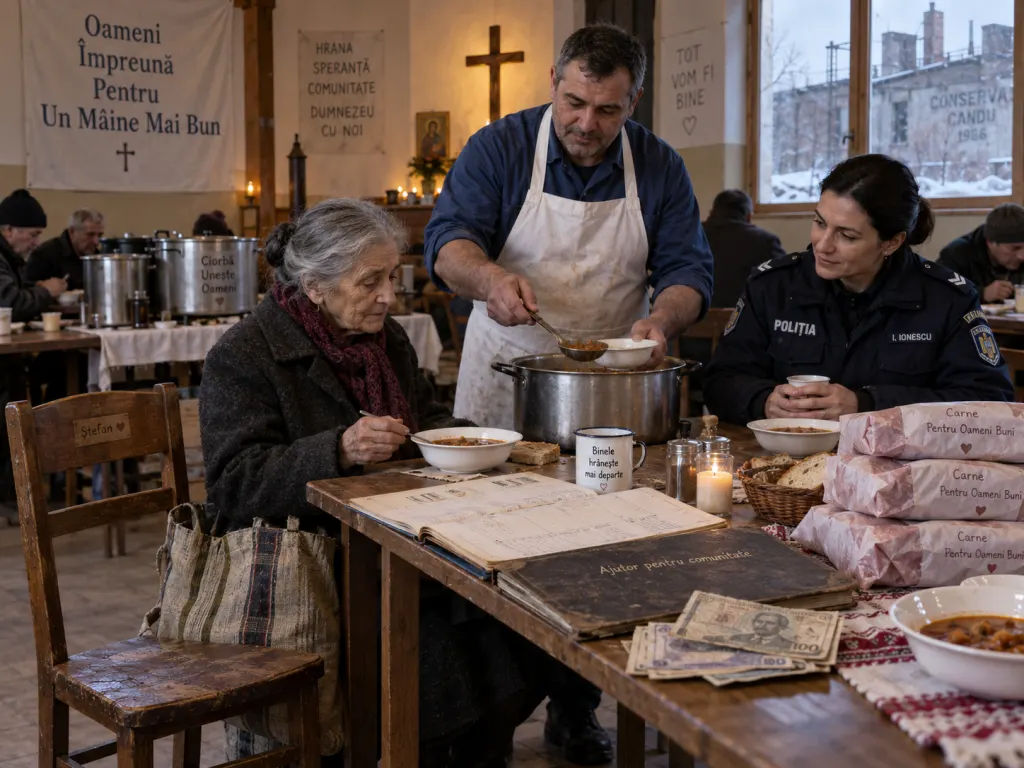
By late afternoon the church hall smelled of onions softening in oil, broth, bread, and wet coats drying over chair backs. The people from the cannery sat at long tables under fluorescent lights that made everyone look tired but visible. Visibility itself seemed to frighten them. The two children stayed near Lidia, their bowls held carefully in both hands.
The town arrived in stages.
First came the curious, pretending to deliver something. Then came the ashamed, carrying rice, apples, soap, clean socks. The lottery man appeared with three bags of potatoes and would not meet Ovidiu's eye. The pharmacist brought boxes of bandages and spoke to no one for once. Someone had written online that the cannery had hidden monsters. Someone else posted a photograph of the children at the church door. Mara saw it, found the person, and made the photograph disappear with a calm so sharp it left marks.
At six, the new owner of the Vasile Street apartments arrived in a black car and a camel-colored coat, smelling faintly of expensive cologne and inconvenience. His name was Doru Stan, and he had the polished impatience of a man used to doors opening before he touched them.
"Sergeant," he said, "I hear my tenants are being encouraged not to meet their obligations."
The hall went quiet.
Lidia stood so quickly her chair scraped backward. Ovidiu expected anger. Instead her voice came out formal, almost courtly.
"My son believed a roof was not a luxury."
Doru glanced at her. "Your son is not managing the property."
"No," Lidia said. "But his promises are still alive in people who trusted him."
"Promises do not pay boilers."
Andrei rose from the table. Mara stepped between him and Doru before the boy could move.
"This is now a municipal matter," she said. "You can discuss notices, locks, and habitability with the proper office tomorrow."
"Habitability," Doru repeated, amused. "Big word for unpaid rent."
The community worker, who had looked overwhelmed all day, straightened then. "And an accurate one. We will document conditions in the building in the morning."
Doru's smile thinned. For the first time, he seemed to count the room correctly: the officer, the worker, the butcher, the baker, the tenants, the witnesses, the bowls of stew that had turned hunger into testimony.
He left without taking off his gloves.
Chapter 8: Stefan's Chair
Lidia did not eat until everyone else had. She moved from table to table with bread, with napkins, with the anxious tenderness of someone who could not sit beside her own good deed. When the pots were nearly empty, Ovidiu found her in the small kitchen at the back of the hall, washing a ladle that was already clean.
"You lied to me," he said.
Her shoulders tightened. "Yes."
"About Stefan."
She put the ladle down. "I do not know how to speak of him in the past tense. Some mornings I can. Some mornings the grammar refuses."
Ovidiu leaned against the counter. He had no tidy answer for that.
"When those families came to me," she said, "I heard him before I heard them. I heard what he would have said. Mama, you have space. Mama, you have soup pots. Mama, do not close the door." A small, humorless smile touched her mouth. "He was bossy when he was kind."
"You could have asked."
"Whom?"
"Me."
She looked at him then, and the shame in her face made him wish he had chosen another word.
"The first day I was afraid," she said. "The second day I was embarrassed. The third day everyone was watching. By the fourth, asking felt like confessing not only that I had made a mistake, but that I had mistaken myself for someone stronger."
Ovidiu thought of all the times he had sold meat for weddings, baptisms, funerals, holidays. He had always believed the counter divided giver and receiver neatly. Customer there, butcher here. Need measured, priced, wrapped. But Lidia had brought him a different arithmetic: sixty kilos of beef, eleven people, six years of grief, one dead son's unfinished promise.
"You are strong," he said. "You are also not a refrigerator truck."
To his relief, she laughed. It was small and cracked, but it was laughter.
Mara appeared in the doorway. "Temporary lodging is arranged for tonight. Not perfect. Better than the cannery. Tomorrow will be paperwork."
"Paperwork is warmer than concrete," Ovidiu said.
"Barely," Mara replied.
Lidia wiped her hands on a towel. "Will they be split apart?"
"Not tonight. After that, we fight for better." Mara's face softened. "And you, Mrs. Marcu, are going home. A medic should look at your hand."
"It is a scratch."
"It is an order disguised as concern."
"You are very young to speak like my mother."
"I have been practicing."
Ovidiu drove Lidia home after the hall was cleaned. Her house stood at the end of a narrow lane behind a quince tree. Inside, the front room was tidy and cold. A framed photograph of Stefan sat on a sideboard: dark hair, crooked grin, one arm thrown around his mother. In front of the frame was an empty chair.
Lidia saw Ovidiu notice it. "I set tea there on his birthday," she said. "It is foolish."
"No," Ovidiu said. "It is a chair."
She touched the back of it, fingers resting where a shoulder might have been. "I thought if I helped the people he failed to finish helping, I could keep him near without admitting he was gone."
"Did it work?"
She considered this honestly. "For moments. Then the meat thawed, the children were cold, the money ran low, and grief became a poor manager."
Outside, a car passed slowly and continued down the lane. Lidia did not flinch this time.
Before Ovidiu left, she reached into her purse and removed the last folded notes. "For what I owe."
He closed her fingers around them. "Tomorrow we start a list. Donations, proper storage, proper kitchen, proper help. Tonight you sleep."
"You sound like Stefan."
"Then I apologize. You said he was bossy."
Her smile trembled. "He was also usually right."
Chapter 9: Sixty Kilos, Divided
The story changed as it traveled, because stories always do. By the next week, some people claimed they had known all along Lidia was feeding families. Others insisted they had never said anything unkind. The town, which had built a monster from silence, began building a legend from the same material.
Lidia disliked both versions.
"I was frightened," she told anyone who tried to praise her too loudly. "I was foolish. I needed help and hid from it. Do not make a statue from that."
But something had shifted. The church hall opened three evenings a week through winter. Ovidiu arranged discounted orders and refused cash when donations covered them. Anca kept a bread crate near her oven labeled simply extra. Mara learned the names of every family from the cannery and used them with care. The community worker, who had once seemed buried under forms, proved stubborn in the useful way and found emergency housing, then longer arrangements, then legal aid.
None of it looked like a miracle. It looked like phone calls. It looked like signatures. It looked like Ovidiu teaching Andrei how to sharpen a knife safely in the shop after school because the boy needed money and also somewhere to stand where adults did not talk around him. It looked like Lidia sitting at a table with two children and peeling carrots slowly while they told her which fairy tales were boring.
One Friday, Doru Stan came to the butcher shop. He did not buy anything. He stood under the bell, face stiff, and told Ovidiu he was being unfairly treated by public opinion.
Ovidiu thought about offering sympathy. Then he thought better.
"Public opinion is not my department," he said. "Stew meat is."
Doru left.
Spring came thinly that year. Snow withdrew from the gutters. The forest road dried. Grass pushed through cracks in the cannery yard, bright as fresh paint. The metal door at the back of the warehouse was welded shut by order of the municipality, and someone painted over the old smears on the concrete. The place remained ugly, but less hungry.
On the anniversary of Stefan's death, Lidia did not set tea by his chair. She brought the chair to the church hall.
Ovidiu saw her carry it in both arms, stubborn as weather, and hurried to help. She let him take one side. Together they placed it at the end of the longest table. No photograph, no candle, no speech. Just a chair in a room full of people eating.
"Is this all right?" she asked.
Andrei, taller now somehow, set a bowl in front of the empty place. "He opened the door," he said.
Lidia sat down beside the chair. She did not hide her tears. That was new too.
Reflection: What Was Really Hidden
People later remembered the number because numbers are easy to hold. Sixty kilos of beef. Four mornings. Eleven people behind a locked door. But the truer weight was harder to measure: a promise left unfinished, a mother trying to feed the shape of her loss, a town learning that suspicion can be a lazy form of attention.
Lidia had hidden people, yes. She had also hidden her need for help. Ovidiu had hidden behind worry until worry forced him to act. Mara had hidden nothing, which was why frightened people eventually believed her. By the end, the secret was not that terrible things can happen in abandoned places. Everyone already knows that. The secret was that mercy, left alone too long, can become dangerous from exhaustion.
What saved them was not one heroic gesture. It was the moment enough people stopped guessing and started carrying what they could: a crate of bread, a phone call, a key, a pot, a name spoken gently, a chair brought back into the room.
Wrap-Up
In this fictional story, Lidia's alarming daily purchase turns out to be a desperate attempt to shelter and feed people connected to her late son's unfinished promises. The discovery forces her town to trade gossip for responsibility.
Frequently Asked Questions
- → Is this story based on a verified real event?
No. This article is presented as original fiction. The characters, dialogue, and events are invented.
- → Why include food-safety references in a fictional story?
The plot involves large amounts of raw beef, so the story includes brief neutral background from public food-safety guidance where it helps the scene feel grounded.