 Save
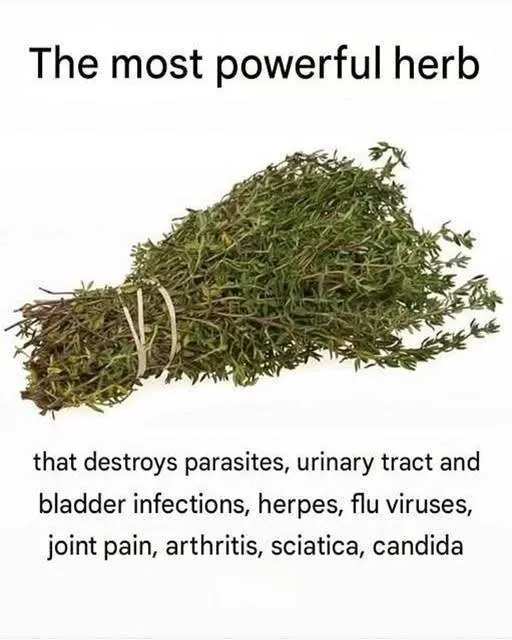
The photo shows a tied bundle of small-leaved herbs, but it does not establish that the plant can cure the conditions printed around it. Its appearance suggests thyme; a species identification cannot be confirmed from this image alone. This article examines the same viral image shared on Facebook, including its claims about parasites, urinary and bladder infections, herpes, flu, joint pain, arthritis, sciatica and Candida.
About the image: We reproduce the original graphic so readers can recognize the post being discussed. The medical claims printed on it are unverified claims being examined, not treatment advice or an endorsement.
What herb is actually in the photo?
The tiny, closely spaced leaves and thin woody stems resemble thyme. North Carolina State Extension describes common thyme as having very small leaves and semi-woody stems. University of California guidance describes oregano as a shrubby herb with oval leaves. These references help explain the visual comparison; neither identifies this particular photograph.
The graphic gives no botanical name, label, scale or close-up detail. Dried herbs can also be difficult to distinguish. We therefore cannot confidently call the bundle oregano, thyme or rosemary. It would be misleading to treat an oregano-oil article as a confirmed explanation of this plant. Do not use an internet photograph to identify a plant for ingestion.
Does the picture demonstrate a powerful cure?
No. A photograph of a herb is not evidence of its effectiveness against a disease. The graphic does not name a tested preparation, a human study, a dose or a measured outcome. It also groups together infections, joint conditions and nerve pain, which do not share one diagnosis or one treatment.
Oregano research is sometimes cited alongside this image. A review of Origanum research describes plant compounds such as carvacrol and thymol and a range of laboratory and preclinical findings. It also says that conclusive evidence is still needed for clinical applications. Activity against an organism in a laboratory does not establish that swallowing a herb, tea or essential oil will treat an infection in a person.
What is known about thyme?
Thyme has an established culinary use, and certain thyme preparations have a history of medicinal use. The European Medicines Agency assessment of thyme herb recognizes traditional use for productive, chesty coughs associated with colds. The agency explains that clinical trial evidence is insufficient for firm conclusions. That limited traditional-use finding is not proof that thyme eliminates influenza viruses or cures the other conditions on the graphic. It also cannot be transferred automatically to an unidentified bundle or a homemade oil mixture.
Checking the infection claims on the image
Urinary tract and bladder infections: A bladder infection is one type of urinary tract infection. CDC guidance explains that these infections commonly involve bacteria and are treated with appropriate antibiotics after assessment. This photograph provides no evidence that the pictured herb can replace that care. Burning when urinating, frequent urination or blood in the urine warrants medical advice; fever, chills or pain in the side or back can indicate a more serious infection.
Herpes: CDC explains that genital herpes has no cure, although antiviral medicines can help manage outbreaks. The image does not establish that a herb can eradicate herpes. Do not apply concentrated essential oils to genital tissue or sores as an improvised treatment.
Flu: Relief of a cough is different from treating influenza. CDC flu guidance describes prescription antiviral treatment, especially for people at increased risk or with severe illness. A claim that an unnamed herb destroys flu viruses is not supported by the image or by the thyme traditional-use assessment.
Parasites: Different parasites require different investigations and treatment. CDC notes that testing depends on the suspected infection and that no single blood test detects every parasitic infection. The graphic does not identify any parasite or provide clinical evidence for treating it.
Candida: Candida is a yeast; an infection caused by it is called candidiasis. CDC treatment guidance describes antifungal medicines selected according to the infection and its severity. The image supplies no basis for replacing those treatments with the pictured herb.
What about joint pain, arthritis and sciatica?
These claims require separate evidence too. Arthritis includes different joint conditions, while sciatica involves irritation or compression of the sciatic nerve. They are not simply germs that a herb can destroy. The graphic offers no clinical evidence that the bundle treats these problems, and an antimicrobial laboratory result would not establish such a benefit.
A cooking herb is not the same as an essential oil
A food ingredient, an herbal medicine and an essential oil are different preparations. Poison Control warns that misused essential oils can cause poisoning, skin reactions and other harm. Some are dangerous if swallowed, and products vary in composition. Do not swallow essential oil or apply it to damaged skin based on this post. Follow product directions and discuss medicinal use with a qualified health professional, especially when taking medicines or considering use for a child.
What readers can take from this photo
The honest identification is a thyme-like herb bundle, with the species unconfirmed. The honest evidence assessment is that this image does not substantiate its broad treatment claims. The same photo can introduce a useful discussion of herbs, but it cannot establish a cure. For symptoms of an infection, persistent joint pain or nerve pain, seek an assessment appropriate to the problem.
Correction, October 19, 2026: An earlier version focused on oregano oil without establishing that oregano was the herb in the Facebook image. This revision uses the original image, makes the identification uncertainty explicit and addresses the conditions printed on the graphic.
Frequently Asked Questions
- → Is the herb in this picture definitely oregano?
No. Its small leaves and woody stems resemble thyme, but the species cannot be confirmed from the photograph. The earlier oregano identification was not established.
- → Does the article endorse the claims printed on the image?
No. The original image is reproduced for identification and discussion. Its broad treatment claims are not substantiated by the graphic or the evidence reviewed here.
- → Does traditional use of thyme for coughs prove that it cures flu?
No. Traditional use for a chesty cough associated with a cold is different from clinical evidence that a preparation treats influenza or eliminates its virus.
References
This content was developed and refined using reliable sources.
- https://plants.ces.ncsu.edu/plants/thymus-vulgaris
- https://ipm.ucanr.edu/home-and-landscape/oregano
- https://pubmed.ncbi.nlm.nih.gov/32789910
- https://www.ema.europa.eu/en/medicines/herbal/thymi-herba
- https://www.cdc.gov/uti/about/index.html
- https://www.cdc.gov/herpes/about/index.html
- https://www.cdc.gov/flu/treatment/index.html
- https://www.cdc.gov/parasites/testing-diagnosis/index.html
- https://www.cdc.gov/candidiasis/treatment
- https://www.nhs.uk/conditions/arthritis
- https://www.nhs.uk/conditions/sciatica
- https://www.poison.org/articles/essential-oils