 Save
Fiction note: This is an original fictional story. General background details about homelessness reporting and estate language were checked against public reference pages, including HUD's AHAR overview on national homelessness estimates, Cornell Law School's Legal Information Institute pages on probate, wills, and beneficiaries. The characters and events below are invented.
Chapter One: Rain on the Sunroom Glass
The night Daniel Marr first saw the inside of Evelyn Whitmore's house, his socks were wet through, his left shoe made a soft clicking sound at the heel, and the rain had found the torn seam in his jacket as if it had been looking for him personally. He stood on the braided rug inside her back door and tried not to drip on anything expensive.
"Leave the shoes there," Evelyn said, pointing with the steady authority of someone who had spent seventy-one years deciding what belonged where. "The rug has seen worse than weather."
Daniel looked down. The rug was old but clean, patterned in blue and red loops. Nothing in the room looked as if it had seen worse than weather. Copper pans shone above the stove. A jar of wooden spoons sat beside a bowl of lemons. Beyond the kitchen, a sunroom held wicker chairs, a wall of framed photographs, and a porch swing visible through rain-streaked glass.
He had come to her house because her mailbox had fallen off its post and he had been the person standing nearest when she tried to lift it. He had fixed it with two borrowed screws and a little theater: narrowed eyes, rolled sleeves, the air of a man useful enough to be missed. Evelyn had invited him in for tea. Daniel had almost laughed. Tea belonged to people whose lives contained intervals. He had a van with a cracked windshield, a duffel bag, three overdue notices, and a phone that no longer rang because no one expected him to answer.
But warmth rolled from the kitchen. The rain struck the windows. He followed her in.
She gave him soup in a white bowl and did not ask the questions people usually asked when they wanted to feel kind without becoming involved. Where are your people? How long has it been like this? What did you do wrong? Evelyn only pushed a folded towel toward him and said, "There is no virtue in shivering while soup cools."
Daniel watched her hands as she poured tea. They were fine-boned, marked with age, and entirely unhurried. On one finger she wore a wedding band thinned by time. The house was too large for one woman. He noticed that first because noticing value had become a habit in him. Silver picture frames. Good rugs. Solid cabinets. A grandfather clock with a brass moon face. A home with rooms no one was using.
By the time he finished the soup, Daniel had already begun to count what she had in square footage.
Chapter Two: A Practical Arrangement
For three weeks, Daniel performed small repairs and pretended not to need what Evelyn offered. He rehung a pantry door. He patched a torn screen. He tightened the loose rail on the porch steps while she sat nearby with her cardigan buttoned wrong and corrected him when he cursed under his breath.
"Words are tools," she said. "Use better ones."
"You got a list of approved words?"
"Yes. It begins with please."
He slept on her sofa twice, then four times, then every night for a week during a cold snap that glazed the gutters silver. Evelyn made no announcement about it. She simply placed clean sheets in the sunroom and left a lamp on. Daniel told himself she was lonely and he was convenient. That made accepting easier. A lonely woman wanted company; a broke man needed shelter. The world ran on trades more honest than most people admitted.
At twenty-five, he had learned to distrust anything that called itself help. Help had terms. Help kept receipts. Help wanted gratitude performed on command. But Evelyn's help arrived like weather: soup, socks, a spare key on a blue ribbon, a tin of coffee set out before he woke.
One April evening, she found him in the garage staring at her late husband's workbench. The place smelled of cedar dust and machine oil. Pegboards held chisels and clamps in orderly rows. A table saw sat under a canvas cover. Daniel ran his thumb along a plane as if it were an artifact from a better civilization.
"Arthur built our kitchen table on that bench," Evelyn said from the doorway.
"I wasn't touching anything."
"You were touching longing. That is allowed."
He looked away. "I used to like making things."
"Then make something."
She asked him to marry her two months later, while they shelled peas at the kitchen table. Daniel dropped three peas into his lap.
"That is not a proposal face," Evelyn said.
"Evelyn."
"I know exactly how old I am."
"People will talk."
"People talk when they lack material."
He laughed because she did, and because the idea was outrageous, and because somewhere beneath the outrage he could hear a door opening. Marriage meant permanence. Marriage meant the house could someday be his if she wrote it so. Marriage meant he could stop sleeping with one ear tuned for police knocking on van glass.
He said yes three days later, after pretending to think about it for reasons that made him feel less naked.
Chapter Three: Caroline at the Gate
Caroline Vale arrived before the wedding with a lawyer's posture and Evelyn's cheekbones sharpened into suspicion. She was Evelyn's niece, forty-two, dressed in charcoal wool though the day was warm. Daniel was trimming the hedge when she stepped out of a black sedan and looked at him as if he were already evidence.
"You must be Daniel," she said.
"Depends who's asking."
"Someone who loves my aunt."
The hedge clippers felt suddenly childish in his hand.
Inside, voices rose and fell. Daniel did not mean to listen. He listened anyway.
"He's twenty-five," Caroline said.
"Yes," Evelyn answered.
"He has nothing."
"That is not a character defect."
"It becomes one when he marries a woman with everything."
The silence afterward was clean and dangerous. Then Evelyn said, "Caroline, you may be right about his beginning. You are wrong if you think beginnings are the only part of a person."
Daniel stood in the hall with hedge leaves stuck to his sleeves and felt the first honest shame he had allowed himself in years. Not because Caroline was wrong. Because she had said aloud what he had been careful to keep wordless. He was not marrying Evelyn for love. He liked her, yes. He respected her in the irritated way one respects weather that refuses prediction. But he was marrying shelter. He was marrying time. He was marrying the possibility that kindness could be converted, eventually, into an address.
The wedding took place in Evelyn's garden under a trellis of climbing roses. Seven people attended. Caroline came, stood stiffly, and kissed Evelyn on the cheek after the vows. When she reached Daniel, she offered her hand.
"Do not make me right," she said.
He smiled as if insulted. "I don't know what you mean."
"That is what worries me."
Chapter Four: The Work of Staying
Marriage to Evelyn did not become what Daniel expected. He had imagined softness, ease, the gradual transfer of control. Instead, she put him to work. Not as punishment. As if work were a form of invitation.
Every morning at eight, she opened the garage and set coffee on the workbench. Daniel began by sanding scrap pine, then repairing a broken drawer, then building a bookcase for the parlor because Evelyn said the leaning stacks of novels looked like a city after a mild disaster. He ruined the first bookcase. One shelf tilted like a grin. Evelyn placed three cookbooks on it and said, "Even bad shelves can hold something until better shelves arrive."
She found an evening carpentry class at the community college and slid the brochure across the table. Daniel pushed it back.
"Too expensive."
"I asked about tuition help."
"You asked?"
"I have a telephone and opinions."
He stared at the brochure. The course title was plain, almost stern: Fundamentals of Residential Carpentry. He wanted it so badly that wanting felt like humiliation.
"Why are you doing this?" he asked.
Evelyn folded her hands. "Because you look less haunted when your hands know what they are doing."
During those years, Daniel learned how wood could argue and yield. He learned to measure twice because impatience had a cost. He learned that oak resisted dull blades, that walnut darkened under oil, that cheap screws stripped when forced. Evelyn sat in the garage doorway and read mystery novels while he worked. Sometimes she fell asleep with the book open against her sweater. Sometimes she woke and caught him watching her.
"What?" she would ask.
"Nothing."
"Nothing is a crowded word."
He began to tell her things in pieces: about his father leaving, his mother losing the apartment, the first night he slept in the van behind a closed laundromat because the dryers vented warm air. He did not tell it for pity. Pity had teeth. He told it because Evelyn listened without rearranging his pain into a lesson.
Years passed by quiet accumulation. A repaired chair. A passed exam. A winter when Daniel no longer checked Evelyn's breathing from the doorway with the secret arithmetic of inheritance ticking in him. He stopped calculating what her death might solve. The thought, when it returned, made him grip the sink until his knuckles paled.
One morning, he found Evelyn in the garden holding pruning shears but not moving. The roses trembled in a thin wind.
"You all right?" he asked.
She smiled without turning. "I was thinking that people imagine love as rescue. Mostly it is repetition."
"Sounds exhausting."
"It can be. So is breathing. We keep at it."
Chapter Five: Three Days in June
Evelyn collapsed in the kitchen on a Wednesday in June. Daniel heard the cup break before he heard her body touch the floor. For years afterward, the sound of porcelain cracking could still empty his chest.
He rode beside her in the ambulance and gave answers he barely understood giving. Name. Age. Address. Known contacts. At the hospital, fluorescent light flattened everyone into worry. Caroline arrived with wet hair and no makeup, her face stripped of all courtroom armor. For once, she did not look at Daniel as an intruder. She looked at him as the only other person who understood the size of the room Evelyn had left behind by being temporarily absent from it.
On the second day, Evelyn woke long enough to recognize him. Daniel leaned close. Her hand, when it found his, was light but decisive.
"Have you eaten?" she whispered.
He made a sound that was not a laugh. "That's what you're asking me?"
"Answer."
"No."
Her eyes closed, but her fingers tightened once. "Still stubborn."
Caroline turned away toward the window. Daniel watched Evelyn's mouth soften around a breath and understood with animal certainty that he was not ready. It did not matter. Readiness had no influence over leaving.
The funeral was held under a sky so blue it felt rude. People Daniel did not know touched his arm and told him Evelyn had been generous, brilliant, impossible, the best neighbor on Maple Street, the only woman who could correct a mayor's grammar during a fund-raiser and leave him grateful. Daniel nodded until his neck hurt.
Caroline stood beside him at the grave. When the first soil struck the coffin, she flinched. Daniel reached for her elbow without thinking. She did not pull away. That small permission nearly undid him.
Three weeks later, they sat in the office of Mr. Hale, Evelyn's attorney. The room smelled of paper, leather, and lemon polish. A wall clock counted each second with courtroom precision. Daniel wore the only suit he owned, a navy one Evelyn had bought for his certification ceremony. It no longer fit perfectly. His shoulders had broadened from work.
Mr. Hale explained the will in a careful voice. The house went to Caroline. Certain savings were divided among charities Evelyn had supported for years. The garage tools were to remain with the property unless Caroline chose otherwise. Daniel received no money, no house, no furniture, no secret account hidden behind a sentimental clause.
He felt Caroline watching him. He should have felt cheated. The old Daniel would have. The old Daniel would have built an argument out of every breakfast cooked, every errand run, every night spent holding Evelyn's hand while she dozed in front of the television. But grief had burned the bargain out of him. There was nothing left to purchase with outrage.
Mr. Hale closed the folder and reached beneath his desk.
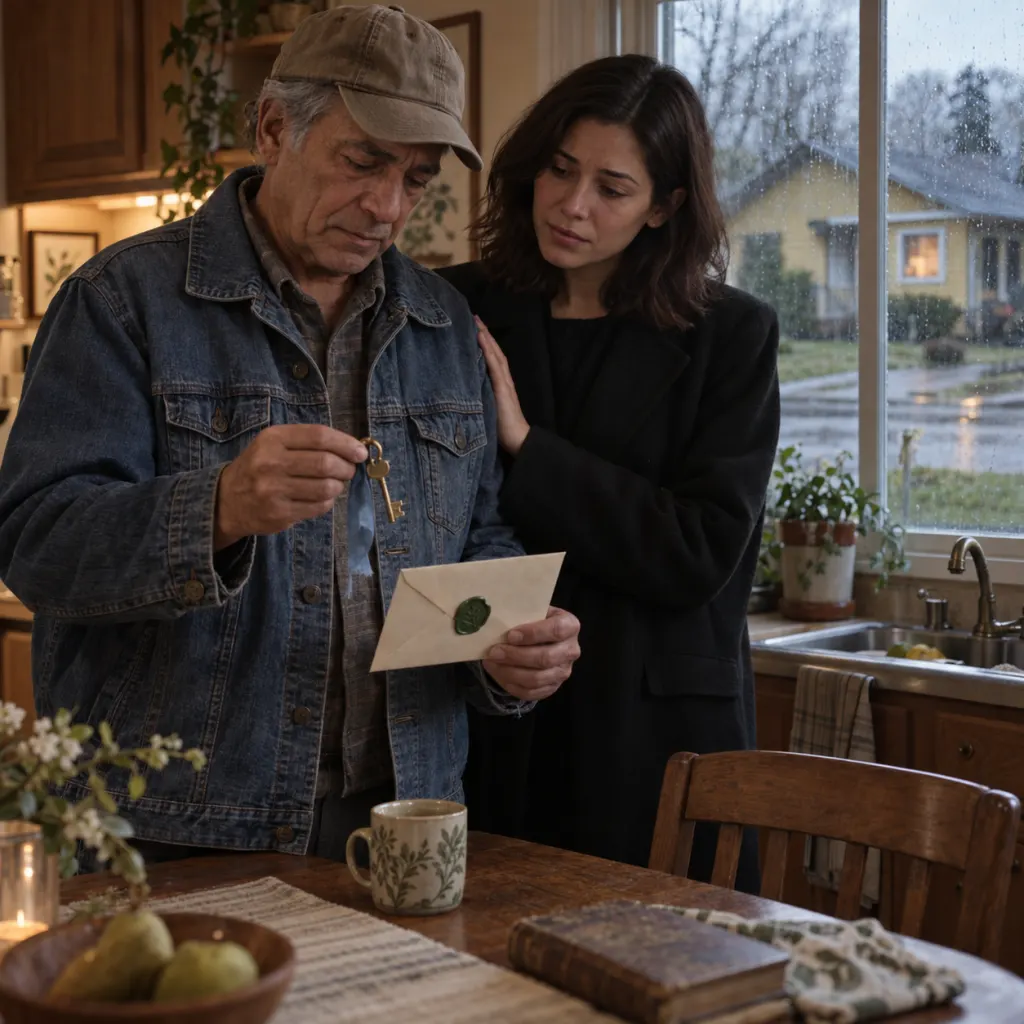
"There is one item outside the estate distribution," he said. "Mrs. Whitmore asked that I give this to you privately, though she suspected privacy would be impossible in this family."
He placed a worn shoebox on the table. Daniel's name was written on the lid in Evelyn's slanted hand.
Chapter Six: Evidence
Daniel did not open the box in Mr. Hale's office. He carried it to the garage because every important thing Evelyn had taught him seemed to have passed through that room first. Caroline followed as far as the threshold.
"Do you want me to leave?" she asked.
He sat on the stool by the workbench. "I don't know what I want."
"That is the first believable thing you've said to me."
He almost smiled. Then he lifted the lid.
The box did not contain jewelry, bank envelopes, or a deed. It contained ordinary evidence. A receipt for the first pair of boots Evelyn had bought him, folded around a note: He pretended they were too heavy, then wore them home. A photograph of Daniel asleep in the sunroom with a woodworking book open on his chest. A crooked wooden spoon he had carved and thrown away, rescued from the trash. A program from his first student showcase. A napkin on which he had sketched the bookshelf that later stood in the parlor, corrected in Evelyn's red pen: Stronger legs. You too.
At the bottom lay an envelope.
Daniel knew her handwriting before he saw his name. He unfolded the letter with hands that had learned steadiness from chisels and failed him now.
Dear Daniel, if you are angry, let yourself be honest about it. Anger is often grief wearing boots. You married me for shelter. I knew that before you did. You were not subtle, dear. You looked at the silver like it might introduce itself.
Caroline made a small sound from the doorway. Daniel kept reading.
I was lonely, yes, but I was not foolish. I did not marry you because I mistook hunger for devotion. I married you because hunger is not the only thing a person is. I saw calculation in you. I also saw tenderness trying not to be noticed.
The letter went on. Evelyn had left the house to Caroline because Caroline had loved it before Daniel knew the address. She had left money elsewhere because she believed generosity should travel beyond one familiar grief. For Daniel, she had arranged something more exacting.
If Caroline agrees, the garage may remain your workshop for one year. Pay the utilities for that space. Keep it clean. Take nothing from the house unless invited. Finish your certification. Build enough honest work to stand elsewhere. I am not leaving you comfort, Daniel. Comfort is too easily confused with love. I am leaving you proof that you changed and a place to prove it again.
Daniel covered his face with both hands. The box sat open before him, full of receipts and scraps and the unbearable record of being seen.
Chapter Seven: Twelve Months
Caroline gave him twelve months. She did it the next morning, standing in the driveway with a clipboard because grief had made her practical to the point of comedy.
"Utilities for the garage," she said. "No entry into the house unless I invite you. No clients in the garden. No taking lumber from the storage shelves without asking. If you damage anything, you repair it or pay for it. If this becomes messy, it ends."
Daniel signed the paper.
"You don't have to do this," he said.
"I know."
"Then why?"
Caroline looked toward the porch swing where Evelyn used to sit with her tea. "Because she asked me to consider the possibility that I might be wrong eventually. I found that insulting enough to try."
The year was harder than Daniel expected. It turned out that grief did not improve bookkeeping. Clients wanted estimates, not sorrow. Wood cost more than hope. The van finally died in the parking lot of a hardware store, and Daniel spent two months cycling across town with tool rolls strapped to his back. He made shelves, benches, small tables, a cradle for a couple who cried when they picked it up, and a cabinet for Mr. Hale's office that the attorney inspected with grave satisfaction.
Every invoice felt like a plank laid over water.
Caroline kept her distance at first. She came to the garage only to check meters or retrieve garden tools. Then one Saturday she stood watching him fit dovetails on a walnut box.
"You still have her teapot?" Daniel asked without looking up.
"Yes."
"Good."
"You don't want it?"
He ran a chisel along the grain. "I want too many things. I'm practicing leaving some where they belong."
At the end of the year, Daniel had enough orders to rent a narrow shop behind a florist on Mercer Avenue. It had bad lighting, one stubborn door, and a leak that appeared only during east wind. He loved it immediately.
Caroline came on his last day in the garage. The room was swept clean. The tools that belonged to the house hung exactly where Arthur Whitmore had placed them decades earlier. Daniel's own tools waited in crates.
"Evelyn would complain you over-sanded that workbench," Caroline said.
"She would be right."
Caroline looked at him for a long time. "I don't think you're pretending anymore."
Daniel swallowed. "I wish she could hear you say that."
"She probably assumed I'd get there late."
Chapter Eight: What the Box Was For
Ten years after the funeral, Daniel bought a small house with a crooked lilac tree, a cracked walkway, and a garage barely large enough for one workbench. He planted roses along the fence because he did not know how else to answer the past without making a speech. By then, Whitmore Woodworks had three employees and a waiting list that still surprised him. He hired people other shops hesitated over: a young man with court fines and a temper he was learning to name before it moved his hands; a woman who had slept in her car through most of trade school; a teenager aging out of a foster placement who measured everything three times because he feared being wrong.
Daniel did not call it charity. Evelyn had disliked grand words attached to ordinary decency. He called it payroll, training, patience, and showing up again after difficult Tuesdays.
Each June, he visited Evelyn's grave with Caroline. Their relationship had become something neither of them named because naming might make it smaller. Not friendship exactly. Not family by blood. A shared custodianship of a woman who had loved them both with inconvenient accuracy.
One year, Caroline arrived carrying a cardboard box. Daniel laughed before he could stop himself.
"If this is another test, I'm too old."
"You're thirty-eight."
"Emotionally, I am several repaired chairs."
Caroline handed him the box. Inside were Evelyn's brown teapot, two cups wrapped in dish towels, and a framed photograph of Evelyn on the porch swing, head tilted back, laughing at something outside the frame.
"She wanted me to keep these until I could give them without resentment," Caroline said. "Apparently she planned to annoy me from beyond all legal deadlines."
Daniel held the teapot as if it were warm. For a moment he was twenty-five again, wet socks on a kitchen rug, counting another person's rooms. Then he was older, standing beside a grave with a woman who had once seen through him and later chose not to look away.
"Thank you," he said.
Caroline nodded. "Use them."
"I will."
"I mean it. Don't turn them into a shrine."
He smiled. "She said the same thing about the good towels."
That evening, Daniel made tea in the small kitchen of his own house. The roses outside had not yet learned the fence, and the floorboards creaked under his boots. He set two cups on the table though he drank alone. Beside them he placed the old shoebox, its corners softened, its lid still bearing his name in Evelyn's hand.
For years, he had thought inheritance meant what passed into your possession. A house. A balance. A key. A signature on paper. Those things mattered; he knew better than to romanticize having nothing. HUD's AHAR overview describes homelessness data as a way to understand people living without stable shelter, and Daniel, though fictional, had once belonged to the fear behind such numbers. Cornell's Legal Information Institute explains wills, probate, and beneficiaries in terms of formal wishes, court processes, and named recipients. Evelyn had respected all of that. She had made the legal choices she meant to make.
But the box had taught him the part no document could complete. Some legacies do not transfer ownership. They transfer attention. They say: I saw where you began, and I refuse to let that be your only evidence.
Daniel opened the box and took out the crooked wooden spoon he had once thrown away. It was badly carved, heavy at the handle, uneven in the bowl. Evelyn had saved it anyway. He turned it in his hands and laughed softly, not because it was funny, but because he finally understood that love had not excused him. It had expected him.
In the morning, he would take the spoon to the shop and show it to his apprentices. He would tell them the truth, or as much of it as they could use: that a person could begin with the wrong motive and still become responsible for the right one. That kindness was not softness. That being seen was sometimes a burden before it became a gift.
Then he washed the teacups, dried them carefully, and left them on the shelf where ordinary things belonged.
Wrap-Up
Daniel Marr marries Evelyn Whitmore with selfish hopes, but her steady love and practical boundaries change him. After her death, he receives no fortune, only a shoebox of evidence that she saw both who he was and who he could become.
Frequently Asked Questions
- → Is The Box Evelyn Left Behind a true story?
No. This version is original fiction. It uses researched background for ordinary legal and housing context, but Daniel, Evelyn, Caroline, and the events are invented.
- → What is the main theme of the story?
The story explores inheritance as more than property. Evelyn leaves Daniel evidence, boundaries, and a chance to become accountable rather than a simple reward.