 Save
This is a work of fiction. Its events and characters are invented, but its emotional backdrop is grounded in an everyday truth: small, consistent contact can matter in a neighborhood. The CDC describes social connection as the range and quality of relationships and support around a person, and the U.S. Surgeon General's social connection framework encourages ordinary acts of service, attention, and community care. Sources: CDC and HHS.
Chapter 1: The Chair Beside the Hydrangeas
The funeral ended with rain tapping softly against the chapel windows, as if the sky had waited until the final hymn to begin its own goodbye. Mara Ellison stood between her husband and her father in the last pew, holding her black umbrella by its hooked handle, watching people she barely recognized move past the casket in careful, murmuring pairs.
Her father, Daniel, had not cried during the service. He had kept both hands folded over the program, his thumb pressed against the printed name as though he could hold it in place: Eleanor Whitcomb, 1941-2026. Neighbor. Teacher. Widow. Friend. The program was thin, too thin for the woman who had occupied the yellow house beside theirs for seventeen years and somehow made the whole street feel observed in the kindest way.
Mara remembered Eleanor first as a voice through the hedge. 'Your sprinkler is aiming at the mailbox, sweetheart.' Then as a pair of garden gloves waving over the fence. Then as the woman who knew every child's birthday, every dog by bark, every delivery driver by route, and every household by the small betrayals of its porch light. Eleanor had been the keeper of ordinary things.
But Daniel had known her differently. For almost nine years, every Saturday morning after Mara's mother died, he had crossed the strip of lawn between their houses and mowed Eleanor's yard. At first, he said he was just being neighborly. Then he fixed a loose gate. Then he replaced a porch bulb. Then he started taking coffee in her kitchen because Eleanor had begun leaving two mugs on the table before he arrived.
After the burial, the mourners gathered under the funeral home awning, all damp wool and lowered voices. Eleanor's relatives, scattered nieces and second cousins from distant cities, clustered with the alert politeness of people who had loved someone mostly by phone. Daniel stood apart from them, hat in hand, staring toward the parking lot where leaves had flattened themselves against the wet pavement.
'Dad,' Mara said softly, touching his sleeve. 'We can go whenever you're ready.'
He nodded, but he did not move. Across the awning, a lean man in a charcoal coat was watching him. He had silver hair combed neatly back and a leather folio tucked under one arm. When their eyes met, the man walked over with a caution that made Mara straighten.
'Mr. Ellison?' he asked.
Daniel looked at him. 'Yes.'
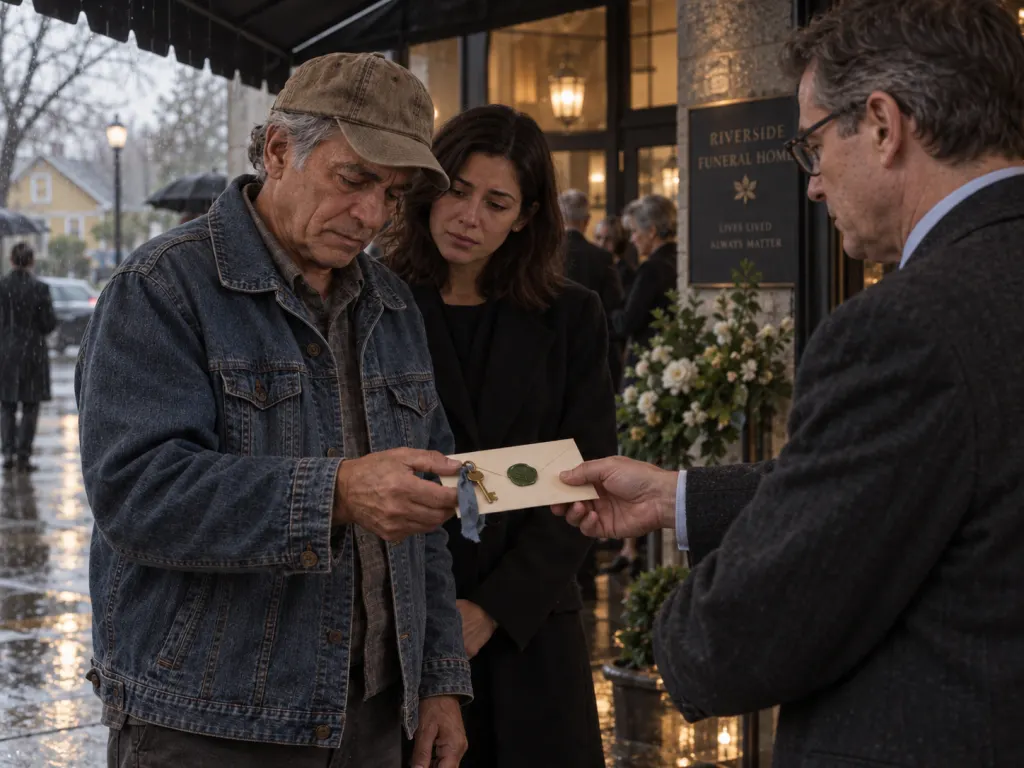
'I'm Adrian Vale. Eleanor's attorney.' He lowered his voice, not secretively, but with respect. 'She asked me to give you something after the service. Not before. Not by mail.'
From inside the folio, he withdrew a cream-colored envelope sealed with dark green wax. Daniel's name was written across the front in Eleanor's steady slant: Daniel Ellison, when everyone has gone home.
The rain seemed to quiet around them. Mara watched her father accept the envelope with both hands.
Chapter 2: The Errand That Became a Ritual
Before Eleanor became a funeral program, before the sealed envelope rested on Daniel's kitchen table like a sleeping thing, she had been the new widow in the yellow house.
Mara had been twenty-nine then, newly married and living two towns away, still raw from her mother's death and unsure how to speak to her father without reopening something in him. Daniel had retired from the county water department the previous spring. He was a practical man, happiest with a wrench in one hand and a radio muttering baseball scores nearby. Grief made him strangely tidy. He cleaned gutters that were already clean. He labeled jars of screws. He sharpened tools no one had asked him to sharpen.
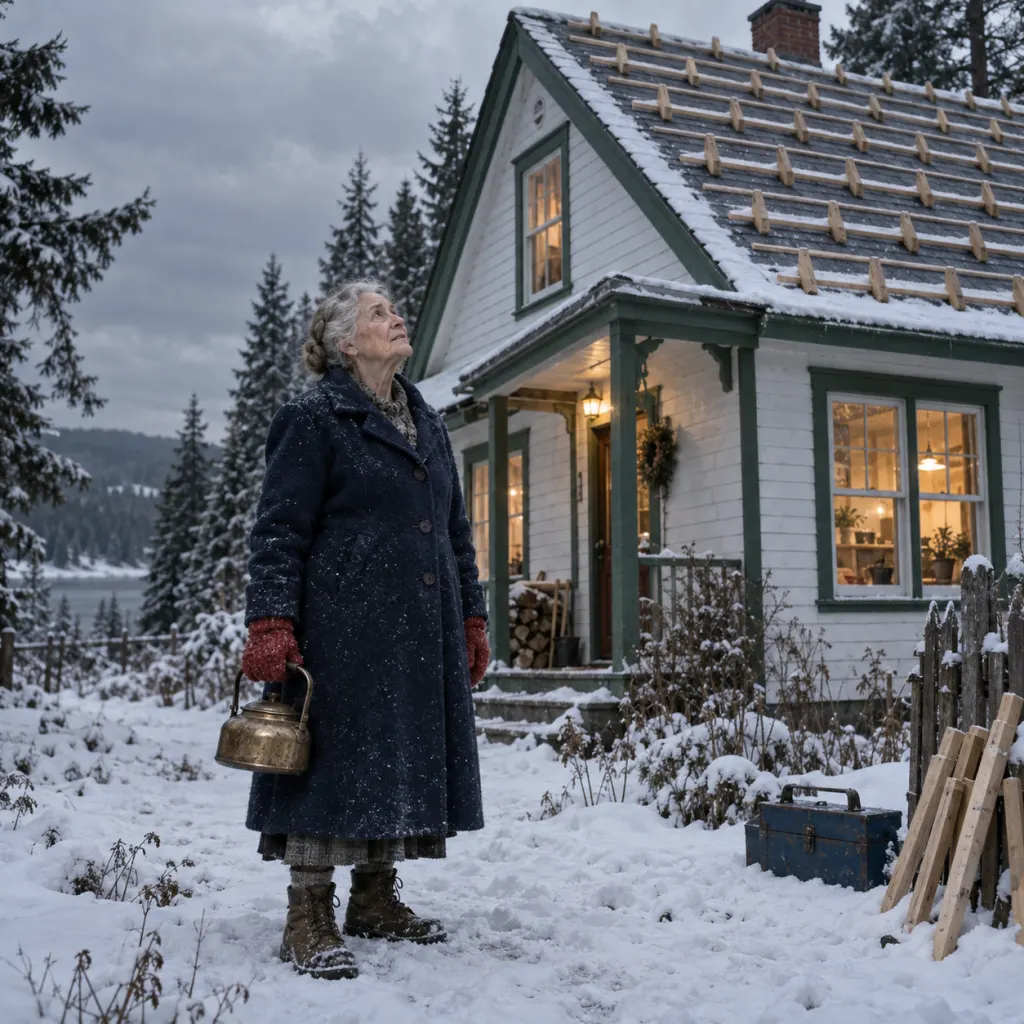
Eleanor moved in at the beginning of October. Her husband had died that summer, and the yellow house, which had belonged to her older sister, came with crooked shutters and a backyard gone shaggy at the edges. Daniel noticed the grass first. He always noticed grass, weeds, leaning fence posts, hoses left in sun. He watched Eleanor try to start an old push mower one Saturday morning until the cord snapped back so hard she staggered.
He crossed the lawn before deciding to.
'That mower's got a mean streak,' he said.
Eleanor looked at him over the top of her glasses. 'So do I, Mr. Ellison. But mine doesn't require gasoline.'
He laughed, surprised by himself. Within ten minutes he had wheeled his own mower over. Within an hour the yard was neat, the clippings swept from the walk, and Eleanor was on the porch with two glasses of iced tea sweating onto paper napkins.
'I can pay you,' she said.
'No.'
'Then I can bake.'
'That's not necessary.'
'Necessary is not the same as pleasant.'
That was Eleanor. She never argued directly when a sideways door would open. The following Saturday there was a plate of lemon bars on the porch rail. Daniel mowed. The Saturday after that there was a note in the mailbox: If you insist on refusing money, at least come in before the coffee gets rude.
Rituals do not announce themselves. They collect. A mower left by the hedge. A mug warmed before arrival. A pie cooling on the sill because Eleanor said a kitchen should have evidence. By winter, Daniel was shoveling her walk before his own. By spring, Eleanor was sending Mara home with jars of strawberry jam and unsolicited advice about planting basil near tomatoes.
At family dinners, Daniel mentioned Eleanor as if she were weather. Eleanor says the maple needs pruning. Eleanor thinks the mail carrier is limping. Eleanor found a blue jay feather by the steps. Mara heard in his voice what he did not say: Saturday has somewhere for me to go.
Chapter 3: The Envelope on the Table
Daniel did not open the envelope at the funeral home. He held it during the drive back with the caution of a man carrying hot glass. Mara drove because her father had given her the keys without being asked. In the passenger seat, he watched the wet streets slide past: the pharmacy, the closed bakery, the small park where leaves spun in the gutter.
'Do you know what it is?' Mara asked.
'No.'
'Did she ever mention leaving you anything?'
'No.'
His answer had a weight that ended the questions. They reached his house just before dusk. The yellow house next door sat dark except for the porch light, which someone had left on. For years, that light had meant Eleanor was awake. Now it only meant electricity had not yet learned the news.
Inside Daniel's kitchen, Mara made tea neither of them wanted. Her husband, Paul, busied himself rinsing cups. Their twelve-year-old son, Owen, stood at the back door staring toward Eleanor's garden.
'Can we still pick the pears?' he asked.
Mara turned. 'Not today, honey.'
'She said the high ones were mine.'
Daniel's face changed then. A small collapse, quickly corrected. He laid the envelope on the table beside the untouched tea.
'She said a lot of things,' he murmured.
For a long moment, no one sat. The kitchen smelled of raincoats, black tea, and lemon furniture polish. On the wall, the clock clicked with insulting confidence.
Finally Daniel pulled out a chair. 'Mara, stay if you want. Or don't. I don't know what she meant for this to be.'
'I want to stay,' she said.
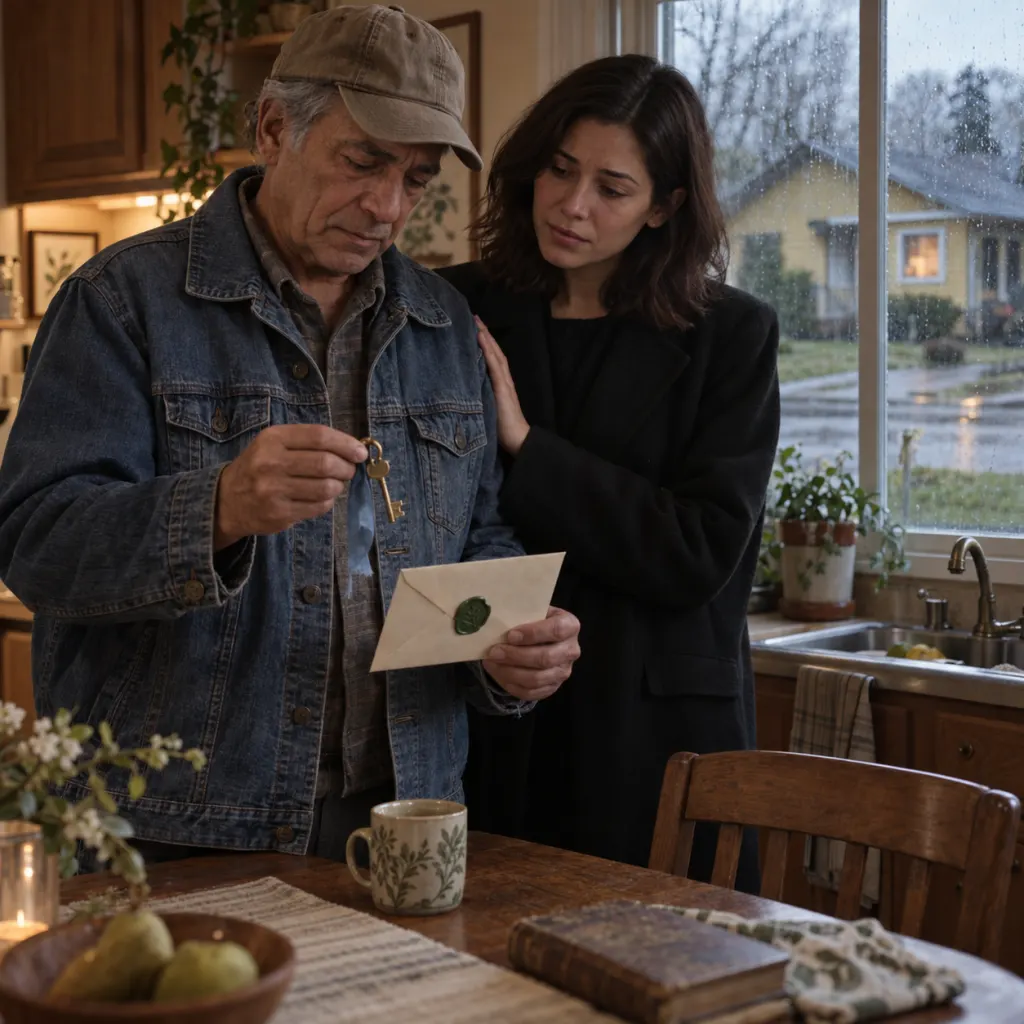
He broke the wax with his thumbnail. Inside were two folded pages and a small brass key tied with faded blue ribbon. The key dropped into Daniel's palm with a quiet tap.
He closed his fingers around it as if it had startled him.
Chapter 4: Eleanor's Letter
Daniel unfolded the pages. Eleanor's handwriting covered them in blue ink, graceful but firm, the lines rising slightly as they crossed the page. At first he tried to read silently. Then his mouth tightened, and Mara knew he could not hold the words alone.
'Read it out loud,' she said.
He looked at her, embarrassed by the relief in his own eyes. Then he began.
'Dear Daniel, if Adrian has followed directions, then I am safely beyond being scolded for making a fuss. You may scold the air if it helps.'
Owen smiled through his confusion. Daniel breathed once, then continued.
'I am leaving you the key to my back door. It is not a claim, a burden, or a legal trick. Adrian has all the proper papers, and my relatives will handle the house. This key is only what it has always been: permission to enter where you are trusted.'
Daniel stopped. The brass key lay on the table between them, dull and plain, its teeth worn smooth with use.
'When Harold died, Saturday became the longest room in my life. It had walls I could not see across. People called, of course. They meant well. They asked if I needed anything, and I did not know how to answer because the thing I needed was not a casserole or a ride. I needed the day to be interrupted before it swallowed me.'
Mara pressed her fingers to her lips.
'Then you came over with your mower and your stubborn refusal to accept money. You thought you were cutting grass. I let you think that, because men of your generation are sometimes more comfortable rescuing a lawn than rescuing a woman. Forgive me. I used your decency against you.'
Daniel gave a broken laugh. Tears stood in his eyes now, bright and unashamed.
'Every Friday evening, I looked out at the yard and decided which corner to neglect. A strip under the lilacs. The patch behind the birdbath. The little hill near the shed. I wanted there to be a reason for you to come back. Later, when you came in for coffee, I understood that you needed the reason too.'
Mara saw her father lower his head. She remembered the first year after her mother died, how his house had stayed too clean, how every conversation had sounded like a report from a distant station. Eleanor had not saved him with speeches. She had given him a weekly appointment with usefulness, then quietly turned it into friendship.
Daniel read more slowly.
'You brought me your family. You brought me Owen's school drawings, Mara's basil disasters, Paul's terrible jokes, and your own silent companionship. You let me send food back across the hedge so I could feel like I still had a table large enough for others. You never made me ask twice. You rarely made me ask once.'
Owen leaned against Mara's side. Paul looked down into the sink.
'So here is my request, and I am making it after death because you cannot argue efficiently with paper. Two houses down from mine, Walter Reed sits on his porch most afternoons. His wife, June, moved into care last year. His lawn is getting away from him. More importantly, I believe his days are getting away from him. Do not begin by offering charity. Begin with the mower. If he refuses, ask about the rosebush by the mailbox. He is proud of it. Pride is a door too.'
Daniel stopped reading. The room held its breath.
'There is more,' Mara whispered.
He nodded and finished.
'The key is not for my house anymore. It is for the habit I hope you will keep. Look for the unfinished corner. Someone always leaves one, whether they mean to or not. With affection, and with more gratitude than I ever managed to say, Eleanor.'
Chapter 5: The House Next Door
For three days, Daniel avoided Walter Reed's house. He told Mara he needed time. He cleaned his garage. He took Eleanor's trash bins back from the curb even though they were empty. He stood at his kitchen window looking at the yellow house until his coffee cooled.
Mara did not push. Grief, she had learned, resented being managed. It would accept company sometimes, errands sometimes, soup almost never, silence often. On Wednesday evening she found Daniel in Eleanor's backyard, kneeling beside the herb bed with a paper grocery bag open beside him.
'What are you doing?' she asked.
'Taking the basil before frost.'
'Dad.'
'She'd haunt me for wasting it.'
The word came out lightly, but his hands were shaking. Mara knelt beside him and began clipping stems. The garden was in that late-season state between abundance and surrender. Tomatoes split on the vine. Rosemary held its scent. A clay frog Owen had painted years before sat near the thyme, one eye chipped away.
'I keep thinking I should have known,' Daniel said.
'Known what?'
'That she was saying goodbye. The extra pie. The way she asked me to check the smoke alarms twice. She gave Owen the bird book. She told me where the shutoff valve was.'
Mara set the shears down. 'Maybe she was preparing. That doesn't mean she wanted you to spend the rest of your life turning every kindness into a clue.'
He looked toward the back door. 'She was alone that night.'
'She was loved that week.'
That answer did not fix him. Mara could see it pass through him, resisted and then partly received.
At the edge of the yard, beyond Eleanor's fence, Walter Reed's house showed through the trees. The grass was high enough to bend under its own weight. A porch chair faced the street. In it sat a man in a brown cardigan, still as a carved thing.
Daniel followed Mara's gaze. 'He told me once he didn't need help.'
'So ask about the rosebush.'
'That feels manipulative.'
'It feels like Eleanor.'
A reluctant smile moved across his face, then disappeared. He picked up the grocery bag of basil. 'Saturday,' he said.
Chapter 6: The Unfinished Corner
Saturday arrived clear and cold. The kind of morning that made every sound distinct: rake teeth on pavement, a dog's chain collar, the papery scrape of leaves along the curb. Daniel stood in his driveway beside the mower, wearing his old denim jacket and the cap Eleanor had once called aggressively beige.
Mara came with Owen, partly for support and partly because her father had asked without asking. Paul stayed back to change a tire on Daniel's car, another useful errand passed from one grieving man to another.
'We don't all have to go,' Daniel said.
'We know,' Mara replied.
They walked two houses down. Walter watched them approach from his porch. Up close, he seemed both stern and fragile, a tall man folded into himself. His white hair was combed carefully. His shoes were polished. Beside the steps, the rosebush by the mailbox held three late red blooms like small stubborn flags.
'Morning, Walter,' Daniel called.
'Morning.'
The mower idled between them.
Daniel cleared his throat. 'Your roses are still going.'
Walter looked at the bush, suspicious of praise. 'June planted that one. Said it was too dramatic for the yard, which is why she liked it.'
'Eleanor admired it.'
At Eleanor's name, something shifted in Walter's face. Not softness exactly. Recognition.
'She came by in June,' he said. 'Brought muffins I couldn't chew. Sat there anyway.'
Daniel nodded. 'That sounds like her.'
Walter looked at the mower. 'If you're here to make me feel useless, you can turn around.'
Daniel's hands tightened on the handle. Mara saw him choose, visibly, against retreat.
'I'm here because my own yard's done and I don't feel like going back inside yet,' he said. 'You can supervise if you want. Tell me everything I'm doing wrong.'
Walter stared at him for several seconds. Then he pointed toward the side fence. 'That corner floods. Don't scalp it.'
Owen coughed to hide a laugh. Daniel nodded solemnly. 'Wouldn't dream of it.'
He started with the strip by the sidewalk. Mara sat on the porch steps, unsure whether she had been invited but tolerated. Walter watched the mower carve clean lines through the overgrowth. After a while he spoke without looking at her.
'You're Daniel's girl.'
'Mara.'
'You used to sell painted rocks at the end of the driveway.'
'That was me.'
'Overpriced.'
She laughed, surprised. 'I had confidence.'
Walter's mouth twitched. Owen wandered toward the rosebush and asked a careful question about thorns. Walter answered. Then he answered another. By the time Daniel reached the flooded corner, Walter had come down one step, then another, until he stood on the walkway with both hands gripping the rail.
'Higher,' Walter called. 'I said don't scalp it.'
Daniel raised the mower blade. He did not look back at Mara, but she saw his shoulders loosen.
Chapter 7: What the Key Opened
The visits did not become easy all at once. Walter was not Eleanor with deeper chairs. He did not bake, did not tuck notes into mailboxes, did not believe every silence required filling. Some Saturdays he complained from the porch. Some Saturdays he pretended not to hear the mower at all. Once he told Daniel that friendship was a word people used when they wanted unpaid labor.
Daniel came home furious that day and put the mower away so hard the garage wall rattled.
'Then stop going,' Mara said, because love sometimes has to offer the exit.
Daniel wiped his hands on a rag. 'I didn't say I was stopping.'
So he returned. He learned that Walter liked black coffee, disliked cinnamon, read old naval histories, and called every streaming service the television maze. He learned that June was not gone in the simple way people implied. She lived forty minutes away in a facility with wide windows and cheerful calendars. Walter visited every Tuesday and left each time with one of her tissues in his pocket because she pressed them into his hand as though preparing him for weather.
In November, Mara drove Daniel and Walter to see June when Walter's car would not start. June held Daniel's hand and asked if he was Harold. Walter flinched, but Daniel only said, 'No ma'am, I'm Daniel. I cut an acceptable lawn.'
June laughed. Walter looked out the window until he could trust his face.
At home that evening, Daniel took Eleanor's brass key from the hook by his back door. He had hung it there after the letter, not with his other keys but alone on a blue ribbon. Mara found him turning it over in his palm.
'You know it doesn't open anything now,' she said.
'It opens me, apparently.'
She leaned against the counter. 'That sounds uncomfortable.'
'Deeply.'
They smiled, and the smile made room for the ache. Daniel had changed in small visible ways. He left the house before errands could excuse him. He called Mara not only when something broke. He asked Owen about school and waited through the answer. He still missed Mara's mother. He still paused before Eleanor's dark windows. But grief no longer seemed to be the only room he entered.
In December, the first snow came early. Mara woke to a message from Daniel: Bring Owen. Walter says we shovel wrong.
By noon, three driveways were cleared. Walter had instructed from the porch until Daniel handed him a broom, at which point he complained but swept the steps. Owen built a lopsided snow fort near the rosebush. Mara went inside Walter's kitchen to warm her hands and found, on the counter, a plate of toast cut into triangles.
'He made those for Owen,' Daniel said quietly from the doorway.
The toast was dry, unevenly buttered, and slightly burned at the corners. Owen ate four pieces and declared them excellent.
Chapter 8: The Letter Mara Wrote
Spring returned with the smell of wet soil and cut stems. Eleanor's yellow house sold to a young couple with a baby and too many boxes. They painted the shutters blue, replaced the porch swing, and asked Daniel if the pear tree was healthy. He told them it was stubborn but generous, which Mara thought was as close as he would come to saying he approved.
On the first warm Saturday of April, the family gathered in Daniel's backyard for Owen's birthday. There were paper plates, grilled corn, folding chairs, and a cake that leaned slightly to the left because Mara had rushed the frosting. Walter came wearing a tie no one had requested. He brought a card with cash tucked inside and told Owen not to spend it on nonsense, then immediately suggested three kinds of nonsense worth considering.
When the sun lowered, Daniel walked to the fence line where Eleanor's lilacs were beginning to leaf. Mara followed him with two cups of coffee.
'I wrote her a letter,' she said.
Daniel looked over. 'Eleanor?'
'Yes.'
'You planning to mail it?'
'I was thinking of putting it under the basil.'
He accepted the coffee. 'She'd say that's dramatic.'
'She'd be delighted.'
Mara had written the letter after midnight two weeks earlier, sitting at her kitchen table while everyone slept. She wrote about the envelope. About Daniel reading aloud. About Walter's roses and June's tissues and the burned toast Owen still mentioned as if it were a delicacy. She wrote that Eleanor had understood something Mara was only beginning to learn: care worked best when it preserved a person's dignity. A mowed lawn could be an errand, but it could also be a bridge. A key could be metal, but it could also be instruction.
She did not write that grief had become smaller. It had not. If anything, it had become more detailed. There was the grief of Eleanor's empty porch, the grief of her father's aging hands, the grief of watching Walter fold and unfold June's napkin after each visit. But grief had acquired company. It sat among chairs now. It passed plates. It corrected mower height. It remembered birthdays.
Daniel sipped his coffee. Across the yard, Walter was showing Owen how to prune a rose cane, his gestures sharp and patient. Paul was rescuing the leaning cake from direct sun. The new neighbors from the yellow house stood shyly near the gate with their baby, and Daniel lifted a hand to wave them in.
'You ever think about what would have happened if you hadn't crossed the lawn that first day?' Mara asked.
Daniel watched the gathering. 'I try not to. Makes me feel too responsible for all the times I stayed on my own side.'
'Maybe that's not the point.'
'What is?'
Mara looked at the blue ribbon hanging from the hook inside his back door, visible through the kitchen window. 'That you crossed once. And then you kept crossing.'
He nodded slowly. The wind moved through the lilacs, carrying the early green scent of them.
Later, after the plates were cleared and the guests drifted home, Mara tucked her letter beneath the basil in Eleanor's old herb bed. She did not expect an answer. That was not the purpose. Some words were not ladders thrown upward but roots placed down.
When she stood, Daniel was waiting by the gate with the mower. Walter's lawn did not need cutting. Neither did the new neighbors'. For once, every visible yard on the street was neat.
'Where are you going?' Mara asked.
Daniel nodded toward the far end of the block, where an overgrown strip leaned around a mailbox and a porch chair faced the road.
'Just looking,' he said.
Mara walked beside him. Behind them, Owen called that he was coming too. The evening light stretched their shadows across the pavement until they touched lawn after lawn, joining houses that had once seemed separate. In Daniel's pocket, the brass key clicked softly against his change, opening nothing, opening everything.
Wrap-Up
A sealed envelope after a funeral gives Daniel a key and a final request from Eleanor, the neighbor whose lawn he mowed for years. By following her instruction to notice another lonely porch, he learns that small acts of care can become a family's inheritance.
Frequently Asked Questions
- → Is this story based on a verified real event?
No. This is an original fictional story. The characters and events are invented.
- → What is the main theme of the story?
The story explores how steady, ordinary kindness can help people feel seen without taking away their dignity.