 Save
Fiction note: This story is invented. The characters, letters, and family history are fictional, though the emotional idea of secrecy is grounded in ordinary family experience. The American Psychological Association has reported on research describing how secrets can feel burdensome and shape closeness, and preservation guidance from the National Archives informs the later scenes involving old papers and photographs.
Chapter 1: The Call Beside the Ice Chest
The beach was loud with other people’s happiness when my phone began vibrating inside the canvas bag. Children shrieked near the shallows. My father, Peter, sat beneath a faded umbrella, peeling an orange with the same pocketknife he used for twine and mail and every small problem he believed could be solved with patience. My mother, Miriam, was ankle-deep in the water, her yellow dress lifted in one hand, watching the tide smooth the sand around her feet.
I almost let the call go. The number belonged to the movers, and the only thing they were supposed to do was carry one old mattress out of my parents’ bedroom and carry one new mattress in. A practical errand. A kindness. A problem I had finally decided to solve because my parents had slept for thirty-one years on a bed that curved toward the middle like a tired boat.
"Ms. Hale?" the mover said when I answered. His voice had lost the brisk friendliness from that morning. "We stopped the job. We found something inside a concealed opening in the old mattress. You should come back."
I stood up so fast the bag slid off my knees. "Is it mold? Wiring?"
He paused. Behind him I could hear paper shifting, a man speaking low, the dull knock of wood. "It is not a house issue. It is personal. There are letters, photographs, a small box. A lot of them. I did not want my crew handling any more than we already had."
Across the bright stretch of sand, my mother turned as if someone had called her name. She saw my face before I spoke. The color left her cheeks in a single, terrible drain.
"What did they find?" she asked.
My father stopped peeling the orange. A ribbon of rind hung from his hand. For one second neither of them looked like parents. They looked like two people caught in a room after the lights came on.
I covered the phone. "Something inside the mattress."
My mother closed her eyes. The water folded around her calves, glittering and indifferent. When she opened them again, she did not ask whether the movers had damaged anything or whether the new mattress had arrived. She said, "We have to go home."
The drive back from the beach took forty minutes. My mother sat in the passenger seat with both hands around her straw hat, crushing the brim into an oval. My father drove ten miles under the limit, his jaw working as if he had a word trapped behind his teeth. I sat in the back like a child again, smelling salt on my skin and sunscreen on the upholstery, furious before I knew what I was furious about.
"Tell me," I said.
My mother looked at my father. He looked at the road.
"Not in the car," she whispered.
That was when I understood that the mattress had not been a habit or a superstition or a stubborn old-married-people preference. It had been a lid.
Chapter 2: The Room with Its Breath Held
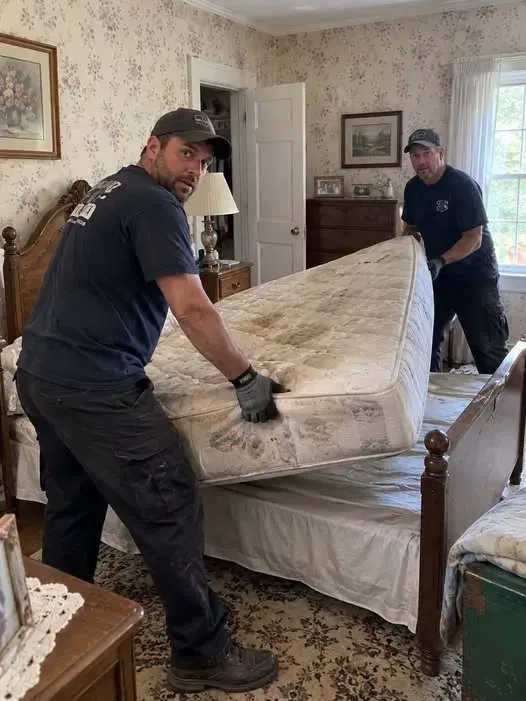
The movers had left the bedroom exactly as it was when they stopped. The new mattress leaned upright against the hallway wall, still sealed in plastic. The old one had been dragged halfway off the frame. A split seam in its underside exposed a concealed fabric pocket. Dust lay in pale fur along the slats. The room smelled of cedar, sun-warmed cotton, and the sour mineral scent that rises when closed places are opened after too long.
"We did not open the small box," the lead mover said. His name was Darren. He had kind eyes and a professional discomfort, the look of a man who had learned that other people’s homes often contained chapters they never meant to show strangers. "The old mattress cover split as we lifted it, and we saw papers tucked inside. I thought you should decide what happens next."
My mother stood at the bedroom door but did not cross the threshold. My father came in behind me and rested one hand on the doorframe. I could feel both of them waiting for me to become younger, easier to guide away. Instead I stepped toward the bed.
There were envelopes fastened beneath the slats with cloth tape gone brown at the edges. Some had loosened and fallen onto the rug. A cedar cigar box sat wedged near the headboard, tied shut with blue ribbon. On top of it lay a photograph curled into a shallow cup by age: a little girl in red overalls, hair clipped to one side, holding a paper crown in both hands.
She was missing one front tooth. Her smile was wide, brave, almost defiant.
I did not know her.
"Who is she?" I asked.
My mother made a sound, not a sob, not a word. My father’s hand slid down the doorframe until his fingers hung empty at his side.
The room had always been ordinary to me. A brass bed. Blue curtains. A quilt my grandmother made from shirts that belonged to men whose names I never learned. A dresser scarred by perfume bottles. But now every object looked implicated. The floorboards. The curtains. The calendar from a farm supply store, permanently turned to August because my mother liked the picture of sunflowers.
I bent and lifted one envelope. It was addressed in my mother’s handwriting, the letters small and upright.
For Elena, when she is old enough.
My name is Nora. I was thirty-one years old that summer. I had a mortgage, a reliable hatchback, a job designing catalog pages for garden tools, and a habit of calling my parents every Sunday. I thought I knew the outline of the family I came from. My parents had married young, bought the country house, had me late enough that people sometimes mistook my mother for my grandmother at school events. There had been lean years, sweet years, a few bitter ones, but only three chairs at the kitchen table.
The photograph in my hand insisted there had once been another chair.
Chapter 3: Elena
My mother finally entered the room. She moved carefully, as if sudden motion might scatter the papers into accusation. She sat on the bare edge of the bed frame, not touching the old mattress, and folded her hands in her lap.
"Her name is Elena," she said.
My father shut the bedroom door. The click sounded too final.
"Whose child?" I asked, though some part of me knew. A body can understand before the mind has finished arranging itself.
My mother looked at me. Her eyes were gray and wet and almost calm, which frightened me more than tears would have. "Mine."
The word took the room apart.
I sat on the floor because my knees no longer trusted me. The envelopes lay around my shoes. The cedar box waited like a heart no one wanted to touch first.
"Before your father and I married," she said. "Before this house. Before you."
My father crossed to the window and pushed the curtain aside, though there was nothing outside but the side yard and the hydrangeas going brown at the edges. "I knew," he said. "Not at first, but before Nora was born. Miriam told me."
"And you both decided not to tell me?" My voice came out flat, almost polite. That embarrassed me, so I sharpened it. "For thirty-one years?"
My mother flinched.
She told the story in pieces, not because she was trying to control it, but because some memories resist being carried whole. She had been nineteen. Elena’s father had left town before the baby was born. My grandmother, whose love arrived disguised as management, arranged for a couple three counties over to adopt the child. Miriam signed papers she barely understood, or understood too well and could not bear to explain. She was told it would be kinder to disappear from Elena’s life completely. She was told young women survived by folding certain years away.
"I did not have a box at first," my mother said. "I had one photograph. Her adoptive mother sent it through an agency when Elena was six. There was no return address. Just a note saying she was well and loved. I slept with the picture under my pillow until your father said I would wear it through."
"So he built the hiding place?"
My father nodded. "I thought I was helping."
I looked at him then. His face had the stunned humility of a man seeing, after decades, that a kindness can become a cage if nobody opens it. He had loved my mother by guarding what hurt her. He had loved me by keeping me outside it. I could not yet decide whether that made him tender or cowardly. I suspected the answer was both, which made it harder to be angry cleanly.
On the bed frame, my mother reached for the cedar box and untied the blue ribbon.
Chapter 4: The Letters They Never Mailed
The box opened with a dry, gentle crack. Inside were letters stacked by year, tied in bundles with thread. The first envelope was dated before my birth. The last was dated three weeks earlier.
My mother had written to Elena every year on her birthday.
Not sent. Not copied. Not confessed. Written and folded and hidden beneath the place where she slept.
I read the first one because my mother handed it to me. The paper trembled between us.
Dear Elena, it began. You are one today, and I do not know whether you like pears or bananas, whether your hair still curls at the neck, whether someone sings to you before sleep.
I stopped there. My throat closed around something too large to swallow.
"You wrote to her," I said.
"I had nowhere to send them."
"You could have told me."
"You were a baby."
"Then I was ten. Then sixteen. Then twenty-five."
My mother lowered her head. "Yes."
The word did not defend itself. It simply stood there.
The letters changed as the years did. At first they were full of details about weather and work and the price of peaches, as if my mother believed ordinary facts might cross whatever distance paperwork had made. Later they grew braver. She wrote about marrying Peter, about trying to make bread and turning out doorstops, about the day she learned she was expecting me and cried in the pantry because joy had arrived carrying guilt by the hand.
There were drawings, too. Not from Elena, as I first thought, but from me. Crooked houses, purple dogs, a family of three beneath a yellow sun. My mother had saved the pictures I brought home from school and placed them with letters to the daughter who could not see them. Beside one kindergarten drawing, she had written, Your sister made this today. I hope one day I can say that out loud.
Your sister.
I folded the paper and pressed my palm over it, not to hide it but to feel the fact through my skin.
In an article on secrecy, the American Psychological Association describes how secrets can become heavy not only because they are hidden in conversation, but because people live with them repeatedly in thought. Sitting on the bedroom floor, surrounded by thirty-one years of my mother’s private sentences, I understood that heaviness in a way no summary could hold. The secret had not slept under the mattress. It had slept in her body.
Chapter 5: What Anger Does When Love Is in the Room
We moved to the kitchen because the bedroom had become too crowded with the past. Darren and his crew waited on the porch, drinking water and pretending not to hear a family rearranging itself indoors. My father paid them for the full job and asked them to come back the next morning. Nobody mentioned the old mattress. It remained upstairs, half-off the bed, like a question paused mid-sentence.
At the kitchen table, my mother placed the cedar box between us. The table had knife marks from childhood craft projects and a pale ring where my father once set down a hot pan of biscuits. I had eaten cereal there, filled out college forms there, told my parents about my first breakup there. Now I sat with my hands under my thighs so I would not reach for every paper at once.
"Did you look for her?" I asked.
My mother nodded. "Once, when she would have been eighteen. The agency had closed. Records had moved. I wrote two letters and received one reply saying nothing could be shared without proper consent from both sides. I put that letter in the box too."
"And after that?"
"After that I was afraid."
The honesty came so plainly that my anger stumbled.
"Afraid of what?"
"That she had forgotten me. That she hated me. That she was happier without me. That she was not. That you would think I had been pretending to be your mother while being someone else’s."
I wanted a cleaner wound. I wanted betrayal without sorrow attached. Instead I had my mother at the kitchen table, sixty-two years old, twisting the hem of her cardigan like a girl waiting outside an office door.
"You let me believe I was your only child," I said.
"You were the only child I raised."
"That is not the same thing."
"No," she said. "It is not."
My father had been quiet long enough that I turned on him. "And you? You never thought I deserved to know?"
He rubbed both hands over his face. "I thought your mother should choose the time."
"For three decades?"
"I know."
"That is not an answer."
"No," he said, and his voice broke on the small word. "It is the failure before the answer."
That undid me more than denial would have. I stood and went to the sink. Outside, the afternoon had gone soft, the yard washed gold. A pair of sheets hung on the line, snapping in the wind. They were the sheets from my parents’ bed, stripped that morning by me while I congratulated myself for being useful.
In the window glass I saw all three of us reflected at once: my mother bent over the box, my father with his shoulders rounded, me gripping the counter as if the house were moving.
Chapter 6: The Photograph with the Red Overalls
That night I slept on the sofa because the guest room had been filled with boxes from the hallway closet, and because some childish part of me wanted my parents to know I was not ready to forgive them comfortably. The house made its familiar nighttime sounds: refrigerator hum, pipe tick, maple branches brushing the shingles. From upstairs came the low murmur of my parents talking. Once, I heard my mother cry. Once, I heard my father say, "I should have made you tell her."
I did not sleep much.
Near dawn, I returned to the kitchen and found the photograph of Elena in the red overalls beside the coffee tin. My mother must have brought it down after I went to bed. In better light, I saw that Elena had my mother’s eyes and my father’s serious way of holding still for a camera, though they shared no blood. That startled me. I had always thought likeness meant inheritance, but perhaps houses teach people similar postures. Perhaps love does too, even when it is only imagined.
Behind the photograph was a date and a line in another woman’s handwriting: She likes paper crowns and hates peas.
I laughed once, softly, because I hated peas too.
My mother found me there, barefoot, hair unpinned, looking older than she had the day before.
"I used to imagine you meeting," she said. "Then I would punish myself for imagining it."
"Did you name me because of her?"
"No. I named you because the nurse who held my hand during labor was named Nora. She told me I could do hard things."
I wanted to keep asking questions until I reached the one that would make everything simple. Why did you give her up? Why did you keep me? Why did you trust paper more than me? But every question opened into a hallway, and at the end of each hallway stood a younger version of my mother with no money, no map, and a newborn she had already been told was not hers to keep.
"I am angry," I said.
"I know."
"I am also sorry."
She covered her mouth.
"Not sorry for you instead of angry," I said, because I had learned by then that tenderness can be used to rush past truth. "Both."
My mother nodded. Tears slid down without drama. "Both is more than I expected."
We spent the morning reading only the envelopes she chose. I did not demand all of them. She did not hide the rest. That was our first small treaty. My father made toast and burned the first batch. Nobody said anything about it. We ate the second batch with butter and raspberry jam while the cedar box sat open in the center of the table, no longer buried, not yet understood.
Chapter 7: The Letter We Could Send
By noon my practical mind returned, limping but alive. "We cannot put these back under a mattress," I said.
My mother looked toward the staircase, as if the old hiding place might overhear us and feel abandoned.
"No," she said. "We cannot."
I opened my laptop and searched for how to handle old family papers without making them worse. The advice from the National Archives was plain enough for people in shock: prepare a clean space, keep food and drink away, wash hands before handling paper, and use care with photographs. A Library of Congress preservation page also advises careful handling by the edges and stable storage for photographs; I bookmarked the Library of Congress guidance before any of us touched another image.
My father drove to town and returned with plain folders, pencils, cotton gloves for the photographs, and a box that advertised itself as archival. He placed everything on the table like offerings.
"I should have done this years ago," he said.
"Years ago we were all different people," I said.
It was not absolution. It was weather. A fact passing over us.
We sorted the letters by date. My mother wrote Elena’s name on a folder, then stopped and pressed the pencil to her lips. "Her name may not be Elena anymore."
"It can still be the name you gave her here," I said.
Late in the afternoon, at the very bottom of the cedar box, we found a sealed envelope newer than the others. It was addressed to me.
My mother stared at it. "I forgot that was there."
The flap was still closed.
"May I?"
She nodded.
The letter inside was dated the week after my twenty-first birthday.
Nora, if I have not told you by now, then fear has been making my choices again. There is a girl, a woman now, who came before you. Her name at birth was Elena. She is your sister in the way grief can make a room in a family even when nobody sets a plate there. I did not tell you because I mistook silence for protection. If this letter reaches you after I am gone, be angry. Then, if you can, be curious too.
I read it twice. My mother watched me as if waiting for a sentence.
"You were going to tell me," I said.
"I was always going to tell you tomorrow."
There it was, the whole trouble of people. Tomorrow can become a house. You can furnish it, sleep in it, raise a child inside it, and still call it temporary.
We found one more thing beneath the letter: a form my mother had printed from an adoption registry three years earlier, filled out but never mailed.
This time, nobody had to ask what we would do with it.
Chapter 8: A Bed Without a Hiding Place
The movers came back the next morning. Darren did not ask questions. He and his crew carried the old mattress down the stairs with solemn efficiency, maneuvering it around the banister, past the family photographs in the hallway, past the kitchen where the cedar box now sat empty and harmless in a patch of sun.
My mother stood beside me at the foot of the stairs. When the mattress passed us, she reached out and touched one corner. Not tenderly. Not with hatred. More like a person touching a door after deciding not to go back through it.
"Goodbye," she said.
My father, who had been pretending to inspect the new bed frame, wiped his eyes with the heel of his hand.
The new mattress looked absurdly white in the old room. It had no history, no sag in the middle, no secret architecture beneath it. We made the bed together because there was nothing else to do with our hands. My father snapped the fitted sheet over one corner. I tucked the other. My mother smoothed the quilt and paused over the pattern of old shirts.
"Your grandmother would have said all this fuss was unnecessary," she said.
"Grandma thought saltines were dinner if you ate them standing up," I said.
My mother laughed, startled and grateful. It was a small laugh, but it belonged to the present, and I held onto that.
That evening we put the registry form in an envelope. My mother wrote the address. My father placed the stamp. I drove us to the blue mailbox outside the post office because none of us trusted the rural route carrier with so much waiting.
At the curb, my mother held the envelope in both hands.
"What if nothing comes back?" she asked.
"Then we will know we tried," I said.
"What if something does?"
I thought of the little girl in red overalls, the paper crown, the letters written into darkness, the sister-shaped room I had inherited without knowing. "Then we will answer slowly."
My mother nodded. She opened the mailbox drawer and let the envelope slide from her fingers. Metal swallowed paper. The sound was ordinary. That almost made it holy.
On the drive home, no one spoke for a while. The road curved past fields and mailboxes and houses where other families were probably keeping their own tender, foolish, frightened things. The sun went down in sheets of copper. My father reached across the console and took my mother’s hand. After a moment, she reached back and took mine.
I did not forgive them all at once. That would be another kind of lie. But I stayed the weekend. I helped label folders. I made coffee. I asked questions and sometimes stopped before the answers. The old mattress was gone, and with it the strange belief that love could be preserved by pressing it flat and hiding it where no light could reach.
The new bed stood upstairs, level and unburdened. For the first time in thirty-one years, my parents slept above nothing but wood, air, and the truth we had finally made room for.
Reflection
Some family secrets are not explosions. Some are slow architecture. They become the rooms people avoid, the birthdays that pass quietly, the subjects that make a mother turn toward the sink. When the hidden thing is finally found, the work is not only discovery. It is deciding what kind of people everyone will become afterward.
I used to think truth arrived like a key. Now I think it arrives more like daylight. It does not fix the house. It simply shows where the dust has gathered, where the walls are sound, and where a door has been waiting all along.
Wrap-Up
When Nora replaces her parents’ old mattress, movers uncover decades of hidden letters and photographs. The discovery reveals Elena, the daughter Nora’s mother placed for adoption before Nora was born, and forces the family to choose truth over the silence that once felt safer.
Frequently Asked Questions
- → What does the original image establish?
Fiction note: This story is invented. The characters, letters, and family history are fictional, though the emotional idea of secrecy is grounded in ordinary family experience. The American Psychological Association has reported on research describing how secrets can feel burdensome and shape closeness, and preservation guidance from the National Archives informs the later scenes involving old papers and photographs.