 Save
This is a fictional story, written as an original domestic drama inspired by a strange roof covered in wooden stakes. It is not a home-repair guide. Real ladder work, roof alterations, and winter-weather decisions should be handled with local guidance and qualified help. NIOSH notes that ladder hazards occur at home as well as at work, the City of Bend describes structural roof changes as permit-triggering work, and NOAA's National Weather Service explains that winter warnings can make travel difficult. NIOSH ladder safety City of Bend reroofing guide National Weather Service winter guidance
Chapter 1: The First Stake
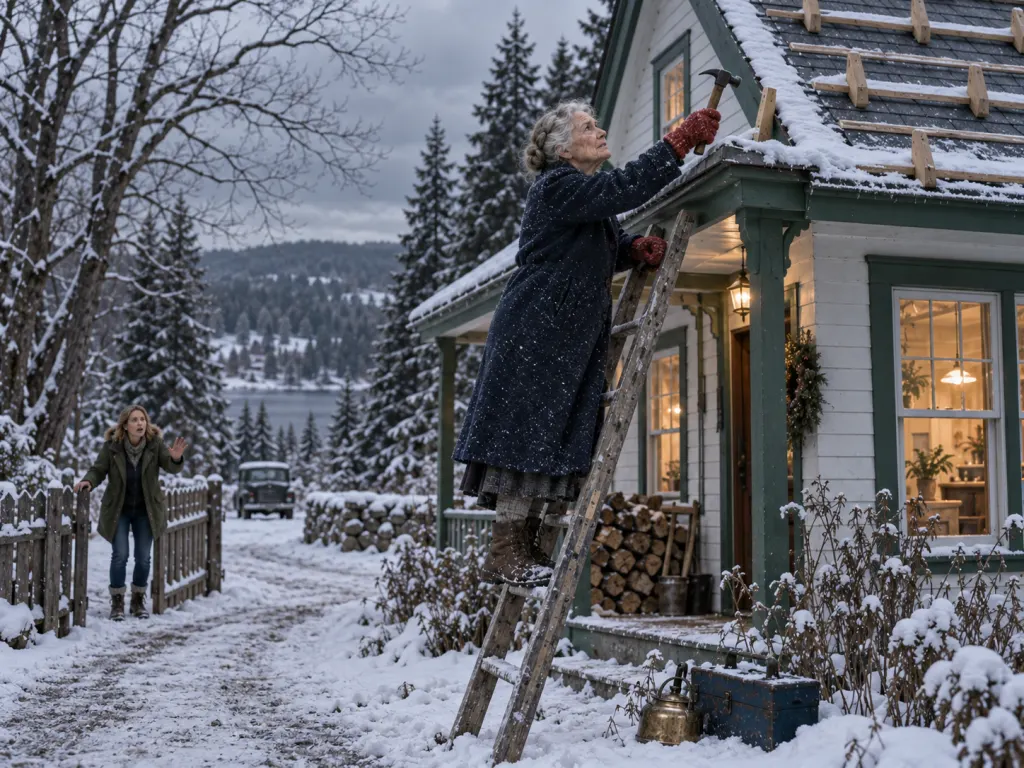
Lila Atwood drove the first cedar stake into the edge of her roof on an October morning so still that the hammer blows seemed to ring across the entire valley. Three strikes, a pause, then two more. The sound bounced from the white clapboard house to the bare maples, crossed the lane, and slipped under the storm door of Mrs. Finch, who was stirring oatmeal in her kitchen.
By nine o'clock, two people had called Lila's daughter. By ten, a delivery driver had slowed so long in front of the house that Lila lifted her hammer and stared until he remembered the road. By noon, the first photograph had appeared in the town's private message board with a caption that made Lila sound either dangerous or confused.
She saw none of it. She was on the porch roof, knees braced against old shingles, a carpenter's apron sagging from her waist. The cedar stakes lay beside her in bundles tied with twine. Each one had been cut clean and tapered at the top, not needle-sharp, but pointed enough to look unfriendly from the street. Lila had sanded them herself in the shed where her husband Elias had once kept jars of screws labeled in his square, careful hand.
Nora arrived just after lunch, tires spitting gravel. She left the car door open and stood at the gate with one hand over her mouth. Her mother, seventy-eight years old and smaller than she had seemed when Nora was a child, was halfway up a ladder with another stake tucked under her arm.
“Mom,” Nora called, keeping her voice level because panic had always made Lila dig in harder. “Please come down.”
Lila did not turn. “If you came to take pictures, stand where the sun is not in your eyes.”
“I came because half the town thinks you are building a fortress.”
That made Lila smile, though not kindly. “Half the town has never had to keep a house alive through February.”
Chapter 2: What the Neighbors Saw
From the road, the Atwood roof looked like the back of some bristling thing. Rows of pale cedar pegs stood along the lower slope, then climbed in uneven ranks toward the chimney. Lila had started above the front walk, where the roof dropped steeply over the porch. By the third week she had crossed the kitchen side and begun along the narrow east face, working only in dry weather, only before the wind rose, and only when she believed no one could stop her.
The town supplied its own explanations. Mrs. Finch said Lila was trying to frighten off children, though no child had cut through her yard since the Atwoods' apple tree came down. The mail carrier thought the stakes were meant to keep large birds away. A man at the hardware store said, with great confidence, that widows did strange things when nobody checked on them.
Nora hated that most of all. Nobody knew how closely she checked. She called every night after work. She ordered groceries when snow was forecast. She had asked, begged, and finally pleaded with Lila to move into town where the sidewalks were level and the roof belonged to someone else.
Lila always answered the same way. “Your father built this porch for me. I am not leaving because the calendar keeps counting.”
That was the part Nora could not argue with cleanly. Elias had touched every inch of the house. The green trim was his color. The pantry shelves were his measurements. Even the stubborn back door, which required a hip to open in damp weather, had been hung by his hands. To Nora, the house had become a museum of loss. To Lila, it was still a living marriage.
On the fourth Saturday, Daniel Reyes from the town office came to the gate wearing a charcoal jacket and the expression of a man who would rather be anywhere else. Lila met him on the porch with sawdust on her sleeves.
“Mrs. Atwood,” he said, “we have had concerns about the roof.”
“I imagine you have had gossip,” she replied.
Daniel looked up. The stakes caught the afternoon light like bleached bones. “I have had both.”
Chapter 3: Elias's Pencil Marks
Daniel asked if he could look from the yard. Lila allowed that. He asked if the stakes were fastened through the roof covering. Lila said yes. He closed his eyes briefly, as if a small headache had stepped into his skull and made itself comfortable.
“Did a roofer install them?”
“No.”
“Did anyone inspect the framing?”
“I inspected my own framing for forty years by listening when the house complained.”
Daniel was gentle, which irritated her more than scolding would have. He explained that roof changes could affect water, weight, and the way a structure handled weather. Lila heard only what people had been telling her since Elias died: that she was alone, old, and no longer trusted with the things she had known all her life.
Nora stood beside the lilac bush, arms folded tight. She wanted Daniel to order the stakes removed. She wanted him to be the villain so she could be the daughter. But when he asked Lila why she had done it, Nora watched her mother's jaw change. Not harden. Tremble.
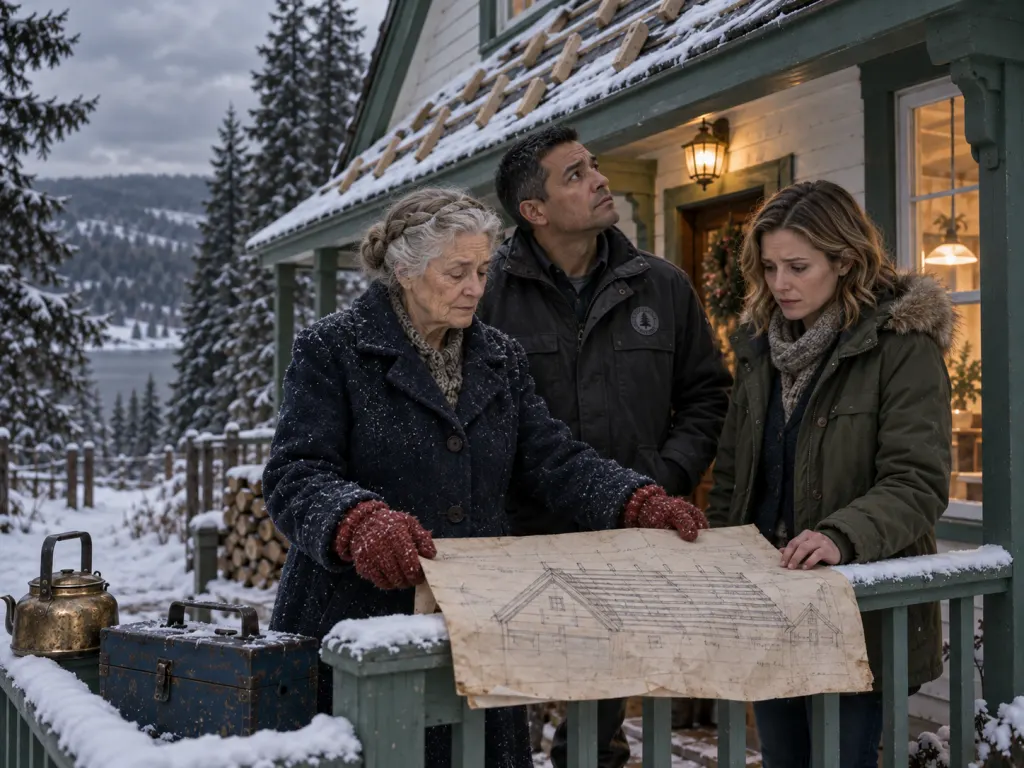
Lila turned and went inside. For a moment Nora thought the conversation was over. Then her mother returned with a folded sheet of paper, soft along the creases and gray at the corners. She opened it on the porch rail.
It was Elias's sketch of the roof. Nora recognized the handwriting at once: measured, upright, patient. Lines marked the rafters. Circles marked old leaks. Along the porch side, Elias had penciled a note: snow slides here. Build guards before another bad winter.
“He wrote that after the storm of '09,” Lila said. “The snow came off in one sheet and broke both porch steps. If I had been standing there, I would not have had time to move.”
Nora stared at the drawing. She remembered the storm, but not the steps. She had been newly married then, busy and elsewhere. Her parents had not wanted to worry her. That was how love had worked in their family: hide the cost, show the table set.
Chapter 4: The House Complains
The first snow came early, thin as sifted flour. It settled on the stakes and made the roof look almost pretty. Lila watched from the kitchen window with a cup of tea cooling in both hands. She had expected triumph. Instead she felt watched by every cedar point.
Nora came by with soup and a folder of contractor names. Lila left both on the counter untouched.
“You cannot stay angry forever,” Nora said.
“I am not angry.”
“Then what are you?”
Lila looked toward the hall where Elias's coat still hung from a peg, though it had not held his shoulders in six years. “Outnumbered.”
That word softened Nora before she could stop it. She took off her gloves and sat at the kitchen table. The room smelled of cedar dust, onion soup, and the lemon oil Lila used on the old cabinets. For a while they listened to the furnace tick.
“When Dad was sick,” Nora said carefully, “you let me believe things were manageable until they were not.”
Lila's fingers tightened around the cup.
“I know you thought you were protecting me. But I spent months after he died wondering what else I had missed. I do not want to find out about this house from a neighbor's photograph.”
Lila turned the cup once, slowly. There was a chip near the rim. Elias had dropped it one winter and glued the broken crescent back because it was her favorite. “If I tell you everything,” she said, “you will solve it by taking it away.”
Nora had an answer ready. Then she swallowed it. In the silence, the house made a low sound above them. A settling beam, perhaps. Or wind under the eaves. Or a complaint at last spoken clearly enough for both women to hear.
Chapter 5: Warning Issued
By December, the stakes had become a landmark. People gave directions by them. Children in the school bus pressed their faces to the glass. Someone left a note in Lila's mailbox asking if she was preparing for monsters, and Lila, who had little patience for cowards, taped it to the refrigerator as evidence of poor penmanship.
Then the National Weather Service issued a winter storm warning, and the town's jokes lost their appetite. Snow began at dusk on a Thursday, first in flakes light enough to drift upward in the porch light, then in hard slanting bands that erased the orchard by midnight. Wind pushed against the house with both palms.
Nora called at seven. Lila answered on the third ring.
“I am fine,” Lila said before hello.
“I did not ask.”
“You were about to.”
Nora laughed despite herself, then heard the strain in her mother's breathing. Not illness, not fear exactly. Effort. Lila was carrying something.
“What are you doing?”
“Moving the kettle off the stove.”
“Mom.”
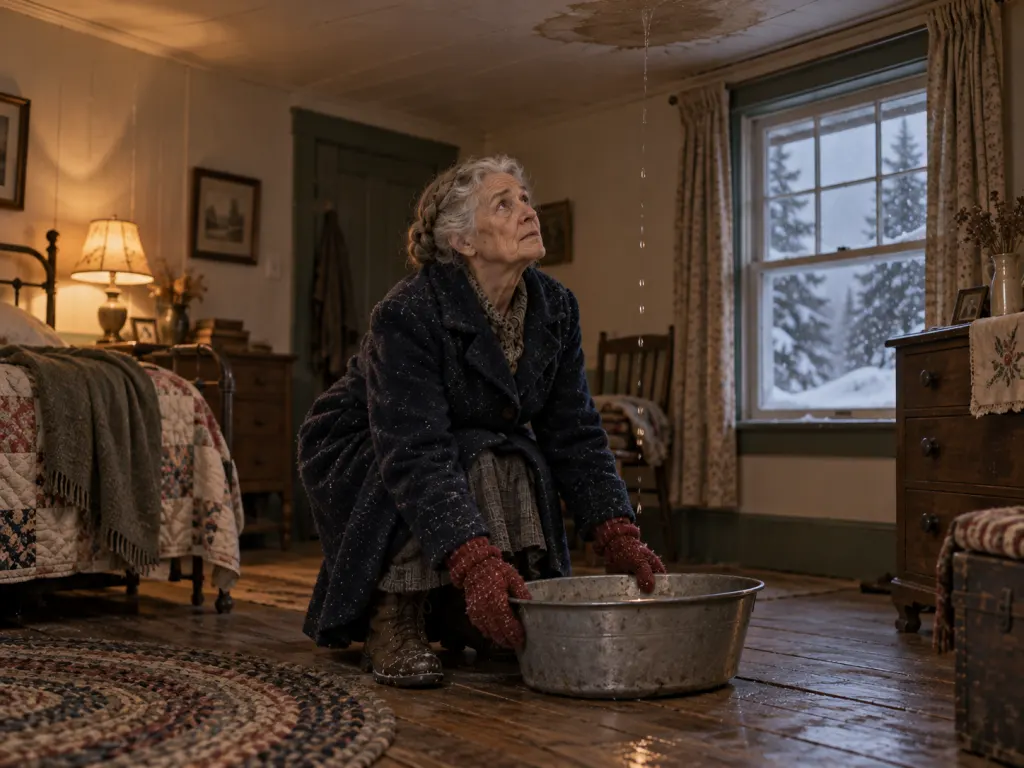
A long pause. Then Lila said, “There is a drip in the front bedroom.”
Nora closed her eyes. The front bedroom was under the staked side of the roof.
By morning, the road was barely visible. The stakes had done what Lila hoped and what Daniel had feared. They held the snow. Instead of sliding loose from the porch, it gathered in ridges, layer on layer, heavy and silent. Inside, a brown stain opened on the bedroom ceiling like a bruise.
Lila put a basin under it. The drop struck metal with humiliating precision.
Chapter 6: The Second Ladder
Daniel arrived with two public works volunteers and a truck whose amber lights turned the snowbanks gold. Nora came behind them in boots still dusted with office salt, her hair trapped under a green parka hood. She had driven too fast until the last mile, then too slowly, whispering bargains to the road.
Lila opened the door before anyone knocked. “I am not leaving.”
Nora stepped onto the porch. The stakes above them were buried to their tips. Only a few pale points showed through, like warnings from underneath.
“Nobody is here to punish you,” Daniel said. “We need you away from the front rooms until a roofer looks at it.”
“A roofer will say I was foolish.”
“Maybe,” Nora said. Her voice broke on the small word. “And then he will say what to do next. Both can be true.”
Lila looked at her daughter then, really looked. Nora's cheeks were red from the cold. Snow melted on her lashes. She was no longer the girl who needed shelter from bad news. She was a grown woman standing in weather because love had dragged her there.
The first creak came from above the parlor. Everyone heard it. Not the ordinary shifting of old lumber, but a strained, deep protest that moved through the walls and into the floorboards beneath their feet.
For a few seconds, pride held Lila upright. Then another drop struck the basin in the bedroom. She thought of Elias's pencil marks. Build guards before another bad winter. Not build them alone. Not build them out of grief. Not turn his unfinished note into a test of whether she deserved to stay.
“Fine,” she said, and reached for her coat. “But I am taking the kettle.”
Nora let out a sound that was almost laughter and almost crying. “Take the kettle.”
Chapter 7: What Came Down
The roof did not collapse. That became important later, because people preferred dramatic endings and the truth was quieter. The volunteers cleared what they could from the ground with long-handled roof rakes. A roofing crew came when the roads opened. They removed the stakes one by one, each leaving a dark puncture that made Lila flinch from the driveway.
She stayed with Nora for four nights. On the first night she slept poorly under a quilt that smelled of detergent instead of cedar. On the second, she criticized the way Nora loaded the dishwasher. On the third, she stood in the hallway outside the guest room and listened to her daughter talking softly on the phone to the roofer, asking questions Lila herself would have asked if shame had not tied her tongue.
On the fourth morning, Nora found her mother at the kitchen table with Elias's roof sketch spread flat beside a legal pad. Lila had copied the measurements in her own hand. Beside them, she had written three columns: urgent, possible, sentimental.
“Sentimental?” Nora asked.
Lila tapped the paper. “The green trim can wait. The porch rail cannot. Your father would pretend otherwise because he liked the green, but he would be lying.”
Nora poured coffee and sat across from her. “I can help with calls.”
“You can help with listening,” Lila said. “Calls after that.”
It was not an apology. Not exactly. In the Atwood family, apologies often arrived wearing work clothes. Nora accepted it in the same language. She pulled the legal pad closer and wrote roof, porch rail, gutters in careful letters.

Chapter 8: Spring Stakes
By spring, the house had a new roof, plain and dark and properly finished. No bristling cedar. No strange silhouette. The porch steps were replaced, the rail tightened, the front bedroom ceiling patched and painted. From the road, the cottage looked less interesting. To Lila, it looked forgiven.
The town moved on. It always did. Another oddity took its place on the message board: a missing garden statue, a dispute about parking near the bakery, a photograph of a fox asleep on a shed roof. Lila's stakes became a story people told with more certainty than accuracy.
Nora heard one version in the grocery line. According to the woman ahead of her, Lila had built the stakes to trap a burglar. According to the cashier, they were an old mountain method. According to the man buying batteries, they had saved the whole house.
Nora did not correct them. Some stories were too thin to carry the truth.
On the first warm Saturday, Lila carried the remaining cedar stakes to the garden. Nora followed with a mallet and a bag of seed packets. Together they drove the stakes along the pea rows, not on a roof this time, not against weather or neighbors or helplessness, but into dark soil that accepted them without argument.
Lila tied twine from stake to stake. Her hands were slower than they used to be. Nora waited, resisting the urge to finish the knot.
“You are learning,” Lila said.
“I was about to say that to you.”
Lila smiled, and for once it held no blade. Above them, the new roof shone in the mild sun. It was not Elias's work, yet it sheltered what Elias had loved. That was the lesson Lila had resisted all winter: accepting help did not erase the hands that came before. It only let their work keep standing.
When the peas climbed, they used the old cedar stakes without knowing anything about pride, grief, or town gossip. They reached because there was something there to hold them. Lila watched them each morning from the porch, her kettle steaming beside her, and understood at last that a house could be kept alive by more than one pair of hands.
Wrap-Up
Lila's roof of cedar stakes begins as an alarming mystery and becomes a portrait of grief, independence, and family repair. Winter exposes the danger in her solitary plan, but it also opens a way for her and Nora to rebuild trust.
Frequently Asked Questions
- → Is this story based on a verified real event?
No. This is an original fictional story inspired by a strange premise. The household conflict, characters, and outcome are invented.
- → Is the roof project in the story meant as advice?
No. The story treats the stakes as a risky choice that brings family and town officials into the situation. Real roof work should be planned with local rules and qualified help.