 Save
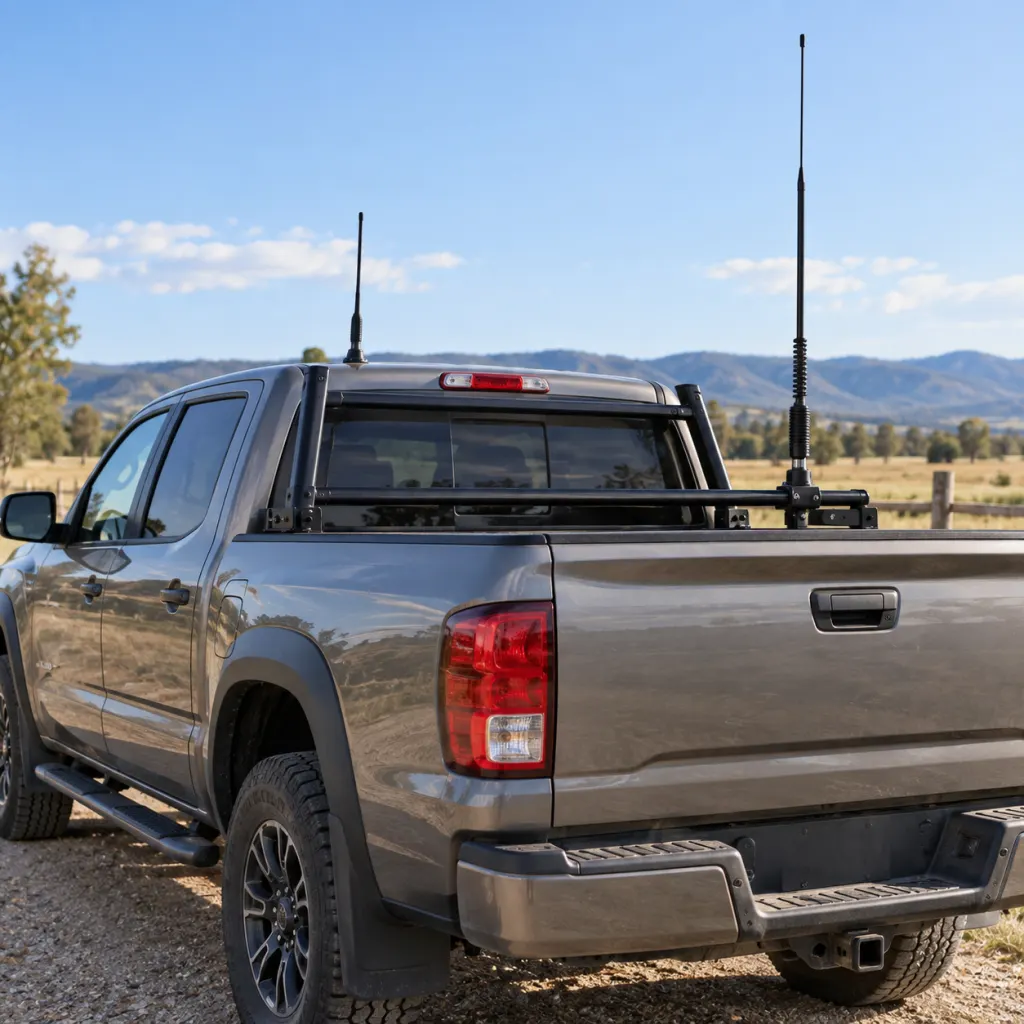
Those sticks on the back of trucks are usually antennas. The most common possibilities are an outside antenna for a cell signal booster, a CB radio antenna, a GMRS two-way radio antenna, or a tall off-road flag whip used so another vehicle can see the truck over dunes, brush, or trail rises. The exact answer depends on the shape, height, cable routing, and where the truck is being driven. A short, smooth rod behind the cab often points to a cellular booster. A very long flexible whip is more likely a CB, GMRS, or trail flag setup. The useful thing to remember is simple: the visible stick is usually only the outside part of a larger communication or visibility setup.
The Quick Clues Most Drivers Can Use
If you are trying to identify one from the next lane, do not worry about the brand or model. Look for the role the rod seems built to play. Antennas need a clear path outside the vehicle, so truck owners mount them high, away from metal obstructions, and near a route where cable can pass into the cab. Visibility whips are different: they are usually taller, more flexible, and may carry a bright flag or light.
- Short, black, spring-mounted rod: often a cellular booster or two-way radio antenna.
- Long stainless or fiberglass whip: often CB, GMRS, amateur radio, or off-road use.
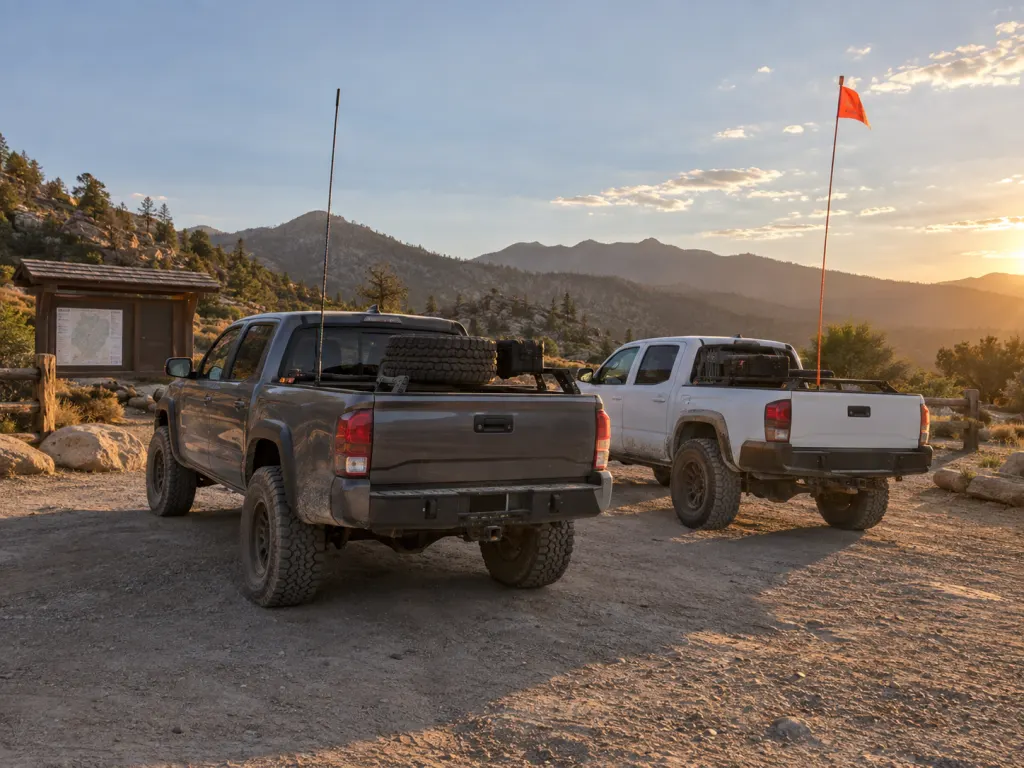
- Rod with a small flag: commonly used for visibility on trails, dunes, work sites, or large lots.
- Two matching rods: often a radio setup or a cosmetic pair, but the cables and mounts reveal more than the count.
- Low-profile puck or fin: more likely GPS, satellite radio, fleet tracking, or factory telematics than the tall sticks people notice behind cabs.
The social-media answer is often too neat: it may call every rod a cell booster antenna. That is a real and common explanation, but it is not the only one. Trucks are popular with people who tow, work in rural areas, travel on remote roads, join trail groups, or coordinate crews. Those use cases overlap, so the same-looking mount can support very different equipment.
When It Is a Cell Signal Booster Antenna
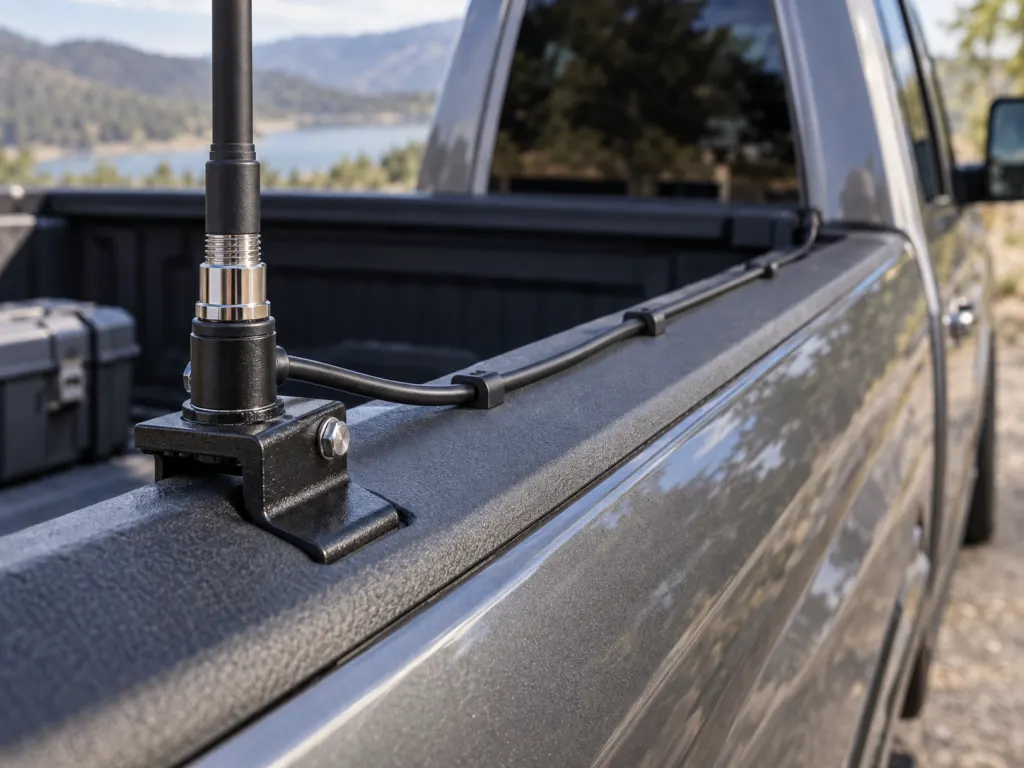
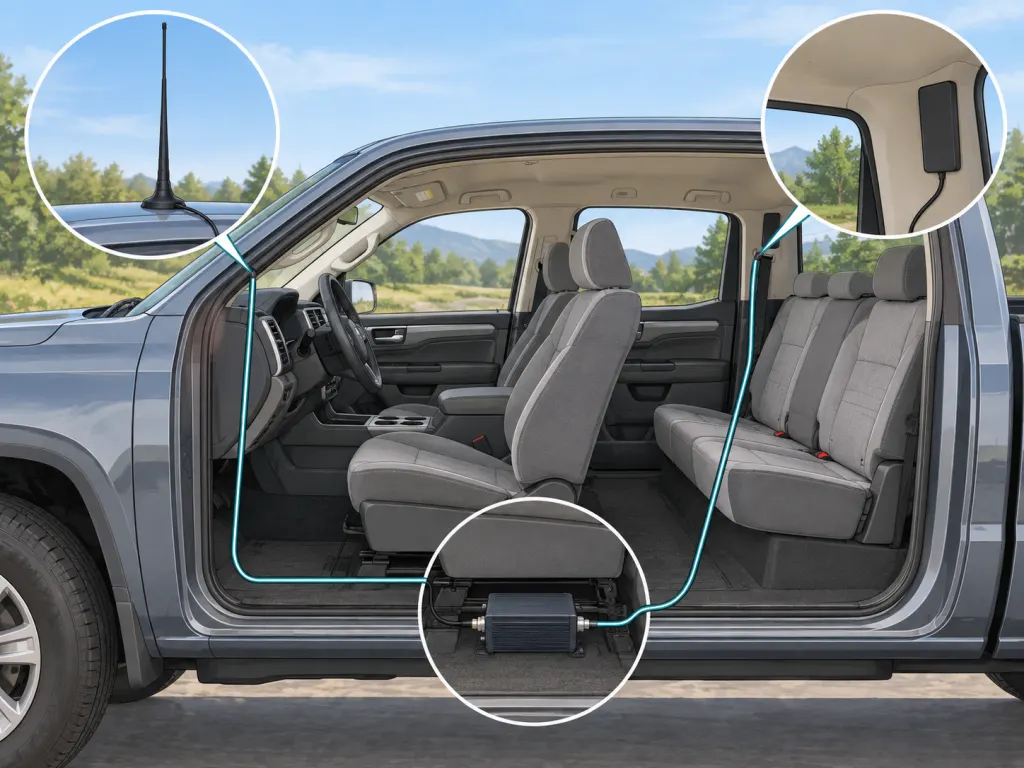
A mobile cellular signal booster has three basic jobs: receive an existing outside cellular signal, amplify it through a powered unit, and rebroadcast a usable signal inside a small space such as a vehicle cabin. The outside antenna is the part you notice on the truck. The amplifier and inside antenna are usually hidden in the cab, under a seat, near the dash, or behind trim. Under U.S. rules, a consumer signal booster is not a free-for-all device. The FCC rule requires carrier consent and registration before operation, requires approved antennas and cables, and says network-protection features must remain active 47 CFR 20.21.
That last part matters because a booster is more than a passive antenna. A plain antenna receives or transmits radio energy for a radio device. A booster adds amplification. If a booster is poorly designed, mismatched with the wrong antenna, or installed in a way that causes feedback between the outside and inside antennas, it can create interference. That is why the rules refer to self-monitoring, anti-oscillation, power-down behavior near base stations, and the use of the approved antenna kit. In everyday terms: the stick on the truck may be harmless-looking, but the powered box attached to it has to behave politely on shared wireless networks.
Why Truck Owners Add Them
People tend to add exterior antennas when factory reception is not enough for how they actually use a truck. A driver who spends most days in a city may never think about it. Someone who works on farms, utility routes, job sites, ranch roads, mining roads, oil fields, mountain passes, or long stretches of interstate can move in and out of weak coverage often. The booster cannot create service where no outside signal exists, but it may improve a weak usable signal when the system is properly matched and installed.
When It Is a CB Radio Antenna
A long whip on a pickup may also be for CB radio. The FCC rules define CB Radio Service as a mobile and fixed two-way voice communication service for personal, business, or voluntary public-service activities, including assistance to highway travelers 47 CFR 95.903. CB has been associated with truckers for decades because it works independently of a cellular subscription and lets nearby drivers speak directly over shared channels. It is still used by some long-haul drivers, off-road groups, pilot-car operators, farmers, and hobbyists.
CB antennas are often longer than cellular booster antennas because the radio frequencies involved differ. They may be mounted on the bed rail, bumper, headache rack, toolbox, mirror bracket, or behind the cab. Some are thin steel whips with a spring at the base. Others are fiberglass rods. A CB antenna can look old-school, but the reason for the height is practical: radio equipment performs better when the antenna has a suitable ground plane, a clear mounting location, and as much unobstructed exposure as the installation allows.
CB also has rules about use. The FCC rules allow two-way voice communications on CB frequencies, and they give priority to emergency communications; Channel 9 is reserved for emergency communications or traveler assistance 47 CFR 95.931. That does not mean every whip you see is being used for emergencies. It means the service has long been organized around short-range practical communication among nearby users.
When It Is GMRS or Another Two-Way Radio
GMRS is another reason you may see a truck with an antenna on the bed rail or roofline. The FCC rules define the General Mobile Radio Service as a mobile two-way voice communication service, with limited data applications, for individual licensees and their family members 47 CFR 95.1703. Unlike many casual handheld radio services, GMRS requires a valid individual license to operate a GMRS station 47 CFR 95.1705. The rules also require GMRS transmitters to be certified for that service 47 CFR 95.1761.
GMRS has become common in some trail, camping, and overland groups because it supports simple voice communication among vehicles traveling together. A GMRS antenna may be shorter than a classic CB whip, but longer than a small cellular booster antenna. On a truck, it might sit on a magnetic roof mount, a hood-channel bracket, a bed-rack tab, or a rear bumper bracket. The driver may use a handheld radio connected to an external antenna or a mounted mobile radio inside the cab.
The Rod Itself Is Not Always the Device
One common misunderstanding is to call the entire visible stick a booster, a radio, or a tracker. Usually it is only the antenna or whip. The real system may include a coaxial cable, a powered amplifier, a radio transceiver, a small internal antenna, a control head, a microphone, or a power connection. That is why two trucks with similar rods can serve different purposes. One may be trying to improve cellular reception. Another may be coordinating with a convoy. Another may be used on a construction site. Another may simply carry a flag so the truck is easier to spot in uneven terrain.
Why They Are Mounted Behind the Cab
The back of the cab is a convenient compromise. It can be high enough to clear the bed, close enough to route cable into the cab, and less likely to interfere with doors than a mirror mount on a pickup. Bed racks, headache racks, toolboxes, and rear stake-pocket brackets also give owners sturdy places to attach hardware. A roof center mount may perform well for some antennas, but many owners avoid drilling the roof or placing a tall whip where it will hit branches, parking structures, garage doors, or car washes.
Placement is not only about height. Antennas interact with the vehicle’s metal surfaces, the cable length, the mount quality, and nearby equipment. For a cellular booster, the outside and inside antennas need enough separation to reduce feedback. For a CB setup, tuning and mounting quality affect performance. For GMRS, the radio, antenna, and cable should match the equipment rules and intended use. The visible rod is the clue, but the installation details determine whether the system works well.
What They Are Not
Most of these sticks are not police equipment, secret surveillance gear, or a sign that the truck has special authority. Fleet trucks may carry GPS, dispatch, or data antennas, but those are often smaller pucks, fins, or domes rather than tall whips. Some work trucks do carry several antennas because the driver uses cellular data, GPS, two-way radio, and job-specific communication equipment at the same time. That can look dramatic from behind, but it is usually ordinary field communication hardware.
A Practical Identification Checklist
If you are close enough to notice details while parked, these checks can help you identify the stick without touching anyone’s truck:
- Look for a flag or light: a flag whip is about visibility, not radio reception.
- Look for a coax cable: a cable running into the cab usually points to radio or booster equipment.
- Notice the antenna length: very short rods often suggest cellular or data equipment; very long flexible rods often suggest CB, GMRS, or trail use.
- Check the mount location: bed-rack tabs, bumper brackets, and stake-pocket mounts are common for owner-installed accessories.
- Notice the setting: rural highways, trailheads, farms, worksites, and convoy travel all make radio and booster equipment more likely.
Should You Add One to Your Own Truck?
Start with the problem you are trying to solve. If the problem is weak cellular reception on routes where your phone still sees some signal, a certified mobile booster may be worth comparing, but the rules and installation requirements matter. If the problem is talking with nearby vehicles on a trail or work route, CB or GMRS may make more sense. If the problem is being seen over terrain, a flag whip is the right category. Buying the wrong stick because it looks like what everyone else has can lead to disappointing results.
For any powered radio or booster system, read the equipment manual before buying mounts and cables. The FCC consumer-booster rule specifically ties operation to approved antennas, cables, and coupling devices 47 CFR 20.21. For GMRS, licensing and certified transmitters are part of the rule set 47 CFR 95.1705. CB is simpler for many users, but it still has permitted-use limits and channel customs. A clean installation is not just about looks; it keeps the equipment stable, reduces interference problems, and keeps the truck usable day to day.
The Bottom Line
When you see a stick on the back of a truck, think antenna first. A short rod behind the cab is often connected to a cellular booster. A long whip may be CB, GMRS, amateur radio, or a trail flag. A work truck with several rods may be carrying several communication systems at once. The best answer is not one universal label, but a small set of likely explanations based on shape, mount, and setting. Once you know the clues, those mysterious sticks start to look less strange and a lot more practical.
Wrap-Up
The sticks on the back of trucks are usually practical hardware: antennas for cellular boosters, CB radios, GMRS radios, or visibility whips for trails and job sites. Cellular booster systems are regulated because they amplify signals and must avoid harmful interference. CB and GMRS antennas support short-range voice communication, with GMRS requiring an individual license. The easiest way to tell them apart is to look at height, flexibility, mounting point, cables, and whether there is a flag or light attached.
Frequently Asked Questions
- → Are the sticks on trucks always cell signal boosters?
No. A short exterior rod behind the cab can be part of a cell signal booster, but similar rods can also be antennas for CB, GMRS, amateur radio, fleet communication, GPS-related equipment, or an off-road visibility whip.
- → Can a cell booster create service where there is no signal at all?
No. A mobile booster works with an existing outside cellular signal. If there is no usable outside signal for the antenna to receive, the booster has nothing meaningful to amplify.
- → Why do some trucks have two antennas?
Two antennas may serve different systems, such as one for cellular data and one for a two-way radio. Some drivers also install dual CB antennas or matching mounts for appearance, so the cable routing and equipment inside the cab matter more than the count.
- → Is a CB antenna the same as a GMRS antenna?
No. CB and GMRS use different radio services and equipment rules. The FCC rules describe CB as a two-way voice service for personal, business, and traveler-assistance communication, while GMRS is a licensed two-way voice service for individual licensees and their family members.
- → Why mount the antenna so high?
A higher, clearer mount can help an antenna work with fewer obstructions from the truck’s metal surfaces, cargo, and nearby accessories. The best position depends on the radio service, antenna design, cable, mount, and how the truck is used.