 Save
After 60, the most useful vitamin strategy for muscle health is not a dramatic supplement stack. It is a steady check on three common support nutrients: vitamin D, vitamin B12, and vitamin C. Vitamin D is tied to muscle movement and bone support, vitamin B12 helps keep nerve and blood cells healthy, and vitamin C is needed for collagen, L-carnitine, and protein metabolism. None of these vitamins can replace resistance exercise, adequate meals, or medical evaluation for new weakness, but each can help close a gap that makes staying strong harder than it needs to be.
Age-related muscle loss is influenced by many moving parts: less challenging activity, lower appetite, illness, medications, reduced outdoor time, and changes in absorption. That is why the best question is not “Which pill stops muscle loss?” but “Which nutrient gaps would make my strength plan less effective?” The sections below explain why these three vitamins deserve attention, how to get them from ordinary foods, and when testing or professional guidance matters.
Why Vitamins Matter, But Do Not Work Alone
Muscle tissue responds most directly to use. The CDC says older adults need weekly aerobic activity, muscle-strengthening activity, and balance activity, with muscle-strengthening work at least two days a week and exercises that use the major muscle groups https://www.cdc.gov/physical-activity-basics/adding-older-adults/what-counts.html. Vitamins support the body systems that let a person train, recover, move confidently, and eat well, but they do not create strength without enough challenge to the muscles.
That distinction matters because older adults are often sold simple answers for a complicated change. A better approach is to look for bottlenecks. Low vitamin D status may affect muscles and bones. Poor vitamin B12 absorption can affect energy, nerves, and balance-related confidence. Low vitamin C intake can reflect a pattern with too few fruits and vegetables, which may also mean fewer helpful minerals, antioxidants, and meal variety. In practice, these vitamins are worth reviewing because they sit at the intersection of food quality, mobility, and aging physiology.

The Three Vitamins To Put On Your Radar
The most practical trio is vitamin D, vitamin B12, and vitamin C. Each has a different job:
- Vitamin D helps the body absorb calcium, and the NIH Office of Dietary Supplements notes that muscles need vitamin D to move https://ods.od.nih.gov/factsheets/VITAMIND-Consumer/.
- Vitamin B12 helps keep nerve and blood cells healthy; trouble absorbing it becomes more common with age https://ods.od.nih.gov/factsheets/VitaminB12-Consumer/.
- Vitamin C is required for collagen, L-carnitine, and protein metabolism, and fruits and vegetables are its best food sources https://ods.od.nih.gov/factsheets/VitaminC-HealthProfessional/.
Think of them as support beams rather than shortcuts. They help create better conditions for activity, but they cannot substitute for progressive movement, enough food, rest, and professional care when symptoms point to a possible deficiency or medical problem.
1. Vitamin D: Muscle Movement, Bone Support, And Low Sun Exposure
Vitamin D deserves first mention because it connects muscles and bones. NIH explains that vitamin D helps the body absorb calcium, that muscles need it to move, and that older adults are more likely to have trouble making vitamin D from sun exposure as efficiently as they did when younger https://ods.od.nih.gov/factsheets/VITAMIND-Consumer/. MedlinePlus also notes that vitamin D has roles in the nervous, muscle, and immune systems, and that older adults are among the groups at higher risk for low vitamin D because skin and kidney changes can affect vitamin D status https://medlineplus.gov/vitaminddeficiency.html.
Food sources are limited compared with many other nutrients. Fatty fish, egg yolks, mushrooms exposed to ultraviolet light, fortified milk, fortified plant milks, fortified cereals, and some fortified juices can contribute. For many adults, fortified foods do much of the work. A useful kitchen habit is to check labels on milk, yogurt, plant milks, and breakfast cereals rather than assuming every similar product contains the same amount.
How To Think About Vitamin D Safely
The goal is adequacy, not excess. NIH states that very high vitamin D intake can be harmful and that high levels are almost always caused by excessive supplement use https://ods.od.nih.gov/factsheets/VITAMIND-Consumer/. This is one reason vitamin D is a good candidate for a measured conversation rather than guesswork, especially for people who already take a multivitamin, calcium product, or separate vitamin D product. A clinician can decide whether a blood test makes sense and how to interpret it in context.
Vitamin D also illustrates the “food plus movement” principle. Maintaining vitamin D status may support the body systems involved in movement, but muscle still needs regular use. If walking, climbing stairs, carrying groceries, or rising from a chair feels harder than before, the answer may include food, activity, medication review, balance training, and evaluation for other causes rather than a vitamin-only plan.

2. Vitamin B12: Nerves, Blood Cells, And Absorption After 50
Vitamin B12 is less directly marketed for muscle, yet it matters because muscles depend on nerves, oxygen delivery, and steady energy. NIH says vitamin B12 helps keep blood and nerve cells healthy and helps make DNA https://ods.od.nih.gov/factsheets/VitaminB12-Consumer/. It also notes that many older adults do not have enough stomach acid to absorb the vitamin B12 naturally present in food, and that people over 50 should get most of their B12 from fortified foods or dietary supplements because these forms are generally easier to absorb.
That does not mean every person over 60 needs the same supplement. It means B12 is worth checking in the food pattern. Animal foods such as fish, meat, poultry, eggs, milk, and dairy products contain B12. Fortified breakfast cereals, fortified nutritional yeast, and other fortified foods can help people who eat little or no animal food. The important practical step is to look for the word “fortified” and read the Nutrition Facts panel instead of assuming a plant-based product contains B12.
Signs That Deserve A Conversation, Not Guessing
NIH reports that B12 deficiency can take years to appear and may involve tiredness, weakness, numbness or tingling in the hands and feet, balance problems, confusion, and poor memory https://ods.od.nih.gov/factsheets/VitaminB12-Consumer/. Those symptoms can have many possible causes, so they should not be self-labeled as a vitamin issue. They are signals to discuss testing and next steps with a qualified health professional.
B12 is especially worth reviewing for people who follow vegan or mostly plant-based eating patterns, people with digestive conditions that affect absorption, and people who have had stomach or intestinal surgery. It may also be relevant when appetite has changed or meals have become repetitive. A simple food log for a week can reveal whether B12-rich or B12-fortified foods appear regularly.
3. Vitamin C: Connective Tissue, Protein Metabolism, And Better Meals
Vitamin C does not build muscle by itself, but it belongs in the conversation because muscle function depends on more than muscle fibers. The NIH Office of Dietary Supplements states that vitamin C is required for the biosynthesis of collagen and L-carnitine and is involved in protein metabolism https://ods.od.nih.gov/factsheets/VitaminC-HealthProfessional/. Collagen is a key part of connective tissue, and L-carnitine is involved in energy-related processes. For an older adult trying to stay active, vitamin C is part of the background nutrition that supports ordinary movement and tissue maintenance.
Vitamin C is also a useful marker of meal quality because its best sources are fruits and vegetables. NIH lists citrus fruits, tomatoes, potatoes, peppers, kiwi, broccoli, strawberries, Brussels sprouts, and cantaloupe among good sources https://ods.od.nih.gov/factsheets/VitaminC-HealthProfessional/. If those foods rarely appear, the problem is not only vitamin C. It may be a pattern with too little color, texture, fiber-rich plant food, and meal variety.

Food-First Ways To Cover The Trio
A food-first approach is usually the most sustainable starting point. Build simple meals around protein-rich foods, colorful produce, and fortified staples where helpful. A breakfast might include fortified cereal or fortified plant milk with berries. Lunch might pair salmon, tuna, eggs, dairy, beans with a fortified food, or another protein source with peppers, tomatoes, or citrus. Dinner might include fish, poultry, eggs, tofu with a fortified beverage, potatoes, broccoli, or Brussels sprouts. The exact pattern can be adapted for budget, chewing comfort, appetite, culture, and cooking energy.
Cooking method can matter for vitamin C because NIH notes that vitamin C can be reduced by prolonged storage and cooking, while steaming or microwaving may lessen losses https://ods.od.nih.gov/factsheets/VitaminC-HealthProfessional/. That does not mean vegetables must always be raw. It means a mix of raw fruit, lightly cooked vegetables, and easy frozen options can be more reliable than waiting for a perfect meal. Frozen broccoli, berries, peppers, and mixed vegetables can make consistency easier.
Pair Vitamins With Strength Work
Nutrition works best when muscles receive a reason to stay capable. The CDC explains that older adults should include activities that strengthen muscles at least two days a week, choosing activities that work legs, hips, back, chest, abdomen, shoulders, and arms https://www.cdc.gov/physical-activity-basics/adding-older-adults/what-counts.html. Strength work can include weights, resistance bands, body-weight exercises, digging in a garden, or yoga postures. The right starting point depends on current ability, pain, balance, and medical history.
The most useful pairing is practical: eat enough to support activity, then choose strength work that can be repeated safely. For some people, that means a supervised program. For others, it may start with sit-to-stand practice, wall push-ups, light hand weights, or resistance bands. Progress should feel challenging but controlled. Sudden weakness, falls, chest discomfort, fainting, or new neurological symptoms belong in medical care rather than a home experiment.
When Supplements May Be Reasonable
Supplements can be useful when food, sunlight exposure, absorption, or medical circumstances make it difficult to meet needs. They are not automatically better than food, and more is not always safer. Vitamin D can build up in the body when taken in excessive amounts. B12 supplements vary widely in amount, and the best form depends on the person. Vitamin C products can be convenient, but many people can meet needs with fruits and vegetables. The safest question is not “What is the strongest product?” but “Is there evidence that I need this, and how does it fit with everything else I take?”
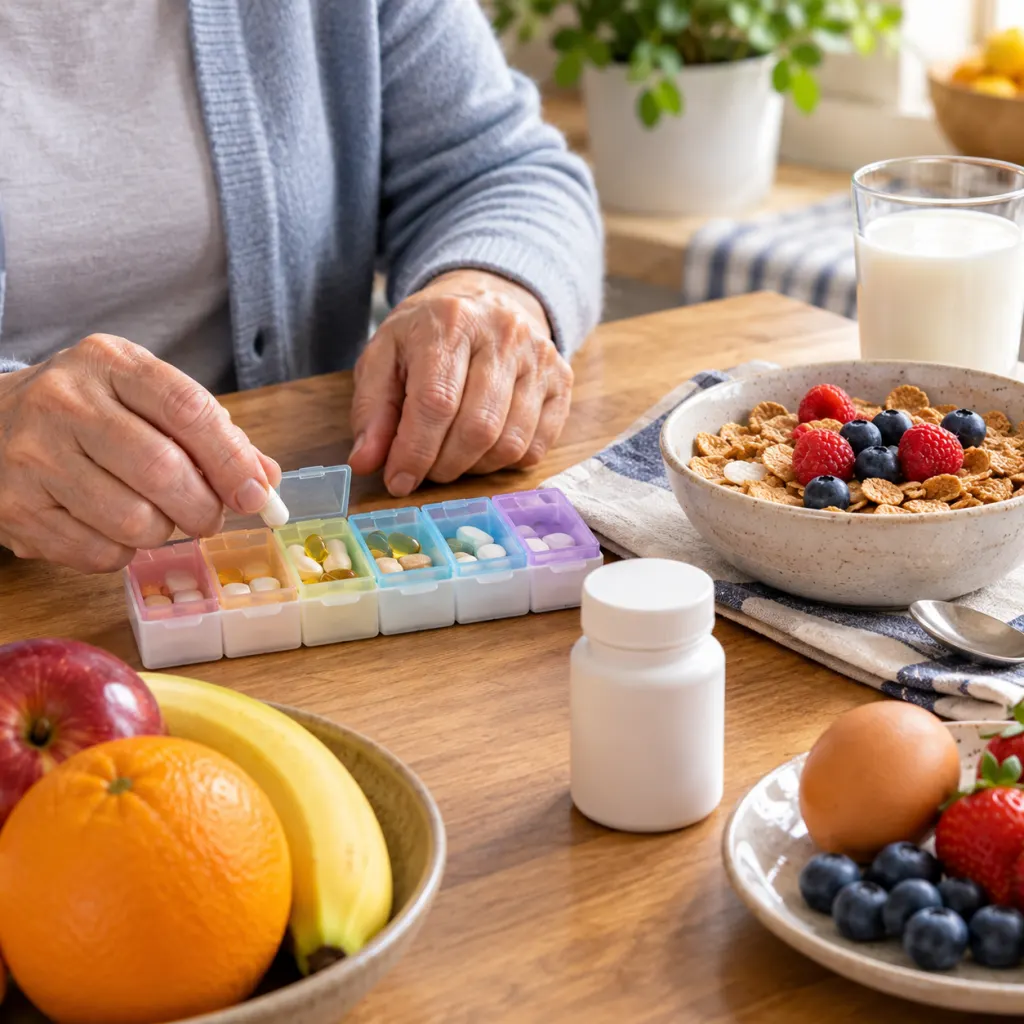
Bring supplement bottles, medication lists, and a short food log to appointments. That makes the conversation more concrete. It also helps avoid accidental overlap from multivitamins, fortified shakes, calcium products, and separate vitamin pills. People with kidney disease, digestive surgery, restricted diets, unexplained weight change, or persistent weakness should be especially cautious about self-directing a supplement plan.
A Practical Weekly Check-In
Once a week, ask three simple questions. First, did I eat vitamin D foods or fortified foods several times? Second, did I include B12-rich or B12-fortified foods, especially if I eat little animal food? Third, did I eat fruits and vegetables that bring vitamin C into ordinary meals? Then add the movement question: did I challenge my muscles at least twice in a way that matched my ability? This kind of check-in is not flashy, but it is honest. It connects nutrients to the routines that actually protect independence.
If the answer is often no, start with the easiest gap. Add fortified milk or plant milk. Keep canned fish, eggs, yogurt, fortified cereal, frozen vegetables, citrus, kiwi, or berries on hand. Put resistance bands where you will see them. Ask a clinician or physical therapist what movements are appropriate if balance, pain, or fear of falling is holding you back. Small repeatable choices are more useful than a complicated plan that disappears after a week.
Wrap-Up
Vitamin D, vitamin B12, and vitamin C are worth special attention after 60 because they support movement, nerve health, connective tissue, and protein-related body processes. The evidence does not support treating vitamins as a stand-alone fix for age-related muscle loss. A stronger plan is to combine nutrient-rich meals, fortified foods when useful, regular muscle-strengthening activity, balance work, and professional guidance when symptoms or risk factors suggest a possible deficiency. Food labels, a one-week food log, and a review of current supplements can turn a vague worry into a clear next step.
Frequently Asked Questions
- → Can vitamins alone maintain muscle after 60?
No. Vitamins can help correct or avoid nutrient gaps, but muscle responds most directly to regular use. Pair vitamin-rich meals with strength activities, balance work, and professional guidance if weakness or falls are concerns.
- → Why is vitamin D often discussed for older adults?
Vitamin D helps with calcium absorption and has roles in muscle and nerve function. Older adults may make less vitamin D from sunlight than younger adults, so food sources, fortified foods, and testing conversations can become more relevant.
- → Who should pay close attention to vitamin B12?
Adults over 50, people who eat little or no animal food, and people with certain digestive conditions or stomach or intestinal surgery may need to review B12 intake and absorption with a qualified health professional.
- → Is vitamin C mainly about the immune system?
Vitamin C has several roles. For muscle-health planning, its relevance includes collagen formation, L-carnitine production, protein metabolism, and the fact that vitamin C-rich foods often improve overall meal quality.
- → What is the safest first step if I feel weaker than usual?
Track meals, activity, symptoms, and supplements for a week, then discuss the pattern with a qualified health professional. New or worsening weakness, balance problems, numbness, or repeated falls should be evaluated rather than handled with self-selected supplements alone.