 Save
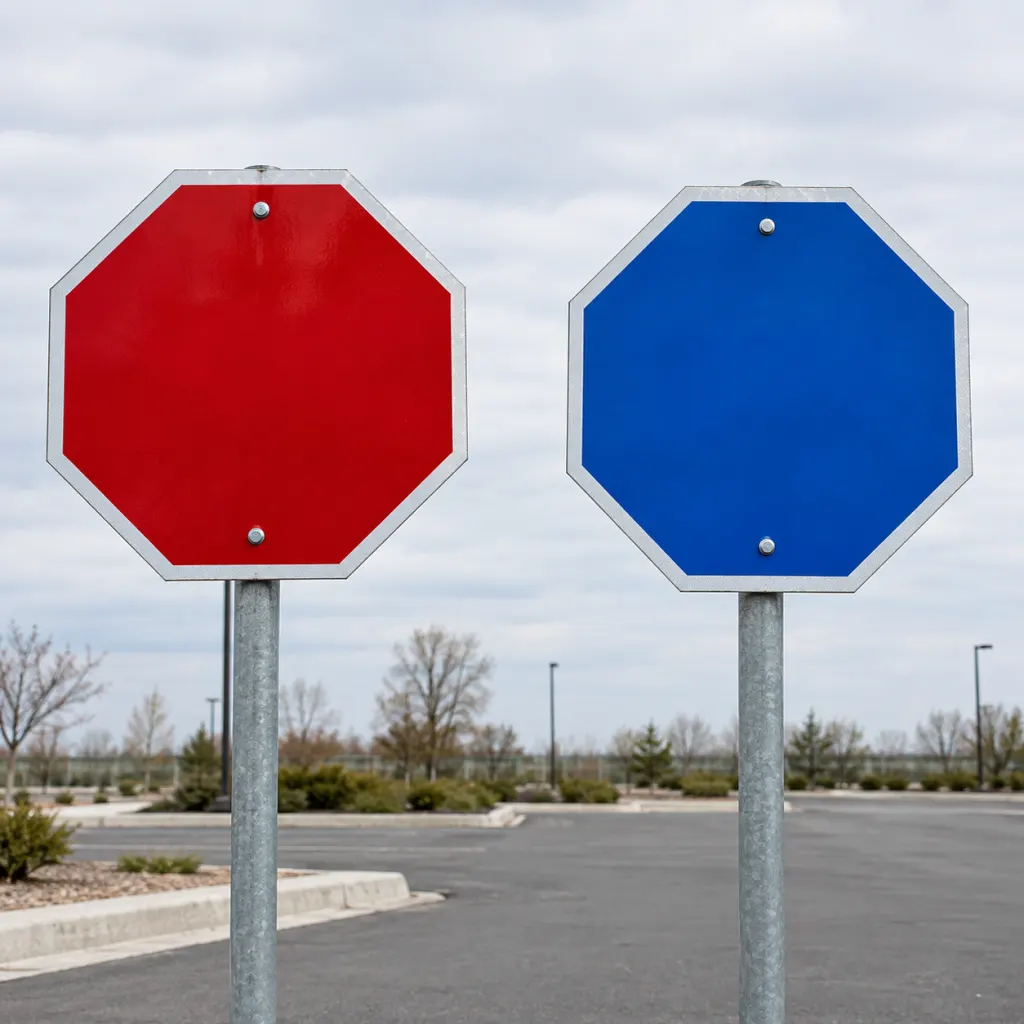
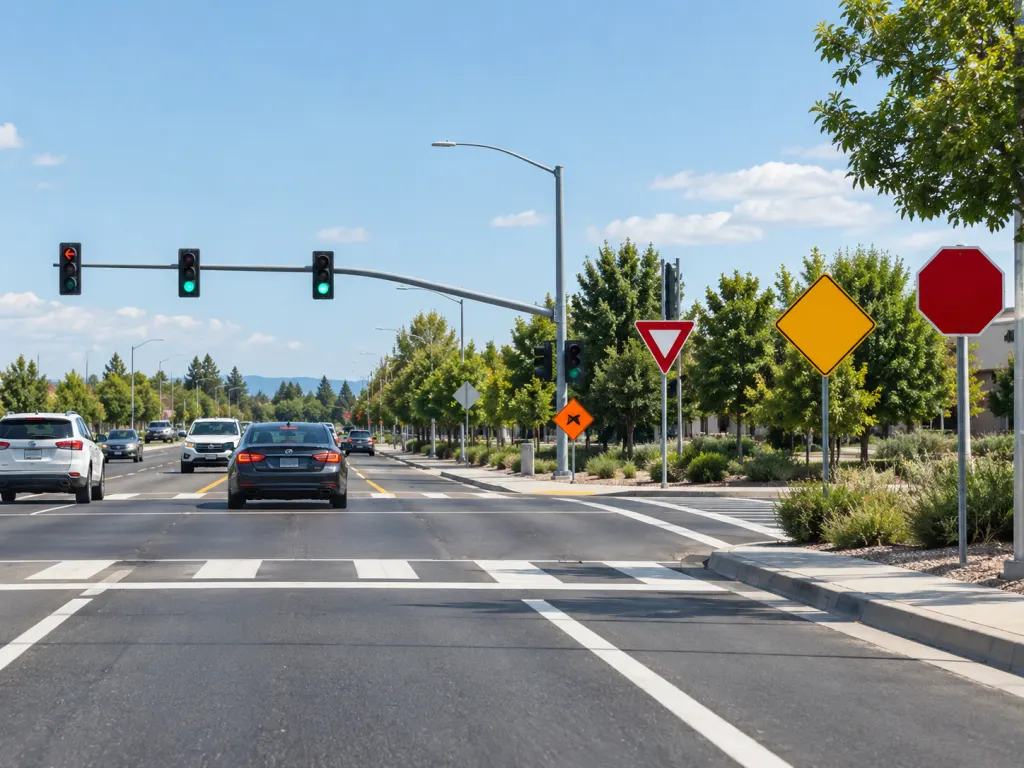
A blue stop sign is not an official traffic control device. Under the Manual on Uniform Traffic Control Devices (MUTCD), the national standard adopted by the U.S. Department of Transportation, a stop sign must be a red octagon with white lettering and border. A sign that is octagon-shaped but colored blue almost always sits on private property, a gated community, a shopping center parking area, a university campus, or an industrial site, where the federal manual's authority does not reach. Treat it the same way you would treat a red one: come to a complete stop, because the owner installed it for a reason, even though no state or federal law technically compels you to obey it the way you must obey a sign on a public road.
What Makes a Standard Stop Sign Red
Every stop sign on a public street or highway in the United States has to follow the same design rule. Federal regulation makes the Manual on Uniform Traffic Control Devices the national standard for every traffic control device installed on a street, highway, or bicycle trail open to public travel. Under that manual, a stop sign is defined by its shape, its color, and its message together: an octagon, colored retroreflective red, with white lettering and border. The Federal Highway Administration also publishes the exact color specifications sign makers must match, so a stop sign in Maine looks the same as one in Arizona. That consistency is the entire point: a driver should recognize a stop sign instantly, without pausing to read it, no matter what state or town they are driving through.
Why a Stop Sign Might Be Blue Instead
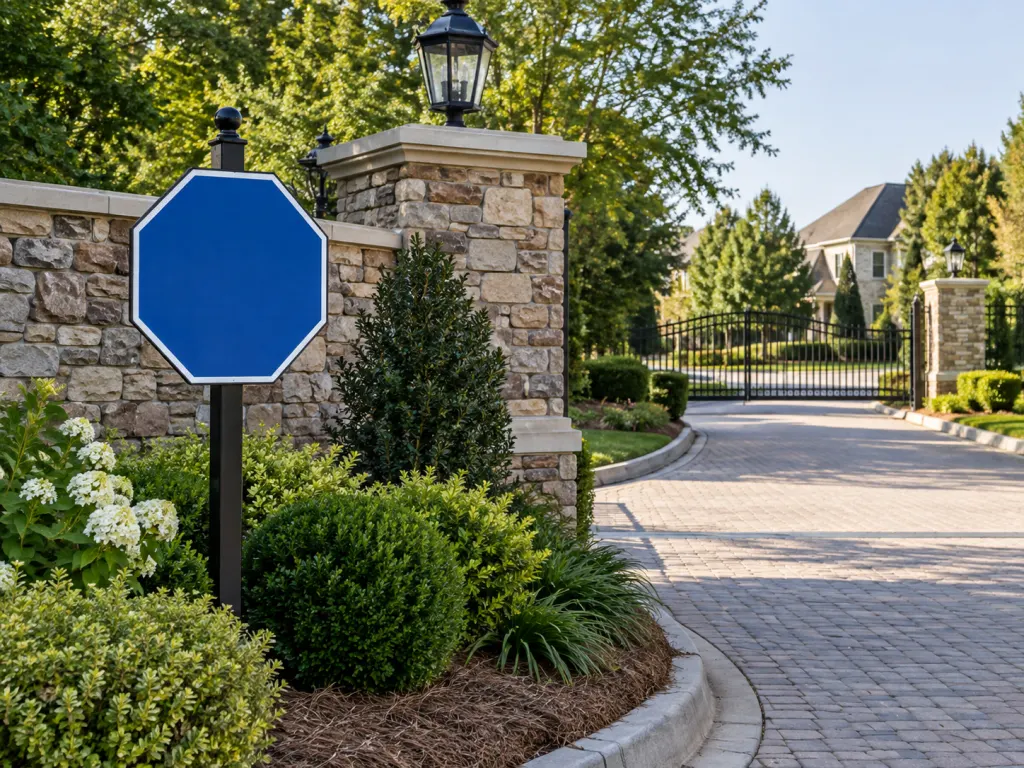
The MUTCD's authority has a boundary. Federal rule limits it to devices on streets, highways, and bicycle trails that are 'open to public travel', a category that includes public roads and privately owned toll roads, plus roads through shopping centers, airports, and similar facilities that the public can enter without passing through a gate. A Federal Highway Administration notice clarifying that definition spells out what falls inside and outside that boundary. Property that restricts access, a gated neighborhood, a fenced industrial yard, most private parking lots and driving aisles, sits outside it. On that private property, the owner can put up whatever sign they like, in whatever color, because no federal color rule applies there. A blue octagon is simply one way an owner signals 'stop here' without using the reserved federal design.
Where Blue Stop Signs Commonly Appear
Because a blue stop sign is a private design choice rather than a government-issued one, it tends to show up in similar kinds of places again and again:
- Gated or private communities, where a homeowners' association wants intersections controlled but prefers its own sign palette.
- Shopping center and business parking lots, where traffic flow needs a stop point but the lot itself is privately owned and managed.
- University and corporate campuses, which sometimes coordinate sign colors with campus branding.
- Industrial or fenced work sites, where internal traffic control does not need to match public road standards.
In every one of these settings, the property owner installed the sign for the same reason a city installs a red one: to mark a point where vehicles need to yield the right of way to cross traffic, pedestrians, or oncoming vehicles.
From Yellow to Red: A Short History of the Stop Sign
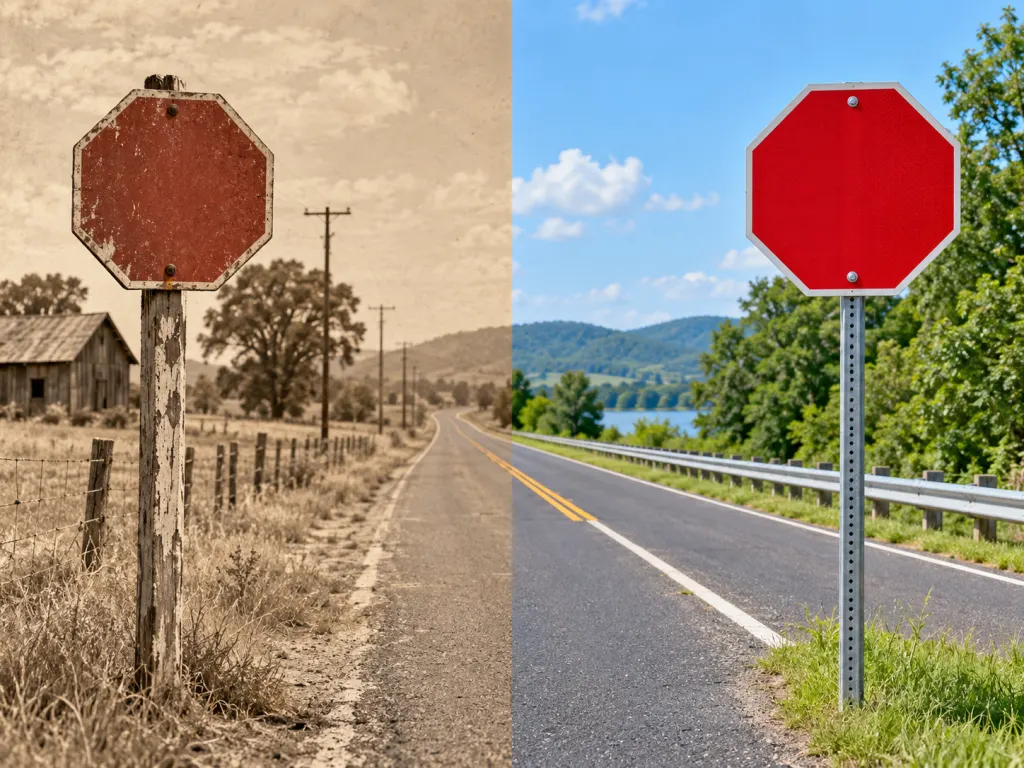
The red octagon feels timeless, but it is younger than many drivers assume. The first edition of the manual, published in 1935, allowed a stop sign to be 'black on yellow or yellow on a red octagon,' according to the Federal Highway Administration's own history of the manual. Red pigments of that era faded quickly outdoors, so early sign makers leaned on yellow, which held its color and stayed visible at night far longer. That changed by the early 1950s, once fade-resistant enamel finishes became widely available. The 1954 revision to the manual switched the stop sign to the white-on-red design still used today, matching the color already used for 'stop' on traffic signals. The shift wasn't decoration, it was a direct response to a materials problem that had finally been solved.
What Other Sign Colors Are Supposed to Tell You
Stop signs are red because the manual assigns red to regulatory, prohibitive messages, a category that also includes yield signs, do-not-enter signs, and wrong-way signs. The manual's color-usage table assigns the rest of the palette just as deliberately:
- Yellow marks general warnings, such as curves or crossing wildlife.
- Orange is reserved for temporary work-zone and incident traffic control.
- Green covers guide signs, directions, exits, and street names.
- Blue, on official public signage, is reserved for services and driver information, such as hospitals, rest areas, and evacuation routes.
- Brown points to recreational and cultural sites.
That is exactly why an official blue sign on a public road never means 'stop', the color is already assigned to a completely different job. A private blue stop sign borrows the octagon shape to communicate 'stop' while sidestepping the reserved public meaning of blue altogether.
Do You Have to Stop at a Blue Stop Sign?
Legally, a blue stop sign on private property is not enforceable the same way a red one on a public street is, since it falls outside the manual's jurisdiction and outside most state vehicle codes that reference it. In practice, though, treating it as optional is a poor bet. The intersection, parking aisle, or driveway crossing it marks still has real cross-traffic and real pedestrians. Ignoring the sign can still end in a collision, a liability dispute with the property owner, or a call to police over a traffic complaint on the property. Many gated communities and campuses also fold their private stop signs into community rules or leases, which can carry their own consequences separate from state traffic law. The simplest approach is the same one traffic engineers rely on everywhere: treat the shape as the instruction, regardless of the color, and stop.
Other Nonstandard Signs You Might Encounter
Blue stop signs are not the only variation drivers run into. Public agencies that want to try a genuinely new device or color on a public road cannot just install it, they have to request permission through the manual's own experimentation and interim-approval process before it can be used outside a lab or pilot study. That is why you will not find officially sanctioned purple or pink stop signs on a public street, even in places that experiment with sign technology. Most of the variation drivers actually encounter, a sign with bilingual wording, a flashing LED border added at a dangerous intersection, or a fluorescent border used for extra daytime visibility, is a supplemental change layered onto the standard red-and-white design, not a replacement of its color. Only on private property, where that approval process does not apply, does the color itself change.
Wrap-Up
A blue stop sign is not a government-issued traffic control device, it is a private one. The MUTCD, the federal manual that governs every officially sanctioned stop sign, requires a red octagon with white lettering and only applies to streets, highways, and bicycle trails open to public travel. Roads on gated, fenced, or otherwise access-restricted private property fall outside that requirement, which is why property owners occasionally choose a blue octagon instead. The color scheme drivers rely on everywhere else in the country, red for stop, yellow for warning, green for direction, blue for services, comes from the same manual, which is also why an official blue sign never means 'stop' on a public road. None of that makes a private blue stop sign safe to ignore. The intersection or driveway it marks still carries real traffic, so the safest and simplest habit is to treat the octagon shape itself as the instruction, whatever color it happens to be painted.
Frequently Asked Questions
- → Is a blue stop sign legal?
Not in the sense of being a government-mandated design. The MUTCD, the federal standard for public road signage, requires stop signs to be red octagons with white lettering. A blue one falls outside that standard, so it is typically found on private property where the federal color rule does not apply, rather than on a public street.
- → Can I get a ticket for not stopping at a blue stop sign?
A police officer generally cannot cite you under the state vehicle code the way they would for a public red stop sign, since a blue sign is usually on private property outside that code's reach. You could still face consequences from the property owner, from private security, or from a lawsuit if ignoring the sign leads to a collision.
- → Why aren't all countries' stop signs red?
Most countries that follow international road-sign conventions do use red octagons or red circular prohibition signs for 'stop,' because red is broadly recognized as a warning and prohibition color. Wording can differ, such as Quebec's French-language 'Arrêt' signs, without changing the required red background.
- → What does a blue traffic sign normally mean on a public road?
On public roads, blue is reserved for driver services and information, not regulation. It marks things like rest areas, hospitals, evacuation routes, and other wayfinding information rather than a command to stop or yield.
- → Who decides what color a stop sign should be?
For public roads, the Federal Highway Administration sets the design through the Manual on Uniform Traffic Control Devices, which every state agrees to follow substantially. For private property, the owner or manager makes that call, since the federal manual's authority does not extend past the boundary of public travel.
References
This content was developed and refined using reliable sources.
- https://www.govinfo.gov/content/pkg/CFR-2011-title23-vol1/xml/CFR-2011-title23-vol1-sec655-603.xml
- https://www.govinfo.gov/content/pkg/FR-2006-12-14/html/E6-21228.htm
- https://mutcd.fhwa.dot.gov/kno-colorspec.htm
- https://mutcd.fhwa.dot.gov/htm/2003r1/part2/part2a.htm
- https://mutcd.fhwa.dot.gov/kno-history.htm