 Save
The best dress for a teacher at school is one that is polished, comfortable, and classroom-ready: easy to move in, not overly revealing, compatible with the school’s employee dress code, and suitable for the actual work of teaching that day. In practice, that often means a knee-length or midi dress, a shirt dress, a simple knit dress with structure, or a modest wrap-style dress paired with comfortable shoes and a cardigan, blazer, or other layer. The decision is less about looking fashionable and more about choosing clothing that supports authority, approachability, movement, and safety. Employers may generally set workplace dress codes, but the U.S. Equal Employment Opportunity Commission notes that dress rules can have exceptions for disability, religion, and national-origin concerns when the law requires accommodation or equal treatment https://www.eeoc.gov/prohibited-employment-policiespractices.
Start With the School’s Actual Dress Code
Before choosing a dress, check the employee handbook, staff memo, union agreement, or district policy that applies to your campus. Teacher dress expectations vary widely. Some schools allow jeans on Fridays, some require business casual clothing most days, and some expect more formal attire for assemblies, parent conferences, observations, or ceremonies. A dress that is perfectly acceptable in one district may feel too casual or too formal in another. The safest rule is to treat the policy as the floor, then add your own professional judgment based on your students’ ages, your subject, and the culture of the building.
A good school dress code should be applied consistently. The EEOC explains that employers may establish dress codes for employees or job categories, but dress rules should not treat workers less favorably because of protected characteristics, and reasonable accommodations may be required in some situations https://www.eeoc.gov/prohibited-employment-policiespractices. For a teacher, that means the practical question is not “Which single dress is correct for every school?” but “Which outfit meets my school’s expectations while letting me teach well and remain myself?”
A Simple Formula That Works Most Days
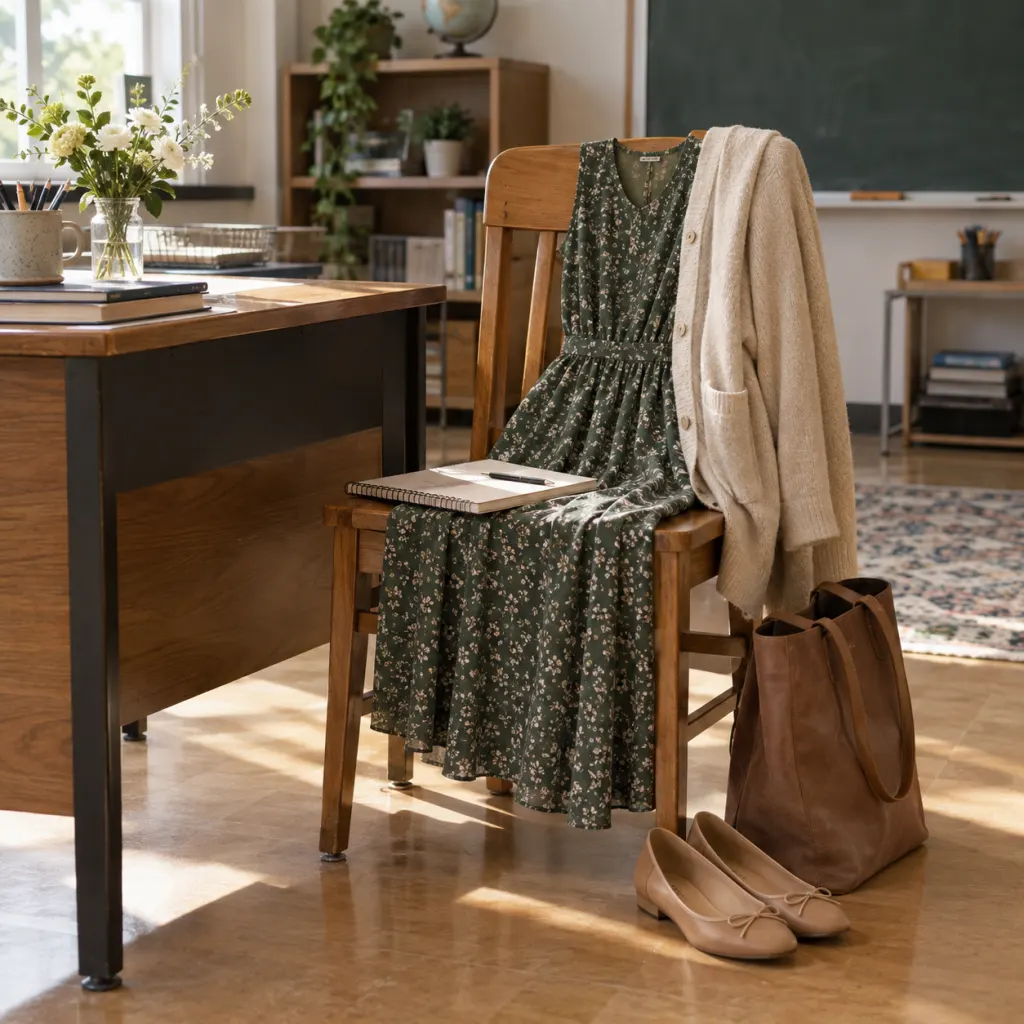
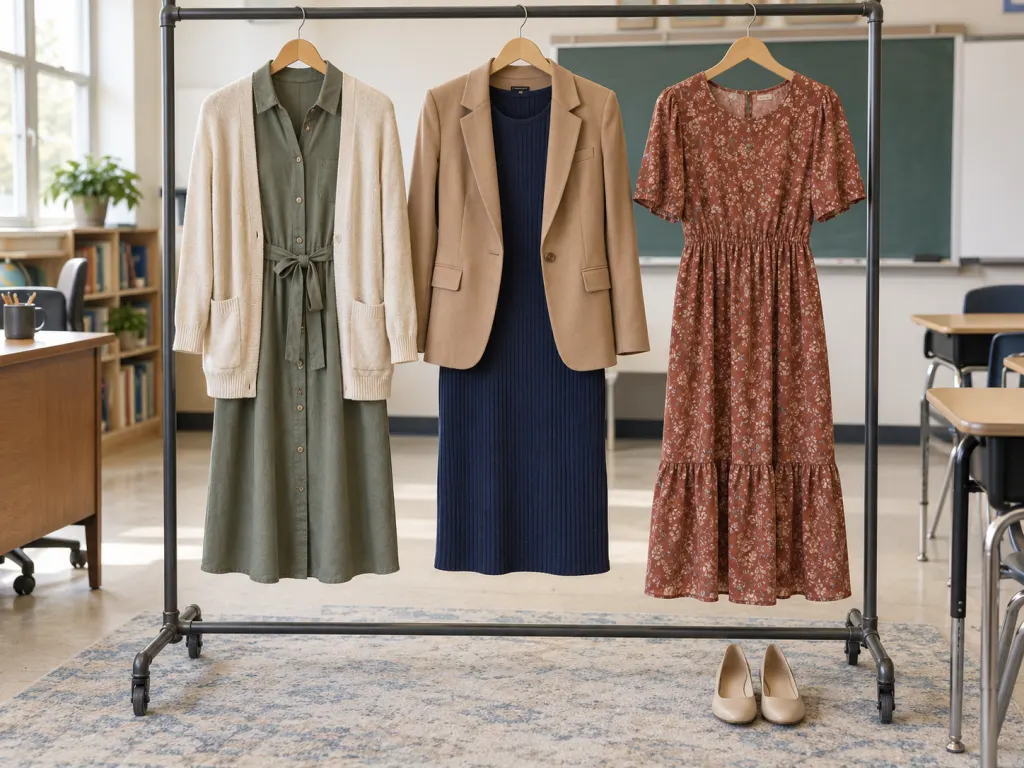
For many classrooms, a reliable teacher outfit follows a simple formula: a structured dress, practical shoes, and one layer that can adjust the tone of the outfit. A shirt dress with a belt, a fit-and-flare dress, a sweater dress that is not clingy, a ponte knit dress, or a plain midi dress can all work. The dress should let you reach, bend, write on the board, sit on a low chair, kneel beside a desk, and walk quickly through a hallway without constant adjusting.
Length and fit matter because teaching is active work. A dress that looks fine while standing in a mirror may become inconvenient when you lean over a student’s desk, sit on the floor for a read-aloud, or climb bus steps during a field trip. As a practical test, try the “classroom movement check” at home: raise your arms as if writing high on a board, sit and stand several times, bend to pick up a dropped pencil, and walk briskly. If you have to tug the dress into place after each movement, save it for a different setting.
What Counts as Professional Without Feeling Stiff
Professional teacher attire does not have to mean a suit or a plain black dress every day. In a school, professional usually means neat, intentional, appropriate to the role, and respectful of the learning environment. Color, pattern, and personality can belong in the classroom. A floral dress, a bright cardigan, a patterned scarf, or comfortable boots may be entirely appropriate when the overall outfit still reads as prepared and school-aware.
The most versatile dresses tend to have a few shared features: fabric with enough weight to drape well, sleeves or straps that work with the school’s expectations, a neckline that stays in place when bending, and a length that remains comfortable when sitting. Teachers who prefer trousers or skirts can use the same logic. The question is not whether a teacher must wear a dress, but which clothing helps them communicate readiness and focus without making the outfit the center of attention.
- Elementary teachers: choose washable fabrics, easy movement, and shoes that handle stairs, playground duty, and sitting near students.
- Middle school teachers: prioritize confident structure, coverage during movement, and pieces that do not invite constant correction.
- High school teachers: business casual dresses, blazers, cardigans, and polished shoes often fit well, especially for presentations or parent meetings.
- Substitute teachers: choose a slightly more formal version of business casual because you may not know the building culture yet.
- Student teachers: lean conservative at first, then adjust after observing mentor teachers and policy expectations.
Match the Outfit to the Day’s Duties
A teacher’s schedule should shape the outfit. A dress that works for a lecture-heavy English class may not work for a chemistry lab, ceramics room, culinary classroom, workshop, field day, or outdoor dismissal in bad weather. The federal workplace PPE regulation in 29 CFR 1910.132 requires hazard assessment and appropriate protective equipment when workplace hazards call for it https://www.ecfr.gov/current/title-29/subtitle-B/chapter-XVII/part-1910/subpart-I/section-1910.132. Teachers should follow their school’s specific safety procedures rather than relying on ordinary fashion choices in specialized spaces.
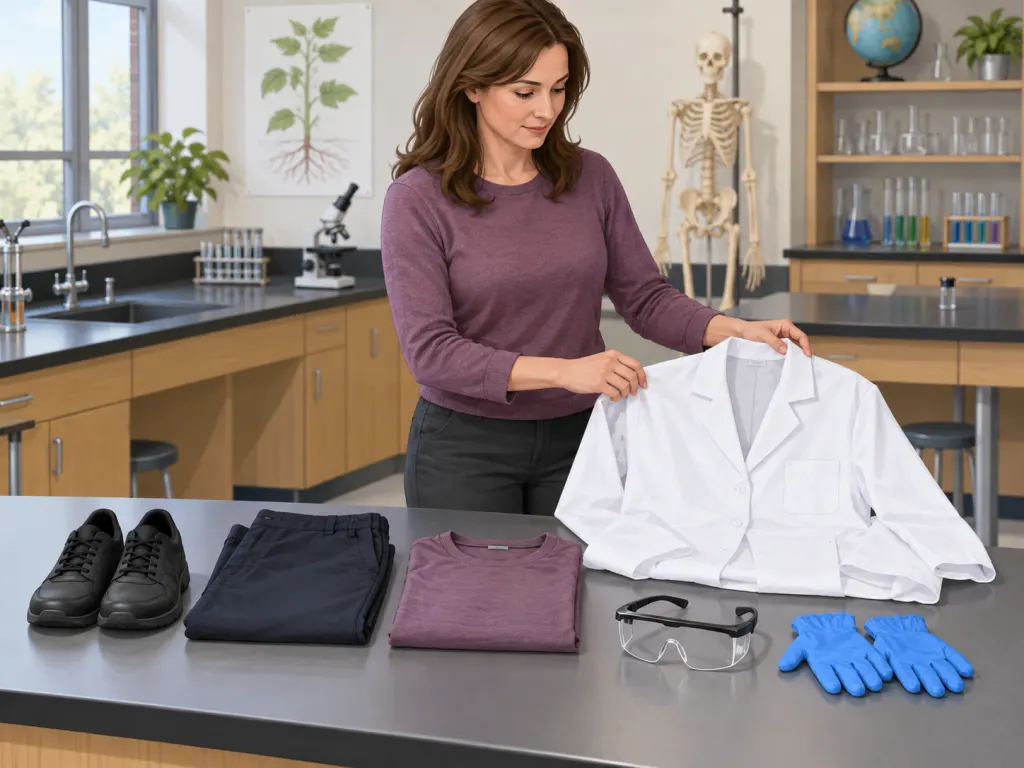
Science teachers, art teachers, career and technical education teachers, and anyone supervising hands-on work may need more protective clothing than a typical classroom outfit. Federal laboratory guidance in 29 CFR 1910.1450 includes recommendations such as lab coats and gloves for hazardous materials, and closed-toe shoes with long pants or clothing that covers the legs in laboratories where hazardous chemicals are used https://www.ecfr.gov/current/title-29/subtitle-B/chapter-XVII/part-1910/section-1910.1450. University laboratory safety pages echo this practical point: the University of Minnesota lists ankle-length leg coverage and closed-toe, closed-heel shoes for labs with hazardous materials https://hsrm.umn.edu/proper-lab-attire.
Footwear and Layers Deserve as Much Thought as the Dress
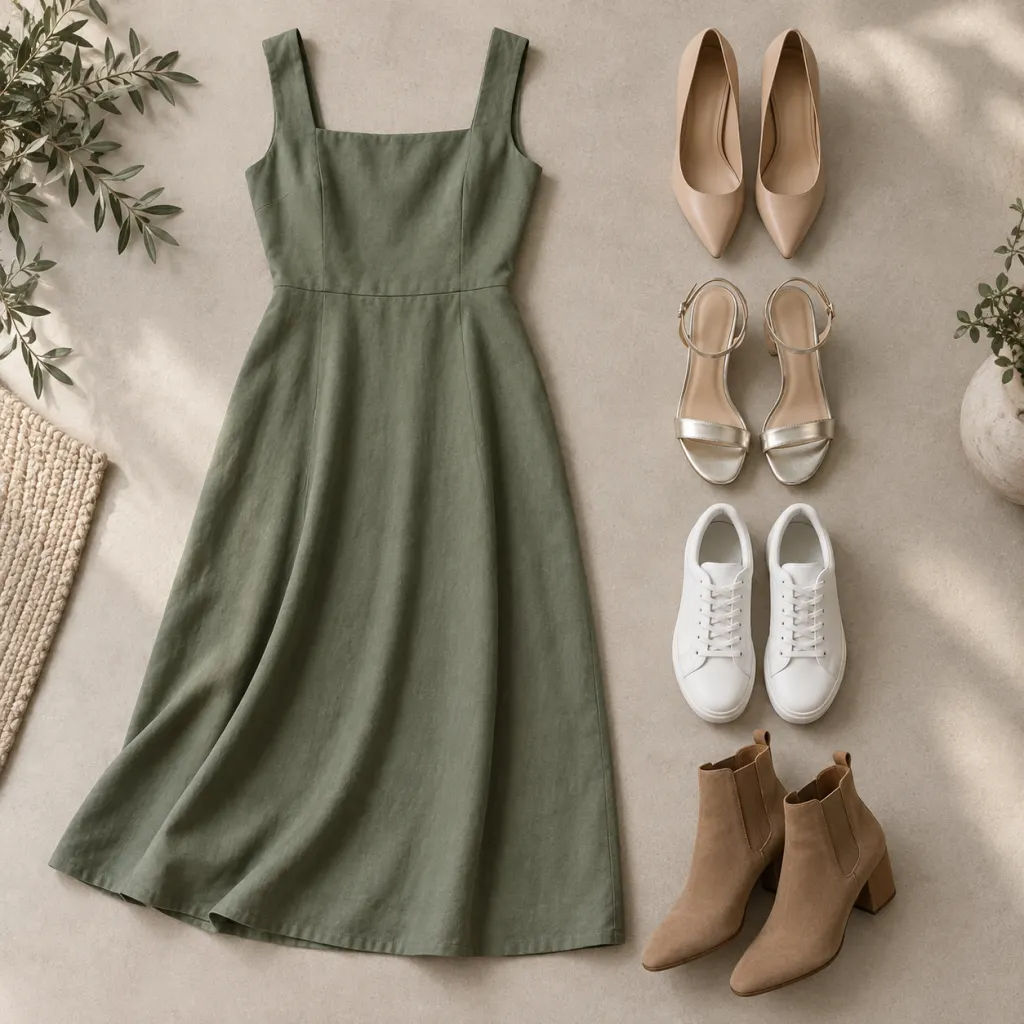
Shoes can make or break a teacher outfit. Many teachers stand for long stretches, circulate through rows, supervise hallways, and move between rooms. A professional dress with unstable shoes can become impractical by second period. Closed-toe flats, low block heels, loafers, simple boots, or supportive dress sneakers may suit many school settings, depending on policy. In labs, shops, kitchens, and other task-specific spaces, follow the stricter safety rule for that room. If the day includes playground duty, rain, snow, or bus supervision, choose shoes that can handle the ground you will actually walk on.
Layers help a dress adapt to school realities. Classrooms can be cold in the morning, warm after lunch, or uneven from one wing to another. A cardigan softens a formal dress; a blazer makes a simple dress feel conference-ready; a denim jacket may work in a casual school but not in a formal one. Layers also help teachers move between roles: teaching, meeting families, attending an IEP meeting, supervising dismissal, or appearing in school photos.
Cultural, Religious, and Personal Expression Belong in the Conversation
Teacher attire is also about identity. Religious dress, modest clothing, head coverings, natural hair, cultural garments, and disability-related clothing needs may be part of a teacher’s daily life. The EEOC’s guidance on religious garb and grooming explains that covered employers often must make exceptions to usual dress or grooming rules for sincerely held religious practices unless doing so would create undue hardship under the applicable legal standard https://www.eeoc.gov/laws/guidance/fact-sheet-religious-garb-and-grooming-workplace-rights-and-responsibilities. That does not mean every situation is identical, but it does mean attire questions should be handled with care, documentation, and respect.
Schools are also places where students watch how adults treat difference. The U.S. Department of Education’s Office for Civil Rights notes that students may be protected from discrimination tied to shared ancestry or ethnic characteristics, including harassment connected to how they look, dress, or speak https://www.ed.gov/laws-and-policy/civil-rights-laws/title-vi/title-vi-key-issues/discrimination-based-shared-ancestry-or-ethnic-characteristics. A teacher’s clothing choices do not have to erase personality or culture to be professional. A healthy school culture makes room for respectful difference while still maintaining practical expectations for the job.
Dresses That Usually Work Well for Teachers
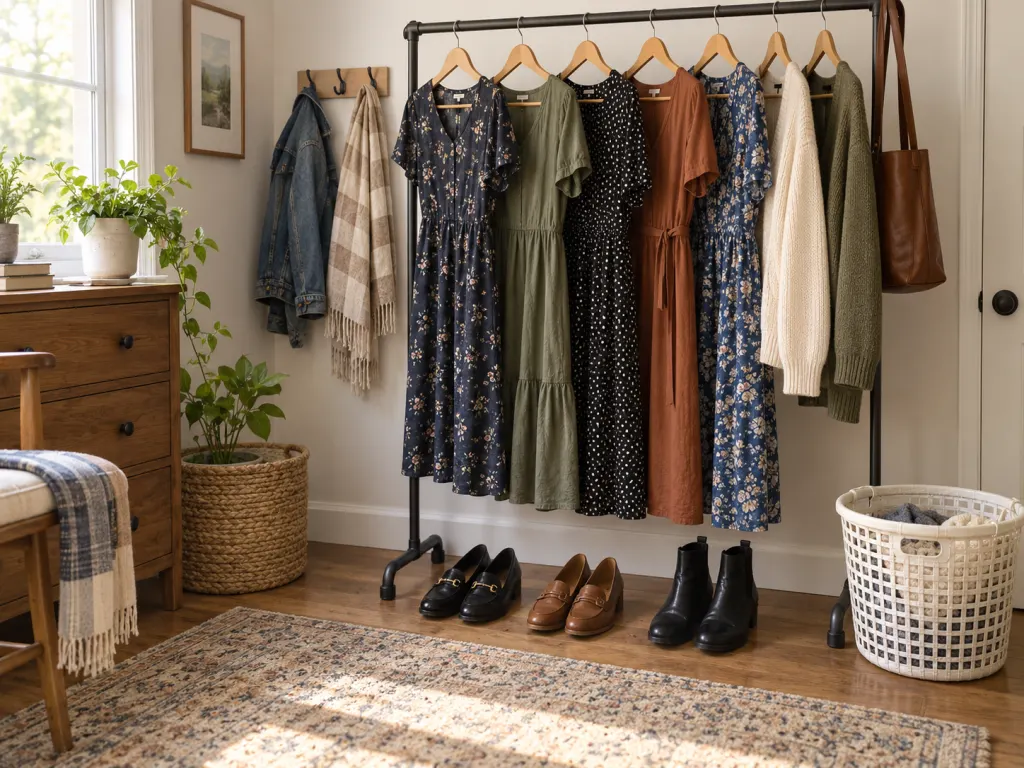
A few dress styles tend to perform well in schools because they balance movement, polish, and simplicity. A shirt dress is easy to make more formal with a belt or blazer. A fit-and-flare dress allows movement without feeling too casual. A ponte or thicker knit dress resists wrinkling and can look structured without being uncomfortable. A midi dress can be elegant and practical when the hem does not interfere with stairs or quick movement. A wrap-style dress can be useful if it stays secure and does not gap at the neckline; many teachers add a camisole or choose a faux-wrap design for reliability.
Fabric matters. Thin fabric may cling, wrinkle, or become transparent in bright classroom lighting. Very delicate fabric can snag on desks, backpacks, lab stools, or art supplies. Heavy fabric may look polished but feel too warm in a crowded classroom. For everyday teaching, many people do well with washable cotton blends, ponte, twill, jersey with structure, chambray, or seasonally appropriate knits. When clothing care affects your routine, it may help to think about washing habits too; related home-care topics such as washing jeans less often and choosing laundry temperatures thoughtfully can shape how long work clothes stay presentable.
What to Avoid Without Turning It Into a List of Shame
Teachers do not need a harsh checklist of forbidden clothing to make a good choice. Still, some outfits create predictable problems at school. Very short hems, plunging necklines, sheer fabrics, strapless dresses, clothing with offensive text, noisy accessories, unstable shoes, or pieces that require constant adjustment can distract from teaching. So can clothing that is too formal for messy hands-on work or too casual for a school that expects business attire. The goal is not to police bodies or personal style. The goal is to reduce friction so the teacher can focus on students.
It is also wise to consider the hidden demands of the day. Are you supervising a fire drill? Sitting on carpet with young children? Leading a lab? Meeting a family after school? Standing outside in wind? Teaching near paint, glue, food, or clay? Moving equipment? A dress may be beautiful and still be wrong for a specific schedule. Practicality is not the enemy of style; for teachers, practicality is part of style.
A Practical Outfit Decision Tree
When you are unsure, work through four questions. First, does this outfit comply with the written dress code and the norms of my building? Second, can I move normally through the physical tasks of teaching? Third, does it fit the most demanding part of my day, not just the easiest part? Fourth, would I feel comfortable wearing it while speaking with a student, administrator, and family member on the same day? If the answer is yes to all four, the dress is probably a good school choice.
New teachers may want to begin slightly more polished than the minimum expectation. That might mean a simple dress with a cardigan, loafers, and minimal accessories rather than an outfit that tests the edge of the dress code. After a few weeks, patterns become clearer: what other teachers wear, what administrators comment on, what feels comfortable in your room, and what makes you feel like yourself while still fitting the role.
The Best Choice Is Professional, Practical, and Yours
So which dress should a teacher wear at school? Choose the dress that lets you teach without fuss. For many teachers, that is a modest midi or knee-length dress in a durable fabric, paired with comfortable closed-toe shoes and a cardigan or blazer. For others, the best answer may be a culturally meaningful garment, a dress over leggings, a tunic, a skirt-and-top outfit, or trousers instead of a dress. The right outfit respects the school setting, supports the work, and leaves enough room for personality that the teacher still feels at home in it.
Wrap-Up
A strong teacher outfit begins with policy, then moves to movement, safety, and personal identity. Most school days call for a dress that is neat, durable, comfortable, and easy to layer. Specialized rooms such as labs, shops, kitchens, and art spaces may require protective clothing or stricter footwear, so the day’s duties matter as much as the dress itself. The most dependable choice is not the most fashionable or the most formal one; it is the one that lets a teacher move through the school day with confidence, respect, and attention where it belongs: on teaching.
Frequently Asked Questions
- → Can a teacher wear a dress every day?
Yes, if dresses fit the school dress code and the teacher’s duties. Many teachers wear dresses regularly because they are simple, polished, and easy to style. The key is choosing fabrics, lengths, shoes, and layers that work for movement, supervision, weather, and classroom tasks.
- → Is a knee-length dress appropriate for school?
A knee-length dress is often appropriate in school settings when it fits comfortably, stays in place while sitting and bending, and follows local policy. Some teachers prefer midi lengths because they offer more coverage during active classroom movement.
- → Should teachers wear formal or casual clothing?
Most teachers do best with business casual clothing unless their school sets a different standard. A simple dress with a cardigan, blazer, loafers, flats, or low boots often feels professional without being stiff. Special events may call for more formal clothing, while field trips or hands-on classes may call for more practical pieces.
- → What should a teacher wear for science labs or hands-on rooms?
Teachers should follow the safety rules for that specific room. Lab, shop, kitchen, art, and career-technical spaces may require closed-toe shoes, leg coverage, protective eyewear, gloves, lab coats, aprons, or other equipment. Ordinary classroom fashion should not override task-specific safety requirements.
- → Can religious or cultural clothing be professional teacher attire?
Yes. Religious and cultural clothing can be fully professional when it is worn in a way that supports the teaching role and follows applicable policy. Employment rules may also require reasonable accommodation in certain situations, so teachers should use the school’s human resources or accommodation process when needed.
References
This content was developed and refined using reliable sources.
- https://www.eeoc.gov/prohibited-employment-policiespractices
- https://www.eeoc.gov/laws/guidance/fact-sheet-religious-garb-and-grooming-workplace-rights-and-responsibilities
- https://www.ed.gov/laws-and-policy/civil-rights-laws/title-vi/title-vi-key-issues/discrimination-based-shared-ancestry-or-ethnic-characteristics
- https://www.ecfr.gov/current/title-29/subtitle-B/chapter-XVII/part-1910/subpart-I/section-1910.132
- https://www.ecfr.gov/current/title-29/subtitle-B/chapter-XVII/part-1910/section-1910.1450
- https://hsrm.umn.edu/proper-lab-attire