 Save
A bouquet choice can reveal something about your taste, mood, and the qualities you want close to you, but it cannot define your whole personality. Treat this as a reflective, low-pressure exercise: choose the flowers you would bring home first, then read the interpretation as a mirror for possible strengths, values, and needs. The tradition behind this kind of game comes partly from floriography, the symbolic language of flowers, and partly from the human habit of using preferences to tell stories about ourselves. California State University Northridge notes that floral meanings were culturally codified during the Victorian period in Britain and the United States, while the University of Missouri Extension describes floriography as communication through flower and color symbolism. Modern personality research is more careful: Carnegie Mellon University describes Big Five measures as structured tools for assessing broad traits such as openness, conscientiousness, extraversion, agreeableness, and emotional stability. So your bouquet is not a verdict. It is a doorway into a useful question: what kind of beauty feels like you today?
How to Use the Bouquet Choice
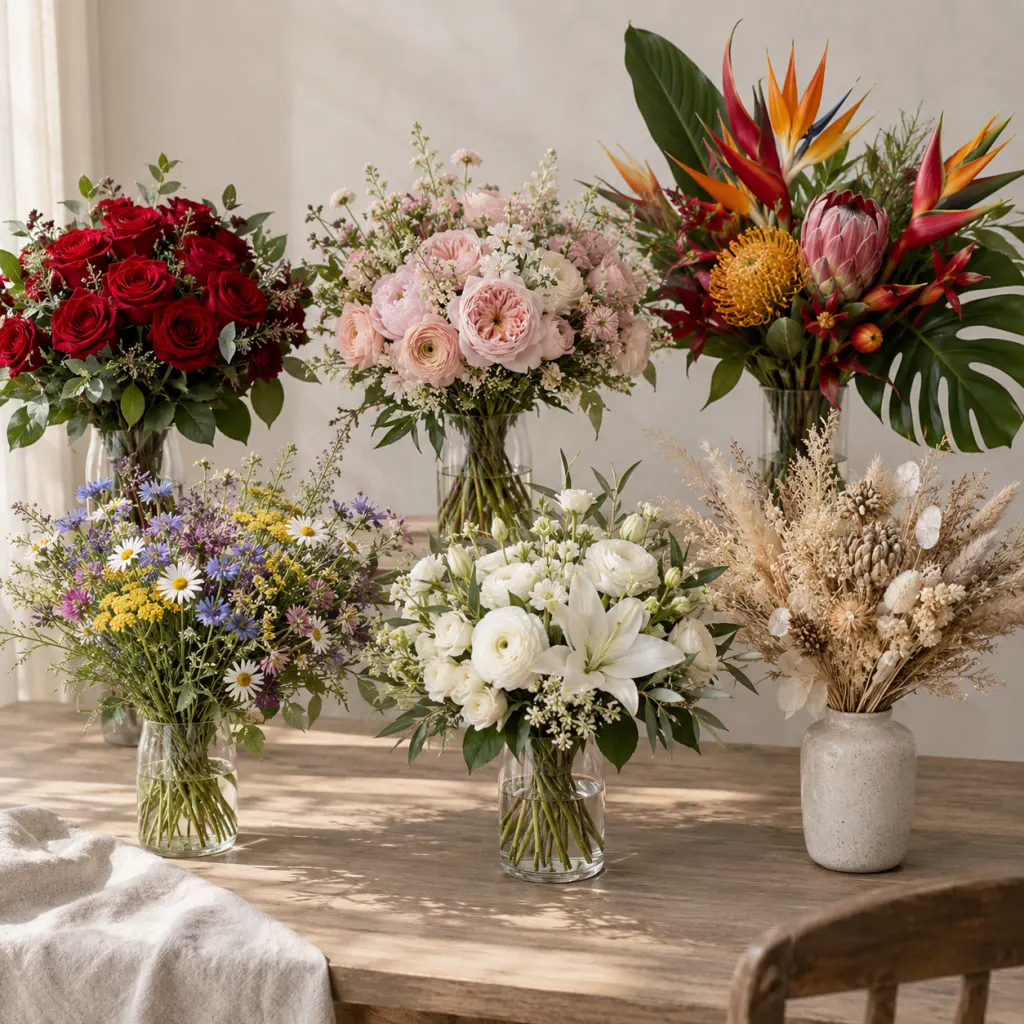
Look at the six bouquet styles below and imagine you can take only one home. Do not overthink which arrangement is most expensive, fashionable, or impressive. Notice what your attention moves toward first: softness, color, order, fragrance, wildness, drama, or calm. That first pull is the point of the exercise. A preference can be shaped by memory, season, culture, current mood, and the room you imagine placing the bouquet in. Because of that, this article uses bouquet choice as a conversation with yourself, not as proof of a fixed type.
Why Flowers Became a Language
Flowers have been used to communicate feeling for centuries, but the best-known Western version is floriography. The CSUN University Library describes the Victorian-era rise of floral dictionaries that assigned culturally created meanings to flowers such as roses, acacia, ranunculus, and others. The University of Missouri Extension adds that flower color could change the message: red flowers often suggested affection or passion in that tradition, yellow could suggest friendship or disappointment depending on the bloom, and white carried different meanings across cultures. That history matters because a bouquet is never only botanical. It is also visual language: color, shape, fragrance, restraint, abundance, and cultural memory all speak at once. CSUN University Library and University of Missouri Extension both emphasize that these meanings are cultural, not universal laws.
Modern personality psychology works differently. The Berkeley Personality Lab describes the Big Five as broad patterns in mental states, emotional experience, and behavior: openness, conscientiousness, extraversion, agreeableness, and neuroticism. Carnegie Mellon University’s Common Cold Project page explains that Big Five measures use multiple self-descriptive items and scoring rather than one aesthetic decision. That contrast is useful. A bouquet quiz can be meaningful when it sparks accurate self-observation, but it becomes misleading if it pretends to measure a person with scientific precision. The healthiest reading is playful and nuanced: your choice may hint at what you value, what you are craving, or how you like to be seen.
A good way to read your result is to ask three questions after choosing:
- What drew me in first? Color, symmetry, scent, delicacy, boldness, or natural looseness can all point to different kinds of attraction.
- Where would I put this bouquet? A desk, kitchen table, bedroom, entryway, or celebration table can reveal the role you want beauty to play in daily life.
- What would I change? Adding greenery, removing a bright flower, or choosing a looser shape can say as much as the first selection.
Bouquet 1: Classic Red Roses and Deep Greenery
If the classic red bouquet catches your eye, you may be drawn to clarity, devotion, and emotionally direct gestures. You probably appreciate signals that are easy to understand: a promise kept, a table set with care, a message that says exactly what it means. In the language of flowers, roses are strongly associated with love in many Western contexts, and that cultural meaning can make a red bouquet feel confident and traditional. Your strength may be the ability to take feelings seriously without needing to decorate them with too much irony.
The shadow side of this choice is intensity. When you care, you may care all the way, and that can make uncertainty feel uncomfortable. The reflective question for this bouquet is: where in my life do I want more directness, and where would a lighter touch help? If you chose red roses, your personality reading is not simply romantic. It may be about loyalty, courage, ceremony, and the wish for relationships or projects that feel unmistakable.
Bouquet 2: Soft Pink Garden Blooms
If you choose soft pink peonies, roses, ranunculus, or similar garden flowers, you may be drawn to warmth, gentleness, and emotional texture. This bouquet suggests someone who notices tone: the pause before an answer, the lighting in a room, the way a person relaxes when they feel understood. Pink arrangements often feel gracious rather than dramatic, which can point to a personality style that values kindness, reassurance, and everyday beauty. You may be the person who remembers small preferences and turns them into care.
This does not mean you are fragile. Softness can require discipline, especially in a noisy world that rewards speed and bluntness. Your likely strength is relational intelligence: sensing what helps people feel welcome while still holding your own center. The question to sit with is: do I offer the same patience to myself that I offer to others? If the pink bouquet feels like yours, your choice may reveal a longing for tenderness that is steady, not performative.
Bouquet 3: Tropical Brights and Sculptural Leaves
If you reach for tropical flowers, saturated oranges, hot pinks, birds-of-paradise shapes, anthuriums, or glossy leaves, you may be energized by novelty. This bouquet points toward curiosity, expressive confidence, and a taste for environments that wake up the senses. In Big Five language, the closest connection is often openness to experience, the broad domain linked with curiosity, imagination, and attraction to new ideas. The Berkeley Personality Lab describes openness as one of the five major personality domains, and a tropical bouquet makes a vivid visual metaphor for that exploratory side.
The gift of this style is momentum. You may be good at changing the energy of a room, spotting possibilities, and encouraging other people to try something less predictable. The caution is that constant stimulation can make quieter commitments feel dull before they have a chance to deepen. Ask yourself: which new experience is actually nourishing, and which one is only a distraction? Your bouquet reading suggests a lively spirit, but also invites you to choose adventures that match your values, not just your appetite for motion.
Bouquet 4: Wildflowers, Herbs, and Loose Stems
If the wildflower bouquet is the one you want to carry home, you may value authenticity over polish. This arrangement feels gathered rather than staged: daisies, cosmos, lavender, chamomile, grasses, or seasonal stems that seem to have their own direction. The personality clue here is independence. You may be comfortable with asymmetry, surprise, and the charm of things that do not look overly managed. Instead of wanting life to appear perfect, you may want it to feel alive.
Wildflower people often bring creative attention to ordinary places. You might notice the shape of a shadow on the wall, the odd little cup at a thrift store, or the friend who becomes quieter in a group. You may resist categories that feel too tight, including personality categories. The useful question is: where does my freedom need more structure so it can last? A wild bouquet can be a symbol of self-trust, but even wild gardens need some tending if they are going to keep blooming.
Bouquet 5: White Flowers and Elegant Foliage
If you choose white lilies, roses, tulips, orchids, or hydrangeas with composed greenery, you may be drawn to calm, proportion, and restraint. This bouquet often signals a love of quiet order. You may prefer fewer, better choices rather than visual clutter. Because the University of Missouri Extension notes that flower colors can carry different meanings across cultures, it is worth reading white flowers carefully: in some settings they feel pure, formal, peaceful, or ceremonial, while in others they may carry associations of mourning. Your personal meaning matters.
As a personality prompt, the white bouquet suggests someone who values thoughtfulness before action. You may be the person others trust when a situation needs a steady voice. You may also have a strong aesthetic filter, knowing quickly when something feels discordant. The growth edge is making sure calm does not become avoidance. Ask yourself: am I choosing peace because it is wise, or because I do not want to disturb the surface? The best version of this bouquet is not cold perfection. It is clarity with grace.
Bouquet 6: Neutral Tones, Dried Flowers, and Textured Greens
If you prefer dried grasses, eucalyptus, beige roses, seed pods, muted carnations, or neutral-toned stems, your personality reading may center on steadiness and practicality. This bouquet does not demand attention in a loud way. It works through texture, endurance, and quiet compatibility with the room around it. You may appreciate usefulness, continuity, and things that age well. A neutral arrangement can suggest someone who finds beauty in materials, routine, and subtle variation rather than spectacle.
This choice may also point to self-sufficiency. You may not need constant praise to keep going, and you may prefer to prove care through reliability. The challenge is that people who seem composed can be overlooked. Your reflective question is: where do I need to let my needs be more visible? A muted bouquet can be deeply expressive when you look closely. Likewise, a practical personality can hold a great deal of feeling beneath a calm surface.
How to Read Mixed Feelings About Two Bouquets
If you feel torn between two arrangements, that may be more revealing than a single choice. A person drawn to both tropical flowers and white orchids may be balancing adventure with control. Someone who loves pink garden blooms and neutral dried stems may want both tenderness and stability. This is closer to how personality often works in real life. Carnegie Mellon University describes Big Five tools as measuring several dimensions, not forcing a person into a single box. You can be sociable and private, orderly and imaginative, gentle and decisive. A bouquet blend may show a current tension or a developing balance.
Try naming your first choice as the quality you are expressing and your second choice as the quality you are learning. For example, red roses plus wildflowers might read as devoted but increasingly independent. White tulips plus tropical leaves might read as composed but ready for creative disruption. This method keeps the exercise generous. Instead of asking, “Which type am I forever?” it asks, “Which parts of me want more room?”
A More Grounded Way to Make the Quiz Useful
The best personality reflections are specific enough to help and flexible enough to stay humane. Personality research, including the summaries from Penn State’s Department of Psychology and the Berkeley Personality Lab, treats personality as patterns that can be relatively stable while still developing across a lifetime. A bouquet choice is far simpler than that, but it can still be useful if it leads to observation. After choosing, write down three traits you hope the bouquet says about you, three traits it actually says about your current season, and one trait you want to practice this week. That turns a pretty image into a small act of self-knowledge.
You can also use the exercise with friends, as long as everyone keeps the tone playful. Ask each person what they chose and why before sharing any interpretation. Their reason may surprise you. One person may choose white flowers because they feel peaceful; another may choose them because they remind them of a grandmother’s garden. One person may choose tropical blooms because they love travel; another may simply be tired of beige rooms. The meaning lives in the dialogue between symbol and person.
Wrap-Up
Choosing a bouquet to reveal your personality works best as a symbolic mirror. Red roses may point to direct devotion, pink garden flowers to tenderness, tropical brights to curiosity, wildflowers to independence, white arrangements to calm clarity, and neutral textured stems to practical steadiness. None of these readings is final or complete. Flower meanings change across cultures, and formal personality research uses structured models such as the Big Five rather than single preferences. Let your bouquet choice start a conversation with yourself: what beauty draws you in, what value it reflects, and what part of your life may be asking for more attention.
Frequently Asked Questions
- → Can a bouquet really reveal my personality?
It can reveal a preference, mood, memory, or value that feels important to you, but it is not a formal personality measure. Read the result as a reflective prompt rather than a fixed description.
- → What if I like more than one bouquet?
That is normal and often useful. Your first choice may show what you naturally express, while your second choice may show a quality you are craving, practicing, or beginning to value more.
- → Are flower meanings the same everywhere?
No. Flower symbolism changes across cultures, time periods, colors, and occasions. A white bouquet, for example, may feel elegant in one setting and carry a very different association in another.
- → Which bouquet suggests creativity?
Tropical brights and wildflower arrangements often make strong creativity prompts because they emphasize novelty, color, looseness, and surprise. Still, creativity can also appear in a restrained bouquet through careful proportion and subtle detail.
- → How should I use this with friends?
Let everyone choose silently first, then ask why they chose that bouquet before reading interpretations. The personal reason behind the choice is usually more meaningful than the category itself.
References
This content was developed and refined using reliable sources.
- https://library.csun.edu/sca/peek-stacks/floriography
- https://extension.missouri.edu/news/the-language-of-flowers-blossoms-on-valentines-day
- https://www.cmu.edu/common-cold-project/measures-by-study/psychological-and-social-constructs/personality-measures/big-five-personality-factors.html
- https://www.ocf.berkeley.edu/~johnlab/research.html
- https://psych.la.psu.edu/about-us/research/personality