 Save
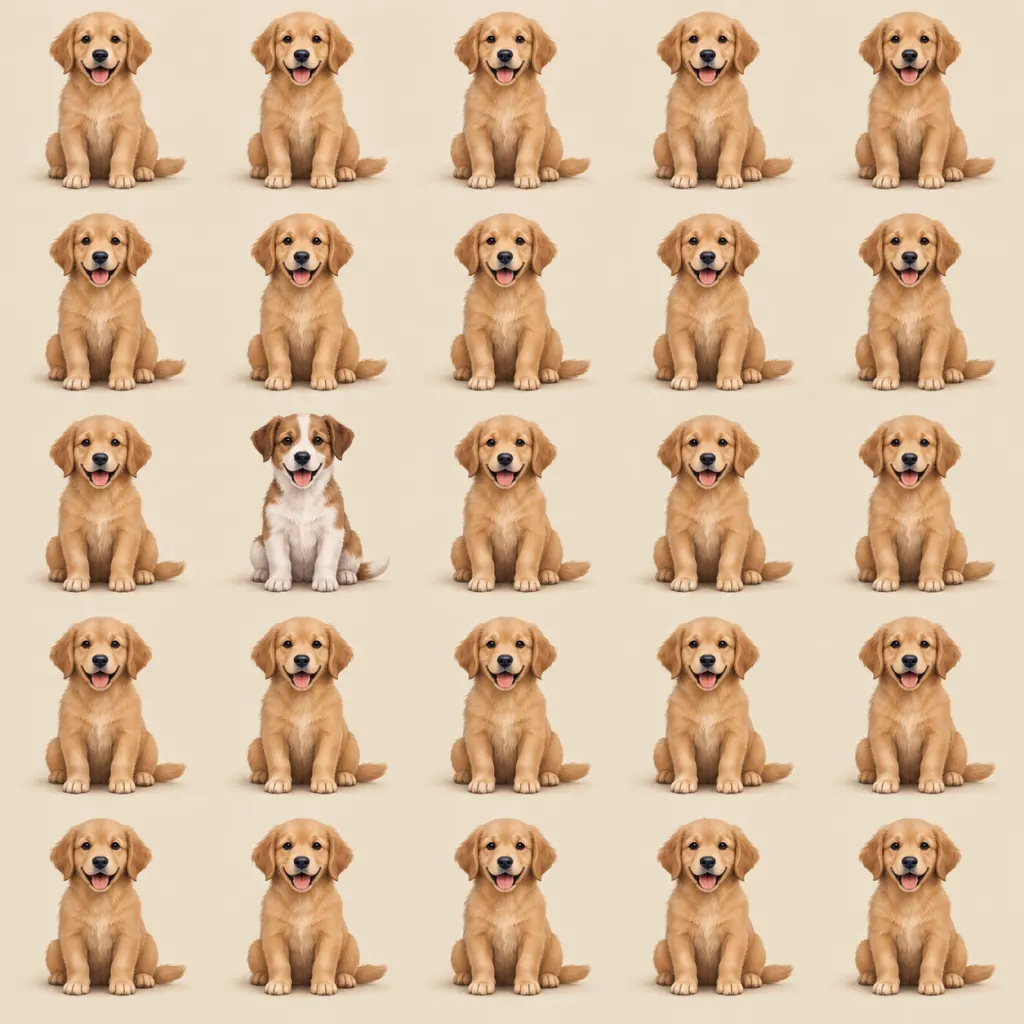
Yes, you can spot which dog is different, but the fastest route is usually not staring harder. Treat the image like a visual-search puzzle: choose one feature, compare it across every dog, then move to the next feature. If the puzzle is designed fairly, the odd dog will differ in a visible detail such as a missing paw line, an extra fur tuft, a changed nose shape, a tilted ear, or a mismatched tail. If the exact image is not available, no single position can be verified, so the useful answer is the method. Research on visual search shows that people do not process every part of a crowded image at once; attention is guided toward likely targets and obvious contrasts, which is why subtle differences can sit in plain sight while we miss them PubMed.
Why This Puzzle Feels Easy Until It Does Not
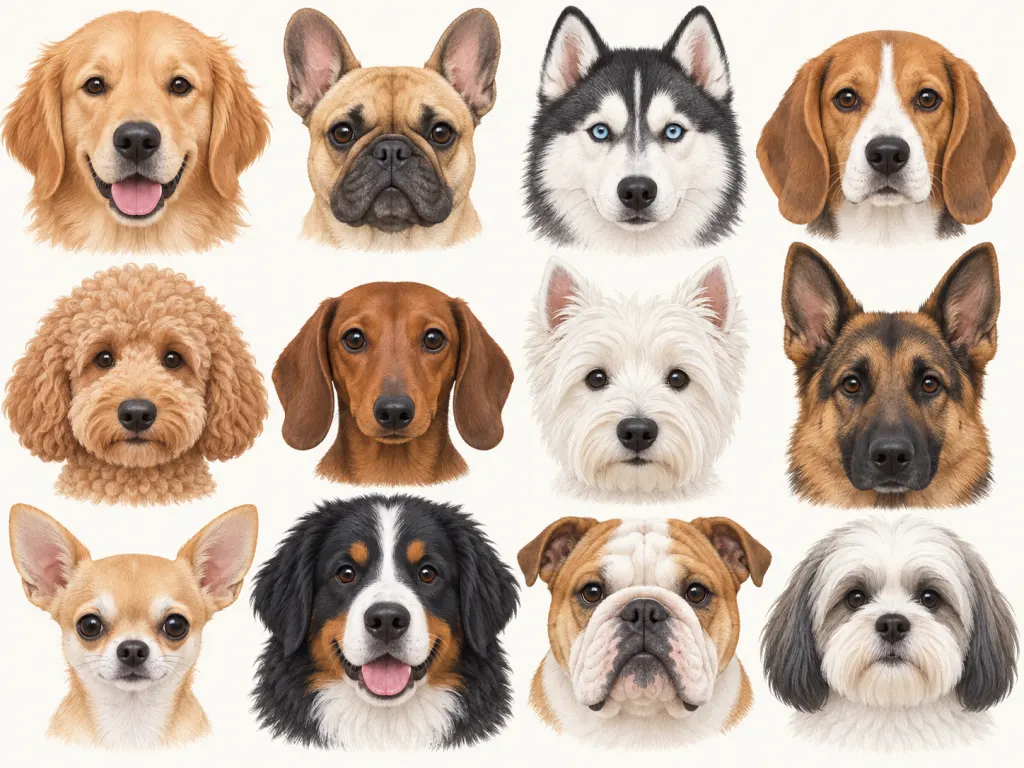
A dog lineup looks friendly and simple because the objects are familiar. Most readers know what a dog should look like: two ears, eyes, nose, mouth, paws, tail, and a general body shape. That familiarity helps you notice a major mismatch quickly. It also creates a trap. Once your brain decides that all eight or twelve figures are basically the same, it starts summarizing the scene instead of checking each mark. A small missing toe line or extra curve under a nose is not emotionally important, so it may not pull attention on its own.
That is the central charm of a spot-the-difference image. It is not a formal eyesight exam, and it is not proof that someone has unusually sharp perception. It is a compact demonstration of visual attention. In a review of visual-search research, Wolfe and Horowitz describe attention as being guided by factors such as bottom-up salience, top-down feature guidance, scene meaning, prior search history, and the value of targets and distractors PubMed. In plain English, you notice some things because they stand out, some because you are looking for them, and some because your past experience tells you where to look first.
Use A Feature-By-Feature Scan
The best way to solve a dog difference puzzle is to stop asking, "Which whole dog looks wrong?" and start asking, "Which exact feature has changed?" Whole-object comparison is slow because several dogs may look nearly identical at first glance. Feature comparison narrows the job. Pick one part of the dog and ignore the rest for a few seconds. Then repeat. This turns a vague challenge into a checklist.
Try this order when the dogs are arranged in rows:
- Ears: compare size, angle, missing tips, and whether one ear points a different way.
- Eyes: check dots, eyelashes, eye direction, and any extra white space.
- Nose and mouth: look for a shorter line, an extra curve, or a swapped expression.
- Paws: inspect toe lines, missing claws, odd spacing, or one paw turned the other way.
- Tail: compare curl direction, length, and whether the tail attaches in the same place.
- Outline: scan the back, belly, cheek, and fur tufts for small added or missing bumps.
Why Your First Guess May Be Wrong
Many puzzle solvers jump to the dog that looks most expressive. A side-eye, a perked ear, or a strong tail curve feels meaningful, so it attracts attention. But in a designed puzzle, the most attention-grabbing dog is not always the answer. Researchers describe visual discrimination as the ability to detect and classify differences in color, position, form, pattern, texture, and size NCBI Bookshelf. A cartoon puzzle can hide the answer in any of those categories. The different dog may be emotionally boring but visually distinct in one small structural way.
The Difference Between A Puzzle Dog And A Real Dog
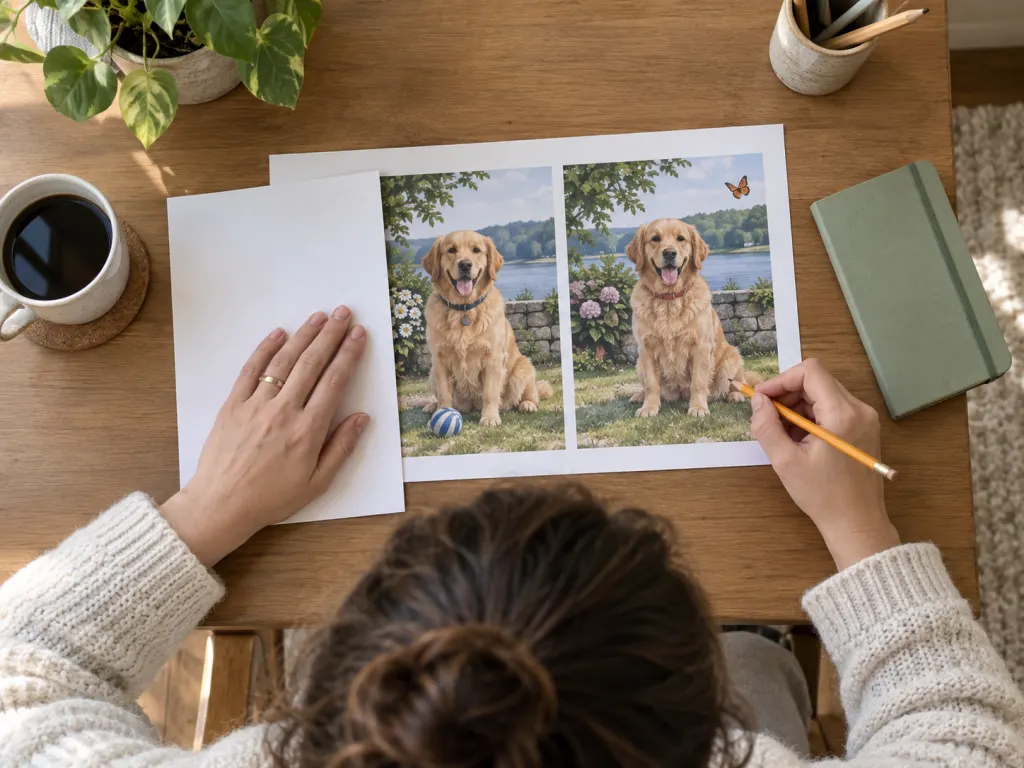
A cartoon dog difference puzzle asks you to inspect marks on a page. Real dogs are different. A real dog's ears, tail, mouth, eyes, posture, and movement can all matter, but no single signal should be read alone. The University of Illinois Extension summarizes the basic idea simply: dogs cannot talk in words, but their body language helps communicate mood and can help people stay safer around them University of Illinois Extension.
That does not mean a puzzle should be treated as a behavioral lesson. A missing line on a cartoon paw is a drawing difference, not a clue about a dog's feelings. Still, the same careful habit can transfer well: look at the whole picture, avoid rushing, and compare details in context. In real life, context matters even more. A wagging tail, for example, should not be interpreted by itself; posture, tension, approach, retreat, ears, eyes, and the situation all help explain what is happening.
What Real Dog Details Are Worth Noticing
If the puzzle makes you more attentive to dogs, use that attention kindly. UC Davis notes that fear in dogs can appear in several ways, including a tucked tail, lowered head, shaking, trembling, lip licking, rolling over, urinating, becoming still, hiding, backing away, barking, or growling when escape feels blocked UC Davis School of Veterinary Medicine. Those signs are not a game. They are reasons to give the dog space and avoid forcing contact.
Noise and stress are also easy to underestimate. UC Davis researchers reported that people may miss subtle fear or anxiety signs when dogs react to common household sounds; examples include panting, lip licking, turning the head away, stiffening, ears turning back, or the head dropping below the shoulders UC Davis School of Veterinary Medicine. A puzzle rewards spotting the tiny thing that changed. Living with a dog rewards noticing tiny signs early enough to make the situation calmer.
A Calm Way To Check Your Answer
Once you think you have found the different dog, test your answer instead of trusting the little spark of certainty. First, name the feature out loud or in your head: "Dog three has one fewer toe line" or "Dog seven has a tail curl in the opposite direction." Second, compare that feature against every other dog. Third, check whether another dog has a different feature too. Some puzzle versions are built around one odd dog, while others are trick questions where several dogs differ in separate ways.
This is where a related visual puzzle can be useful. If you enjoy careful comparison, you may also like the site article Can You Identify Which Skeleton Is Female?, which asks readers to slow down and examine visible structure rather than jump at a first impression. And if the dog theme has you thinking about everyday pet questions, Can Baking Soda Fix Dog Urine Spots on Your Lawn? is a more practical dog-adjacent guide.
Why Timers Make People Miss Obvious Details
Many online versions of this challenge add a countdown, often thirty seconds or less. The timer changes the experience. Instead of scanning calmly, people search for whatever jumps out first. That can help when the target is highly salient, such as one red object in a field of blue objects. It can hurt when the difference is a small conjunction of features, such as the same dog shape with only one altered paw mark. The more similar the dogs are, the more likely a careful sequence beats frantic zooming.
A timer also makes people compare themselves with an imaginary crowd. That pressure is fun in small doses, but it is not a meaningful measure of intelligence. The same person may perform differently depending on screen size, lighting, fatigue, image compression, or whether they already know the kind of trick a puzzle maker tends to use. A phone screen can blur tiny lines. A social-media crop can hide edges. A dark display can reduce contrast. Before deciding you failed, enlarge the image and check whether the visual information is actually clear.
If The Puzzle Shows Real Dogs, Be Extra Careful
Some difference challenges use photographs instead of drawings. With real dogs, the difference might be breed, size, coat pattern, ear set, collar, position, or a small background object. Avoid turning that into a claim about temperament or health from appearance alone. A still image cannot tell you everything about a dog's comfort, training, history, or safety. The CDC advises people not to approach unfamiliar dogs, to avoid direct eye contact, and not to disturb dogs that are sleeping, eating, or caring for puppies CDC. Those are practical safety principles, not puzzle tricks.
The Takeaway For The Dog Detective Challenge
The smartest answer to "Can you spot which dog is different?" is: yes, if you search like a patient editor instead of a panicked contestant. Start with the ears, then the eyes, muzzle, paws, tail, outline, and background. Say exactly what changed. Confirm that no second dog has a different change. If the puzzle image is missing, cropped, or low resolution, be honest that the exact dog cannot be verified. That honesty is part of good observation too.
What makes the challenge satisfying is not the dog itself but the moment your attention clicks into place. A mark that was invisible a second ago suddenly becomes obvious. That little shift is a reminder that seeing is active. We do not merely receive an image; we select, compare, ignore, revisit, and interpret. A cheerful row of dogs is a gentle way to practice that skill.
Wrap-Up
Dog difference puzzles are visual-search exercises wrapped in a cute theme. The most reliable method is to compare one feature at a time: ears, eyes, nose, mouth, paws, tail, outline, and background. A timed first glance may miss subtle changes because attention is guided by expectations and obvious contrasts. For real dogs, use careful observation with humility: body language must be read in context, and safety matters more than guessing from one cue.
Frequently Asked Questions
- → What is the fastest way to solve a dog spot-the-difference puzzle?
Scan by feature instead of by whole dog. Compare all ears first, then eyes, nose and mouth, paws, tail, outline, and background. When you think you found the answer, name the exact changed feature and compare it against every other dog.
- → Why do I miss the different dog when it seems obvious afterward?
That is common. Visual attention does not inspect every detail equally. It is guided by contrast, expectation, scene meaning, and previous search habits. Once you know the changed feature, your attention locks onto it and the answer feels much easier than it was before.
- → Does being good at these puzzles prove I have better eyesight?
No. These puzzles are not formal vision tests. Performance can depend on screen size, image quality, contrast, time pressure, attention, and practice. If a puzzle is tiny or compressed, the fairest move is to enlarge it before judging your answer.
- → Can dog body-language clues help in a cartoon puzzle?
Sometimes they help you choose where to look, but a cartoon line is not the same as a real dog's behavior. In real life, ears, tail, posture, eyes, mouth, movement, and context should be considered together. Avoid making big conclusions from one still detail.
- → What if more than one dog looks different?
Some versions are trick puzzles with multiple altered dogs. Write down each difference you find and check whether the prompt asks for one odd dog or all differences. If the original image is unclear or unavailable, the exact position cannot be verified responsibly.
References
This content was developed and refined using reliable sources.
- https://pubmed.ncbi.nlm.nih.gov/36711068
- https://www.ncbi.nlm.nih.gov/books/NBK563242
- https://web.extension.illinois.edu/dogs/dogbodylanguage.cfm
- https://healthtopics.vetmed.ucdavis.edu/health-topics/canine/your-dogs-fear
- https://www.vetmed.ucdavis.edu/news/common-household-noises-may-be-stressing-your-dog
- https://www.cdc.gov/natural-disasters/psa-toolkit/staying-safe-around-dogs.html