 Save
Cats bite because biting is part of their normal movement, play, defense, and communication system, but the meaning depends on the moment. A quick nip during play is different from a hard bite after petting, a fearful bite from a cornered cat, or a sudden bite from a cat who may be sore. The useful question is not simply whether a cat is “being aggressive,” but what changed right before the bite: your hands, the cat’s body language, another animal, a noise, a painful spot, or a missing outlet for normal hunting-style play. Cornell’s Feline Health Center describes feline aggression as a behavior with several possible causes, including play, fear, petting-induced, redirected, pain-related, territorial, maternal, and inter-cat patterns, which is why context matters more than a single label Cornell University College of Veterinary Medicine.
Biting Is Communication, Not One Single Mood
A cat’s mouth is one of the tools it uses to explore, hunt, hold, warn, and defend. That does not make biting acceptable in a household, especially when people or children can be hurt, but it does mean the behavior usually has a reason. Cats do not have a human-style way to say, “That touch is too much,” “I need distance,” “I am wound up,” or “Something hurts.” Instead, they combine posture, movement, ears, eyes, whiskers, tail position, vocal sound, and sometimes teeth.
Ohio State University’s Indoor Pet Initiative explains that indoor cats still need outlets for natural behaviors such as hunting, hiding, climbing, and protecting themselves from threats; without acceptable outlets, normal cat behavior may show up in ways people experience as scratching or biting Ohio State University Indoor Pet Initiative. That framing is helpful because it moves the owner’s job from blame to observation: identify the trigger, reduce the pressure, and teach safer choices.
The Clues Right Before a Bite Matter Most
Before many bites, there are small changes: pupils widen, ears rotate back or flatten, the tail begins to lash, the body lowers or stiffens, whiskers pin back or angle forward, the cat stops leaning into touch, or the skin along the back ripples. Cornell notes that fear and aggression cues can include dilated pupils, flattened ears, tucked or raised tail postures, arched backs, and raised hair, depending on the situation Cornell University College of Veterinary Medicine.
Those signals are easy to miss because many cats give them for only a few seconds. A cat may enjoy three strokes and dislike the fourth. Another may tolerate petting on the head but not along the back or belly. A third may be watching a bird, a delivery truck, or another cat through the window and already be too aroused for handling. The bite looks sudden to the person, but to the cat it may be the final step in a sequence.
Play Biting: When Hands Become the Wrong Toy
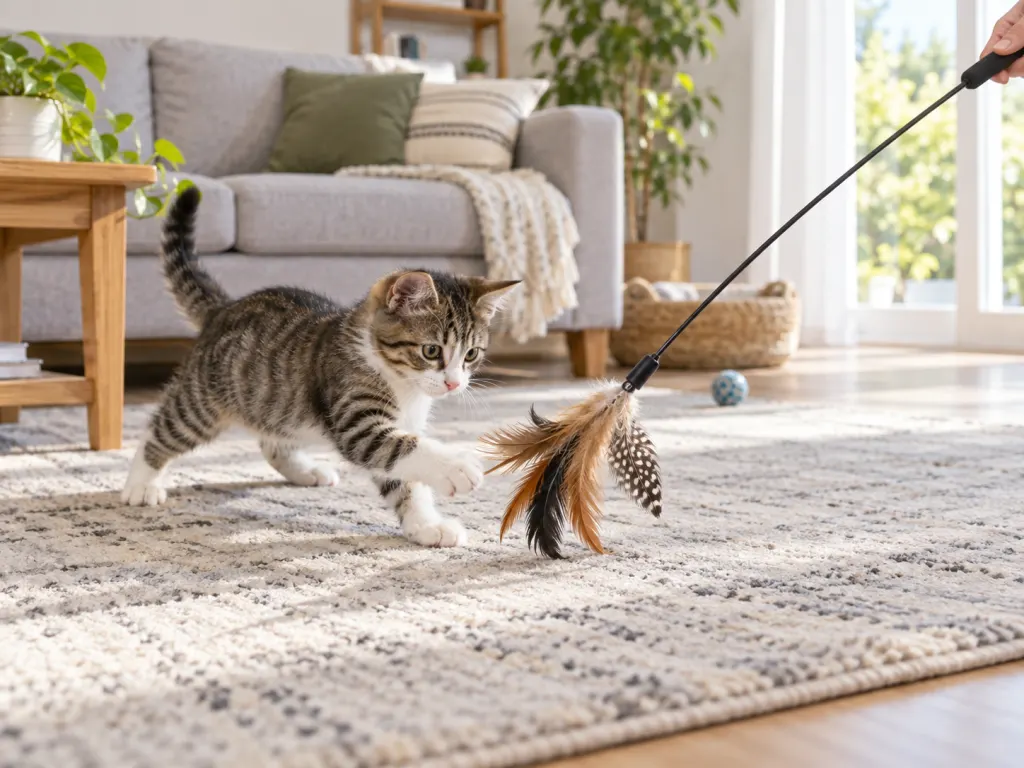
Play biting is especially common in kittens and young cats, though adult cats can keep the habit if it has been rewarded for months or years. UC Davis School of Veterinary Medicine describes rough play as behavior that can begin when people use fingers or toes as play objects; the habit may seem harmless in a small kitten and become painful as the cat grows UC Davis School of Veterinary Medicine. In play biting, the cat often stalks, pounces, grabs, bunny-kicks, or bites moving hands and feet. The face may look alert rather than frightened, and the cat may not hiss or growl.
The fix is not to remove play. It is to move play onto appropriate objects. Wand toys, tossed soft toys, rolling balls, crinkly paper, and food puzzles let a cat chase and grab without learning that human skin is the target. Ohio State recommends planned activity, controlled play, and not using hands, fingers, or other body parts as toys because cats can learn to bite and scratch them Ohio State University Indoor Pet Initiative. Short, predictable play sessions often work better than waiting until the cat is already racing around the house and looking for something to attack.
Petting Overload: The Bite That Follows a Nice Moment
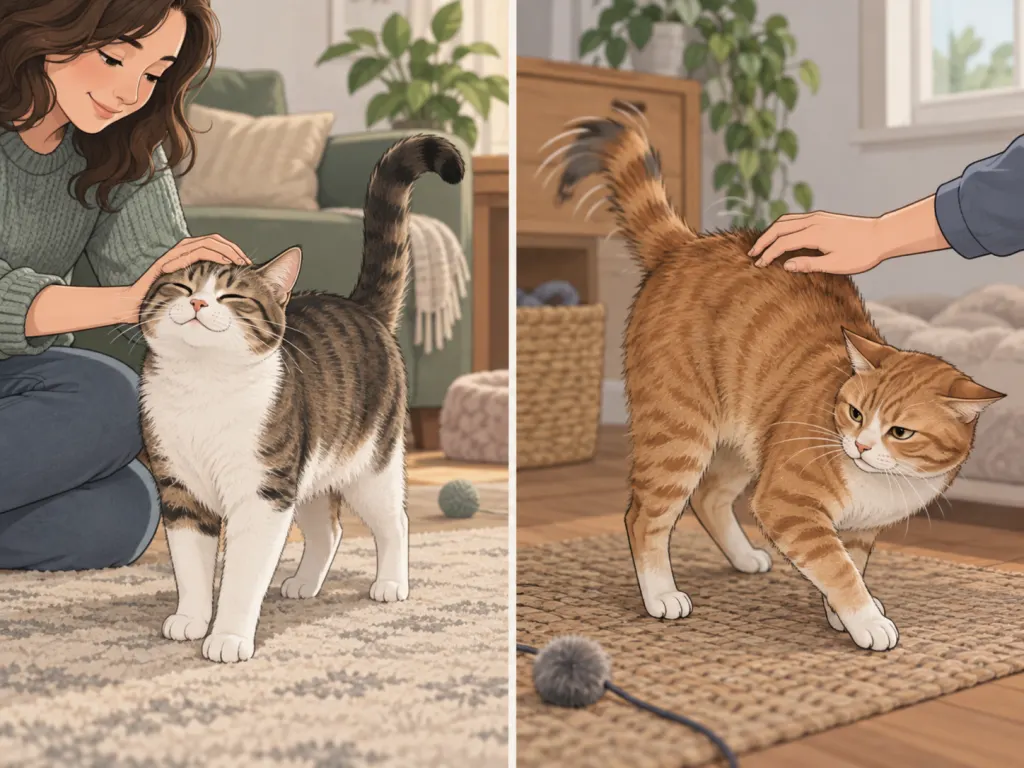
One of the most confusing bites happens during affection. A cat sits near you, accepts petting, may even purr, then turns and bites. Cornell calls this petting-induced aggression and notes that possible explanations include overstimulation or the cat controlling when touch ends Cornell University College of Veterinary Medicine. This does not mean the cat was pretending to enjoy you. It usually means the cat’s tolerance changed before the person noticed.
For these cats, consent is practical, not sentimental. Let the cat approach. Pet briefly in areas the cat usually accepts, often the cheek, chin, or side of the head. Stop while the interaction is still going well. If the cat leans back in, you can continue for another short round. If the cat turns its head sharply, twitches its tail, ripples its skin, shifts away, pins the ears, or stops looking relaxed, end the contact. Over time, the cat learns that being near you does not mean being handled past its limit.
Fear, Defense, and Being Cornered
A frightened cat may bite because it cannot find a safe exit. This can happen with unfamiliar visitors, loud noises, forced handling, veterinary carriers, bathing, nail trimming, being grabbed, or a child leaning over the cat. Fearful cats may crouch, hide, freeze, hiss, growl, flatten their ears, tuck the tail, or try to flee first. If escape is blocked, biting becomes a distance-making behavior.
The humane response is to reduce pressure. Do not chase a hiding cat, pull it from under furniture, or punish warning signals. Warning signals are useful; they tell you the cat is not coping. Give the cat a route away, a raised perch, a quiet room, and predictable handling. If a task must happen, such as transport to the veterinarian, use calm preparation, familiar bedding, and professional guidance rather than wrestling the cat at the last second. Physical punishment can increase fear and worsen aggression, according to Cornell’s guidance on feline aggression Cornell University College of Veterinary Medicine.
Pain, Illness, or a Sudden Behavior Change
A cat that suddenly starts biting, bites when touched in one specific area, or reacts differently during grooming, lifting, stair use, jumping, or play may need a veterinary check. Cornell notes that pain-related aggression can occur when cats try to avoid touch, movement, or activities that worsen discomfort, and it advises working with a veterinarian when medical causes may be involved Cornell University College of Veterinary Medicine. UC Davis also advises contacting a veterinarian for behavior changes, painful reactions to touch, or other health signs UC Davis School of Veterinary Medicine.
This is especially important with older cats, newly adopted cats, cats who have recently fallen or fought, and cats who are hiding more than usual. Cats often mask discomfort. A bite may be the first obvious sign that normal handling no longer feels normal to them. Until you know more, avoid pressing the sensitive area, reduce lifting, and keep interactions low-pressure.

Redirected Biting: The Trigger Is Somewhere Else
Redirected biting happens when a cat is aroused by one thing but bites a nearby person or animal instead. A common example is an indoor cat watching an outdoor cat through the window. The indoor cat cannot reach the outdoor cat, becomes highly activated, and then bites the person who tries to pick it up or the housemate who walks by. Cornell identifies redirected aggression as a response to an exciting stimulus the cat cannot directly reach, such as a loud noise, an outdoor cat, or another conflict in the home Cornell University College of Veterinary Medicine.
With redirected biting, comfort handling can backfire. The cat is already over threshold. Give space, block the view if an outdoor animal is the trigger, separate cats without putting your hands between them, and wait until the cat’s posture returns to normal. If outdoor cats regularly visit windows, visual barriers, motion-activated deterrents outside, or moving perches away from high-conflict windows may reduce repeated episodes.
Territory, Multi-Cat Stress, and Resource Pressure
Some biting is tied to space and access. Cats may guard preferred resting places, block another cat from food, stalk a housemate, or react when a new pet arrives. Ohio State’s conflict guidance explains that signs between cats can be open, such as stalking, hissing, swatting, wrestling, and biting, or subtle, such as staring, blocking, hiding, avoiding eye contact, or yielding resources Ohio State University Indoor Pet Initiative. People sometimes get bitten while interrupting these conflicts or while touching a cat who is already tense.
Resource layout matters. In a multi-cat home, food, water, litter boxes, scratching surfaces, perches, and resting spots should not all be clustered in one place where one cat can control access. The CDC advises one litter box for each cat plus one additional box Centers for Disease Control and Prevention. That same principle applies broadly: multiple routes, multiple resting places, and multiple valuable resources lower the chance that one cat has to confront another to get what it needs.
What To Do After a Bite, Without Escalating the Moment
First, stop the interaction. Do not yell, hit, scruff, chase, or keep trying to pet the cat to “make up.” Step away if you can do so safely. If the cat is latched on, freeze rather than pulling hard, because pulling can worsen tissue damage. Once free, give the cat a quiet path away. The learning goal is simple: biting ends the interaction, but it does not produce a loud, exciting battle.
For people, the CDC advises washing cat bites and scratches right away with warm soapy water and seeking medical attention in specific situations, including when the wound is serious, becomes red, painful, warm, or swollen, the cat appears sick, rabies vaccination status is unknown, or tetanus timing is a concern Centers for Disease Control and Prevention. The CDC also notes that cat bites and scratches can spread germs even when a wound does not look deep, and that reported cat bites and scratches have a wide reported infection range Centers for Disease Control and Prevention. If the bite involves a stray cat, an unprovoked event, or uncertain rabies status, follow local public-health instructions.
How To Lower the Chance of Future Bites
The most reliable plan combines environment, timing, and consistency. A cat who has good outlets, predictable routines, and respected limits has fewer reasons to use teeth. Start with the pattern: What time of day? Which room? Which hand motion? Which person? Which cat? What happened in the minute before the bite?
- Use wand toys and tossed toys so teeth land on objects, not hands.
- End play before the cat becomes frantic, and restart only when the cat is calmer.
- Keep petting short, especially with cats who nip during affection.
- Teach children to watch ears, tail, and escape attempts, and supervise their time with cats.
- Add perches, hiding places, scratching posts, and separate resources in busy homes.
- Pause handling if a cat is watching another animal, startled by noise, eating, sleeping, or hiding.
- Ask a veterinarian about sudden, severe, repeated, or hard-to-explain biting.
None of this requires treating a cat as unfriendly. It means treating the cat as a small predator with strong preferences about distance, touch, movement, and control. The better those needs are met, the easier it is for the cat to choose softer behaviors.
When a Bite Is More Than a Training Issue
Some situations deserve prompt professional help. A cat who bites hard, breaks skin repeatedly, targets children, stalks people, attacks without an obvious trigger, fights intensely with another pet, or changes behavior suddenly should not be managed by guesswork alone. A veterinarian can look for pain or other health contributors, and a veterinary behavior professional can help build a plan that protects both people and the cat.
Cat scratch disease is one reason bite and scratch hygiene matters. The CDC explains that it is linked to Bartonella henselae bacteria and that people should seek care if they develop fever, enlarged tender lymph nodes after cat exposure, or a pustule at the scratch site Centers for Disease Control and Prevention. Most everyday cat interactions are safe and affectionate, but a bite that breaks skin should be treated as a real exposure, not just a behavior note.
Wrap-Up
Cats bite for many reasons: rough play, petting overload, fear, pain, redirected arousal, territorial pressure, or stress between cats. The best response is calm observation followed by safer structure: hands are not toys, petting stops before warning signs build, frightened cats get space, and sudden changes go to a veterinarian. If a bite breaks skin, clean it promptly and follow qualified medical guidance when warning signs or rabies questions are present.
Frequently Asked Questions
- → Why does my cat bite me while I am petting them?
Your cat may have reached its touch limit. Some cats enjoy brief petting but become overstimulated or uncomfortable when it continues. Watch for tail lashing, ears moving back, skin twitching, head turning toward your hand, or the cat shifting away. Stop before those signs build.
- → Is my cat biting because they are angry?
Sometimes a bite reflects fear, frustration, territorial pressure, or pain, but many bites are not simple anger. The context matters: play bites often follow movement, fear bites happen when escape feels blocked, and redirected bites can happen when the real trigger is another animal or noise nearby.
- → How do I stop my kitten from biting my hands?
Stop using hands or feet as toys. Use wand toys, rolling toys, soft tossed toys, and short play sessions instead. If biting starts, remove your hands calmly and redirect to a toy from a distance or end play briefly. Everyone in the home should follow the same rule.
- → When should I call a veterinarian about biting?
Call a veterinarian if biting is new, intense, repeated, linked to touch in one body area, paired with hiding or appetite changes, or directed at children or other pets. A professional can help sort out pain, stress, and behavior patterns.
- → What should I do if a cat bite breaks skin?
Wash the area promptly with warm soapy water. Seek qualified medical guidance if the wound is serious, becomes red, painful, warm, or swollen, the cat seems sick, rabies vaccination status is unknown, or you have tetanus concerns. Follow local public-health instructions for stray or unprovoked bites.
References
This content was developed and refined using reliable sources.
- https://www.vet.cornell.edu/departments-centers-and-institutes/cornell-feline-health-center/health-information/feline-health-topics/feline-behavior-problems-aggression
- https://indoorpet.osu.edu/cats/understanding-cats
- https://indoorpet.osu.edu/cats/problem-solving/increasing-activity
- https://indoorpet.osu.edu/cats/problemsolving/conflict
- https://healthtopics.vetmed.ucdavis.edu/health-topics/feline/managing-your-kittens-rough-play
- https://www.cdc.gov/healthy-pets/about/cats.html
- https://www.cdc.gov/bartonella/about/about-cat-scratch-disease.html