 Save
This is an original work of fiction. The characters, neighborhood, dialogue, and central events are invented, though the story touches on real-world ideas about permission, property, and repair after damage.
For general background, Cornell Law School’s Legal Information Institute explains trespass as knowingly entering another person’s land without permission, and the U.S. Department of Transportation’s Pipeline and Hazardous Materials Safety Administration says homeowners and contractors should contact the one-call center before digging because buried utilities may be present. For property loss documentation, the California Department of Insurance advises homeowners to protect property from further damage, save receipts, and keep careful records: Cornell Wex on trespass, PHMSA Call Before You Dig, and California residential property claims guide.
1. Sunday Evening
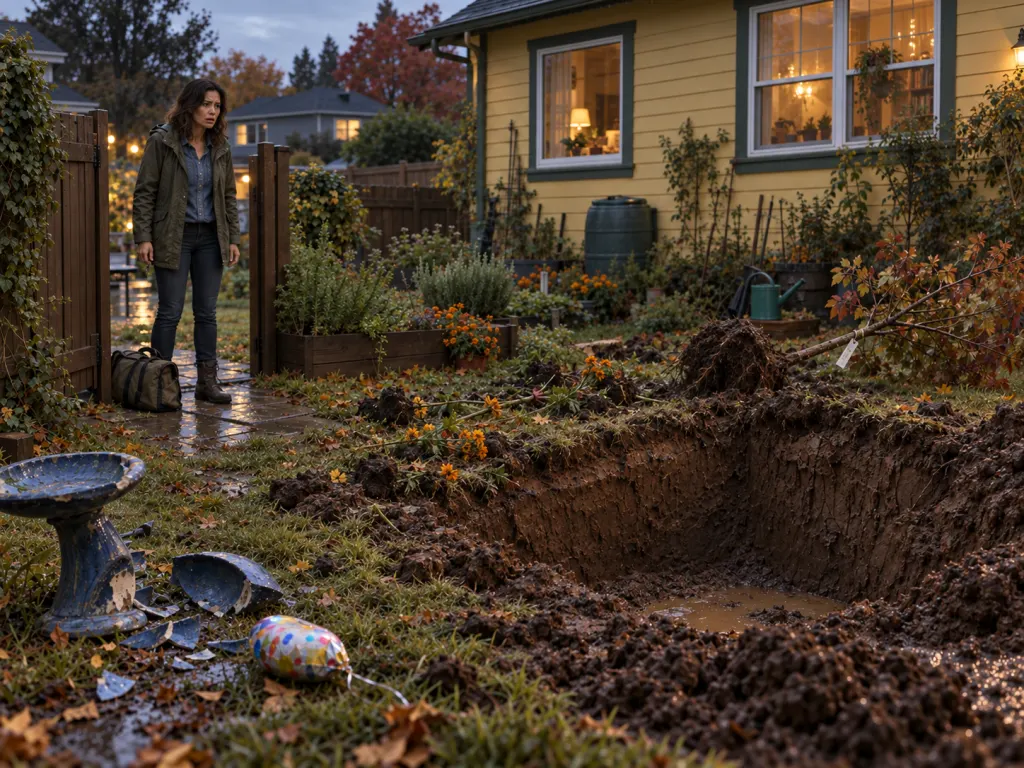
The first thing Lina Marr saw was the maple sapling lying on its side like something that had tried to crawl away and failed.
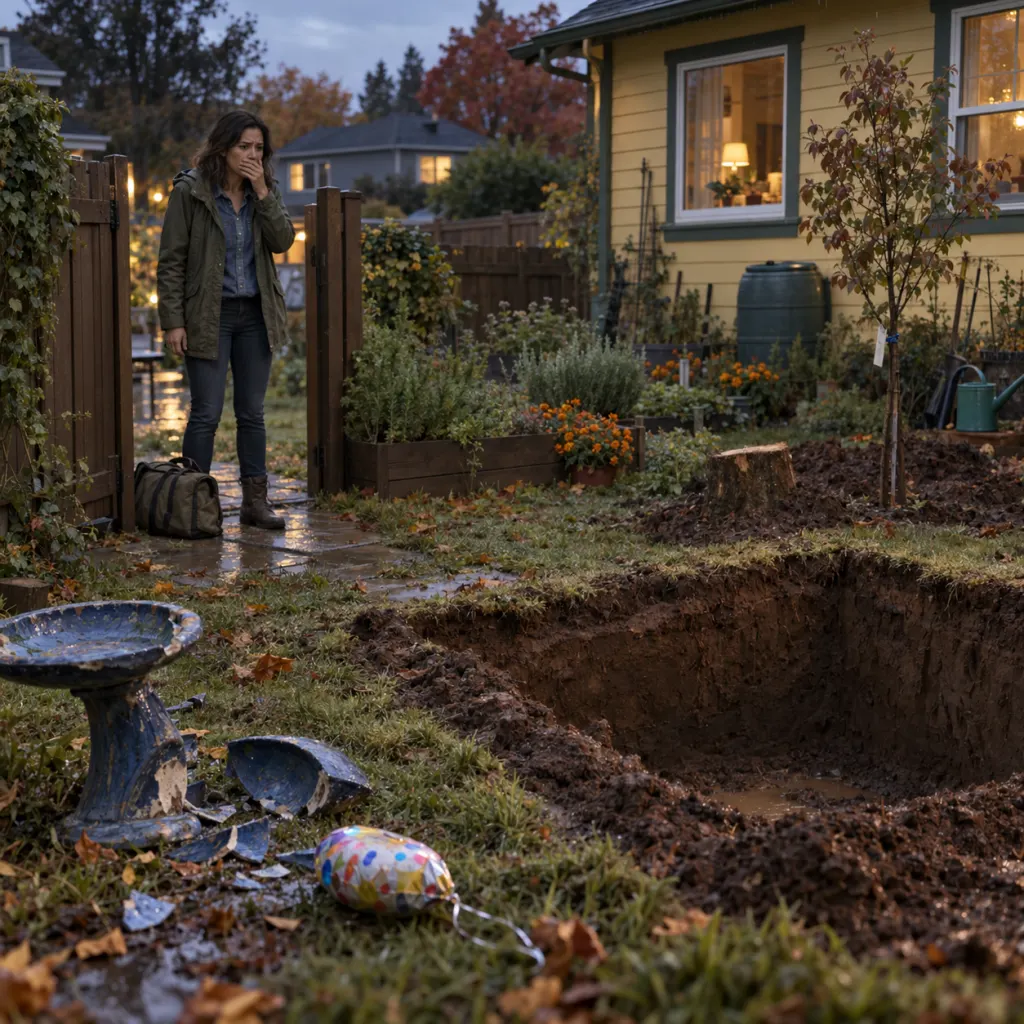
She stood at the open gate with her overnight bag still on her shoulder, the brass key in her hand, and the late Sunday light pooling over what had been her backyard. On Friday morning the yard had smelled of cut grass and basil. There had been a blue ceramic birdbath near the fence, a little crooked, and a row of marigolds bright enough to embarrass the rest of the garden. Now the birdbath was broken in three pieces. The marigolds were churned into mud. In the middle of the lawn yawned a square hole, deep and deliberate, its edges cut too cleanly to be the work of children or weather.
Lina did not move at first. Her mind did the small, useless tasks it could manage. Count the fence panels. Find the chair cushions. Look for party trash. She found a deflated silver balloon caught in the hydrangea and a paper plate plastered to the side path by rain. The balloon said HAPPY BIRTHDAY in curling blue letters. The hole said something else.
Behind her, the neighborhood carried on in the soft, ordinary way it always did at six-thirty. A dog barked once. Someone shut a car door. The laundry vent from the Carvers’ house breathed detergent into the alley. Lina’s own house, a narrow yellow bungalow with green trim, watched her with its dark kitchen windows.
She set down her bag. Her fingers were numb, though the evening was warm.
“Theo?” she called.
His house next door was silent. On Friday, Theo Bell had stood in this same gate with both hands wrapped around a mug, asking for a favor. His daughter Olive was turning nine, he had said. The community room at the library had double-booked them. The park was too muddy. Lina’s yard was perfect, and he would keep it small, gentle, finished by sunset. No one inside the house, no loud music, no mess. He had smiled as if embarrassed by his own need.
“I know it’s a lot to ask,” he had said. “You’d be saving me.”
Lina had wanted, painfully, to be the kind of woman who saved people.
Now she took one step forward and heard the ground crumble at the lip of the excavation. She stopped. At the bottom, six feet down at least, water glimmered in muddy pockets. Thick tire tracks ran from the alley gate across the grass. One track had crushed the stepping stones her father set the summer before he died.
For a moment, Lina felt no anger. Anger would have been clean. What came first was a cold, childlike bewilderment. She had lent a yard. She had not lent the earth beneath it.
2. The Favor
Two days earlier, the favor had seemed almost sweet.
Lina was packing a tote bag for the weekend, folding her mother’s blue sweater on top because the rehabilitation center was always chilly. Her mother had broken her wrist in April and disliked admitting she needed help with buttons, bottles, or the small tyrannies of daily life. Lina drove across the county every other weekend, sat with her through lunch, trimmed her nails, listened to the same story about the neighbor with the loud television, then came home tired and oddly grateful for her own quiet kitchen.
The bell rang while she was looking for her charger.
Theo stood on the porch in a gray hoodie, his sandy hair damp from a quick shower or nervous sweat. He was a polite neighbor in the careful way of people who had learned not to take up too much room. He shoveled Lina’s walk when it snowed. She watered his tomatoes when he worked late. Olive sometimes brought over drawings of imaginary castles and asked whether Lina thought queens needed garages.
“I hate asking,” Theo said.
That was how people opened doors inside Lina. Not with entitlement. With reluctance.
He told her about the birthday plans falling apart. Nine children, maybe ten. His sister would help. Pizza, cake, bubbles, two folding tables. “No bounce house,” he promised, lifting one hand. “No hired magician. No chaos with a permit attached.”
Lina laughed because he looked so solemn.
“Why my yard?” she asked.
He glanced past her toward the strip of green visible through the side gate. “It’s fenced. It’s pretty. Olive loves your maple tree.”
The tree had been her father’s last present to the house. He arrived with it in the back of his old station wagon, announcing that every home needed one thing planted by someone who expected the future to come. Lina had rolled her eyes then. After he died, she watered it as if it could report back to him.
“I’m gone until Sunday,” she said.
“That’s why I thought it might work. You won’t have to listen to them shriek.” Theo smiled, then sobered. “I’ll lock up. I’ll clean everything. I swear.”
Lina hesitated, not because she suspected anything, but because she felt the familiar tug between privacy and kindness. She worked from home editing technical manuals. She lived alone. She knew people called her reserved, though rarely to her face. After her divorce, reserve had become less a mood than a front door with three locks.
“No one inside,” she said.
“Absolutely.”
“No digging stakes into the ground. I have irrigation lines near the beds.”
“No stakes.”
“And please keep people off the herb boxes.”
“I will guard them with my life.”
She gave him the side-gate key on a blue ribbon so it would be hard to lose. He took it with both hands.
“You’re doing a good thing,” he said.
The sentence warmed her more than it should have. That was another thing Lina would remember later: how easily gratitude could be used as wrapping paper.
3. The Rules We Think Are Enough
At her mother’s room on Saturday morning, Lina received one photo from Theo. It showed two folding tables under the maple, both covered with yellow cloths. A string of paper stars crossed the fence. The grass looked perfect.
“All set,” his message said. “Thank you again.”
Lina showed the photo to her mother, who squinted through her reading glasses.
“That’s your yard?”
“Yes.”
“Looks cheerful.”
“It’s for Olive’s birthday.”
Her mother made a small sound. “People with children always need something.”
“Mom.”
“I didn’t say don’t help. I said they need something.”
Lina slid the phone into her pocket. Her mother had never lent anything without naming its return date, condition, and consequences. She labeled casserole dishes. She wrote initials on garden tools. As a child, Lina found it embarrassing. As an adult, she mistook her own looseness for generosity.
On Saturday afternoon, Theo did not send another picture. Lina noticed but did not worry. At five, she texted, “Hope it went well.” The message showed delivered. No reply.
At eight, her mother fell asleep during a television game show, and Lina sat by the window watching the parking lot lamps flicker on. She imagined Olive sticky with frosting, Theo carrying trash bags to the curb, the borrowed yard emptying back into itself. She liked the thought. She liked being part of a happy day without having to stand in the center of it.
When she returned Sunday, the house next door had no curtains.
She did not register that at first. The hole took all the air from the world. But after calling Theo twice and hearing his phone go straight to voicemail, Lina crossed to his porch. The little clay turtle Olive kept by the step was gone. Through the front window, Lina saw pale rectangles on the wall where pictures had hung. The living room was empty except for a twist tie on the floor and a dust line where the sofa had been.
Her stomach tightened.
She backed away from the glass, suddenly aware that she was alone outside a vacant house with mud on her shoes and a key ribbon missing from her life.
Lina took photographs before she touched anything. She did it almost automatically, because her work had taught her that chaos became more manageable when documented in order. Wide shot from the gate. Wide shot from the porch. Close shot of the broken birdbath. Tire tracks. Crushed stepping stones. The maple roots exposed like nerves.
Then she called the non-emergency police number, and her voice sounded calm enough to belong to someone else.
“My neighbor had permission to use my backyard for a party,” she said. “He did not have permission to excavate it.”
The dispatcher paused only long enough to ask whether anyone was injured or in immediate danger.
“No,” Lina said, looking at the hole. “I don’t think so.”
While she waited, June Carver from across the alley appeared at her own gate wearing gardening gloves and a cardigan buttoned wrong.
“Lina,” June said. “Oh, honey.”
The sympathy nearly undid her.
“Did you see what happened?” Lina asked.
June’s face changed. Concern drew inward into guilt. “I saw a truck.”
“What kind of truck?”
“A rental box truck Saturday morning. Then later a little digging machine. I thought you knew.”
“A digging machine?”
June nodded. “Theo said you were putting in a pond for your mother. I said that sounded lovely.” She swallowed. “I should have called you.”
Lina looked back at the wound in the lawn, the too-square shape, the clean walls. This had not been a party gone wild. This had been a plan wearing a party hat.
4. June’s Window
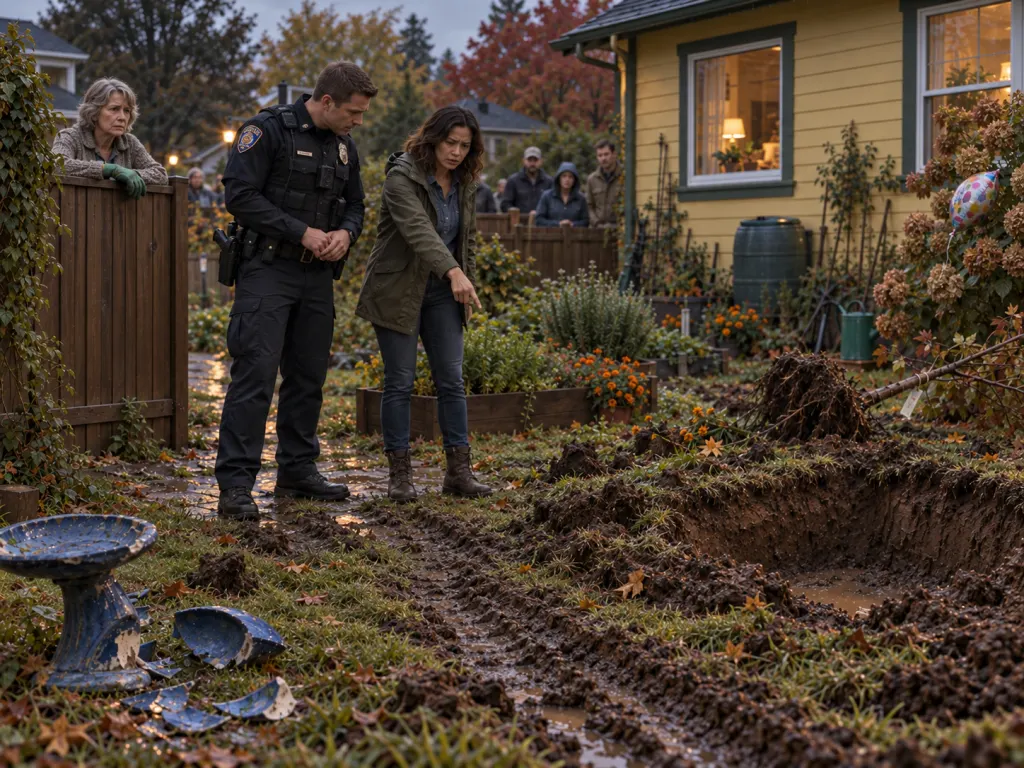
The officer who arrived was young enough to look apologetic about the authority of his uniform. His name was Officer Patel. He stepped carefully, keeping away from the unstable edge, and asked Lina to begin at Friday.
She told the story once. Then again, slower. She showed him the text messages, the photo of the yellow tables, the unanswered calls. June came over and gave her account from the alley side. By then, two other neighbors had drifted near their fences, drawn by the strange magnet of damage.
“He moved out?” Officer Patel asked.
June pointed toward Theo’s empty house. “Looked that way. The truck came at eight. Furniture first. Digging machine after lunch.”
“Did you see children?”
June’s mouth opened, then closed. “No.”
The absence landed heavily.
No children. No cake. No song. The birthday party had existed only in a photo staged before the real work began.
Officer Patel photographed the yard, the gate, the tracks. He asked whether Lina had given Theo written permission.
“Texts,” she said. “For the party.”
“Not for digging.”
“No.”
He looked toward the excavation. “You’ll want to call your insurance company and a contractor to secure this. Don’t let anyone walk back here tonight.”
“I know.”
She did not know. Not really. She knew how to correct commas, how to coax her mother into eating soup, how to pay bills on time. She did not know how to be the woman standing beside a crater where trust used to be.
After the officer left, June stayed.
“Come sleep at my place,” she said.
“My house is fine.”
“Your house is fine. You are vibrating.”
Lina almost smiled. “I need to lock the gate.”
“Then lock it, and come over.”
The key Theo had borrowed was gone, of course. Lina found an old bicycle chain in the shed and looped it through the gate slats with hands that shook so badly June had to close the padlock for her.
Inside June’s kitchen, under a light that hummed faintly, Lina sat with a cup of tea she did not drink. June placed a yellow legal pad in front of her.
“Write down everything,” June said.
“You sound like my mother.”
“Good. Mothers are annoying because they have watched the world repeat itself.”
Lina began. Friday, 4:12 p.m., Theo asked. Friday, 4:29 p.m., I gave key. Saturday, 9:03 a.m., photo received. Sunday, 6:34 p.m., returned home.
The list steadied her. Each line was a plank across panic.
5. Under the Mulberry
By Monday morning, the backyard had become official.
A city inspector came first, then a utility crew, then a contractor June recommended because he had once rebuilt her porch after a storm and had not spoken to her as if age made her foolish. The contractor, Samir, stood at the edge of the hole and whistled through his teeth.
“This was measured,” he said. “Whoever dug knew where they wanted to go.”
“Could they have hit something?” Lina asked.
“They were lucky if they didn’t.”
That word, lucky, made her angry for the first time. Theo had gambled with her yard, her home, the buried lines beneath it, and then vanished into whatever story he thought mattered more.
Near noon, Olive arrived.
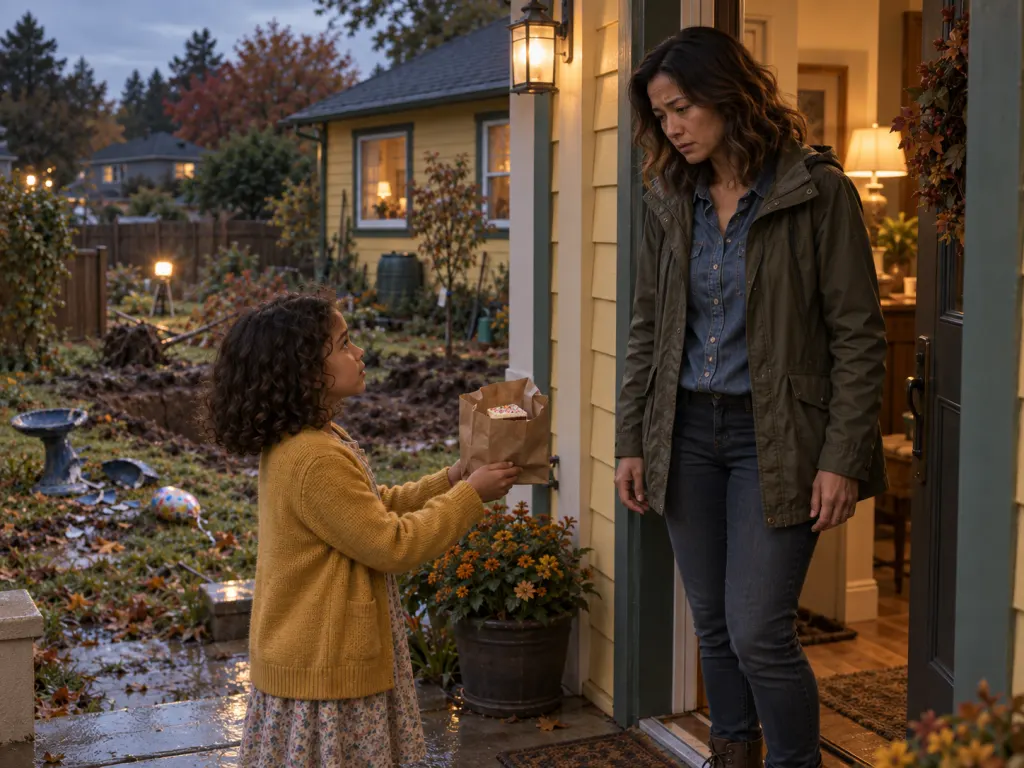
Lina saw her through the front window: a small girl in a yellow cardigan, standing on the porch with a paper bag hugged to her chest. Her dark curls were flattened on one side as if she had slept badly. Lina opened the door before Olive knocked.
“Hi, Miss Marr.”
“Olive.” Lina crouched, then decided that crouching felt too dramatic and stood again. “Are you okay?”
Olive looked at the porch boards. “Dad said you might be mad.”
The sentence put a careful wall between Lina’s anger and the child in front of her.
“I’m upset about the yard,” Lina said. “I’m not mad at you.”
Olive held out the paper bag. Inside was a slice of birthday cake in a plastic container. The frosting had smeared against the lid, blue and yellow. “We had it at Aunt Willa’s apartment. Not here.”
So there had been a cake somewhere. A child had still turned nine while adults rearranged the truth around her.
“Thank you,” Lina said.
Olive nodded, solemn with borrowed worry.
“Do you know where your dad is?” Lina asked gently.
Olive shook her head. “Aunt Willa says he had to fix a grown-up mistake.”
Lina thought of the hole and the moving truck and the staged photograph. “I hope he does.”
Olive looked past Lina into the hall. “He said the box was important.”
The word settled between them.
“What box?” Lina asked.
But Olive had already gone pale, as if she had stepped beyond the border of what she was allowed to know. “I’m not supposed to talk.”
Lina did not press. She took the cake and watched Olive cross the lawn to June, who had appeared at the sidewalk with the timing of a guardian and the expression of someone pretending not to listen.
That afternoon, Officer Patel called. Theo’s sister Willa had reported him missing. She had also told police that Theo had spent the last month asking strange questions about old property surveys, former owners, and a mulberry tree that had been removed from Lina’s yard before Lina bought the house.
“There used to be a mulberry?” Lina asked.
“According to the sister.”
Lina looked toward the hole. Her father’s maple stood close to where the old tree must have been. One tree replacing another, one family’s memory planted over someone else’s secret.
6. The Box Story
Theo called at 11:17 that night.
Lina was awake in bed with every light on downstairs. The new locksmith had come before dinner. Her gate had a new lock; her back door had a new deadbolt; her trust, less conveniently, had no hardware.
The phone buzzed on the nightstand. Unknown number.
She let it ring twice before answering. “Hello?”
“Lina.”
His voice was rough and far away.
She sat up. “Where are you?”
“I can’t say.”
“Then you shouldn’t have called.”
Silence. She heard traffic, or maybe rain.
“I’m sorry,” Theo said.
The words were so small beside the damage that Lina almost laughed.
“You dug up my yard.”
“I know.”
“You lied about your daughter’s birthday.”
“I lied about having it there. Not about her birthday.”
“That is not the moral foothold you think it is.”
He exhaled. “I found something in my father’s papers. A drawing. Notes. He used to work for the man who owned your house before the Danvers family. There was a metal box buried near the mulberry.”
Lina closed her eyes. She could see him Friday on the porch, humble and damp-haired, offering need like a bowl she was meant to fill.
“Why not ask me?” she said.
“Because you would have said no.”
“Yes.”
“I had to know what was in it.”
“No,” Lina said, and her voice surprised her. It was not loud. It was worse than loud. It was certain. “You wanted to know. You chose wanting over asking.”
The traffic sound grew louder, then faded.
“My father spent his life hinting there was money somewhere,” Theo said. “After he died, creditors took almost everything. Willa’s helping with Olive. I’m behind on rent. I thought if I found it, I could fix things.”
“By breaking mine?”
He said nothing.
“What was in the box?”
“Documents. Some jewelry. Cash, but old. Not enough.”
“Not enough for what?”
“Not enough to become the person I needed to be by Monday.”
There it was, the terrible childishness beneath the planning. Theo had not only wanted money. He had wanted a trapdoor out of consequence.
“You need to turn yourself in,” Lina said.
“I’m scared.”
“Good. Be scared and do it anyway.”
He gave a broken little laugh. “You sound different.”
“I am standing in the life you left me.”
After they hung up, Lina called Officer Patel and gave him the number, the words, the sound of traffic, everything she could remember. Then she went downstairs and stood at the back window. The yard was dark except for the temporary work light Samir had clipped near the hole. Moths battered themselves against the glow.
Lina ate one forkful of Olive’s cake at the kitchen counter. It tasted like sugar, cardboard, and the strange grief of being sorry for someone who had harmed you.
7. What Permission Cannot Hold
Theo was found the next afternoon at a bus depot two towns over, sitting on a bench with a backpack between his shoes and mud still under his fingernails. The box was in a rented storage locker. Officer Patel did not tell Lina everything in it, and Lina discovered she did not want everything. Curiosity had already done enough damage in this story.
What mattered was simpler: Theo admitted he had invented the backyard party as cover. He admitted hiring the equipment under a friend’s account. He admitted moving out before Lina returned because he believed he could disappear long enough to sell whatever he found, pay what he owed, and mail her money for repairs later.
“Later,” Lina told June when she heard. “The national anthem of cowards.”
June raised her tea mug. “Put that on a pillow.”
The legal process moved without the cinematic speed Lina’s anger wanted. Statements. Estimates. Calls. More calls. A stern woman from the insurance company asking whether Lina had given permission for a gathering. Samir measuring the damage with a clipboard. The city requiring the excavation to be stabilized. Lina learned the vocabulary of disturbance: fill, compaction, drainage, root shock.
The maple survived the first week. Then its leaves curled brown at the edges.
When Samir told her it might not make it, Lina turned away before he finished. She had held herself together through police forms and repair estimates, through neighbors bringing casseroles she had no appetite for, through her mother saying, “I never liked that man’s shoes,” as if footwear had been the clue. But the tree was not paperwork. The tree was her father’s hand pressing soil around a fragile trunk.
That evening Lina sat on the back steps and cried with the blunt privacy of a person too tired to hide from windows.
Olive saw her.
The girl had been staying with Willa, who lived three blocks away. She appeared at the side fence with June beside her, clutching a drawing. June’s face asked permission. Lina wiped her cheeks and nodded.
Olive came only as far as the path.
“I made this,” she said.
The drawing showed Lina’s yard before: maple, birdbath, marigolds, a woman with long dark hair standing beside a girl in a yellow sweater. In the sky Olive had drawn a large, stern sun.
“It’s beautiful,” Lina said.
“Dad says he has to say sorry in person when they let him.”
Lina folded her hands together. “That will be hard.”
“For him?”
“For both of us.”
Olive looked at the damaged yard. “Aunt Willa says grown-ups can love you and still make a mess you can’t clean for them.”
Lina looked at June.
June lifted both palms. “Don’t look at me. Willa earned that one.”
For the first time since Sunday, Lina laughed. It came out rough, almost rusty, but it came.
8. The Apology
The apology happened in a municipal meeting room that smelled of floor wax and old coffee.
Lina had imagined many versions of it. In some, she was eloquent. In others, she was merciless. Once, while brushing her teeth, she delivered a speech so devastating that she had to spit quickly before choking on toothpaste.
The real apology was quieter.
Theo sat across from her with his sister Willa on one side and an attorney on the other. He looked thinner, but Lina distrusted the part of herself that noticed suffering and rushed to organize itself around it. That part had opened the gate.
“I’m sorry,” Theo said. “I lied to you. I used Olive’s birthday to make the lie easier for you to believe. I damaged your property and left you to find it alone.”
Lina watched his hands. They were flat on the table, fingers spread, as if he had been told not to reach for anything.
“I don’t need you to explain why again,” she said. “I need you to understand what you took.”
He nodded.
“You took my yard. You took my weekend. You took my father’s tree, maybe. You took the feeling that when a neighbor knocks, I can answer without bracing myself.” Her voice wavered, but she kept going. “You also put your daughter inside your lie. She brought me cake because you made her think your mistake was something she had to soften.”
Theo’s face changed then. Not dramatically. He simply stopped trying to look composed.
“I know,” he whispered.
“Do you?”
He covered his mouth, then lowered his hand. “I didn’t until she asked if birthdays were bad luck.”
No one spoke for a moment.
Lina had come prepared to protect herself from his excuses. She was less prepared for remorse that did not ask to be excused.
“You will pay what the court orders and what the restitution agreement requires,” she said. “You will not contact me except through the approved process. You will let Willa decide what Olive needs from you, because right now your guilt is not a parenting plan.”
His attorney shifted. Willa looked down at the table, blinking fast.
Theo nodded. “Yes.”
There was no embrace. No absolution. No swelling music. Just signatures, dates, copies, and the strange dignity of a boundary spoken clearly.
When Lina stepped outside, the air smelled like rain on hot pavement. June was waiting by the curb with two coffees and no questions.
“Well?” June said.
Lina took one cup. “I didn’t forgive him.”
June nodded.
“I didn’t destroy him either.”
“Also acceptable.”
Lina sipped the coffee. It was too sweet, exactly the way June drank it. “I think I told the truth.”
June linked her arm through Lina’s. “That tends to be enough work for one morning.”
9. New Grass
Repair took longer than anyone promised.
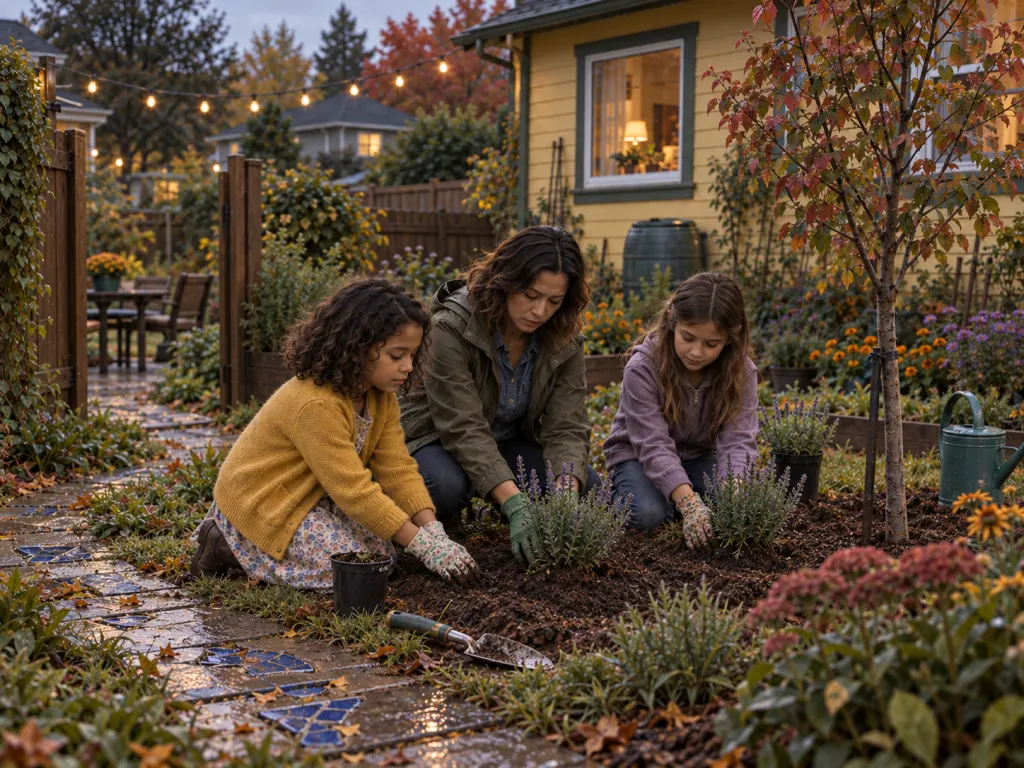
The yard had to be filled in layers, each one packed and checked. The irrigation line near the herb boxes needed replacing. The marigolds were gone. The birdbath could not be repaired, though Samir saved one blue shard and set it into the edge of the new path like a small, stubborn moon.
The maple did not survive.
Lina waited until the arborist said it twice before she accepted it. When the crew removed the tree, she stayed inside and cleaned the pantry with unnecessary force. Later, she found a leaf pressed against the back step and put it in the dictionary under M, not because she believed leaves could remain themselves forever, but because grief sometimes needed a place to stand.
Her mother visited in September, wrist healed, opinions fully intact. She stepped carefully along the new path with her cane and surveyed the young serviceberry tree Lina had planted where the maple had been.
“Your father would complain it’s too small,” her mother said.
“Everything starts too small.”
“He would also like the red stems.”
Lina smiled. “I know.”
Neighbors came by with plants. June brought black-eyed Susans. Willa brought lavender and stood awkwardly at the gate until Lina invited her in. Olive came with her, taller somehow, or maybe just less folded into herself.
“I know it’s not my fault,” Olive said suddenly, while Willa knelt by the bed.
Lina set down the trowel. “Good.”
“Sometimes it feels like it is anyway.”
“Feelings are stubborn. They don’t always check the facts before arriving.”
Olive considered this. “Do yours?”
“Almost never.”
The girl smiled, small but real.
Lina did not become the neighborhood cynic. That would have made the story too easy. She still lent sugar once, and a ladder after making sure it came back the same afternoon. She still watered tomatoes. She still opened the door when someone knocked.
But she changed the terms of her kindness. She wrote things down. She said no without sending flowers afterward to apologize for the shape of the word. She learned that suspicion was not the only alternative to being used. Clarity could stand there too, plain and decent, holding the gate.
One evening in early October, Lina hosted a small dinner in the repaired yard. June came. Samir came with his husband and a lemon tart. Willa and Olive came for an hour, because complicated things can still be allowed a chair if everyone agrees where the exits are.
They ate at one long table under string lights. The serviceberry leaves trembled red in the dusk. At some point Olive laughed so hard lemonade came out of her nose, and everyone pretended not to see while also absolutely seeing.
Lina looked across the yard. There were scars if you knew where to look: a faint low place in the grass, new stones brighter than old ones, the blue shard in the path. The yard was not what it had been. Neither was she.
That, she thought, was not the same as ruin.
10. Reflection
Years later, when people asked Lina why she was so particular about gates, keys, and borrowed things, she did not always tell the whole story. Sometimes she only said, “I learned the hard way that a favor still needs edges.”
But privately, she understood the lesson had been larger and less tidy.
Theo had not tricked her because she was kind. He had tricked her because he was willing to. That distinction mattered. It kept her from blaming the gentlest parts of herself for someone else’s choices.
Kindness was not the problem. The problem was kindness left alone without language, without limits, without the courage to disappoint someone before they disappointed you.
So Lina kept the blue ribbon that had once held the old gate key. She tied it around the handle of her garden basket, where it faded in sun and rain. Not as a warning exactly. Not as a shrine to betrayal. More like a bookmark in the chapter where she finally stopped confusing openness with absence of a door.
In the repaired yard, beneath a tree her father never saw but might have liked, Lina learned to welcome people through the gate one honest yes at a time.
Wrap-Up
Lina lends her backyard for a neighbor’s small birthday party and returns to find a deliberate excavation, a vanished neighbor, and a damaged garden tied to her deepest memories of home. As the truth emerges, she learns that compassion without clear limits can become a door others walk through without asking.