 Save
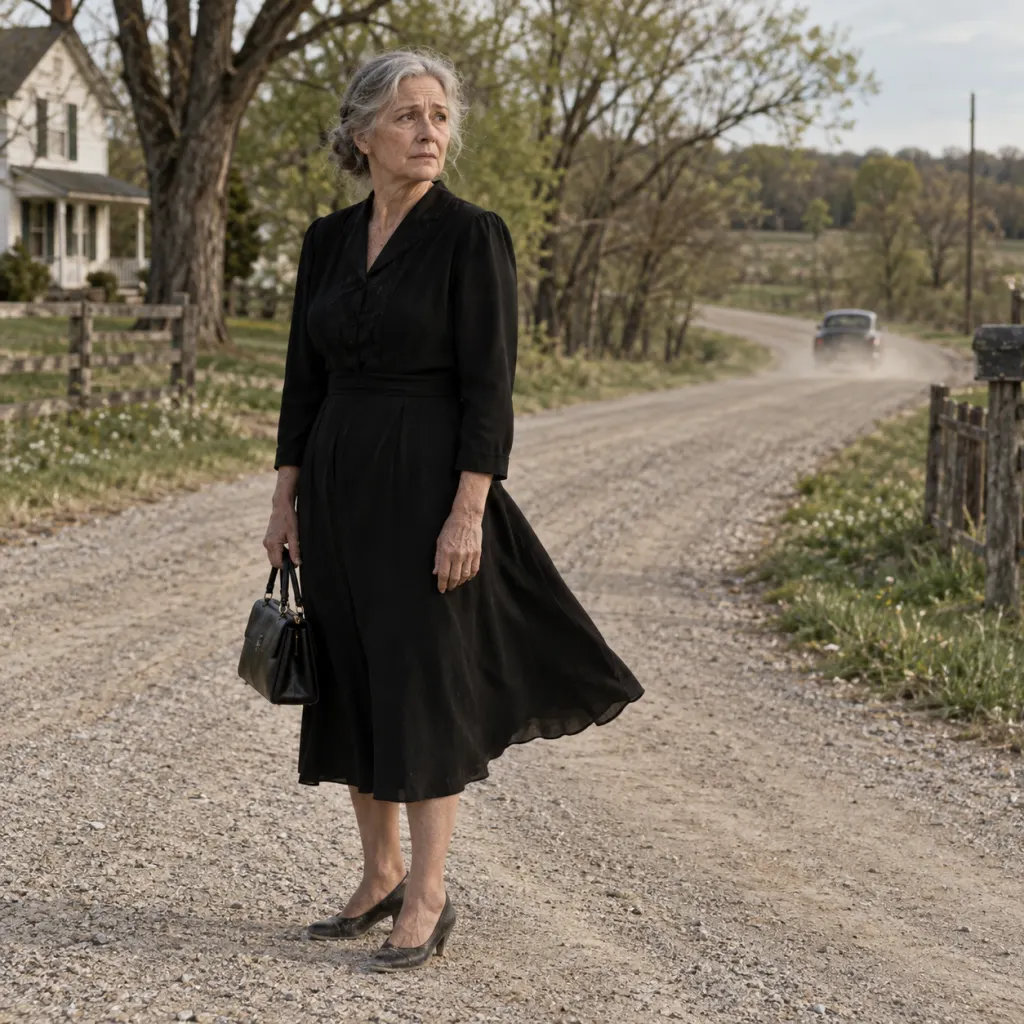
The road was empty enough to make any sound feel personal: gravel under my shoes, wind in the dry grass, the fading engine of my son’s car as he drove away with my daughter sitting silent beside him. I had buried my husband three days earlier. Now my children believed they had buried the rest of me too.
Chapter 1: The Road Beyond Town
The first thing I noticed after Brandon left me there was the dust. It clung to the hem of my black dress, settled into the creases of my shoes, and floated in the afternoon light as if the road itself had been waiting to cover me up. His SUV moved toward the bend without slowing. For one foolish second, I thought I saw the brake lights flicker. Then the car passed behind a wall of early corn and was gone.
I stood with my purse pressed against my ribs, listening to the country road return to itself. No houses. No passing trucks. No helpful neighbor leaning over a fence to ask whether I needed a ride. Just a wide white sky, two ditches full of pale grass, and the smell of damp soil rising from the fields.
Three days earlier, I had stood at the cemetery while the wind worried the corners of Nicholas’s memorial program. People told me he was a good man. They said it softly, as if goodness was something fragile that might break if spoken too loudly. I nodded until my neck hurt. I thanked them for casseroles, for flowers, for coming. I did the widow’s work because there is work even in sorrow: shake hands, receive embraces, remember where someone left the coffee urn, keep breathing when everyone else goes home.
Brandon had flown in that morning with a garment bag and a phone that never seemed to leave his palm. Melissa arrived soon after, polished and distant, her hair pinned neatly at the back of her head, her sunglasses hiding whatever she did not want me to read. They kissed my cheek. They called me Mom. They stood near me in the receiving line as if proximity could pass for devotion.
At the house afterward, they moved through the rooms like appraisers. Brandon noticed the cracked tile by the back door before he noticed the empty chair at the kitchen table. Melissa opened the silverware drawer and closed it again, as if checking whether childhood had left anything worth taking. I watched them from the sink, my hands in dishwater gone cold, and felt something I did not want to name.
That morning, when Brandon said we were going to look at a place that would be easier for me, I understood more than he meant me to. He did not say where. He did not ask whether I wanted to go. Melissa stood by the entryway holding my coat, not meeting my eyes. I looked at the suitcase beside Brandon’s foot. It was small, borrowed-looking, and already packed.
I could have refused at the door. I could have sat down at my own kitchen table and told him to try moving me. Instead, I followed them. Some part of me needed to know how far my son would carry his confidence before the weight of it frightened him.
Now I knew.
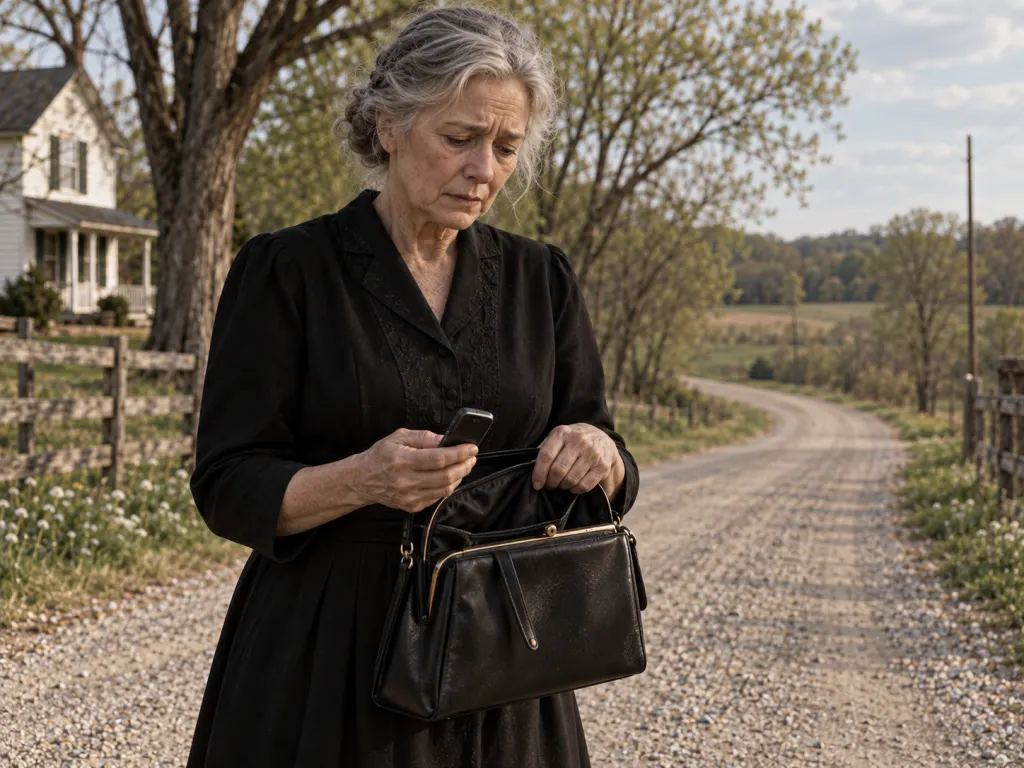
I reached into the inside pocket of my purse and touched the flat shape sewn into the lining. Brandon had taken the phone from the hall table. He had asked for my wallet under the gentle pretense of organizing documents. He had not known that Nicholas and I had spent the last year learning how much a person can hide in plain sight when people stop looking at her as a whole human being.
Chapter 2: What My Children Wanted
People like to imagine greed arriving in a dramatic coat, all shouting and slammed doors. In our house, it came wearing good shoes and using polite words. It asked for clarity. It requested signatures. It said things like practical arrangement
and the best thing for everyone
while stepping carefully around the grief still lying open on the floor.
Brandon had always been quick. As a boy he could take apart a radio and put it back together with two screws left over and still make it play. Nicholas used to laugh and call him a born operator. I heard pride in it then. Later, when Brandon learned to turn every conversation into a calculation, I wondered whether we had mistaken sharpness for strength.
Melissa was different. She did not push. She arranged. She softened the edges of Brandon’s demands until they could pass through a room without cutting anyone who did not look closely. She brought me tea I had not asked for. She sat beside me on the sofa and patted my knee while Brandon opened folders on the dining table. When I said I was tired, she murmured, We know, Mom. That’s why we’re helping.
Helping meant asking where Nicholas kept passwords. Helping meant suggesting the house was too much for me. Helping meant referring to the business as if it had naturally drifted into Brandon’s hands the moment his father stopped breathing.
The business was not grand, but it was ours. Canton Hardware sat two blocks off Main Street, between the florist and the shop that repaired vacuum cleaners long after most people would have thrown them away. Nicholas opened it in 1984 with a loan, three aisles of inventory, and more faith than sense. I kept the books at the kitchen table while babies slept upstairs. Later, I learned suppliers, payroll, tax forms, seasonal orders, the rhythm of snow shovels and tomato cages, the strange poetry of receipts.
Brandon had worked there during summers until he decided stocking shelves was beneath him. Melissa gift-wrapped purchases at Christmas and flirted with boys who came in for batteries. They remembered the store as backdrop, not foundation. To them, it was something their father had owned. To me, it was something we had survived inside.
Nicholas saw the change before I wanted to. In his final year, Brandon called more often, but his questions were narrow. What was the building worth? Had we considered selling? Was the retirement account in both names? Nicholas would hang up and sit very still afterward, one hand on the receiver, his face angled toward the window.
He thinks I’m already gone,
Nicholas said once.
I told him not to talk that way. It was easier to scold him than to admit I had heard it too.
So we made quiet appointments. We sat across from Elaine Porter, an attorney who wore navy suits and listened better than most people pray. We made lists. We asked hard questions. We wrote down what mattered. Not punishment. Not control from beyond the grave. Protection. Continuity. A way to keep the home from becoming a prize and the store from becoming a liquidation sale.
Nicholas signed first. Then I signed. My signature looked unsteady beside his, but it held.
Chapter 3: The Secret Nicholas and I Kept
The secret was not a treasure hidden under floorboards. It was not cash in a coffee can or a second house in another county. It was paperwork, which sounds dull until you have watched dull paper stand between you and ruin.
Nicholas and I had placed the house in a trust that allowed me to remain there for the rest of my life unless I chose otherwise. The hardware store had been moved into a structure that gave me operating authority and set a path for the employees to buy in over time if I stepped away. Brandon could inherit money someday, if there was money to inherit. Melissa too. But they could not take the roof over my head. They could not strip the store, fire the staff, and sell the building before Nicholas’s work boots were cold in the mudroom.
We did not tell the children because Nicholas hoped we would never need to. He was tender that way, even when tenderness cost him sleep. He wanted to leave them the chance to be better than our fears. I wanted that too. No mother wants proof that caution was wisdom.
The week before he died, Nicholas asked me to bring him the red folder from the desk. His hands looked thinner than I could bear. He tapped the folder once with two fingers.
Promise me you’ll use it if you have to.
I sat on the edge of the bed and tried to smile. Use what?
Your spine, Naomi.
That was my husband: leaving me legal protection and a joke because he knew I would accept one more easily than the other.
After the funeral, while Brandon spoke of next steps, the red folder rested in a locked drawer at Elaine Porter’s office. A duplicate key sat in the lining of my purse. A prepaid phone, charged and wrapped in an old scarf, lay flat against the bottom seam. The purse itself looked like the same worn black bag I had carried for fifteen years. Brandon glanced at it once and dismissed it as clutter.
On the road outside town, I pulled the phone free and held it in my palm. My fingers trembled so much I almost dropped it. Not because I was helpless. Because a mother’s heart does not stop being a mother’s heart just because her child has done something cruel.
I turned the phone on and waited. The screen lit my face faintly in the empty afternoon. There were only four numbers saved. Elaine. Ruth from the store. A taxi company. The sheriff’s non-emergency line.
I called Ruth.
She answered on the second ring. Canton Hardware.
For a moment, I could not speak. I heard the familiar bell above the store door in the background, the old register drawer sliding shut, a man asking where we kept furnace filters. The ordinary sound of the life Brandon thought he had ended.
Ruth,
I said. It’s Naomi.
Her voice changed immediately. Where are you?
I looked down the road Brandon had chosen for me. About four miles outside town. Near the Miller fields. I need a ride, and I need you to call Elaine.
Chapter 4: Ruth’s Truck
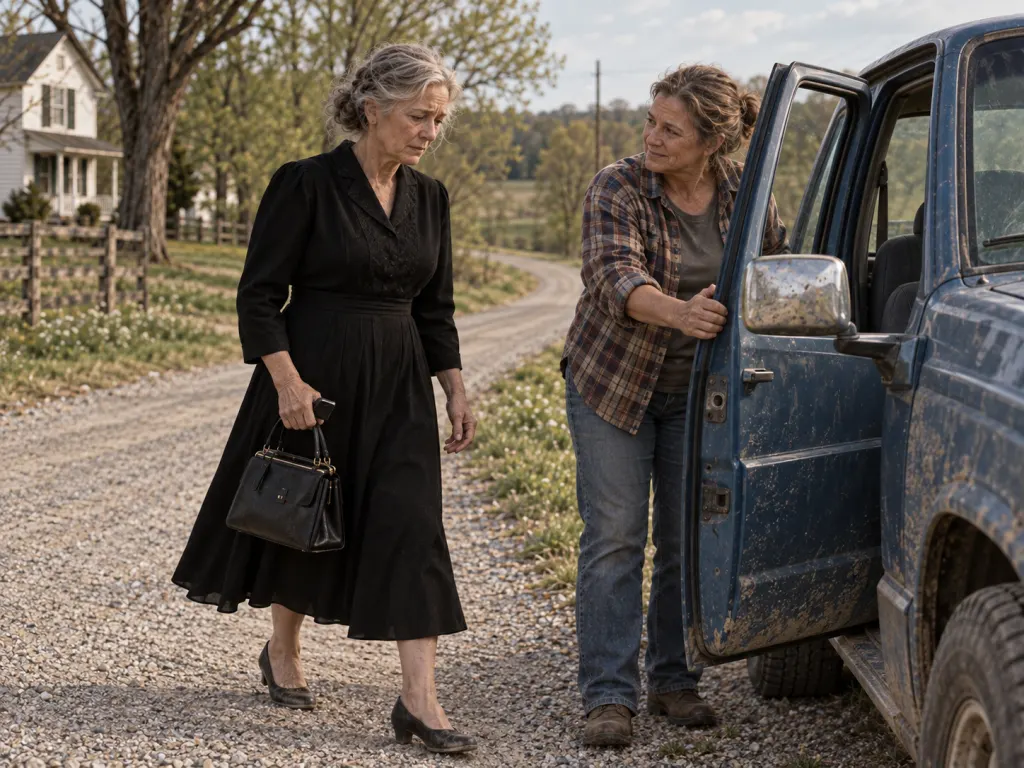
Ruth arrived in the old blue pickup she used for store deliveries, the one with a dented tailgate and a coffee cup permanently wedged in the console. She did not ask questions when she saw me. She pulled onto the shoulder, got out, and crossed the road fast for a woman with bad knees and no patience for ceremony.
Get in before I say something I’ll have to repent for,
she said.
I laughed then. It startled me. The sound came out cracked and small, but it was laughter. Ruth opened the passenger door and helped me climb in. The cab smelled like sawdust, peppermint gum, and the cardboard scent of new stock. On the dash, a faded receipt fluttered in the vent’s breath.
She handed me a paper cup of water from the gas station. I drank too fast and spilled some on my dress. Ruth pretended not to notice.
Elaine’s meeting us at the store,
she said. I called Tom too.
Tom managed the paint counter and had worked for us since Brandon was in middle school. He knew every regular customer by project, not name. If Mrs. Alvarez came in, he remembered she was patching the porch rail. If Mr. Dempsey came in, he knew to ask whether the basement leak had stayed fixed. The store was full of such quiet loyalties. I had forgotten, in the shadow of my children’s plans, that family is not only blood. Sometimes it is the person who keeps the back door key because you trust them to open the shop after a storm.
Ruth drove without turning on the radio. At the edge of town, she glanced at me. Do you want to go home first?
The word home landed hard. I pictured Brandon’s suitcase in my hallway, Melissa’s hand on the stair rail, both of them believing the rooms had already changed owners because they had changed their tone.
No,
I said. The store.
She nodded once, approving.
Canton Hardware looked exactly as it had that morning: green awning, front windows crowded with spring seed packets, a hand-lettered sign Nicholas had refused to replace because people recognized it. When Ruth pulled into the alley, Tom was waiting by the back door with his arms folded. Elaine stood beside him holding a leather briefcase.
I had known Elaine for only a year, but grief had a way of rearranging closeness. She came toward me with no fuss, no pitying face. Naomi, are you physically all right?
Yes.
Do you want to make a report about being left without transportation or access to your regular phone and wallet?
I looked toward Main Street, where traffic moved in slow weekday drifts. A mother’s instinct rose in me, old and automatic: protect him, explain him, soften the facts until they hurt less. Then I remembered the road. The suitcase. Melissa’s silence. Brandon saying the house and business were his with the calm voice of a man reading numbers from a screen.
I want everything documented,
I said. And then I want to go home.
Chapter 5: The House With All the Lights On
We did not go back alone. Elaine drove her sedan. Ruth followed in the truck. Tom came in his own car after closing the store early with a sign on the door that read, Family matter. Back tomorrow.
I sat beside Elaine, watching the familiar streets pass by with the strange sensation that I had been away for years instead of an hour.
The house stood at the end of Maple Lane, white siding weathered at the corners, porch steps Nicholas had meant to repaint in May. Every window on the first floor was lit. That was the first thing I noticed. Brandon hated waste. As a boy, he had followed Nicholas around turning off lamps for the pleasure of being right.
Elaine parked at the curb. You do not have to enter if you feel unsafe,
she said.
I looked at my front door. The wreath Melissa had bought for the funeral still hung there, pale ribbon lifting in the breeze. I’m entering my home.
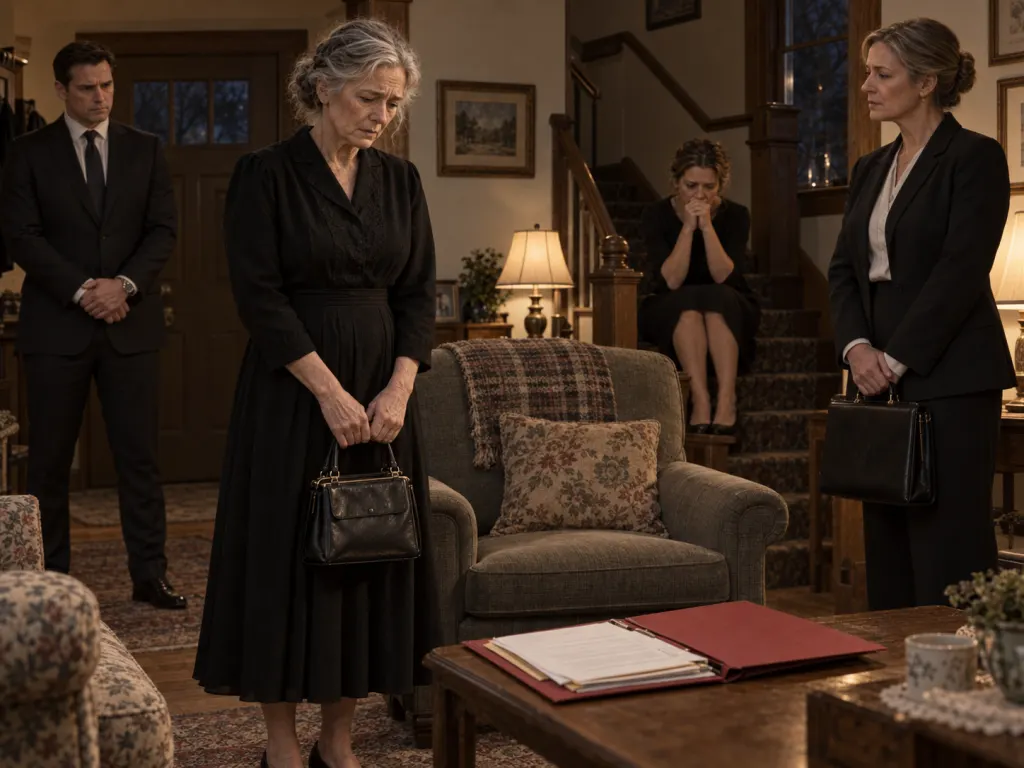
Inside, Brandon stood in the foyer with my desk drawer open on the hall table. Melissa was on the stairs, one hand to her mouth. My regular phone lay beside a stack of papers. My wallet was there too, emptied of cards and lined up like evidence.
Brandon turned when he heard the door. For the first time that day, his confidence stumbled.
Mom.
One word. Not apology. Not relief. A calculation trying to become a son again.
Ruth stepped in behind me. Tom remained on the porch. Elaine entered last, closing the door with careful softness.
Naomi has asked that all further discussion about the house and business happen with documentation present,
Elaine said.
Brandon’s face hardened. This is a private family matter.
It became something else when you left your mother on a rural road without her regular belongings,
Elaine replied.
Melissa whispered, Brandon, stop.
He ignored her. You don’t understand what Dad wanted.
There it was: the last shelter of people who have run out of decent arguments. The dead cannot correct us, so we put words in their mouths and call it loyalty.
I walked past him into the living room. Nicholas’s chair sat by the window, its cushion sunken slightly in the shape of him. For three days, I had not been able to look at it directly. Now I placed my palm on the back of it and felt steadier.
Your father wanted the people he loved to act with honor,
I said. When he became unsure they would, he made plans.
Brandon looked at Elaine’s briefcase. A small muscle moved in his jaw.
Plans?
Elaine opened the briefcase on the coffee table. She did not spread papers dramatically. She simply removed a folder, set it down, and turned it toward me. The red cover looked brighter under the lamp than it had in the lawyer’s office, almost alive.
Chapter 6: The Red Folder
I did not let Elaine speak first. That mattered. For too long, people had spoken around me as if age had thinned my claim to my own life.
The house is protected,
I said. I live here unless I choose to leave. The business remains under my authority, and there is a succession plan for the employees. Your father and I made those decisions together.
Brandon stared at me as if I had changed languages. You can’t just cut us out.
I didn’t cut you out. I stopped you from cutting me out.
Melissa sat down on the bottom stair. Her face had gone pale beneath her makeup. For a moment, she looked younger, not innocent, but frightened in the way children are frightened when the story they told themselves stops holding.
I thought,
she said, then stopped.
You thought what?
I asked.
She looked at Brandon. He gave her a warning glance. She looked back at me anyway. I thought we were taking you somewhere with staff. Brandon said you had agreed before Dad passed. He said you’d forget saying yes if we asked again.
The room seemed to tilt. Not because I believed her completely. Melissa had her own choices to answer for. But there was a difference between cruelty invented and cruelty obeyed. I had raised both of them, and I knew the shape of their weaknesses. Brandon pushed. Melissa yielded, then called it peace.
Brandon snapped, Don’t do that.
Do what?
Melissa said, her voice shaking. Tell her what you told me?
Elaine lifted one hand. This conversation is becoming heated. Naomi, would you like your children to leave for tonight?
The question opened a door inside me. I had spent decades keeping doors open for my children: bedroom doors when they were afraid of the dark, kitchen doors when they came home late, emotional doors when they hurt me and needed a place to return. Closing one felt unnatural. It also felt necessary.
I turned to Brandon. You will return my cards. You will leave my phone where it belongs. You will take the suitcase you packed for me and put it in your car. Tonight you will sleep somewhere else.
Mom, you’re upset.
I am clear.
Those three words surprised even me. They landed in the room with more force than shouting would have. Ruth, still near the doorway, lowered her eyes, but I saw her mouth tighten as if she was holding back a smile.
Brandon looked from me to Elaine to the folder. The old habits were moving through him. Find leverage. Find sympathy. Find the weakest board in the floor. But there was no board to press. Nicholas and I had built this part carefully.
He gathered his coat with stiff movements. Melissa stood too, wiping under one eye with the side of her finger. At the door, she paused.
Mom, I’m sorry.
I wanted to take the apology and make a blanket from it. I wanted to say it was all right, because mothers are trained by love and exhaustion to end discomfort quickly. Instead, I nodded.
I hope you become sorry in a way that changes you,
I said.
Chapter 7: The Morning After
I slept in Nicholas’s chair that night, not because it was comfortable, but because I could not bring myself to climb the stairs. Ruth stayed in the guest room without asking. Elaine left after making notes and arranging to meet me the next morning. Tom fixed the back door latch before he went home, though it had not been broken.
At dawn, the house held that strange blue quiet that comes before appliances wake and traffic begins. I made coffee. The first cup after a betrayal tastes metallic, in case you have never had one. I drank it anyway, standing at the counter where Nicholas used to butter toast and read the sports section aloud as if I had asked.
Ruth came in wearing yesterday’s sweater and carrying her shoes. I didn’t want to track mud on the stairs,
she said.
At this point, Ruth, the stairs have survived worse than mud.
She smiled, then grew serious. What do you want to do today?
The question was kinder than it sounded. Not what should be done. Not what would look strong. What did I want?
I looked at the calendar on the refrigerator. Nicholas’s handwriting still marked inventory review on Thursday and call plumber on Friday. He had written small reminders as if the future had promised to keep its appointments.
I want to open the store,
I said.
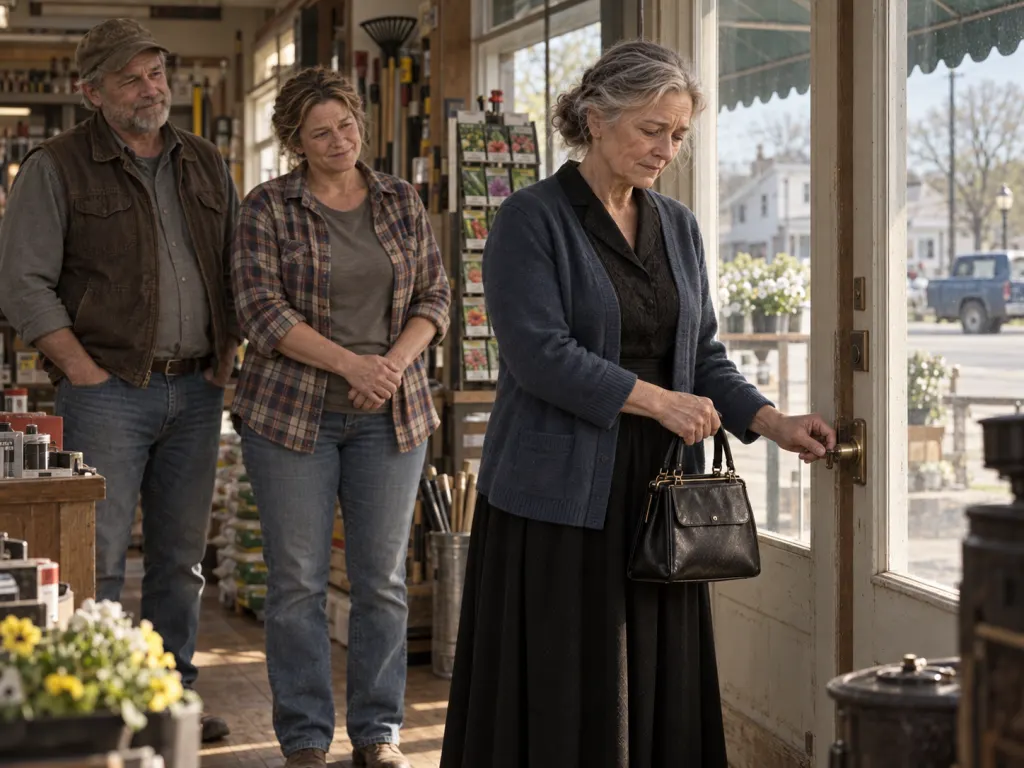
So we did. I put on a blue cardigan over my black dress because I had not yet decided what else to wear as a widow. Ruth drove me downtown. Tom had already swept the front walk. When I unlocked the door, the bell rang above my head, bright and familiar.
The morning customers knew something had happened because small towns are made of windows. Mrs. Alvarez squeezed my hand across the counter. Mr. Dempsey bought lightbulbs he did not need and pretended badly that he had come in by chance. No one asked for details. Their restraint felt like a mercy.
Around noon, Brandon called the prepaid phone. I let it ring until it stopped. Then he called the store. Ruth answered, listened for a moment, and looked at me.
He wants to speak to you.
I wiped my hands on a towel, though they were not dirty. Tell him he can send a message through Elaine.
Ruth repeated it and hung up before he finished responding.
There was no victory in that moment. Only space. Space to breathe. Space to choose. Space where panic had been.
Chapter 8: What I Kept
In the weeks that followed, people expected me to collapse or harden. I did neither perfectly. Some mornings I cried into the laundry because Nicholas’s socks were still paired in the drawer. Some afternoons I worked six hours at the store and came home proud of my own tiredness. At night, I checked the locks twice and reminded myself that caution was not fear. It was care.
Brandon sent emails at first. They began with outrage, moved into blame, then softened into language that sounded borrowed from someone who had advised him to appear reasonable. Elaine answered the legal parts. I answered none of the rest.
Melissa came by one Saturday and stood on the porch with a paper bag from the bakery. I did not invite her in immediately. That small pause cost me more than anyone watching would have known.
I should have stopped him,
she said.
Yes.
She flinched, but stayed.
I told myself it was easier if I kept things calm.
Calm for whom?
She looked down at the bag in her hands. For me, I think.
That answer was the first honest thing she had given me in years. I stepped aside and let her into the kitchen, not because everything was repaired, but because repair has to begin somewhere smaller than trust. We drank coffee. She did not ask about the house. She did not mention the business. Before she left, she washed both mugs and set them upside down on a towel the way I had taught her.
Brandon took longer. Maybe he will take longer than I have years. I have learned not to build my life around the day someone else might become ready to love me properly. That sounds bitter until you live it. Then it sounds like freedom.
The store changed slowly. Tom took over more ordering. Ruth began training two younger employees on the books. We put the employee succession plan into motion, step by careful step. The first time I saw their names on the paperwork beside mine, I cried in Elaine’s office. Not because I was losing Canton Hardware, but because Nicholas’s work would keep feeding lives instead of becoming a trophy in a family fight.
At home, I moved Nicholas’s chair three feet closer to the window. It was a small rebellion against the museum grief tries to make of a house. I planted basil in pots on the sill. I repainted the porch steps myself over two slow afternoons, resting between coats, leaving a faint blue smear on my wrist until it wore away.
People sometimes ask, in lowered voices, whether I ever forgave my son. They want a clean ending, something polished enough to carry away. I tell them the truth: forgiveness is not a door I can be pushed through for the comfort of people waiting outside. It is a room I may enter someday, if I can do so without abandoning myself.
What I kept after that road was not only my house, or the store, or the legal right to stay where I had built my life. I kept my name. Naomi Marie Canton. Widow of Nicholas, mother of Brandon and Melissa, owner of my choices, still here.
And when I think of that afternoon now, I do not begin with the image of my son’s car disappearing. I begin with the moment after: the dust settling, the phone lighting in my hand, the wide road ahead of me. I had thought I was stranded. I was wrong. I was standing at the beginning of the rest of my life.
Wrap-Up
After her son abandons her on a rural road, Naomi discovers that the quiet protections she and her late husband put in place were not acts of suspicion, but acts of love for the life they built. The story ends with Naomi choosing dignity over revenge, boundaries over denial, and a future rooted in her own name.