 Save
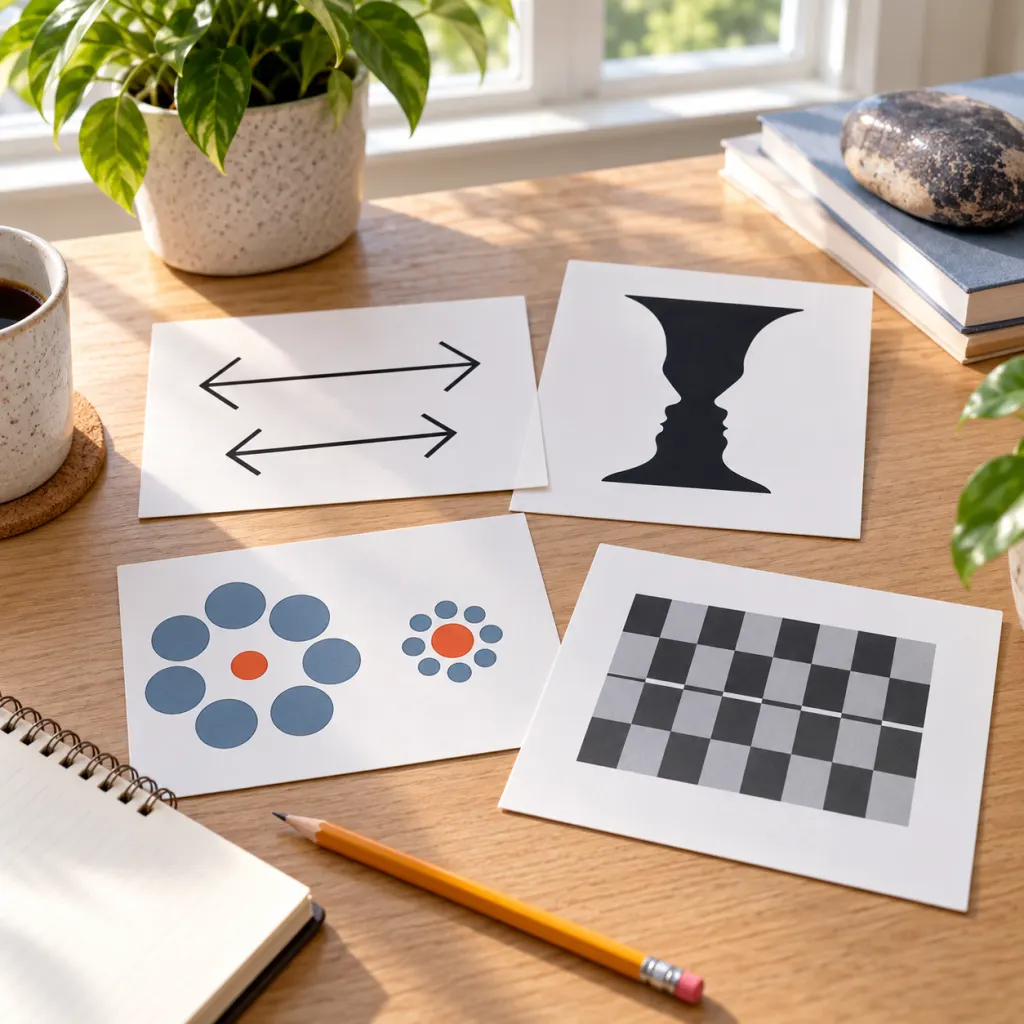
Optical illusions challenge self-awareness because they make one quiet fact hard to ignore: seeing is an interpretation. The useful lesson is not that an illusion can diagnose your personality. It is that your attention, expectations, confidence, and context can shape what you notice first and how certain you feel about it. Educational illusion collections explain that color, light, and patterns can make perception differ from the physical image, because visual information is interpreted after it reaches the eye by the brain. The eight illusions below are best used as small mirrors for attention, not as mystical tests. Try each one slowly, notice your first answer, then ask what changed when your perception shifted.
Why Illusions Are Useful For Self-Awareness
An optical illusion becomes interesting when it separates the image from the experience of the image. A line may be the same length while appearing longer, a flat drawing may seem three-dimensional, or a still arrangement may imply movement. Researchers use such effects because they offer clues about visual processing. One functional MRI study notes that optical illusions can help researchers investigate the neural mechanisms behind visual perception, including the roles of early visual areas and higher-level processing during illusion perception. For everyday readers, the same idea can be gentler: illusions invite you to pause before treating first impressions as complete reports.
How To Use These Illusions As Mirrors, Not Tests
Many viral illusion posts turn a first impression into a personality label. That is tempting, but too strong. A better use is to observe the process. Did you choose quickly? Did you keep looking after your first answer? Did another interpretation feel impossible until it suddenly appeared? The self-awareness question is not, “What type of person am I?” It is, “What did my attention do before I noticed it?”
- Look once quickly. Name the first thing you see without trying to be clever.
- Look again slowly. Search for a second interpretation, even if the first feels obvious.
- Change the context. Cover part of the image, step back, rotate the page, or describe it to someone else.
- Notice confidence. The most useful moment is often when certainty softens.
1. Rubin Vase: What Becomes The Foreground?
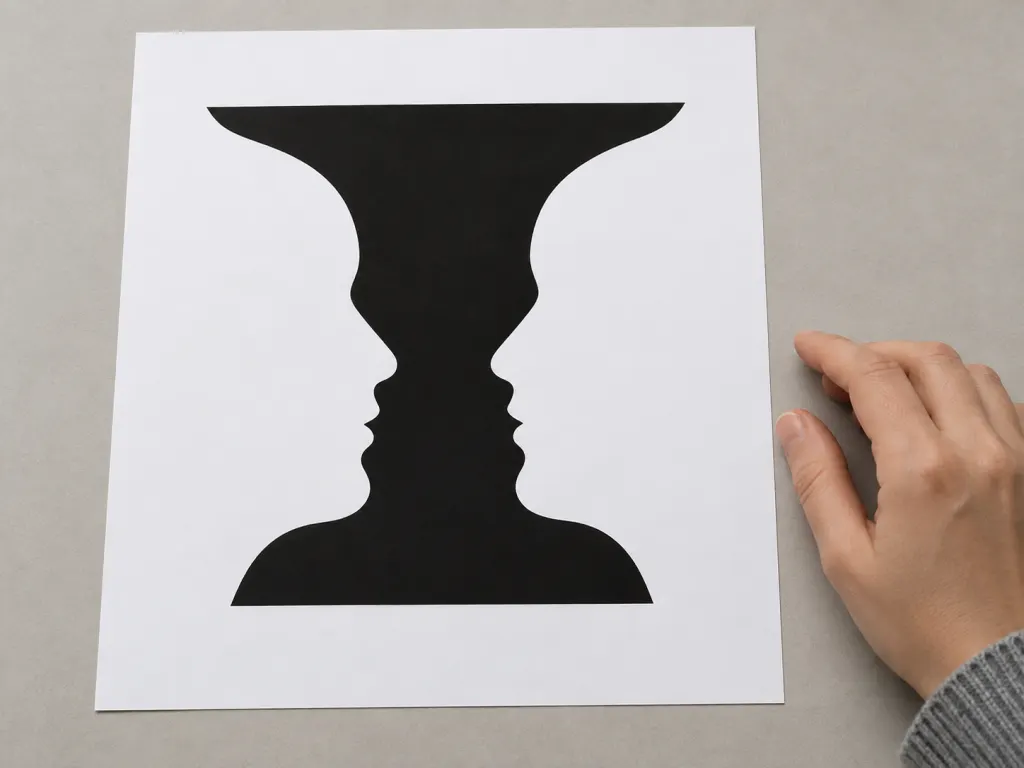
The Rubin vase is a classic figure-ground illusion: some viewers see a vase, while others see two faces in profile. Hanover College’s interactive psychology material explains that figure-ground organization is the experience of deciding which part of an image is the object and which part is background; in the face-vase figure, the border can belong to either interpretation, but not both at the same time in ordinary viewing. Its self-awareness lesson is simple and surprisingly practical: attention selects. In conversation, work, and family life, the “figure” is often whatever feels urgent, familiar, or emotionally bright. The “ground” may still be there, but it can disappear from awareness until you deliberately search for it.
2. Necker Cube: When A Stable Object Flips
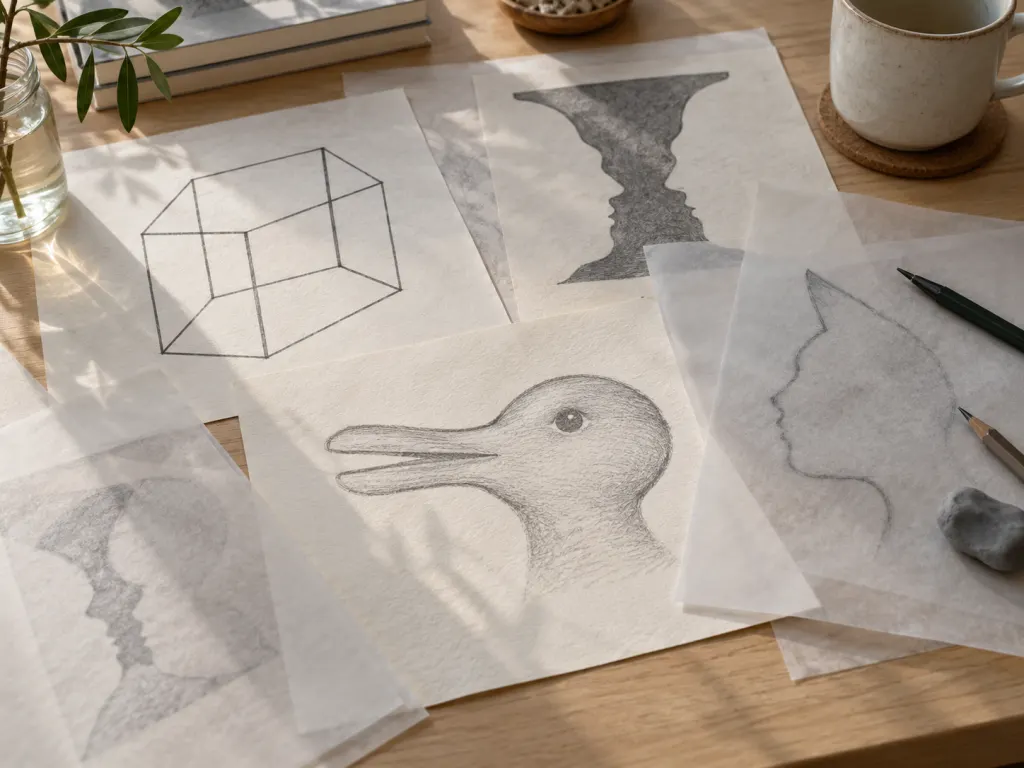
The Necker cube is a line drawing that can be seen with either of two faces in front. Stanford’s discussion of ambiguous figures describes it as an image that can reverse between different cube orientations, even though the visual input stays the same on the page. That makes it a compact lesson in mental flexibility. You may not control the exact instant when the cube flips, but you can learn that a different structure is possible. In self-awareness terms, this is the difference between saying, “This is the only way to see it,” and saying, “This is the way my mind has settled for now.”
3. Duck-Rabbit: The Power Of A Prompt
The duck-rabbit drawing is another ambiguous figure: the same outline can become a duck facing one way or a rabbit facing the other. Stanford uses it to show how concepts, expectations, and context can influence perception when input is ambiguous. Its challenge to self-awareness is especially social. If someone tells you, “Look for the rabbit,” you may suddenly find what was unavailable seconds earlier. That does not mean the prompt invented the image from nothing. It means attention became organized around a new possibility. Good questions can do the same thing in ordinary thinking.
4. Young Woman Or Older Woman: Familiar Features, Different Stories
The famous ambiguous woman image can be read as a young woman looking away or an older woman in profile. Stanford lists it among classic examples in which the same physical input can support more than one perception depending on interpretation. The self-awareness value is in noticing how quickly recognition becomes narrative. Once you see a face, you do not merely see lines; you infer age, direction, expression, and sometimes mood. That is useful in daily life, but it also means that perception often arrives already bundled with a story. Pausing to separate “what is visible” from “what I inferred” is a small but powerful habit.
5. Müller-Lyer: Equal Lines That Refuse To Look Equal
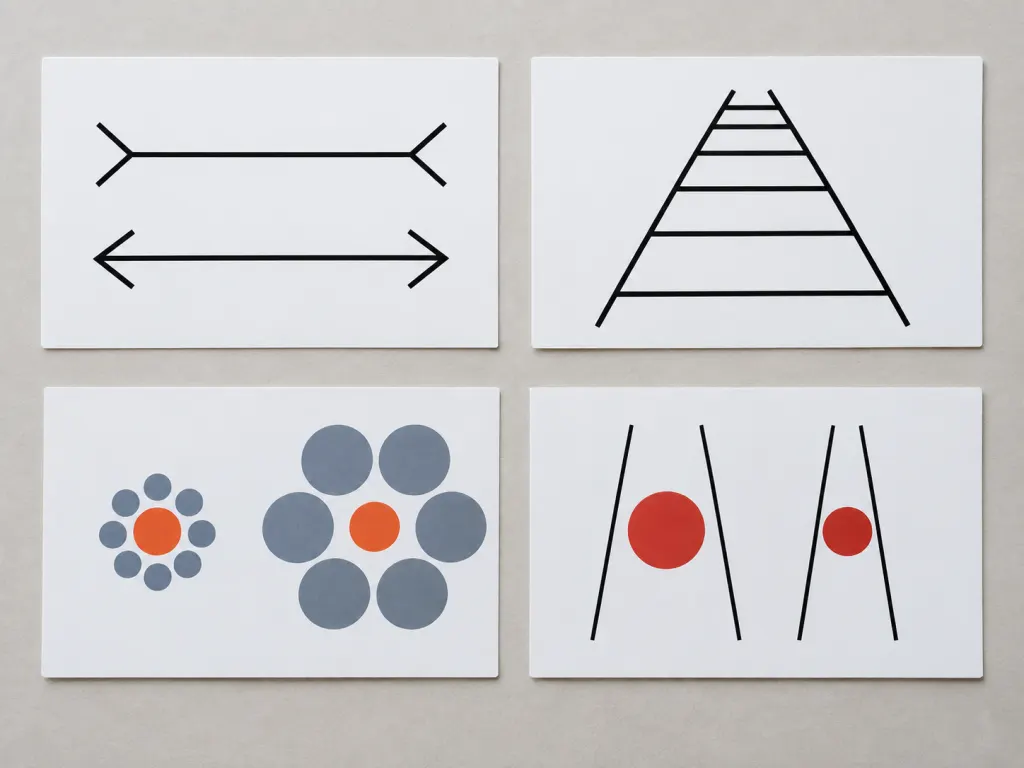
In the Müller-Lyer illusion, two lines of equal length can look unequal because of the arrow-like fins at their ends. The fMRI study on illusion perception included Müller-Lyer figures among several illusion types used to examine how people process line and area illusions in a controlled task. This illusion challenges a different part of self-awareness: measurement humility. Even when you know the two shafts are equal, the unequal appearance may persist. That gap is useful. It shows that knowing a correction is not always the same as experiencing the correction. In everyday judgment, facts can update conclusions before they update feelings.
6. Ponzo Illusion: Context Changes Apparent Size
The Ponzo illusion uses converging lines, like railway tracks or a road receding into the distance, to make equal objects appear different in size. The University of Colorado Boulder’s physics demonstration page describes optical demonstrations that show how the brain constructs three-dimensional perception from two-dimensional images and highlights the role of depth cues in visual interpretation. The self-awareness lesson is that context can quietly become evidence. Something placed “farther away” in a perspective scene may seem larger because the visual system is trying to maintain a coherent world. In practical terms, comparisons are rarely neutral unless you understand the frame around them.
7. Ebbinghaus: Comparison Shapes What Seems Big Or Small
In the Ebbinghaus illusion, a central circle appears larger or smaller depending on the size of circles around it, even when the central circle itself does not change. The same NIH-indexed fMRI study included Ebbinghaus figures among area illusions used to investigate illusion processing with visual tasks. This illusion is a neat model of social comparison. A choice, achievement, room, meal, or problem can feel large or small depending on what surrounds it. The illusion does not prove that comparison is bad; comparison is often how people make sense of scale. It does suggest that a change in surroundings can change perceived importance before anything about the target itself changes.
8. Apparent Motion Quartet: When Still Events Become A Path
The apparent motion quartet uses alternating dots at diagonal corners of an implied square. MIT News describes the visual version as an illusion in which people perceive the dots as moving horizontally or vertically, and the perceived direction can flip even when the stimulus pattern is unchanged over time. This is a strong illusion for self-awareness because it shows how the mind links separate moments into a path. That ability is valuable: it helps people track motion and make sense of sequences. But it also reminds us that a pattern can feel continuous because the mind connected the points. Sometimes the most honest question is, “What did I actually observe, and what path did I add?”
What These Eight Illusions Can And Cannot Tell You
These illusions can reveal habits of attention, not hidden destiny. They can show that you noticed the foreground before the background, accepted depth cues quickly, changed interpretation after a prompt, or felt confident before the image shifted. They cannot reliably sort people into fixed personality categories from a single glance. The most responsible reading is modest: illusions make perception visible as a process. When that process becomes visible, it becomes easier to ask better questions about everyday judgments.
- They can teach patience. A second look often changes the experience.
- They can teach precision. Appearance and measurement are not identical.
- They can teach curiosity. Another person may honestly see something else first.
- They can teach context awareness. Surroundings, prompts, and expectations matter.
A Practical Way To Reflect After Viewing One
After trying an illusion, write down three short notes: what you saw first, what changed, and what helped the change happen. That turns the illusion from entertainment into a small exercise in attention. If the second perception never appears, that is still useful information; it shows where the image remains stable for you. If it flips easily, notice whether you can hold both possibilities in mind without forcing one to win. In real life, self-awareness often grows in the same way: not by distrusting perception completely, but by learning how perception is built.
Wrap-Up
Optical illusions are most useful when they are treated as demonstrations of perception rather than personality quizzes. The Rubin vase highlights figure and ground. The Necker cube, duck-rabbit, and ambiguous woman show how the same input can support different interpretations. Müller-Lyer, Ponzo, and Ebbinghaus illusions show how surrounding cues can change apparent length, depth, or size. The apparent motion quartet shows how separate events can become a felt path. Together, these eight illusions challenge self-awareness by asking readers to notice how quickly a first impression becomes certainty, how context changes experience, and how another interpretation can be real without making the first viewer dishonest.
Frequently Asked Questions
- → Do optical illusions reveal my personality?
Not in a reliable one-glance way. They are better understood as demonstrations of attention, context, and visual interpretation. Your first response may be interesting, but it should not be treated as a fixed personality label.
- → Why can two people see different things in the same illusion?
Some illusions are ambiguous enough to support more than one interpretation. Attention, prompts, contrast, viewing distance, past experience, and context can all make one interpretation become more available than another.
- → Why does an illusion still work after I know the answer?
Knowledge and perception do not always update at the same speed. With illusions such as Müller-Lyer, you may know that two lines are equal while the surrounding cues still make them appear unequal.
- → What is the best way to try these illusions?
Look once quickly, name the first thing you see, then look again more slowly. Change distance, cover nearby details, or ask someone else what they see. The reflective part is noticing what helped your perception shift.
- → Are optical illusions mistakes?
They are not simply failures. Many illusions happen because the visual system uses shortcuts that are helpful in ordinary scenes, such as judging depth, separating foreground from background, or linking events into motion.
References
This content was developed and refined using reliable sources.
- https://osa.magnet.fsu.edu/illusions
- https://pmc.ncbi.nlm.nih.gov/articles/PMC4470923
- https://isle.hanover.edu/Ch05Object/Ch05AmbigFigGround_evt.html
- https://plato.stanford.edu/archives/sum2007/entries/relativism/supplement1.html
- https://news.mit.edu/2008/touch-0717
- https://physicslabs.colorado.edu/demos/optics/the-eye/physiology/optical-illusions