 Save
The best quick answer is this: choose a watermelon that feels heavy for its size, has a creamy yellow field spot, looks symmetrical, and has a sound rind without deep bruises, cuts, or soft areas. A pale white field spot often points to a melon picked too early, while a richer yellow patch is a better sign that the fruit spent enough time maturing on the ground side. No single trick is perfect, but using several clues together gives you a much better chance of bringing home a sweet, crisp watermelon.
Why Sweetness Is Decided Before You Buy It
Watermelon is not like a banana or peach that can sit on the counter and keep developing more sweetness. University extension sources describe watermelon as a fruit that should be harvested at full maturity because its sugar level does not increase after it is removed from the vine. UC Davis notes that watermelon typically does not increase in sugars after harvest, and the University of Minnesota Extension makes the same practical point for shoppers and growers: once the fruit is off the plant, it may change in condition, but it will not become sweeter. That means your job at the market is not to buy a nearly ripe melon and wait. Your job is to identify one that was already mature when harvested. UC Davis Postharvest Center University of Minnesota Extension
This is also why the most useful signs are not decorative details. A good watermelon should show evidence of proper maturity, careful handling, and sound structure. Commercial standards from the USDA emphasize maturity, fairly good shape, freedom from major damage, and being not overripe as important grading ideas. For a shopper, that translates into a calm checklist: look for the ground spot, lift and compare, inspect the rind, and use the tap test only after the visual clues have already narrowed your choices. USDA Agricultural Marketing Service
Start With the Field Spot
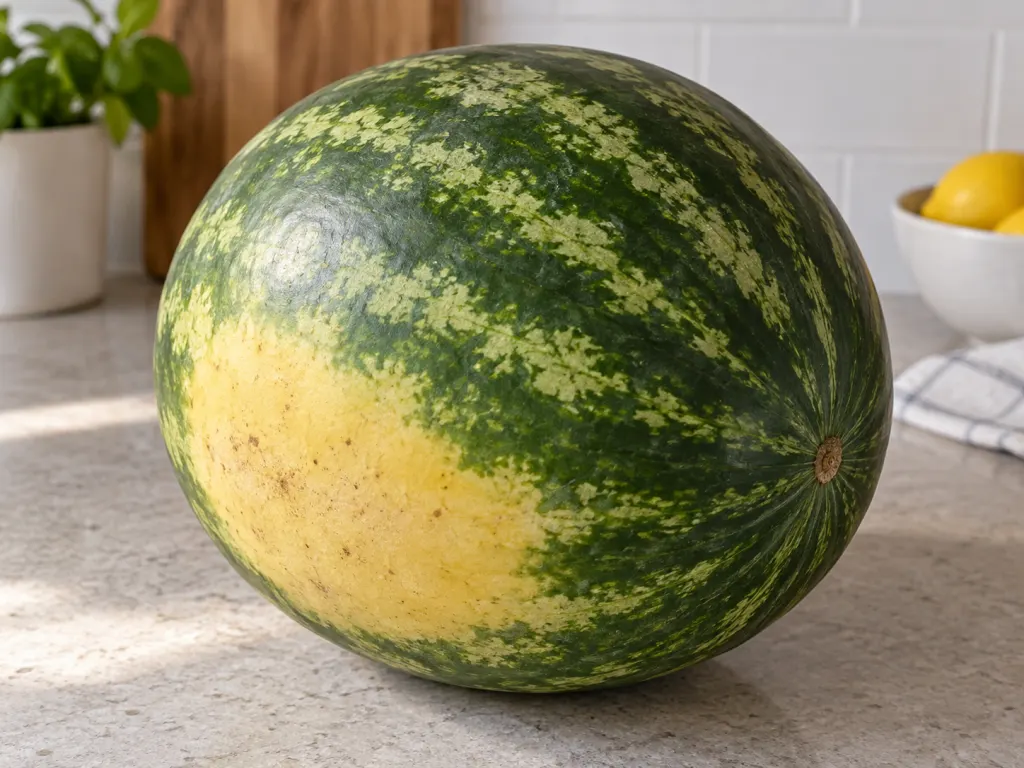
The field spot, sometimes called the ground spot, is the lighter patch where the watermelon rested against the soil or mulch as it grew. It is the most useful visual clue for an everyday shopper because it is easy to check without cutting the fruit. UC Davis describes the ground spot changing from pale white to creamy yellow at proper harvest maturity. Minnesota Extension and Illinois Extension also point to yellowing on the ground side as a sign of ripeness. A creamy yellow, buttery yellow, or deeper yellow spot is generally better than a white or barely visible one. University of Illinois Extension
Do not confuse a field spot with damage. A field spot is broad, flat, and part of the rind color. It should not feel sunken, wet, cracked, or mushy. On some striped varieties the spot can look uneven around the edges, and on small personal-size watermelons it may be modest rather than huge. The color matters more than dramatic size. If two melons are similar in shape and weight, the one with the creamier yellow spot is usually the better bet.
Then Compare Weight for Size
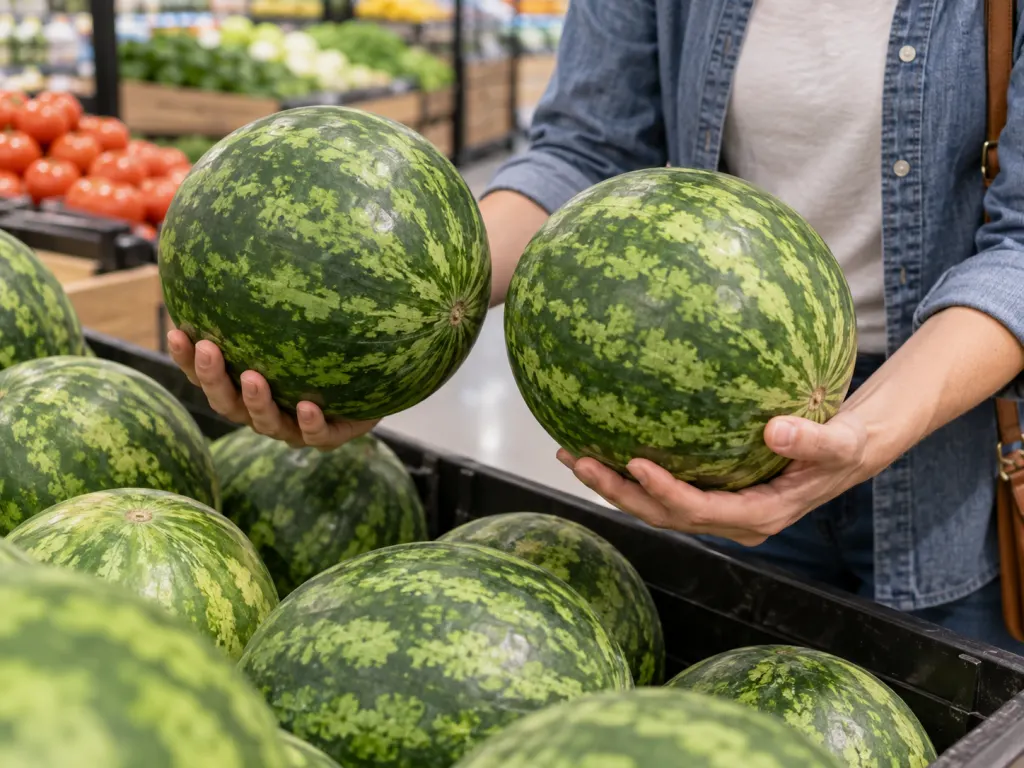
After the field spot, lift two or three watermelons of similar size. Choose the one that feels heavier than it looks. UC Davis lists “appears heavy for size” among watermelon quality indices, and this remains one of the most practical store tests because it compares density rather than guessing by diameter. A large watermelon can disappoint if it feels oddly light, while a slightly smaller one can be excellent if it feels dense and solid in the hands. UC Davis Postharvest Center
Weight is not a sweetness meter by itself. It cannot tell you the exact flavor, variety, or internal texture. But when paired with a yellow field spot and a sound rind, a heavy feel suggests the melon is full and less likely to be dried out or poorly developed. If you are shopping from a bin, compare melons from the same display because they are more likely to be from the same shipment and variety.
Look for a Symmetrical, Sound Rind
A good watermelon does not have to be perfectly round. Many excellent watermelons are oval, oblong, or compact, depending on the variety. What you want is symmetry for that variety: no sharply flattened side beyond the normal field spot, no deep dents, and no lopsided bulges that make the fruit look poorly filled. UC Davis quality guidance says watermelons should be symmetrical and uniform in appearance, without scars, bruising, transit abrasions, or other surface defects. The USDA grade language also treats shape and freedom from damage as important quality ideas.
Small superficial scratches are not automatically a problem, especially on watermelons that have been moved through field bins and store displays. The warning signs are deeper cuts, wet cracks, large bruised patches, soft spots, and areas that feel spongy under gentle pressure. A rind should feel firm and intact. If the melon has a stem stub, it should look dry rather than fresh and green. At a farmers market, a dry nearby tendril can be a useful harvest clue, but most grocery watermelons arrive without the vine attached, so you usually cannot rely on that sign.
Use Rind Sheen Carefully
Many shoppers hear that a sweet watermelon should be dull rather than shiny. The truth is a little more nuanced. Utah State University lists rind sheen and strong color difference between stripes among harvest maturity indicators, and it notes that the ground spot should be creamy yellow and the nearest tendril should dry. Other extension guidance says the shine can change with maturity but can depend on variety. Meanwhile, UC Davis describes good quality watermelons as having a waxy, bright surface. These statements are not really contradictions; they are looking at different parts of quality. Utah State University Extension
For a shopper, the most useful interpretation is this: avoid a watermelon that looks glassy, freshly polished, and pale with a white field spot, because that combination can suggest immaturity. Also avoid a melon that looks shriveled, tired, or dry in a way that suggests rough handling or age. A mature watermelon often has a waxy surface and clear striping, not a wet-looking shine. Let the field spot, weight, and rind condition carry more weight than sheen alone.
What About Thumping?
Thumping is popular because it feels immediate, but it is not the most dependable test for most shoppers. Minnesota Extension lists a hollow, dull sound among ripeness signs, while Utah State University says thumping is less effective and that a dull or muffled sound can also point to over-maturity. Illinois Extension specifically advises shoppers to look for yellowing on one side rather than depending on the hollow-sound test, because newer varieties can be firm and crisp. In other words, sound can be a supporting clue, but it should not overrule better evidence.
- Good use of thumping: compare several similar melons after you have already checked the field spot and rind.
- Weak use of thumping: choosing the loudest or deepest-sounding melon from a mixed bin without inspecting anything else.
- Red flag: a very dull, lifeless thud paired with soft areas, cracks, or a tired rind.
- Best habit: treat the tap as a tie-breaker, not the main decision.
Do Not Chase Viral Marks Too Hard
Online tips often focus on one small mark: webbing, a tiny blossom end, a particular stripe pattern, or a dramatic scar. Those details can be tempting because they promise certainty. The problem is that university and produce-quality references consistently emphasize broader maturity and quality signs instead: field spot color, weight for size, rind condition, shape, stripe contrast, tendril condition when visible, and postharvest handling. If a small mark appears on a melon that otherwise looks excellent, it is not a reason to reject it. If a small mark appears on a melon with a white field spot, light feel, or soft rind, it is not enough to save it.
Stripe pattern also varies by variety. Some watermelons have bold dark and light stripes, some are nearly solid green, and some specialty types look quite different from the classic picnic melon. This is why “strong color differentiation between the stripes,” noted by Utah State University as one possible maturity indicator, is useful mainly when comparing watermelons of the same type. Do not compare a dark solid-skinned melon to a striped one and assume the striped one is sweeter. Compare like with like whenever you can.
Farmers Market Versus Grocery Store Clues
At a farmers market or roadside stand, you may be able to ask when the melon was picked and whether it came from a recent local harvest. Illinois Extension notes that melons are best left on the vine until full maturity, when sugar content is highest. A grower who harvested close to peak ripeness has given you a real advantage. You may also see short stem pieces or learn the variety, which can help explain why one melon is round and another is long. At a grocery store, you usually have less background information, so your best tools are physical comparison and careful inspection.
Do not assume the biggest watermelon is automatically the sweetest. Size is partly variety, partly growing conditions, and partly market sorting. A huge melon can be wonderful, but a smaller dense melon with a creamy spot and clean rind can be the better choice. If you are buying for one or two people, a smaller watermelon may also be easier to chill, cut, and finish while the texture is at its best.
A Simple Shopping Routine That Works
Use the same short routine every time and you will get better at spotting good melons quickly. First, scan the bin for watermelons that are symmetrical and free of serious rind damage. Second, roll each candidate gently enough to view the underside and look for a creamy yellow field spot. Third, lift two or three of the best-looking melons in the same size range and choose the one that feels dense. Fourth, give the rind a light tap only as a final comparison. Fifth, choose a melon you can use soon, especially if it is already fully ripe.
This routine is more reliable than trying to memorize one “infallible” detail. Watermelon quality is the result of maturity, variety, weather, harvest timing, and handling. A field spot is powerful because it reflects maturity, but it still belongs in a group of clues. The more signs that agree, the better your odds.
After You Bring It Home
Storage matters because a good melon can lose eating quality if it sits too long or is held poorly. UC Davis gives watermelon an optimum storage range of 10 to 15 degrees Celsius, or 50 to 59 degrees Fahrenheit, and notes that quality can decline under poor handling. Utah State University says watermelons kept around 55 to 60 degrees Fahrenheit and high humidity may keep for 10 to 15 days, while ambient temperatures shorten that window. For the home kitchen, the practical takeaway is to keep a whole ripe watermelon cool when you can and plan to cut it within a reasonable time.
Because watermelon will not become sweeter after purchase, leaving it on the counter for several days is not a flavor-improvement strategy. It may become softer with time, but that is not the same as becoming sweeter. If your refrigerator has space, chilling a ripe watermelon before serving can make it more refreshing and easier to slice cleanly. If space is limited, keep it in the coolest practical spot and avoid placing heavy items on top of it.
The Best Watermelon Is the One With Several Good Signs
A sweet watermelon is rarely identified by one magic mark. The strongest shopper-friendly clue is a creamy yellow field spot, especially when it appears on a melon that is heavy for its size, evenly shaped, firm, and free from deep damage. Rind sheen and tapping can help at the edges, but they should not lead the decision. Once you know that watermelon sweetness is set before harvest, the whole process becomes clearer: you are looking for maturity already achieved, not ripeness you can create later.
Wrap-Up
Choose a watermelon by combining clues: creamy yellow field spot, heavy feel for size, symmetrical shape, firm rind, and clean surface condition. Do not rely on thumping alone, and do not expect a watermelon to become sweeter after you buy it.
Frequently Asked Questions
- → What is the most reliable visual sign of a sweet watermelon?
The most useful visual sign is a creamy yellow field spot, which is the patch where the watermelon rested on the ground. A white or barely visible spot often suggests the fruit was picked before full maturity.
- → Does a watermelon get sweeter after sitting on the counter?
No. Watermelon does not increase in sweetness after harvest. It may change in texture as it sits, but the sweetness you taste was largely determined before the fruit was picked.
- → Should a ripe watermelon sound hollow when tapped?
A tap can be a backup clue, but it is not the best first test. Use it only after checking the field spot, weight, shape, and rind condition. Sound can vary by variety and can be hard to judge in a store.
- → Is a bigger watermelon usually sweeter?
Not necessarily. Size often reflects variety and growing conditions. Compare melons of similar size and choose the one with the better field spot, heavier feel, firmer rind, and more even shape.
- → Are scratches or web-like marks on the rind a good sign?
Small surface marks are not the main thing to judge. They matter less than maturity and quality clues such as a yellow field spot, firm rind, heavy feel, and lack of deep cuts, soft spots, or major bruising.
References
This content was developed and refined using reliable sources.
- https://postharvest.ucdavis.edu/ar/produce-facts-sheets/watermelon
- https://extension.umn.edu/agriculture/specialty-crops/commercial-fruit-production/harvesting-and-storing-melons-squash-and-pumpkins
- https://extension.usu.edu/vegetableguide/cucurbits/harvest-handling
- https://www.ams.usda.gov/grades-standards/watermelon-grades-and-standards
- https://extension.illinois.edu/news-releases/selecting-and-harvesting-melons