 Save
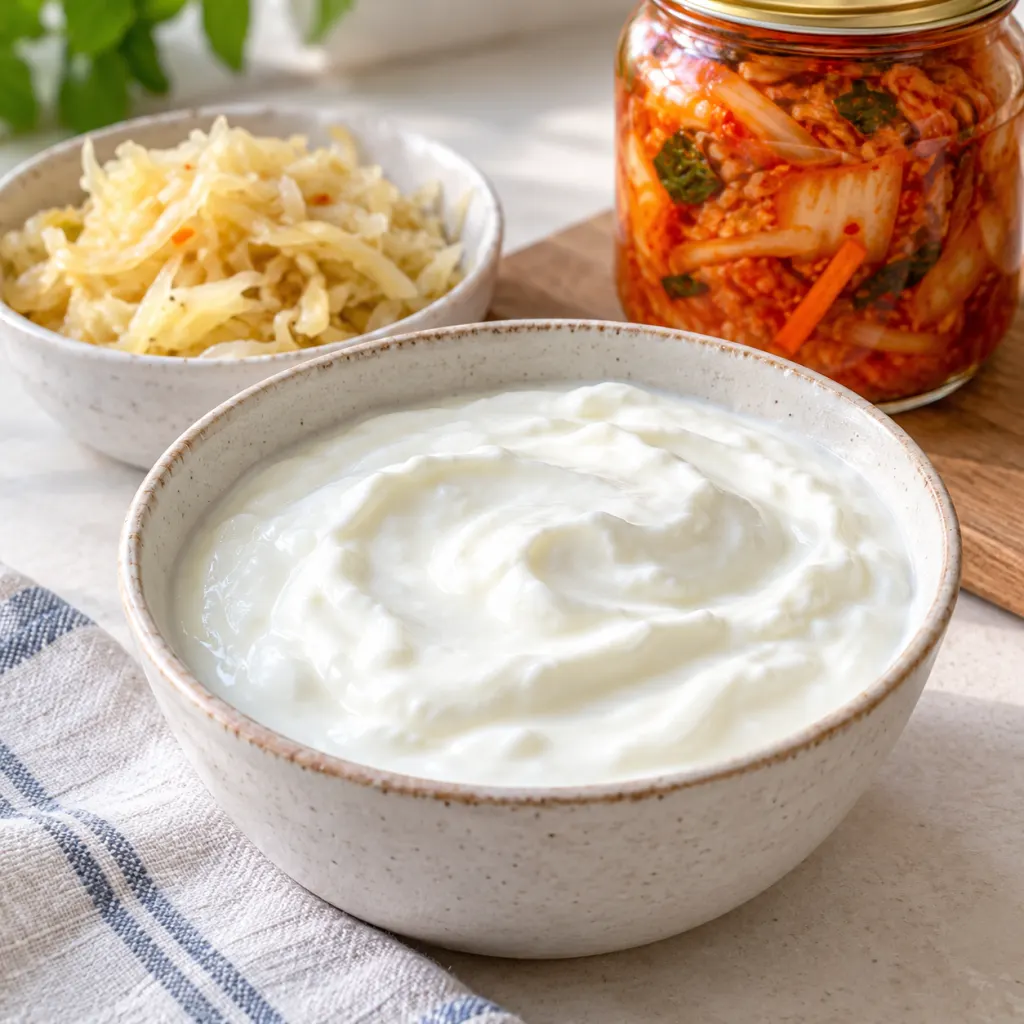
Fermented foods can be enjoyable additions to everyday meals, and research suggests some fermented-food eating patterns can change the gut microbiome. However, fermented, live-culture, and probiotic describe different things. A food can be fermented without containing living microorganisms when you eat it, and live cultures alone do not establish a specific health benefit. These distinctions are explained by Harvard’s Nutrition Source.
The useful question at the grocery store is therefore more specific than whether a food is fermented: What does this particular product contain, what evidence supports its claims, and how would it fit into meals you already enjoy?
Fermentation describes how a food is made
Fermentation involves microorganisms transforming food components through controlled microbial growth and enzyme activity. Yogurt, kimchi, sauerkraut, and sourdough bread illustrate how varied the results can be. Processing afterward matters: baking bread or heating fermented vegetables can inactivate the organisms involved. The finished food remains fermented even when those organisms are no longer alive. Harvard’s explanation of fermented foods makes this distinction.
Probiotic has a more specific meaning: living microorganisms that provide a demonstrated health benefit when consumed in sufficient amounts. The identity of the organisms matters, including their strain. A familiar bacterial name or a large number on a package cannot establish the same benefit for every product. See the NIH Office of Dietary Supplements overview.

What the small Stanford study actually found
A widely discussed 2021 Stanford study compared eating patterns emphasizing fermented foods or fiber-rich foods. Stanford’s report describes 36 healthy adults assigned to the two groups during a 10-week dietary intervention. The fermented-food group ate a range of products, including yogurt, kefir, and fermented vegetables, and showed an increase in gut microbial diversity. The fiber-focused group did not show the same average diversity change during that period. These findings come from Stanford Medicine’s account of the trial.
The study is useful evidence that an eating pattern can influence the microbial community. Its size, duration, and focus on healthy adults limit broader conclusions. It did not establish that any individual jar or yogurt produces the same result, or that the observed diversity change translates into a particular long-term health outcome. Comparing two eating patterns also leaves questions about which foods, combinations, and amounts contributed most. Those are reasons to keep investigating, rather than convert the study into a universal shopping prescription.
Questions that make a health headline easier to assess
When a headline makes a broad claim about fermented foods, look for the underlying comparison. A study of one cultured milk product answers a different question from a study asking participants to change several parts of their eating pattern. Likewise, measuring microbial diversity answers a different question from asking whether people experience a meaningful improvement in everyday health.
- Who participated? Check whether the participants resemble the people the headline addresses.
- What changed? Identify the actual food, product, or eating pattern studied.
- What was compared? Another active eating pattern is different from an unchanged routine.
- What was measured? Keep a laboratory observation separate from an outcome people can experience.
- How far does the conclusion reach? Notice whether the headline extends beyond the study’s duration or participants.
These questions are useful when deciding what a study means. You do not need to dismiss a promising result to recognize that it answers only part of a larger question.
Pasteurized milk and live-culture yogurt are compatible
Pasteurization before culturing and heat treatment after culturing are different steps. Under the US yogurt standard described in FDA guidance on yogurt, the dairy ingredients must be pasteurized or ultra-pasteurized before the required bacterial cultures are added. Yogurt made from pasteurized milk can therefore contain live cultures.
The FDA also distinguishes yogurt that retains live cultures from yogurt treated afterward to inactivate them. For US products, that later treatment requires a statement that the yogurt does not contain live and active cultures. A live-culture statement is optional for qualifying products, so its absence alone does not settle the question.
There is no need to seek raw milk to obtain cultured dairy. The CDC recommends pasteurized milk and dairy products because raw milk can contain harmful germs. When comparing yogurts, check both the dairy ingredients and any information about cultures or treatment after fermentation.

Read sodium and added sugars alongside culture claims
A culture claim answers only one part of a shopping decision. Compare sodium in savory products and added sugars in sweetened products, using equivalent serving sizes. On US Nutrition Facts labels, the FDA considers 5% Daily Value or less per serving low and 20% or more high. The agency’s Nutrition Facts guide also explains that total sugars include naturally occurring sugars, such as those in milk, as well as added sugars.
For example, imagine two hypothetical vegetable products listing 10% and 20% Daily Value for sodium for the same serving size. That is a meaningful comparison. If their serving sizes differ, compare the amounts you would actually eat first. Similarly, two servings of a product provide twice its listed sodium and added sugars. A small spoonful used as a condiment and a large bowlful deserve different consideration.
Choose a culinary role before choosing a product
Start with a meal you already make. Plain yogurt could become a breakfast component, a spoonful beside a savory dish, or the base of a simple dressing. Fermented vegetables could provide a tangy accent to a sandwich or grain bowl. These are serving ideas, rather than targets for producing a particular biological response.
This approach also helps with cost and waste. If you only want an occasional spoonful of fermented vegetables, a smaller jar may be more useful than a large container bought for an ambitious routine. If you dislike drinking kefir, there is little practical value in organizing breakfast around it. Choose foods you would willingly eat for their taste and convenience.
For a household with different preferences, serve the fermented component separately. One person can add yogurt to breakfast while another chooses something else. A shared meal does not need to become a test of who can eat the greatest variety of fermented products.
Fiber and live cultures have different roles
Microorganisms already living in the intestine can break down certain carbohydrates that reach them, including some dietary fibers. This is distinct from consuming microorganisms in a food. Harvard’s microbiome overview explains this process and identifies fruits, vegetables, beans, and whole grains as food sources of fibers used by gut microbes.
At the table, the distinction supports a straightforward combination: yogurt with oats and fruit, or a grain-and-bean bowl with a fermented vegetable accent. Neither ingredient needs to crowd out the others. The same Harvard resource notes that suddenly increasing foods rich in fermentable fibers can bring gas and bloating, so sweeping changes are not necessarily the most comfortable approach.

Safety deserves individual attention
People with weakened immune systems need particular care with food choices and handling. FoodSafety.gov’s guidance emphasizes clean hands and utensils, separation from raw animal foods, appropriate cooking, and prompt refrigeration. Follow each product’s storage instructions, including instructions after opening.
There is also a separate question about deliberately consuming live microorganisms. The NIH probiotic fact sheet describes additional concerns for people who are seriously ill or have weakened immune systems. If this applies to you, discuss specific live-culture foods and probiotic products with your qualified health professional before making a substantial change. Guidance about a supplement should not automatically be applied to every ordinary fermented food.
For that conversation, bring the actual product name or a photograph of its packaging. Its ingredients, culture information, storage directions, and intended use give the professional something concrete to assess.
A practical comparison at the store
Suppose you are choosing between three yogurts: a plain product you enjoy, a sweetened version with an appealing flavor, and a premium product with prominent culture marketing. Begin with what you want from the purchase. Is it breakfast, a cooking ingredient, or a snack? Then compare equivalent quantities, the ingredient lists, and the label information relevant to your priorities.
If the premium product makes a research claim, ask whether it identifies the product or cultures studied and provides an accessible source. An unfamiliar scientific name is a starting point for a question, rather than a reason by itself to pay more. You can also choose the plain product for versatility or the flavored one because you prefer it, while remaining clear about what the packaging establishes.
Keep the comparison manageable. You do not need to rank every fermented food in the shop. Two or three products that suit your meals, budget, and storage space are enough for a useful decision.
Keep expectations specific
If you try a new food, make the initial question practical: Do you like it? Can you store and use it as directed? Does it fit comfortably into your usual meals? Those observations can help you decide whether to buy it again. They cannot reveal exactly what happened to your microbial community.
Changing several foods at once also makes personal impressions harder to interpret. A simpler change leaves fewer moving parts, although it still does not amount to a controlled experiment. The most useful outcome may be finding a convenient breakfast or a condiment you enjoy. That is a reasonable reason to keep a food in your kitchen without attaching a larger medical conclusion to it.
Wrap-Up
Use fermentation as information about a food’s production, and look separately for evidence about living cultures and probiotic claims. The current research offers interesting findings alongside substantial unanswered questions. For everyday choices, a product’s taste, ingredients, serving size, storage requirements, and place in your meals remain useful guides.
Frequently Asked Questions
- → Does a sour taste show that a food contains live cultures?
No. Taste is not a culture test. A fermented food can retain its characteristic flavor after processing that inactivates microorganisms. Look for product-specific information about cultures and processing rather than relying on sourness, appearance, or the word fermented. Harvard explains the distinction.
- → Does heating make a fermented food pointless to eat?
No. Heating can reduce or inactivate living cultures, but a food may still have a useful culinary role. Baked sourdough remains bread made through fermentation. Choose heated fermented foods for their flavor and place in the meal, while keeping claims about living organisms separate. See Harvard’s discussion of processing and live microorganisms.
- → Is a product with a higher culture count automatically better?
No. The NIH Office of Dietary Supplements explains that higher colony-forming unit counts alone do not establish greater benefit. The organisms and supporting evidence matter. Avoid using a single large number as a ranking system for otherwise different products.
- → Should I buy several fermented foods to begin with?
You can keep the first purchase simple. Choose one food that fits a meal you already enjoy, read its storage directions, and consider whether you will finish the container. Buying a wide selection at once can create extra expense and waste. A manageable shopping choice does not require an ambitious daily routine or a commitment to unfamiliar foods.
References
This content was developed and refined using reliable sources.
- https://nutritionsource.hsph.harvard.edu/probiotics
- https://ods.od.nih.gov/factsheets/Probiotics-Consumer
- https://med.stanford.edu/news/all-news/2021/07/fermented-food-diet-increases-microbiome-diversity-lowers-inflammation?os=os
- https://www.fda.gov/media/174050/download
- https://www.cdc.gov/food-safety/foods/raw-milk.html
- https://www.fda.gov/food/nutrition-facts-label/how-understand-and-use-nutrition-facts-label
- https://nutritionsource.hsph.harvard.edu/microbiome
- https://www.foodsafety.gov/people-at-risk/people-with-weakened-immune-systems