 Save
Night shift work is classified by the International Agency for Research on Cancer, or IARC, as probably carcinogenic to humans, Group 2A. That classification warrants attention, but it does not predict whether an individual night worker will develop cancer. IARC’s assessment combines limited human evidence with animal and mechanistic evidence. IARC’s published assessment explains that basis.
For workers, the useful questions concern what researchers actually found, what remains uncertain, and how to make sleep and work arrangements more manageable. Understanding those distinctions supports considered conversations without turning a scientific classification into a personal forecast.
What the Group 2A classification means
IARC’s 2020 monograph defines night shift work as work occurring during the usual sleeping hours of the general population. Its assessment concerns an occupational pattern, rather than a single late evening or an occasional night spent awake. The agency reviewed evidence from people, experimental animals, and studies examining biological processes. IARC describes the scope of that evaluation here.
The phrase “probably carcinogenic” is a formal evidence category. The word “probably” should not be read as a statement that cancer is the probable outcome for a particular worker. The category concerns the strength of evidence about an exposure’s capacity to cause cancer. It does not supply a percentage for someone working three nights a week, a prediction based on their job title, or a timetable for an individual outcome. IARC explains how its classification system works.
A hazard classification is different from a personal risk estimate
A hazard is something capable of causing harm under some circumstances. Risk concerns the probability of that harm under particular conditions. IARC explicitly distinguishes these questions: its monographs identify cancer hazards but do not calculate risks for specific exposure circumstances. Two exposures in the same category can therefore have very different implications. The agency’s explanation of hazard and risk is central to interpreting the night-work classification.
The American Cancer Society likewise explains that carcinogen lists describe evidence strength rather than how much an exposure raises risk. It also notes that cancer risk depends on the circumstances and extent of exposure, alongside individual factors. Its guide to known and probable carcinogens provides an independent explanation of this distinction.
Before accepting a headline’s percentage, ask which workers were studied, which cancer was measured, what comparison group was used, and over what period. A number without that context is difficult to apply to a real working life.

What human studies found, and why uncertainty remains
IARC found limited evidence in humans, with positive associations reported for cancers of the breast, prostate, colon, and rectum. Its evaluation describes positive findings in the largest, highest-quality case-control studies, alongside inconsistent results among cohort studies. It also identifies substantial differences in how studies measured night-work exposure. The monograph’s evaluation and rationale sets out these qualifications.
Case-control studies compare people who have a condition with people who do not, then examine earlier exposures. Cohort studies follow groups over time. These approaches offer different strengths and limitations; a study’s design alone does not settle how well it captured a lifetime of working nights.
IARC’s overall conclusion also drew on sufficient evidence in experimental animals and strong mechanistic evidence in experimental systems. Those findings contribute to hazard identification, while leaving questions about the size of any effect in particular human work patterns. IARC’s rationale should be read as an integrated assessment, rather than a claim that every human study reached the same result.
Why the details of a working schedule matter
Consider two hypothetical workers. One covers occasional overnight absences; another has worked frequent rotating nights for many years. Calling both simply “night workers” leaves out much of their history. A useful description would include how often they worked nights, how long that pattern continued, whether shifts rotated, and whether their schedule changed over time.
This example illustrates the exposure-measurement problem highlighted in IARC’s assessment. It is not a formula for ranking the two people’s cancer risk. The classification itself supplies no universal number of shifts or years that separates a harmless schedule from a hazardous one. Keep a description of the actual pattern when discussing concerns with occupational health, rather than trying to convert the category into a personal calculator.
Circadian rhythms help explain the scientific concern
Circadian rhythms are recurring changes across roughly a 24-hour cycle. Light and darkness are their strongest environmental influences, although activity, food intake, and other cues also matter. These rhythms help coordinate sleep patterns, hormone release, and body temperature. A master clock in the brain helps synchronize clocks throughout the body. The National Institute of General Medical Sciences explains this timing system.
Night work can put required activity and available sleep at odds with that timing. Being exhausted after a shift and still struggling to sleep during daylight can therefore be understandable. Sleep opportunity and biological timing are related, but they are different parts of the problem.
That biological background makes circadian disruption relevant to research. It does not turn any particular lamp, bedroom curtain, or sleep routine into a proven way to change cancer outcomes. A plausible biological explanation and a demonstrated long-term benefit from an intervention are separate kinds of evidence.
Start with a realistic opportunity to sleep
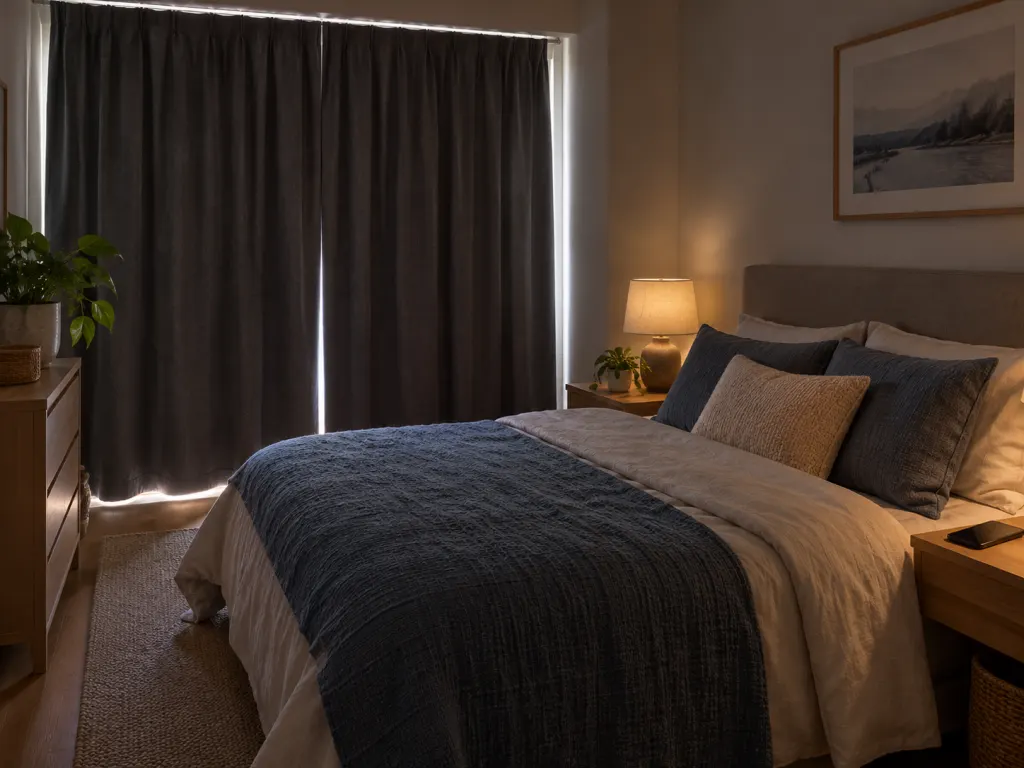
The National Heart, Lung, and Blood Institute recommends increasing the time available for sleep, limiting unnecessary shift changes, and removing sound and light distractions during daytime rest. It also recommends keeping the bedroom quiet, cool, and dark, and limiting caffeine to the first part of a shift. Its sleep guidance includes specific suggestions for shift workers.
Translate those ideas into arrangements that fit your home. Agree on a protected quiet period with household members. Move deliveries or appointments outside it where possible. Set phone notifications so routine interruptions can wait, while essential contacts remain reachable. If you share caring responsibilities, discuss a specific handover instead of relying on an undefined promise to “sleep later.”
A person finishing at 7 a.m., for example, could first map the commute, essential responsibilities, and intended sleep period. That is a planning exercise, not a recommended timetable for everyone. If the available window is repeatedly squeezed by overtime or obligations, improving the bedroom alone will leave the main constraint unresolved.
Use light, caffeine, and naps with their limits in mind
Light that supports alertness during work can conflict with winding down afterward. NHLBI includes brighter workplace lighting among its shift-worker suggestions and advises avoiding bright artificial light before bed. Caffeine can also interfere with later sleep, which is why its timing matters. These are sleep and alertness recommendations, rather than evidence about changing cancer risk.
Planned naps may help alertness where the work setting permits them. NIOSH distinguishes an organized nap opportunity from unplanned dozing and advises allowing time for post-nap grogginess to clear before resuming tasks. Its guidance on naps at work emphasizes that practical distinction.
A workable arrangement needs coverage, a suitable place, and enough time to wake fully. An opportunity that exists only on paper is less useful than an agreed procedure colleagues can actually follow. A nap should also fit around the main sleep period rather than becoming the only rest a schedule allows.
Make fatigue management a shared workplace task
NIOSH describes fatigue management as a responsibility shared by workers and managers. Its healthcare guidance recommends planning for seven or more hours of sleep each day alongside recovery time, and addresses breaks, scheduling, communication, and reporting excessive fatigue. Although written for healthcare during crisis conditions, it makes an important organizational point: adequate recovery requires support beyond individual effort. Read the NIOSH guidance in its original context.
Useful questions for a workplace discussion include:
- How much time is realistically available between leaving work and returning?
- Who covers essential duties during scheduled breaks?
- How can a worker report being too fatigued for a task?
- Can avoidable last-minute schedule changes be reduced?
- What transport or rest options exist after an unexpectedly demanding shift?
Bring one concrete example, such as repeated overtime removing a planned sleep window. A specific problem gives a manager, worker representative, or occupational-health team something reviewable. The aim is to improve the arrangement within the realities of the job and household.

Know when sleep difficulties deserve individual attention
NHLBI describes shift work disorder as a circadian rhythm disorder that can involve difficulty sleeping, extreme tiredness, and sleepiness during night work. Having a night schedule by itself does not establish that diagnosis. Its overview of circadian rhythm disorders explains the distinction.
If sleep difficulties persist or adapting to the schedule remains difficult, discuss the pattern with a qualified health professional, as NHLBI advises. Bring your work schedule, approximate sleep times, interruptions, caffeine timing, and examples of how tiredness affects daily tasks. These observations help describe the problem without requiring you to diagnose its cause.
Severe sleepiness during a safety-critical activity requires immediate practical action. Pause the activity, tell the appropriate supervisor, and arrange a safe alternative if you cannot stay alert for the journey home. NIOSH specifically advises reporting when fatigue makes work unsafe. Its fatigue guidance treats this as a present safety concern, distinct from the longer-term cancer question.
Apply the same evidence questions to evening-routine claims
Night workers often encounter advice about foods, drinks, bedroom products, and elaborate routines. Start by identifying the claimed outcome. Falling asleep more easily, feeling more alert, and changing a long-term cancer outcome require different evidence. Ask whether a source studied the actual practice, the relevant workers, and the outcome being advertised.
The same reading questions are useful when exploring separate topics such as cinnamon, sleep, and bloating or eating a banana every night. Those subjects should remain separate from the occupational evidence discussed here. Familiarity, testimonials, and a convincing explanation cannot supply the missing study of a specific outcome.
Wrap-Up
The evidence supports taking night shift work seriously as an occupational cancer hazard while keeping uncertainty about individual risk visible. For practical decisions, describe your actual schedule, identify barriers to adequate rest, and involve workplace support when arrangements need attention. Judge sleep changes by relevant outcomes such as sleep opportunity and alertness; their effect on long-term cancer outcomes remains an unresolved question.
Frequently Asked Questions
- → Does Group 2A mean a night worker is likely to develop cancer?
Group 2A describes evidence that an exposure can cause cancer under some circumstances. It does not state an individual worker’s probability of developing cancer. IARC distinguishes hazard classification from risk assessment.
- → Can I use the classification to compare two job offers?
The category alone cannot calculate which offer carries a particular cancer risk. For a practical comparison, request the actual rota, expected overtime, notice of changes, break arrangements, and time between shifts. Those details also make an occupational-health discussion more concrete.
- → Does occasional late-night screen use count as the exposure studied?
IARC’s night-work evaluation concerns work during the population’s usual sleeping hours. Occasional screen use is a different exposure question and cannot simply inherit the occupational classification. IARC describes the assessment’s scope here.
- → What should I record before a sleep appointment?
Record shift start and finish times, when you try to sleep, approximate waking times, interruptions, naps, and caffeine timing. Include examples of tiredness affecting work or travel. The purpose is to give the professional a clear picture of your routine, rather than produce a score or diagnose yourself.
References
This content was developed and refined using reliable sources.
- https://www.iarc.who.int/news-events/iarc-monographs-volume-124-night-shift-work
- https://www.iarc.who.int/featured-news/iarc-monographs-programme
- https://www.cancer.org/cancer/risk-prevention/understanding-cancer-risk/known-and-probable-human-carcinogens.html
- https://www.ncbi.nlm.nih.gov/sites/books/NBK568194
- https://www.nigms.nih.gov/education/fact-sheets/Pages/circadian-rhythms
- https://www.nhlbi.nih.gov/health/sleep-deprivation/healthy-sleep-habits
- https://www.cdc.gov/niosh/work-hour-training-for-nurses/longhours/mod7/07.html
- https://www.cdc.gov/niosh/bulletin/2020/fatigue-crisis.html
- https://www.nhlbi.nih.gov/health/circadian-rhythm-disorders/types