 Save
Your home may be telling you something if everyday tasks suddenly feel harder, clutter gathers in places that used to stay clear, rest feels difficult, or you avoid rooms that once felt comfortable. The direct answer is simple: these are not signs that you are lazy or broken. They can be signs that your current load is bigger than your current recovery. The National Institute of Mental Health describes self-care as time spent doing things that help you live well and support physical and mental well-being, including sleep, movement, connection, and setting priorities https://www.nimh.nih.gov/health/topics/caring-for-your-mental-health. Looking at your home with curiosity, rather than blame, can help you choose the next gentle step.
A Home Can Reflect Capacity, Not Character
It is tempting to read a messy room as a personal verdict. In reality, a home is often a record of time, attention, caregiving, money, work pressure, mobility, grief, celebration, and dozens of ordinary interruptions. A sink full of dishes may simply mean dinner happened after a long day. A chair covered in clothes may mean mornings have been rushed. A stack of unopened mail may mean decisions have been arriving faster than you can comfortably make them.
That distinction matters because shame rarely makes a home easier to care for. Curiosity does. Instead of asking, “What is wrong with me?” try asking, “What has changed around me?” Maybe your schedule expanded, your sleep shortened, your social life thinned out, or every room started carrying more jobs than it used to. The Centers for Disease Control and Prevention explains emotional well-being as including the ability to manage emotions, handle stress and change, look for useful solutions, and ask for help and support https://www.cdc.gov/emotional-well-being/about/index.html. A home check-in can become one practical way to notice those needs early.

Sign 1: Clutter Is Gathering Where Decisions Happen
Clutter is not just “too much stuff.” Often, it is a pile of delayed decisions. Mail on the counter may represent bills, forms, invitations, medical notices, school papers, or choices you do not have the energy to make. Clothing on the floor may represent laundry, sizing, weather, body changes, or a shortage of storage. When clutter gathers in decision-heavy places, such as the kitchen table, entryway, desk, nightstand, or passenger seat, it may be less about tidiness and more about mental load.
Research on attention helps explain why visual busyness can feel tiring. Princeton researchers describe natural scenes as containing many competing objects that cannot all be processed at once, meaning attention has to select what matters and filter what does not https://collaborate.princeton.edu/en/publications/visual-attention-as-a-multilevel-selection-process/. In a lived-in home, that does not mean every object must disappear. It means one crowded surface can become a constant set of tiny demands.
A useful self-care response is to make one decision smaller. Choose a single “landing zone” for mail, keys, bags, and papers. Set a timer for ten minutes and sort only into broad groups: keep, recycle, reply, and not sure. The “not sure” pile is allowed. The goal is not to create a magazine-ready counter; it is to reduce the number of open loops tugging at your attention each time you walk by.
Sign 2: Rest Spaces No Longer Help You Rest
A bedroom does not need to be spare or perfectly styled, but it should make sleep easier rather than harder. If the bed has become a folding station, laptop desk, snack area, phone dock, and worry zone all at once, your body may have fewer cues that this is a place to power down. The CDC notes that good sleep supports emotional well-being, attention, memory, and daily functioning, and it recommends habits such as keeping a consistent schedule, making the bedroom quiet and relaxing, and turning off electronic devices at least 30 minutes before bedtime https://www.cdc.gov/sleep/about/.
One gentle reset is to protect the first two feet around the bed. Clear only the floor where your feet land, the top of the nightstand, and the surface where you place water, glasses, or a book. If the rest of the room is still unfinished, that is fine. The signal you are creating is specific: there is at least one small area where the day is allowed to end.

Sign 3: The Kitchen Has Become a Place of Avoidance
Kitchens often show capacity quickly because they combine physical tasks, planning, sensory input, timing, and cleanup. If you keep skipping the kitchen, eating wherever you can, or letting dishes sit because the room feels like a wall of work, that may be a signal to simplify rather than scold yourself. The NIMH self-care guidance includes regular meals, hydration, movement, relaxing activities, and setting priorities; the common thread is not perfection, but basic daily support https://www.nimh.nih.gov/health/topics/caring-for-your-mental-health.
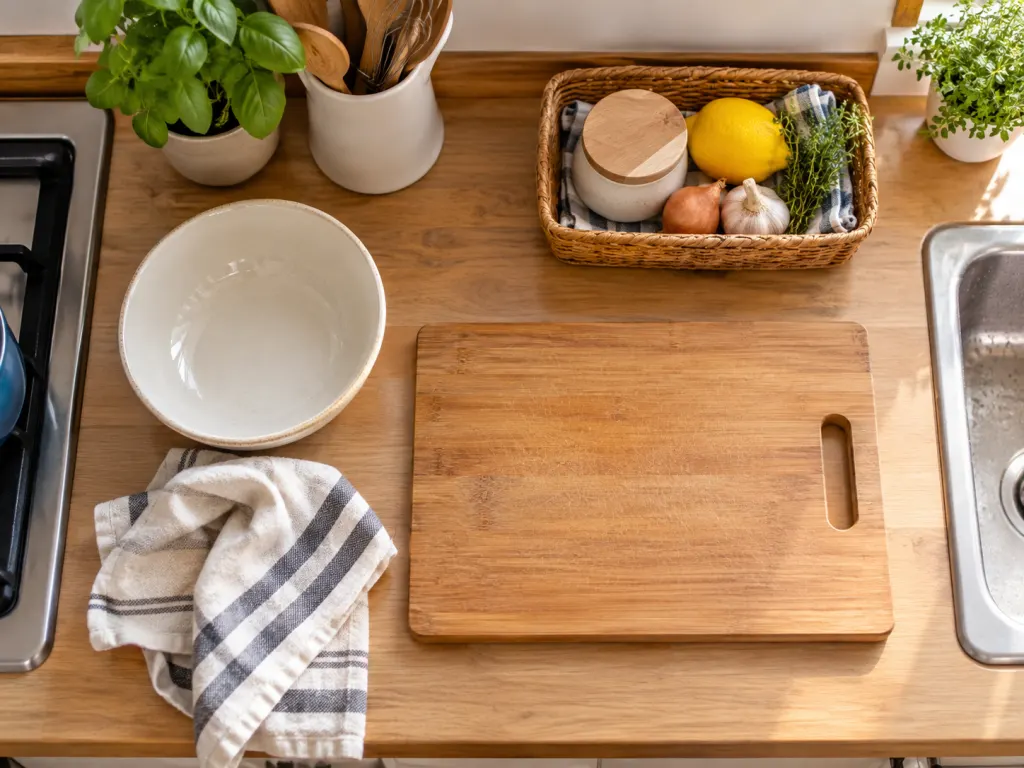
Try choosing one “minimum viable kitchen” standard for a difficult week. It might be: one clear cutting board, one clean cup, one pan or bowl you can use again, and one trash bag taken out before it overflows. If cooking feels like too much, the self-care move may be making the next meal easier to assemble, not planning a full menu. A calmer kitchen can begin with access, not ambition.
A Small Reset List That Actually Respects Low Energy
When your home feels overwhelming, a huge checklist can become another burden. A smaller list works better because it gives your attention somewhere to land. Choose one item, stop when the timer ends, and leave the rest for later.
- Clear one chair so you have a place to sit without moving anything first.
- Put all dishes in one zone, even if you do not wash them yet.
- Open one window or curtain for a few minutes of light and air.
- Place a laundry basket near the area where clothes actually pile up.
- Throw away obvious trash from one room, then stop.
- Prepare one bedtime cue, such as a glass of water, a book, or a charger outside the bed.
- Send one short message asking for company, help, or a check-in.
Sign 4: You Keep Moving Items Instead of Solving the Friction
One quiet sign of overload is “shuffling”: moving the same items from table to chair, chair to bed, bed to basket, and basket back to table. Shuffling usually means the item has no realistic home, the decision is too complicated, or the storage system was designed for an earlier season of life. Instead of asking where the item “should” go, ask where you are likely to use it next.
For example, if vitamins, keys, or work badges keep landing in the kitchen, a small tray there may work better than an ideal storage spot by the front door. If clean laundry never reaches drawers, a labeled open bin may be more honest than a folding system you cannot maintain right now. Self-care can look like designing around your real habits, not the imaginary habits of a less tired version of you.
Sign 5: Every Room Feels Like It Has Too Many Jobs
Homes become harder to live in when each room is asked to perform too many roles without boundaries. The dining table becomes an office, craft area, homework station, bill center, and laundry surface. The sofa becomes a nap space, work space, storage shelf, and evening recovery zone. Shared spaces may need multiple functions, especially in small homes, but each function needs a beginning and an ending cue.
A simple cue can be physical: a basket for work papers, a box for craft supplies, a tray for remote controls, or a cloth that marks a temporary project area. When the cue is full, the project has reached its current limit. This is not only about order; it is about helping your nervous system understand when one role is over and another can begin. The CDC’s emotional well-being guidance highlights the value of useful problem solving and asking for help when adapting to stress and change https://www.cdc.gov/emotional-well-being/about/index.html. Room boundaries are one practical form of that problem solving.
Sign 6: You Feel Lonely at Home, Even When It Is Full
A home can be busy and still feel lonely. You may live with family, roommates, or a partner and still feel like the household tasks, decisions, or emotional load are yours alone. You may also live by yourself and notice that the quiet has shifted from peaceful to isolating. The CDC notes that small acts of social connection can be meaningful, including checking in with friends, spending quality time with others, volunteering, or joining community activities https://www.cdc.gov/social-connectedness/improving/index.html.
If your home is reflecting disconnection, the next step does not have to be dramatic. Send one honest message: “I am having a low-capacity week. Could you sit with me while I fold laundry?” or “Can we talk for ten minutes while I clear the kitchen?” The CDC also suggests supportive conversations can help people cope, especially when listeners use open-ended questions, reduce distractions, and offer concern without trying to fix everything immediately https://www.cdc.gov/emotional-well-being/conversations-matter/index.html.
Sign 7: The Same Task Keeps Feeling Impossible
When one task repeatedly feels impossible, it may be asking for a different structure. Maybe the trash is hard because bags are stored too far away. Maybe laundry is hard because the hamper is in the wrong room. Maybe paperwork is hard because every document requires a new decision. Maybe cleaning the bathroom is hard because the job has become too large to start.
Break the task into a version that is almost too small to resist. “Clean the bathroom” becomes “put towels in the hamper.” “Organize paperwork” becomes “find the envelope from the insurance company.” “Do laundry” becomes “move one load to the washer.” This is not a trick; it is a way to lower the starting cost. The CDC’s How Right Now guidance notes that even 10 to 15 minutes spent doing something for yourself can reduce stress, and it includes quick home cleaning, relaxation, checking in with yourself, gratitude, hobbies, and social connection among possible options https://www.cdc.gov/howrightnow/wellbeing/index.html.
When the Mirror Shows More Than a Busy Season
Some home signals deserve extra attention. If you have gone two weeks or more feeling unable to complete usual activities, having ongoing trouble sleeping, losing interest in things you usually enjoy, struggling to get out of bed because of mood, or feeling unusually irritable or restless, NIMH recommends seeking professional help https://www.nimh.nih.gov/health/topics/caring-for-your-mental-health. If there is immediate danger or thoughts of self-harm, call or text 988 in the United States or contact local emergency services.
How to Read Your Home Kindly
A kind home check-in has three steps. First, observe without insult: “The entryway is crowded,” not “I am a disaster.” Second, connect the room to a need: “I need an easier way to come home,” not “I should be better at this.” Third, choose one adjustment: a shoe basket, a hook, a five-minute reset, or a request for help. This turns the home from a courtroom into a map.
It also helps to separate visible mess from hidden strain. A tidy room can still belong to someone who is exhausted, and a cluttered room can belong to someone who is caring, competent, and overloaded. The goal is not to make your home prove you are well. The goal is to let your home point gently toward what would make the next day more humane.
Wrap-Up
Your home can be a mirror, but it should not become a weapon against you. Notice where clutter, avoidance, poor rest, or repeated friction are showing up, then answer with one small act of care: a clear surface, an easier routine, a protected sleep cue, or a supportive conversation. A livable home is built through repeatable kindness, not all-at-once transformation.
Frequently Asked Questions
- → Does a messy home always mean I need self-care?
No. Homes get messy for ordinary reasons: cooking, caregiving, work, hobbies, small spaces, and busy weeks. It may be a self-care signal when the change is unusual for you, when tasks feel harder than normal, or when your space stops supporting basic rest, meals, connection, or daily routines.
- → What is the best first step when the whole house feels overwhelming?
Pick one small, visible task that makes the next hour easier. Clear a chair, gather dishes in one place, take out obvious trash, or prepare your bedside area for tonight. A tiny completed action can lower the sense of pressure better than planning a full-house reset you do not have energy to begin.
- → How can I tell the difference between clutter and a deeper concern?
Look at duration, distress, and function. If clutter is temporary and your routines still work, a practical reset may be enough. If you feel stuck for weeks, avoid important rooms, cannot complete usual activities, or feel persistently overwhelmed, consider talking with a qualified professional or trusted support person.
- → Can self-care include cleaning?
Yes, if the task genuinely supports you. A ten-minute kitchen reset, a clear path to the bed, or a basket for recurring clutter can be self-care. Cleaning stops feeling like self-care when it becomes punishment, perfectionism, or a way to ignore the need for rest, connection, or help.
- → What should I do if I share my home with people who do not notice the same problems?
Use specific requests instead of global criticism. Try, “Can we keep this table clear after dinner?” or “Could you take over trash on Tuesdays?” Shared homes often improve when tasks are visible, limited, and assigned, rather than treated as something one person is expected to silently manage.
References
This content was developed and refined using reliable sources.
- https://www.nimh.nih.gov/health/topics/caring-for-your-mental-health
- https://www.cdc.gov/emotional-well-being/about/index.html
- https://www.cdc.gov/sleep/about
- https://collaborate.princeton.edu/en/publications/visual-attention-as-a-multilevel-selection-process
- https://www.cdc.gov/social-connectedness/improving/index.html
- https://www.cdc.gov/emotional-well-being/conversations-matter/index.html
- https://www.cdc.gov/howrightnow/wellbeing/index.html