 Save
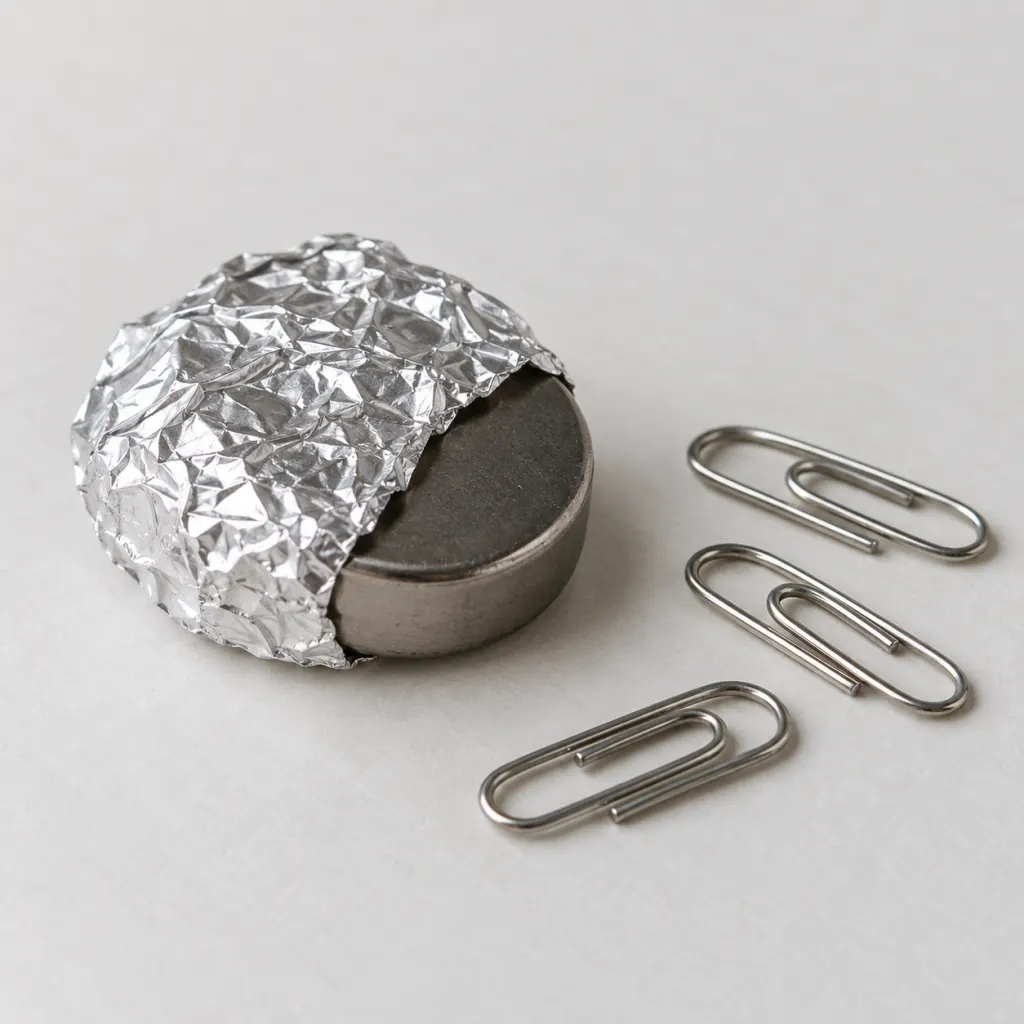
Wrapping a magnet in aluminum foil does not normally turn it off, neutralize it, or make aluminum stick to it. If the wrapped magnet is held still near paper clips or steel, the attraction is usually still there, although the added foil and air gap can make the pull seem slightly weaker. The real physics starts when the magnet or the foil moves. A moving magnet changes the magnetic flux through the conductor, and that changing flux can create eddy currents in the aluminum. Those currents make a magnetic field that opposes the change, which is why some magnet-and-aluminum demonstrations look surprisingly slow or resistant.
The Short Version: Foil Is Not a Magnetic Shield
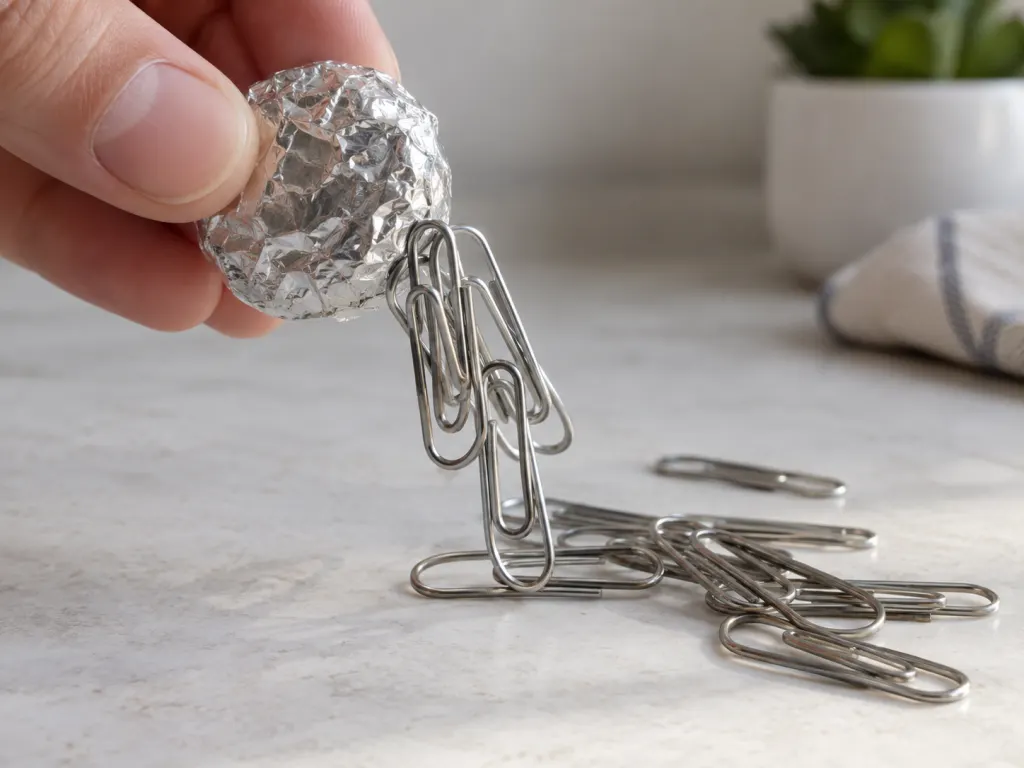
Aluminum foil is a conductor, but it is not a practical shield for an ordinary steady magnet. A refrigerator magnet or neodymium magnet wrapped in kitchen foil still has a magnetic field outside the wrapping. If you bring the wrapped magnet near steel, the steel can still be attracted because the magnetic field is not being stopped in the way light is blocked by cardboard.
The reason is material response. Aluminum is classified as paramagnetic, meaning it has a very small positive magnetic susceptibility. In the University Physics table hosted by the University of Central Florida, aluminum is listed with a susceptibility of about 2.2 x 10^-5, a tiny number compared with ferromagnetic materials such as iron, cobalt, and nickel. The same chapter explains that paramagnetic susceptibility is small, so the material only slightly changes the field passing through it: University Physics, Magnetism in Matter.
That is the first clue for understanding the popular demonstration. Aluminum is not secretly repelling the magnet in a strong static way. If you wrap the magnet and leave everything still, there is no dramatic force waiting inside the foil. The magnetic pull you test at rest is mostly set by the magnet strength, the distance to the steel object, and the thickness and shape of the foil layer.
Why the Magnet Still Works Through the Foil
A magnetic field is not the same kind of thing as an electric charge sitting on a surface. Aluminum foil is famous for blocking many electric-field effects and radio-frequency signals when arranged well, but a steady magnetic field needs a different kind of shielding. Materials with very high magnetic permeability can redirect magnetic field lines much more effectively than ordinary aluminum. Aluminum does not have that kind of strong magnetic permeability. The University of Texas physics notes on susceptibility and permeability make the same general point: common paramagnetic and diamagnetic materials have permeabilities that do not differ substantially from free space, so their magnetic properties can often be neglected for ordinary purposes: UT Austin, Magnetic Susceptibility and Permeability.
So, if the foil seems to weaken the magnet, the simplest explanation is often distance. Magnetic forces drop off quickly as separation grows. A crumpled foil wrap may hold the magnet a few millimeters farther from the paper clip, cabinet door, or steel screw. That spacing can matter more than aluminum's own magnetic response.
There is also a shape effect. Wrinkled foil can create uneven contact, little air pockets, and extra layers at the edges. A flat magnet pressed directly against a steel surface may grip better than the same magnet wrapped in a cushion of folded metal. That does not mean aluminum has blocked the field; it means the geometry of the test changed.
The Moving Part: Faraday's Law Changes the Story
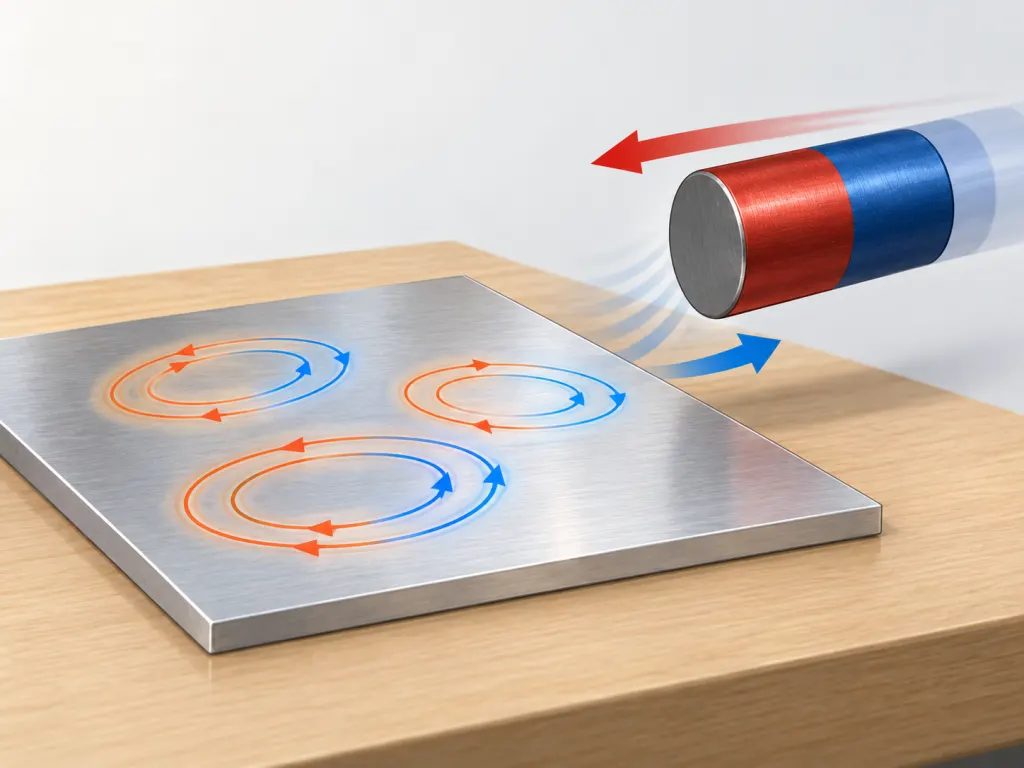
The interesting result appears when motion enters the setup. Faraday's law says that a changing magnetic flux through a circuit can induce an electromotive force. In the University Physics discussion of Faraday's law, moving a magnet relative to a coil creates a short-lived induced emf, and no emf appears when the magnet is stationary relative to the coil: University Physics, Faraday's Law. Aluminum foil is not a neat coil of wire, but it is conductive, so electrons in the foil can still circulate in loops when the magnetic environment changes.
Those circulating currents are called eddy currents. They are not currents you normally see with your eyes. Instead, you notice their effects: a slight drag, a delayed fall, a resistant feel when a strong magnet is moved quickly near a conductor, or a floating pie pan that follows a moving magnet across water. The stronger and faster the change, the stronger the induced current tends to be, within the limits set by the conductor's shape, thickness, and resistance.
Lenz's law explains the direction of the response. It says the induced current acts in a direction that opposes the change in magnetic flux that caused it. The University Physics section on Lenz's law phrases this as an induced emf driving current around a loop so that it opposes the changing flux: University Physics, Lenz's Law. In everyday language, the aluminum resists the change, not the existence of the magnet itself.
What You Might Actually Observe at Home
If you try simple observations with a household magnet and foil, the results can seem underwhelming unless the magnet is strong and the movement is clear. That is normal. A thin sheet of foil has limited metal for currents to circulate through, and kitchen magnets are often not strong enough to make the effect obvious. A neodymium magnet gives a more noticeable response, but even then, a loose wrap of foil around a stationary magnet is not the most dramatic arrangement.
Here are the main observations to separate from one another:
- Stationary wrapped magnet near steel: the magnet usually still attracts the steel, with any change mostly due to added distance.
- Magnet sliding quickly over foil: a strong magnet may feel slightly resisted because the changing field induces eddy currents.
- Magnet dropped through an aluminum tube: the slowing can be dramatic because the tube gives eddy currents a large, continuous path.
- Foil cylinder with a slit: the effect can change because the slit interrupts some current paths.
- Nonconductive wrap: paper or plastic does not create the same eddy-current response, although it can still add distance.
Physics demonstration collections make the tube version clear because the geometry is favorable. The University of Iowa's Lenz's law tube demonstration uses copper and aluminum tubes with magnets and notes that a neodymium magnet stack can take much longer to travel through a one-meter tube than nonmagnetic slugs: University of Iowa, Lenz's Law - Tubes and Magnets. The tube acts like many closed paths stacked along the magnet's route, so the induced currents can keep opposing the magnet's motion all the way down.
Why a Tube Works Better Than a Loose Foil Wrap
A tube and a foil wrap may both be aluminum, but they are not equivalent experiments. In a tube, the falling magnet is surrounded by conductive material over a long path. As the magnet moves, different rings of the tube experience changing magnetic flux. That encourages strong eddy-current loops around the tube. In a loose piece of foil, the current paths may be broken by wrinkles, tears, gaps, and poor contact between layers.
The foil's thinness matters too. Eddy currents depend on the electrical resistance of the available path. More conductive material generally allows stronger currents. A thick aluminum wall or plate gives the electrons more room to circulate than a single sheet of kitchen foil. That is why laboratory demonstrations often use aluminum plates, channels, or tubes rather than a casual crumpled wrapper.
Harvard's Natural Sciences Lecture Demonstrations describes an aluminum sheet falling slowly between the poles of a magnet because induced currents in the sheet create magnetic fields opposing the motion: Harvard Natural Sciences, Eddy Current Damping. In that setup, the aluminum is deliberately placed where the magnetic field changes as the sheet enters and leaves the region between the poles.

The Viral Trick Usually Blends Several Effects
Many short videos compress the explanation into a single surprising claim, but several ordinary effects can be happening at once. First, foil adds distance. Second, aluminum conducts electricity, so motion can produce eddy currents. Third, strong magnets create more noticeable effects than weak magnets. Fourth, the shape of the conductor controls whether the induced currents have good paths to circulate.
The ERIC record for a peer-reviewed Physics Education article is useful because it points to a specific teaching version using household aluminum foil and a lengthwise slit. Its abstract describes a Lenz's law demonstration with aluminum foil and then asks what changes when the foil cylinder is cut lengthwise: ERIC, Lenz's Law with Aluminum Foil and a Lengthwise Slit. That detail matters: a slit can break up current loops, which is why slotted plates and split rings are classic ways to show that the conductor's path is part of the effect.
This is also why a full sheet, a torn strip, a snug tube, and a crumpled wrap may not behave the same way. They have the same base material, but not the same electrical pathways. If a video shows a magnet slowing dramatically through aluminum, look for a tube, channel, thick plate, or carefully shaped foil cylinder. If it shows a still wrapped magnet refusing to attract steel, suspect hidden distance, weak magnetic contact, editing, or a different object being used off camera.
What Aluminum Foil Can and Cannot Do
Aluminum foil can participate in electromagnetic induction. It can carry eddy currents when a magnetic field changes relative to it. It can make a moving strong magnet feel resisted, especially when the foil is arranged into a continuous surface or tube. It can also act as a spacer, changing a magnet's grip simply by increasing distance from a steel target.
What it cannot do in an ordinary static setup is erase the magnet's field. Wrapping a magnet in foil does not demagnetize it. It does not turn aluminum into iron. It does not make a fridge magnet suddenly powerless unless the setup has added enough distance or created some other mechanical barrier. If the magnet was strong before wrapping, it will usually still be strong after unwrapping.
The clearest way to think about it is this: aluminum foil is mostly transparent to a steady magnet, but it reacts to change. Hold things still, and there is little drama. Move the magnet quickly near a good conductor, and the conductor pushes back through induced currents. That pushback is not a magical repulsion between aluminum and magnets; it is energy moving from mechanical motion into electrical currents and, eventually, a tiny amount of heat.
A Better Mental Model
Imagine the foil as a crowd that does not care much about a parked car but reacts when the car starts moving through the street. A steady magnet is like the parked car: the foil's magnetic response is weak. A moving magnet is the change: the conductor's charges rearrange into currents that oppose what is happening. The analogy is imperfect, but it keeps the focus in the right place. The foil is not blocking the magnet. It is responding to changing magnetic flux.
This model also explains why speed matters. Move a strong magnet slowly across foil, and the effect may be faint. Move it faster, and the changing flux happens more quickly, so the induced emf can be larger. Use a thicker or more continuous conductor, and the current paths can be stronger. Cut slots in the conductor, and the paths are disrupted. These are the same patterns shown in formal eddy-current demonstrations with plates, pendulums, rings, and tubes.
Bottom Line
Wrapping a magnet in aluminum foil is not a switch that turns magnetism off. The foil mostly lets a steady magnetic field pass through, with only a very small material response. The striking part is dynamic: when the magnet and foil move relative to each other, the changing magnetic flux can induce eddy currents in the aluminum, and those currents oppose the change. That is why a falling magnet can slow in an aluminum tube, why a moving magnet can tug a foil pan, and why a still wrapped magnet usually remains a magnet.
Wrap-Up
Aluminum foil does not meaningfully shield a stationary magnet in ordinary home conditions. Any weaker attraction you notice is usually from added spacing or an uneven wrap. The real effect comes from motion: a changing magnetic field induces eddy currents in conductive aluminum, and those currents create magnetic fields that oppose the change. Continuous, thicker conductors such as tubes and plates show the effect much more clearly than a thin loose wrap of kitchen foil.
Frequently Asked Questions
- → Does aluminum foil block a magnet?
Not in the simple way many people imagine. A steady magnet's field mostly passes through ordinary aluminum foil. The foil may reduce the magnet's apparent grip if it adds distance or creates an uneven barrier, but it is not a strong static magnetic shield.
- → Why does a magnet slow down in an aluminum tube?
As the magnet falls, the magnetic field through the conductive tube changes. That change induces eddy currents in the tube, and those currents produce magnetic fields that oppose the falling motion. The result is magnetic damping.
- → Will wrapping a magnet in foil damage or demagnetize it?
Simply wrapping a magnet in foil should not demagnetize it. Magnets are more affected by factors such as strong opposing fields, high temperature, impact, or material quality than by being covered with a thin layer of household foil.
- → Why does movement matter so much?
Electromagnetic induction depends on changing magnetic flux. When the magnet and foil are still relative to each other, there is little induced current. When one moves near the other, the changing field can drive currents in the aluminum.
- → Why do slits or cuts in aluminum change the effect?
Eddy currents need conductive paths to circulate. A slit interrupts some of those paths, so the induced currents can be weaker or arranged differently. That is why slotted plates and split rings are often used in teaching demonstrations.
References
This content was developed and refined using reliable sources.
- https://pressbooks.online.ucf.edu/osuniversityphysics2/chapter/magnetism-in-matter
- https://farside.ph.utexas.edu/teaching/jk1/lectures/node57.html
- https://pressbooks.online.ucf.edu/osuniversityphysics2/chapter/faradays-law
- https://pressbooks.online.ucf.edu/osuniversityphysics2/chapter/lenzs-law
- https://pressbooks.online.ucf.edu/osuniversityphysics2/chapter/eddy-currents
- https://instructional-resources.physics.uiowa.edu/5k2025-lenzs-law-tubes-and-magnets
- https://sciencedemonstrations.fas.harvard.edu/presentations/eddy-current-damping
- https://eric.ed.gov/?id=EJ1177742