 Save
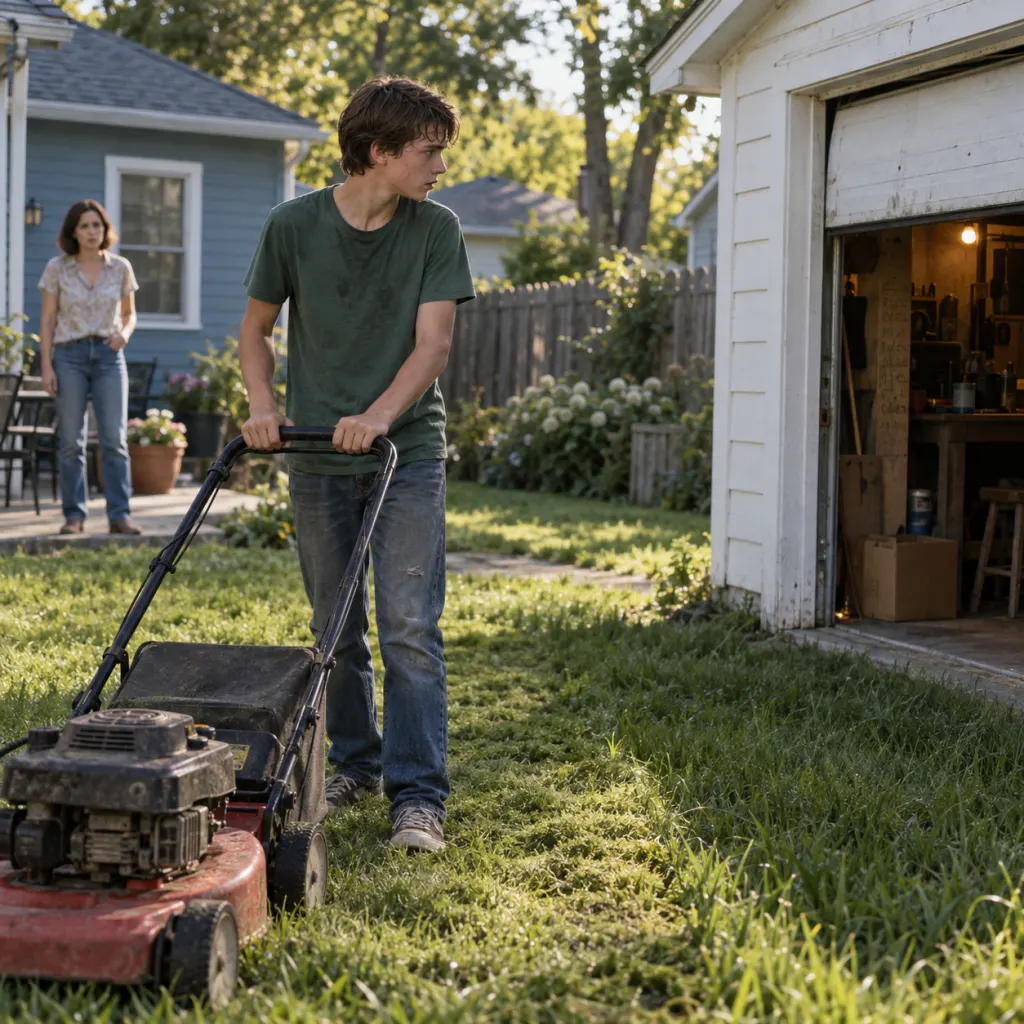
The mower was still running when I found it alone in the backyard, trembling in the heat like a thing abandoned mid-thought.
1. The Mower Running Alone
The first thing I noticed was the sound. Not the shape of the lawn, not the half-cut stripe across the grass, not the old red mower resting crooked beside the fence, but the sound of its engine coughing and rattling with nobody behind it. I had come home early because the office air conditioner had quit and my manager, flushed and sticky in his short-sleeved shirt, told everyone to finish the day from home. I remember being grateful for the unexpected hours. I had imagined iced tea, bare feet, and maybe ten quiet minutes on the back steps of a house that still did not feel entirely mine.
Instead, I stood by the gate with my purse cutting into my shoulder and watched the empty handle of the mower vibrate. Grass clippings dusted the wheels. Heat lifted off the yard in pale sheets. Somewhere nearby, a cicada buzzed so loudly it sounded mechanical, as if the whole afternoon had been wound too tight.
“Chase?” I called.
No answer came from the side yard. No movement in the long shadows of the fence. I set my purse on the patio chair and walked toward the mower, already annoyed in the ordinary adult way people become annoyed before fear has time to introduce itself. Maybe he had gone to get water. Maybe he had cut his hand. Maybe he had wandered into the front to trim the strip near the mailbox. But the closer I got to the garage, the more my thoughts thinned out.
The detached garage sat at the back of the property, squat and square, painted a tired white that had yellowed along the seams. I had owned the house for just over a month and had used the garage exactly once, on moving day, when two men shoved a dented metal shelving unit against the wall and asked if I wanted the old boxes left by the previous owner thrown away. I had said no because I was too tired to make one more decision. Since then, I had kept the garage locked. The key lived alone on a blue plastic ring in my kitchen drawer.
That afternoon, the garage door stood open six inches.
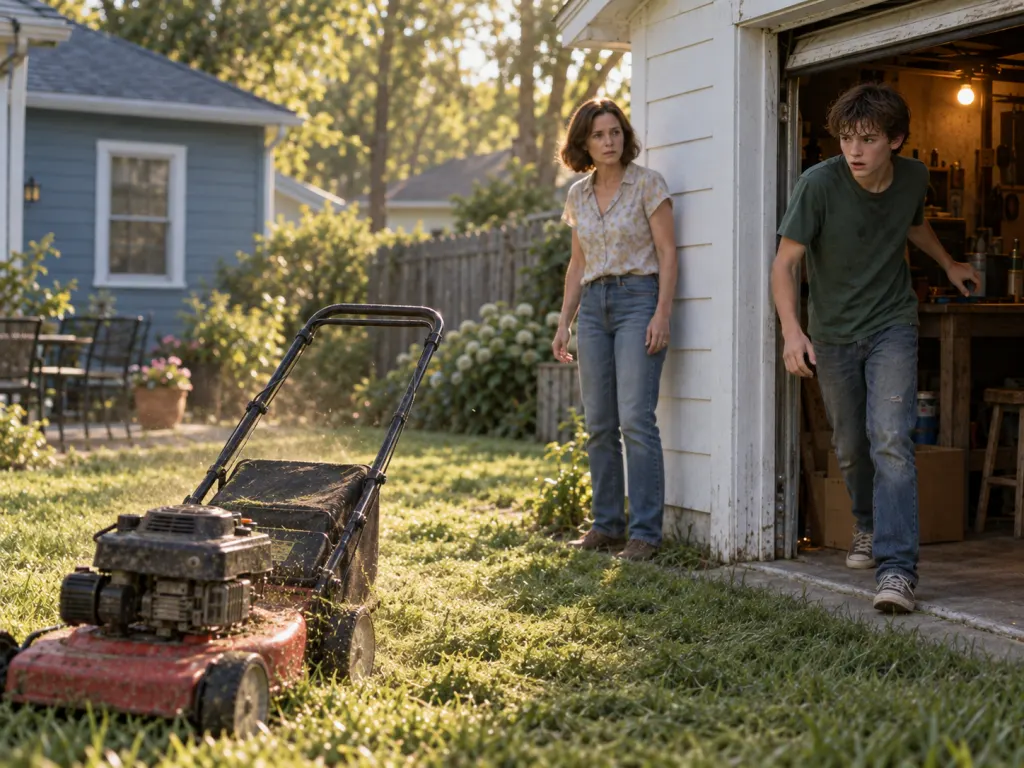
I stopped walking. The mower coughed behind me, a rough little reminder that something ordinary had been interrupted. I called Chase’s name again, louder this time, and my voice came out sharper than I meant it to. A second later, the side door of the garage flew open and he stepped into the light.
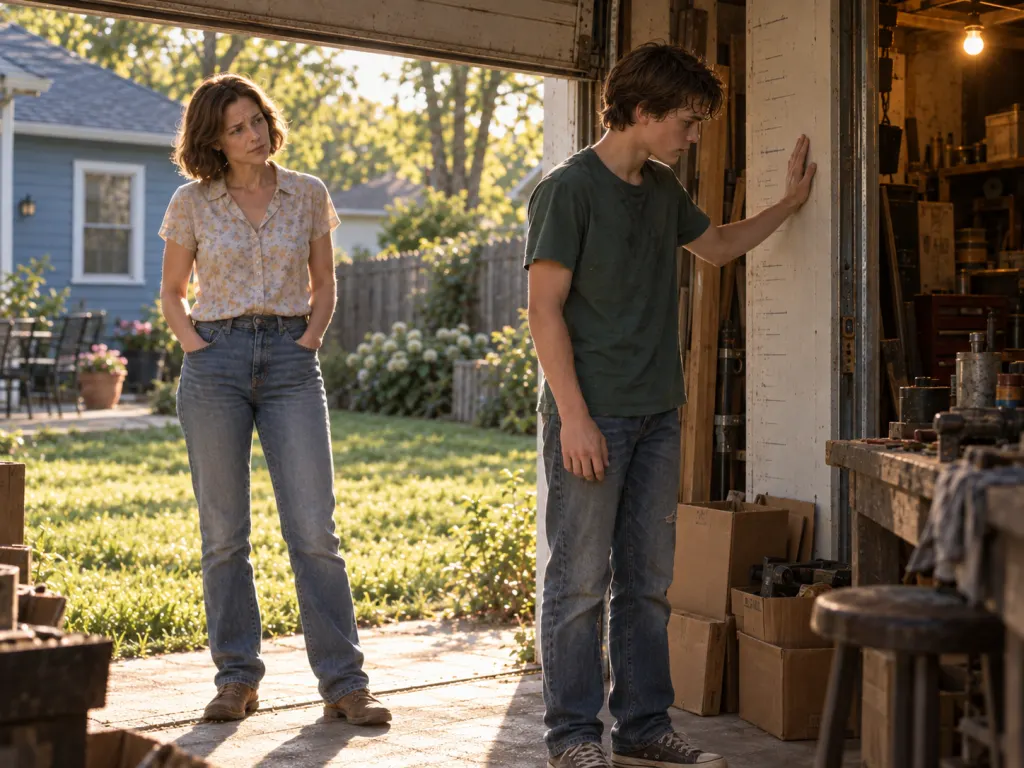
He looked fifteen, maybe sixteen, all elbows and sudden height, with brown hair stuck damply to his forehead and a green T-shirt darkened with sweat at the collar. His face did the thing faces do when they try to become innocent too quickly. His eyes widened, then dropped to the grass.
“Mrs. Avery,” he said, though I had told him three times to call me Claire.
“What were you doing in there?”
He wiped one palm down his jeans. “It was hot. The door was open, so I just went in for a minute.”
The lie landed between us with a small, dull weight. I knew the door had not been open. I knew, with the prickling certainty that comes from being a woman alone in a new place, that the door had been locked when I left. But Chase stood there looking so young that my anger could not find a clean shape. His old sneakers were dusted green. His mower shook itself in the yard behind me. He had worked hard every Saturday since the day he knocked on my door, and until that moment, he had given me no reason to think badly of him.
“Finish the lawn,” I said at last. “Then we need to talk.”
He nodded too quickly and hurried back to the mower. I stood by the garage until he passed me, keeping my body between him and the open door. Inside, beyond the narrow gap, the garage smelled of hot wood, cardboard, oil, and dust. Nothing looked obviously disturbed. Still, something in the air felt touched.
2. The Boy at the Door
A month earlier, Chase had appeared on my front porch with the same mower and the same careful posture, as though he had practiced how to take up as little space as possible. I had been kneeling in the flower bed, losing a battle with weeds that had roots like wire, when I heard the squeak of wheels on the sidewalk. He stopped at the bottom of the porch steps and waited until I looked up.
“Do you need anybody to mow?” he asked.
His voice was polite but not polished. He wore a gray shirt faded thin from washing and carried a folded sheet of paper with three phone numbers written on it. References, he explained, from people whose yards he had done the previous summer. There was a seriousness about him that made me sit back on my heels and really look.
“You live nearby?” I asked.
He pointed vaguely past the main road, toward the low stretch of town where trailers and small rental houses sat under old trees. “With my mom,” he said. “I’m trying to earn some money before school starts.”
There was nothing unusual in that. When I was his age, I had babysat three children every Friday night for cash folded into my palm by parents already backing out the door. Teenagers wanted money, independence, the dignity of buying their own shoes. The lawn, meanwhile, had become a public announcement that I was not keeping up. So I hired him on the spot.
“Every Saturday?” I said.
He nodded. “I can come early, before it gets bad out.”
He worked with a kind of fierce concentration that first morning. He did not drag the mower in bored loops or stop every few minutes to check his phone. He walked the yard in straight lines, trimmed around the fence with hand shears he pulled from a backpack, swept the walkway, and gathered fallen twigs into a tidy pile near the curb. When I brought him lemonade, he accepted it with both hands and drank only half before setting the glass carefully in the shade.
“You can sit down,” I told him.
“I’m okay,” he said.
It was not pride exactly. It was more like vigilance. Even then, before the garage, before the grocery store, before the truth unfolded one folded corner at a time, I had the sense that Chase was listening for something I could not hear.
By the third week, I had begun leaving a little extra cash in the envelope. He always counted it in front of me and always tried to hand back the difference.
“That’s too much,” he said the first time.
“The flower beds look better than when I moved in,” I told him. “Consider it a bonus.”
He looked down at the envelope as if generosity were a problem with sharp edges. “Thanks,” he said finally, and tucked it into his backpack.
The oddest part was not his manners, or his old mower, or even the way he sometimes paused near the detached garage with one hand on the mower handle. The oddest part was his face. From the first morning, I felt I had seen him before. Not in town, not at the grocery store, not in any place I could name. It was the slope of his eyebrows, the serious mouth, the way he squinted into the sun. Familiarity hovered around him like a word on the tip of my tongue.
3. A House Still Holding Its Breath
I had bought the house after my divorce became final, though I rarely said it that plainly. To coworkers, I called it downsizing. To neighbors, I called it a fresh start. To my sister, who knew every humiliating detail, I called it the only place I could afford that had a decent roof and a kitchen window facing east.
The house was a small blue bungalow on Marigold Lane, with narrow rooms and floors that creaked in different keys. In the mornings, light slid across the kitchen tiles and made the chipped yellow counters seem almost cheerful. The previous owner had left behind curtain rods, a cracked birdbath, three jars of rusty nails, and a faint smell of cedar in the hall closet. I had signed papers, changed locks, scrubbed cabinets, and told myself ownership meant arrival.
But houses do not become yours simply because your name is printed on a document. They resist at first. They hold the habits of the people before you. They creak at times you do not expect. They make you reach for switches in the wrong places. For weeks, I felt like a guest who had overstayed and started moving furniture.
The garage was the worst of it. It stood apart from the house, accessible by a cracked concrete path that vanished under weeds near the back. Inside were the boxes I had not opened, a workbench scarred by years of projects, and pencil marks on one wall where someone had measured a child’s height. The names beside the marks had faded, but the dates were still legible in places. June. October. April. Years stacked in graphite, small proof that someone had once stood barefoot against that wall while an adult pressed a ruler to their head.
I saw those marks on moving day and looked away quickly. There are some intimacies you do not mean to inherit.
After I caught Chase in the garage, I waited until he left before going inside. I carried a flashlight though it was still afternoon. Dust floated through the hot air. The old boxes sat where they had been, or seemed to. A coil of rope hung from a peg. A metal toolbox rested under the bench. On a high shelf, pushed behind a cracked plastic planter, I noticed a rectangle in the dust where something had recently moved.
I reached up and found a small wooden frame lying flat behind the planter. It held a photograph, face down. When I turned it over, the breath went out of me so quietly I almost did not hear it.
The photo showed the house in winter, blue paint brighter then, porch rail wrapped with white lights. In front of it stood a family of three: a woman with short dark hair, a man in a flannel jacket, and a little boy missing one front tooth. The boy’s serious eyebrows pulled together against the sun. His mouth was familiar. His eyes were Chase’s eyes.
On the back, in neat handwriting, someone had written: Our last Christmas on Marigold, maybe.
I stood in the garage with the frame in my hand and felt my suspicion shift, not disappear, but change weight. Chase had lied. The door had not opened itself. Yet the lie no longer looked like simple mischief. It looked like a door he had not known how to ask me to unlock.
4. The Other Chase
Three days later, I saw him at the grocery store.
I had gone in for coffee, paper towels, and the kind of frozen dinner that makes you feel both practical and defeated. The store was crowded with late-afternoon shoppers, carts knocking softly into displays, children bargaining for cereal, the bakery pumping out the sweet smell of sugar and warm bread. I turned into the cereal aisle and saw Chase standing by the endcap, holding a basket.
At first my mind rejected him. This boy wore clean white sneakers, a navy shirt with a small stitched logo, and a watch that caught the fluorescent light when he reached for a box. His hair was combed back. His shoulders were relaxed in a way I had never seen in my yard. He looked less like a teenager hustling for summer cash and more like a teenager waiting for someone to ask which private camp he had just returned from.
I stopped beside the oatmeal and pretended to read labels.
He moved through the store quickly, choosing apples, pasta, a carton of milk, nothing strange. But everything about him unsettled me because it did not match the story he had offered. The worn shoes, the trailer park, the envelope counted twice. Had any of it been true? I felt foolish, and then angry that I felt foolish, and then ashamed because his face in the old Christmas photo had not left me alone.
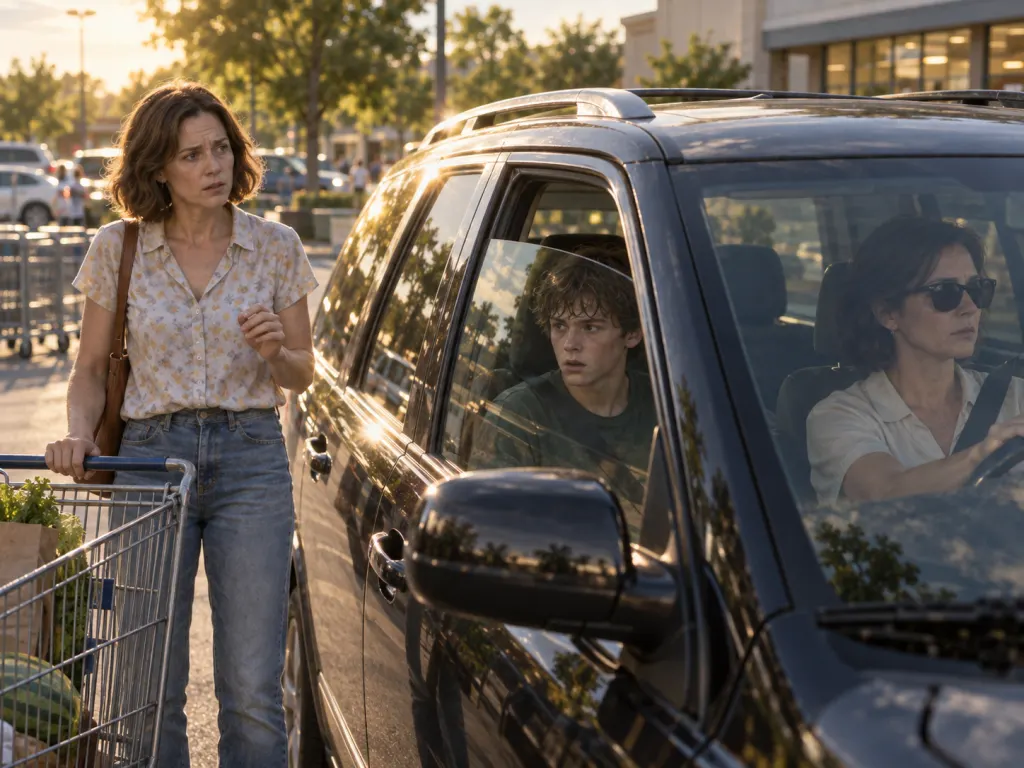
When he left the store, I followed at a distance, pushing my cart with the exaggerated casualness of a person doing something she knows she should not do. Outside, sun flashed off windshields. Chase crossed the lot and climbed into the passenger seat of a black SUV so new it still had temporary paper taped inside the back window.
I stood with one hand on my cart. A woman sat behind the wheel. I could see only the line of her jaw and one hand on the steering wheel. Chase said something to her, and she looked toward the store entrance.
I should have walked away. I know that now. Curiosity has a way of dressing itself as caution, especially when you are afraid of being taken advantage of. I pushed my cart to the side, crossed the lane, and knocked lightly on the passenger window.
Chase turned. The moment he recognized me, his face went white.
The driver looked at him, then at me. Her expression closed so fast it was almost audible. Before the window lowered, before I could say his name, the SUV pulled out of the space and rolled away. Not recklessly, not dramatically, but firmly, as if a decision had been made for all of us.
I stood in the heat with my hand still raised.
That night, the framed photo sat on my kitchen table. I had placed it there intending to study it, but by evening I was avoiding the kitchen entirely. Every time I passed the doorway, the little boy in the picture seemed to ask a question I did not know how to answer.
5. The Woman in the SUV
On Saturday morning, Chase did not come.
I told myself I was relieved. I drank coffee on the porch and watched the grass stir in the faint breeze. The yard had grown uneven in the humid week, small tufts rising along the fence line. At eight, no mower squeaked down the sidewalk. At nine, no knock came at the door. By ten, the relief had curdled into worry.
I found his references sheet in the junk drawer. Two numbers had gone out of service. The third belonged to an older man named Mr. Bell, who remembered Chase immediately.
“Good kid,” he said. “Quiet. Did my yard after my knee got bad last summer.”
“Do you know where he lives?”
There was a pause. “Not exactly. I know his family used to be on Marigold. Your house, actually. Hard time for them when they had to leave. I don’t know the whole of it, and what I do know isn’t mine to tell.”
After we hung up, I sat very still.
It is strange how quickly a house can rearrange itself in your mind. The pencil marks in the garage were no longer anonymous. The workbench was no longer simply old. The cracked birdbath, the curtain rods, the faint cedar smell in the closet, all of it belonged to a family who had not vanished just because a transaction had been completed. I had moved into the after of someone else’s life.
Near noon, the black SUV pulled up in front of my house.
The woman who stepped out was in her late thirties or early forties, with the same dark hair as the woman in the Christmas photograph, though cut shorter now. She wore a pale blouse and sunglasses, and for a second she stood beside the vehicle without shutting the door, one hand on the roof, looking at the house as if bracing herself against an old weather.
I met her halfway down the walk.
“I’m Claire Avery,” I said.
“Nora Bennett.” She took off her sunglasses. Her eyes were tired, guarded, and very direct. “I’m Chase’s mother.”
Behind the tinted window, I could make out Chase in the passenger seat, staring down at his knees.
“Is he all right?” I asked.
Her mouth tightened. “He’s embarrassed. And I’m angry. But he wanted to come back and apologize, so we’re here.”
We stood in the yard he had mowed so carefully, two women measuring each other across a patch of summer grass. I wanted to explain the garage, the photograph, the lie. Nora spoke before I could.
“He should never have gone into your garage,” she said. “He knows that. I know that. But there are things in that garage that belonged to his father.”
The sentence changed the air.
She looked past me toward the detached garage. “We lost the house faster than we expected. There was a storage agreement with the bank, then a misunderstanding, then the sale. By the time I got the energy to fight over boxes, I didn’t have much fight left. Most of what mattered was supposed to be gone. Chase thought maybe something was still here.”
I thought of the photo on my kitchen table. “Why didn’t he just ask?”
Nora looked at the SUV, where her son sat rigid and miserable. “Because he’s fifteen. Because he missed his dad. Because boys that age would rather carry a piano uphill than say they’re heartbroken.”
There was no accusation in her voice, but I felt the truth of it all the same. I had demanded honesty from a child who had been trying, clumsily and wrongly, to stand near the remains of his old life without being sent away from them.
6. What the Garage Kept
I invited them in through the side gate.
Chase got out of the SUV slowly. Without the mower between his hands, he looked younger. His shoulders were hunched, and his face had the tight, bright look of someone determined not to cry in front of adults. He did not meet my eyes until we reached the garage.
“I’m sorry,” he said. The words came out flat from overuse, as if he had practiced them in the car. Then, more quietly, “I shouldn’t have lied.”
“No,” I said. “You shouldn’t have.”
He flinched, and Nora’s hand moved halfway toward his shoulder before she stopped herself.
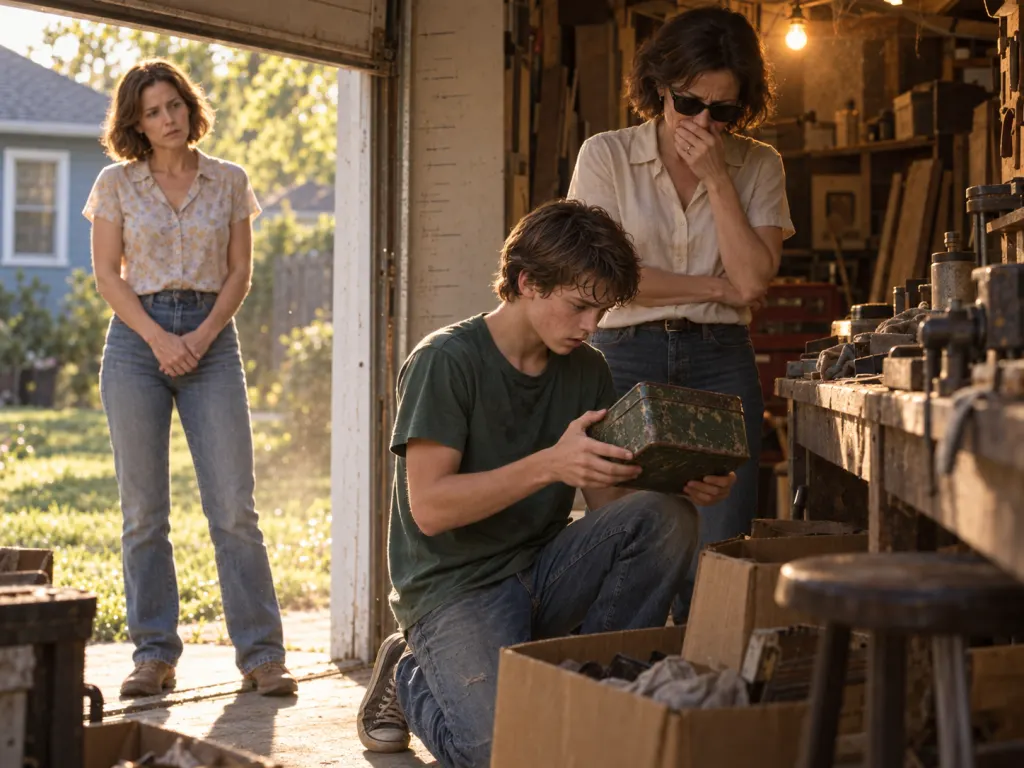
I unlocked the garage fully and pushed the door open. Light spilled over the concrete floor. Dust lifted, delicate and gold. For a moment none of us went inside. Nora stood with one hand over her mouth. Chase stared at the pencil marks on the wall.
“They’re still there,” he said.
His voice broke on the last word, and he turned away, pretending to cough. Nora closed her eyes.
I stepped aside. “Take your time.”
They entered carefully, as if the garage were a room where someone was sleeping. Chase went first to the workbench. His hand hovered over the scarred wood, then settled on a dark stain near the corner.
“He spilled coffee there,” he said. “Mom got mad because he put the mug too close to the edge.”
Nora gave a small, surprised laugh that turned into a breath she had to steady. “I forgot about that.”
They opened boxes with my permission. Most held things of no value to anyone outside that room: sandpaper, holiday hooks, a cracked thermos, loose screws in a coffee can, a child’s baseball glove stiff with age. Chase touched each object with restraint, taking nothing until Nora nodded. It was not a search for treasure. It was a search for proof.
Finally, behind the workbench, Chase crouched and reached into the narrow space between the wall and a low cabinet. He pulled out a flat metal tin, green with scratches, its lid held shut by a rubber band gone brittle.
Nora made a sound I could not name.
Chase looked at her. “This is it?”
She nodded, both hands pressed to her lips.
Inside the tin were ordinary things made sacred by keeping: a few photographs, a folded program from a school concert, a keychain shaped like a guitar, ticket stubs, and a stack of index cards written in a man’s blocky handwriting. Chase picked up the keychain first and held it in his palm.
“Dad kept this on his work keys,” he said to me, though I had not asked.
I understood then that explanation was easier than grief. Naming the object gave him something to do with his hands, a place for his voice to stand.
7. The Work He Really Wanted
We carried the tin to the patio because the garage was too hot and too full of ghosts. I brought out water and three glasses. Chase sat on the edge of the chair, the tin on his knees, while Nora sorted the contents with careful fingers.
“I didn’t know he hid it back there,” she said.
“He told me once,” Chase said. “Not exactly. He said if everything ever got messy, the important stuff was where the lawn mower slept.”
Nora looked at him sharply, not angry now, only startled by the private sentence her husband had left behind in their son’s memory.
For a while, we said very little. A delivery truck rumbled past. A neighbor’s sprinkler ticked in steady arcs. The summer afternoon went on being itself, indifferent and bright, while the three of us sat around a tin of small belongings that had pulled a teenage boy back across town every Saturday.
“I did need the money,” Chase said suddenly.
I turned to him.
His cheeks flushed. “I didn’t lie about all of it. I mean, we don’t live in the trailer park anymore. We stayed there for a while after we left here, but Mom got a better job and my uncle helped with the car. I just thought if I said that, you’d hire me. People hire kids who need help. They don’t hire kids who say they want to mow because they miss a garage.”
Nora closed her eyes again, but this time she was fighting a smile and tears at once.
I thought of the envelope, of him trying to return the extra bills. I thought of myself in the grocery parking lot, hand raised to the glass, ready to demand a clean answer from a boy whose life had not been cleanly divided into truth and lie.
“You could have told me,” I said, and heard how useless it sounded.
Chase looked toward the yard. “I didn’t want you to say no.”
There it was, the hidden reason stripped of drama. He had not come to steal from me. He had not come to trick me out of money. He had come because the house had a hold on him, because the garage still contained a version of his father he could touch, because loss had made him strategic in the heartbreaking way children become strategic when adults control every door.
I could have ended it there. I could have handed over the tin, accepted the apology, and asked him not to return. It would have been reasonable. Boundaries matter. So does trust.
But the yard lay around us in half-wild summer green, and his mower sat in my memory still running alone, not abandoned out of carelessness but left behind in the moment when longing outran judgment. I had been living in the house as if my loneliness were the only history under its roof. Chase had reminded me that every beginning arrives through someone else’s ending.
“Here’s what we’re going to do,” I said.
Both of them looked at me.
“You don’t go into the garage unless I’m here and I say it’s okay. No exceptions. If there’s something you remember and want to look for, you ask. If you want to mow, you can keep mowing, but only as a job, with honest terms. No stories designed to make me feel sorry for you.”
Chase swallowed. “Okay.”
“And if you find something that belongs to your family, we talk about it with your mom present.”
Nora nodded. “That’s fair.”
Chase looked down at the tin, then up at me for the first time without flinching. “Thank you.”
The words were simple. They did not fix everything. But they landed honestly, and that was more than we had had in the morning.
8. The Last Saturday of Summer
After that day, Chase came on Saturdays at nine.
The first week, Nora walked him to the porch and waited while he knocked. The formality of it embarrassed him so deeply that I nearly laughed, but I understood what she was doing. She was teaching him that repair has a shape. You do not simply feel sorry and move on. You show up differently.
He mowed the lawn. I paid him the agreed amount. Sometimes, when the work was done, we spent twenty minutes in the garage with the door wide open. He found a bent screwdriver his father had wrapped with black tape, a box of old house numbers, a stack of wood scraps marked with measurements. Most of it he left. A few things went home in a cardboard box Nora labeled before placing it in the SUV.
Little by little, the garage became less haunted. Not empty of feeling, exactly, but less trapped. Nora told me which rosebush had been planted the year Chase was born. Chase showed me where his father had once built a crooked shelf that still leaned a little to the left. I told them about the kitchen drawer that stuck and the upstairs window that rattled in rain. They laughed knowingly, and the house seemed to exhale.
On the last Saturday before school started, Chase arrived wearing the old green T-shirt again, but his shoes were clean and his backpack looked lighter. He mowed in the cool part of the morning, laying neat stripes across the yard. I watched from the kitchen window, coffee warm between my hands, as he paused near the garage and then kept walking. That small choice moved me more than any apology could have.
When he finished, I brought out the envelope and a paper bag from the bakery down the street. Cinnamon rolls, still warm. He grinned despite himself.
“My mom says you pay too much,” he said.
“Your mom is probably right.”
He tucked the envelope away without counting it in front of me this time. Trust, I learned, can be measured in gestures so small they would look like nothing to anyone else.
Before he left, he asked if he could see the garage one more time.
I went with him. He stood in front of the pencil marks on the wall, hands in his pockets. The highest mark bore his name and a date from years earlier. He had been shorter then by almost a foot. He touched the wall lightly beside it, not on the mark itself.
“I used to hate standing here,” he said. “Dad would say, ‘Hold still,’ and I never did.”
“That sounds about right.”
He smiled, then grew quiet. “Do you think it’s weird that I wanted to come back?”
I looked around the garage: the workbench, the dust, the bright rectangle where the tin had been, the open door letting in the smell of cut grass. I thought of all the places people return to in their minds, even when the places themselves belong to someone else now.
“No,” I said. “I think it means you loved your life here.”
He nodded once. His eyes shone, but he did not look away.
9. What a House Can Give Back
Autumn arrived quietly that year. The grass slowed. The flower beds, finally cleared, held a few stubborn marigolds that bloomed late and bright against the cooling soil. Chase’s Saturday visits became occasional, then stopped when school and weather made mowing unnecessary. Sometimes Nora texted before coming by to collect one more remembered thing from the garage. Sometimes she simply sent a photo of Chase in a school shirt, taller each time, his serious eyebrows still making him look as if he were solving a problem no one else could see.
I kept the pencil marks on the garage wall.
At first, I told myself I would paint over them once I finished organizing. Then winter came, and I told myself spring would be better. By the time spring arrived, I understood that I was not delaying a chore. I had made a decision. Those marks did not make the house less mine. They made it more honest.
There are things ownership cannot erase. A key can change hands. A deed can be filed. Furniture can be moved in and curtains replaced. But the life that happened before you arrived does not vanish politely. It lingers in nail holes, in garden beds, in the worn center of a wooden step. Sometimes, if you are lucky, it knocks on your door pushing an old mower and asks for work.
I am still not proud of following Chase in the grocery parking lot. Suspicion made me smaller that day. Fear did too. But I am grateful the story did not end at the worst thing each of us did. He lied. I pried. Nora guarded her son fiercely enough to drive away from a stranger in a parking lot. All of us were trying, imperfectly, to protect something tender.
The hidden reason was not shocking once I understood it. It was ordinary and human: a boy missed his father, missed his old house, missed being able to walk into a garage where every object knew his name. He wanted a reason to come back that would not make him sound broken. So he chose work. He chose sweat and straight lines in the grass. He chose an old mower because work was easier to explain than longing.
Sometimes, on summer evenings, I sit on the back steps and listen to the neighborhood settle. The garage stands open now more often than closed. Inside, my own boxes have joined the old shelves. My rake hangs beside the taped screwdriver Chase decided to leave because, he said, it belonged with the bench. The house feels like mine at last, but not because it forgot who came before me.
It feels like mine because I stopped asking it to.
Wrap-Up
A new homeowner hires Chase, a polite teenager with an old mower, and later catches him inside her locked garage. Her suspicion deepens when she sees him dressed differently and riding in a new SUV, but the truth is quieter than deception: Chase once lived in the house, and the garage still holds belongings connected to his father. Through apology, boundaries, and compassion, the homeowner learns that a house can belong to a new person while still carrying the echoes of an old family’s love.