 Save
The short answer: your olive oil is not automatically fake, but fraud is a real enough problem that labels deserve a second look. Be wary of viral claims that most bottles are counterfeit; the FDA says the true frequency of food fraud is hard to estimate because fraud is designed to avoid detection. What you can do is buy more deliberately, understand what the words on the bottle mean, and treat freshness, packaging, and traceability as practical clues rather than guarantees. Food fraud in olive oil is mainly an identity and value problem: a bottle may be diluted with a cheaper oil, sold as extra virgin when it does not meet that grade, or marketed with origin language that is easy to misunderstand. The FDA describes this broader category as economically motivated adulteration.
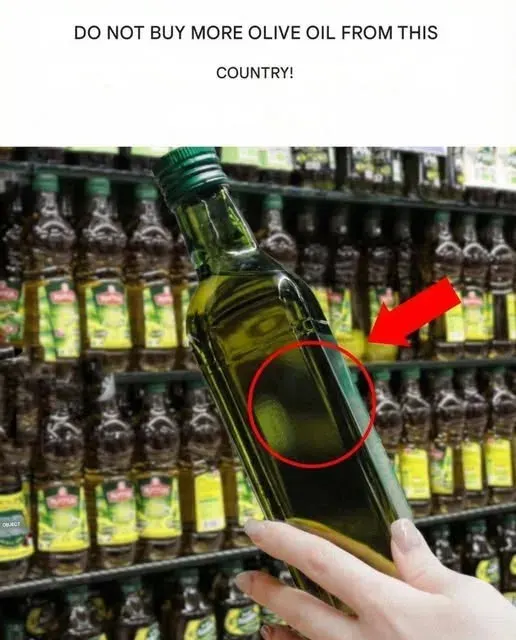
The country warning printed on the image
The photo says not to buy olive oil from “this country” without naming one or supplying a traceable test. Country of origin alone does not prove a bottle is fraudulent, and the picture gives no basis for a country-wide boycott. Check the specific producer, label, lot information and reliable findings about the product. The unsupported “80% fake” claim should not be treated as a measured result for every market.
What Olive Oil Fraud Usually Means
Olive oil fraud is not one single trick. Regulators use the broader term economically motivated adulteration for cases where someone leaves out, substitutes, or adds something to a food for economic gain. In the olive oil example, the FDA describes a company diluting more expensive extra-virgin olive oil with less expensive vegetable oil while selling it as pure olive oil. That is different from a bottle simply tasting flat because it is old, poorly stored, or past its best quality window, but both situations can disappoint a shopper who paid for a premium oil.
The word "fake" can make the issue sound simpler than it is. A fraudulent bottle may still contain some olive oil. A legally named "olive oil" may be a blend of refined olive oil and virgin olive oil, which is not the same thing as extra virgin but is not automatically fraudulent if the label is clear. A bottle labeled extra virgin, however, is making a higher quality claim. In USDA grading language, U.S. Extra Virgin Olive Oil has excellent flavor and odor, a median of defects equal to zero, fruitiness greater than zero, and free fatty acid content of not more than 0.8 grams per 100 grams. USDA grade descriptions explain these distinctions.
Why The Viral Percentages Are A Poor Guide
You may see posts claiming that an enormous share of olive oil is fake. The problem is that a dramatic percentage rarely tells you which market, year, sampling method, grade, or test was involved. The FDA is more cautious: it says estimating the frequency or economic impact of food fraud is difficult because fraud is meant to avoid detection. That does not mean olive oil fraud is imaginary. It means shoppers should avoid turning an unsourced number into a rule for every country, store, and bottle.
There is legitimate scientific work on olive oil authenticity. FDA researchers have published and cataloged studies on analytical methods such as near-infrared spectroscopy for screening extra-virgin olive oil. One FDA staff publication reported results from 88 retail products labeled EVOO in the United States and used the study to discuss rapid screening methods, not to give a universal fraud rate for every shelf. That study entry is useful because it shows how technical authenticity testing is. A shopper in a grocery aisle cannot reproduce those measurements at home.
What Extra Virgin Is Supposed To Signal
Extra virgin is not just a fancy phrase. It is meant to signal a category of virgin olive oil with sensory and chemical limits. Under USDA grade language, extra virgin has no sensory defects and must meet acidity and other requirements. In the European Union, olive oil marketing standards define characteristics for categories, packaging and labeling rules, and conformity checks. The European Commission notes that approved tasting panels and laboratory methods are part of verifying virgin olive oil characteristics. EU olive oil information explains the role of marketing standards and conformity checks.
The international Codex standard gives another way to understand the basic identity of olive oil. It describes olive oil as oil obtained from the fruit of the olive tree, while virgin olive oil is obtained by mechanical or other physical means under conditions that do not alter the oil. The same Codex text separates refined olive oil and olive-pomace oil into different descriptions. The FAO-hosted Codex standard also includes quality factors, labeling provisions, and methods of analysis. In plain shopping terms, category words matter because they are not interchangeable.
A Practical Label Checklist
A careful label does not prove authenticity, but it can help you avoid vague or stale bottles. Look for clear category language first: "extra virgin olive oil" should be easy to find if that is what you are buying. Then look for date information. A harvest date is especially useful because it tells you when the olives were picked, while a best-by date depends on the producer's shelf-life assumptions. Dark glass, a tin, or another light-protective container is preferable to clear glass on a bright shelf. A smaller bottle may be a better buy if you use olive oil slowly.
Use this quick buying checklist before paying extra for a premium bottle:
- Category: choose the grade you actually want, such as extra virgin for raw drizzling and finishing.
- Date: prefer a recent harvest date when available, or a best-by date that leaves enough time for your normal use.
- Container: favor dark glass, tins, or packaging that limits light exposure.
- Origin detail: look for a specific country, region, estate, cooperative, or lot information rather than only romantic wording.
- Certification or inspection marks: treat credible seals as helpful signals, while remembering that not every good producer uses the same program.
- Seller turnover: buy from stores that move product quickly and do not keep oil under hot display lights.
What Taste Can And Cannot Tell You
Fresh extra-virgin olive oil often has fruitiness, bitterness, and a peppery finish. Those traits can be gentle or strong depending on olive variety, ripeness, region, and style. A rancid oil may smell like crayons, stale nuts, old paint, or waxy cardboard. A fusty or muddy note can suggest poor olive handling before milling. Those impressions are useful because they help you reject a bottle that tastes tired or unpleasant, especially if you planned to use it in a simple dish like Mediterranean Olive Oil Dip.
Still, taste is not a courtroom. Some authentic olive oils are mild. Some flawed oils are subtle. Some people are more sensitive to bitterness than others. The old refrigerator test is also unreliable: cloudiness or solidification depends on fatty acid composition and temperature, not a simple true-or-false authenticity switch. If a bottle seems off, your best response is practical: stop paying premium prices for that brand, contact the seller or producer with the lot code, and choose a better-documented bottle next time.
Storage Matters After You Bring It Home
Even a genuine bottle can lose quality quickly if it is treated badly. Store olive oil closed, away from heat, light, and air. Do not keep your everyday bottle next to a hot stove or in direct sun. If you buy a large tin, consider decanting a small amount into a clean, dark, tightly capped bottle for daily use and keeping the larger container closed in a cool cabinet. Utah State University Extension notes that oils exposed to air can turn rancid over time, affecting aroma and flavor, and cooler temperatures slow the reaction that causes rancidity. That storage principle applies broadly to kitchen oils.
For cooking, choose the oil that fits the job. Extra virgin can be lovely in bean dishes, vegetables, dressings, and finishing applications where its aroma matters, such as Mediterranean White Beans Greens. For high-volume frying or very neutral flavor, you may decide that a less expensive clearly labeled oil is enough. Fraud avoidance is not only about buying the most expensive bottle; it is about paying for what the label honestly promises.
When A Bottle Should Raise Suspicion
No single clue proves fraud, but patterns matter. A very cheap extra-virgin bottle in premium-looking packaging may deserve skepticism, especially when the label gives little origin, date, producer, or lot information. A bottle that tastes stale immediately after opening may be old or poorly stored. A label crowded with vague Mediterranean imagery but lacking a clear category can also be a warning sign. If the brand claims a protected origin, estate harvest, or single variety, the label should make that traceability easier, not harder, to understand.
If you believe a product is mislabeled, keep the bottle, cap, receipt, and lot code. Contact the retailer or producer first if the issue is quality. For a suspected labeling or adulteration issue in the United States, the FDA explains that it uses inspections, sampling, analytical chemistry, collaborations, import alerts, recalls, seizures, and other enforcement tools for food fraud cases. Ordinary shoppers do not need to become investigators, but retaining the lot information makes any complaint more useful.
The Sensible Bottom Line
The best defense is boring in a good way: buy from reputable sellers, prefer clear grade and date information, keep bottles small enough to finish while fresh, and learn the aroma of good oil by tasting a few side by side. Avoid both extremes: do not assume every imported bottle is fraudulent, and do not assume a rustic label is proof of quality. Standards exist because category, chemistry, sensory quality, and labeling all matter. A good bottle should make those basics easier to verify.
For most home cooks, the goal is not laboratory certainty. It is better buying. Choose oil with transparent labeling, store it well, taste it while it is fresh, and reserve premium extra virgin for places where its flavor can actually shine. That approach will not eliminate every risk of fraud, but it will make you a harder target for vague labels and tired bottles.
Wrap-Up
Olive oil fraud exists, but viral claims that nearly every bottle is fake oversimplify the issue. Fraud can mean dilution, substitution, misleading grade claims, or confusing origin language. Extra virgin has specific quality expectations, and regulators use laboratory and sensory methods to assess compliance. At home, focus on category, date, container, traceability, seller turnover, and fresh flavor. Treat taste as a useful warning system, not proof. Store oil away from heat, light, and air, and buy only what you can use while it still tastes fresh.
Frequently Asked Questions
- → Can I prove olive oil is fake with a home test?
No simple home test can prove authenticity. Taste, smell, packaging, and date clues can help you spot poor quality or stale oil, but confirmation requires appropriate laboratory and sensory methods.
- → Is extra virgin always better than regular olive oil?
Extra virgin is the premium category for flavor and strict quality expectations, especially for raw uses and finishing. Regular olive oil can still be legitimate when clearly labeled, but it is a different category and should not be priced or judged as extra virgin.
- → Does a country of origin guarantee authenticity?
No. Origin can be helpful when it is specific and traceable, but a country name alone is not proof. Look for category, date, lot code, producer information, and credible certification or inspection signals.
- → What should fresh extra-virgin olive oil taste like?
It often tastes fruity, grassy, bitter, peppery, or herbaceous, depending on the olives and harvest style. Stale oil may smell waxy, flat, nutty in an old way, or like cardboard.
- → How should I store olive oil after opening?
Keep it tightly closed in a cool, dark cabinet away from the stove and direct sunlight. Buy a bottle size you can finish reasonably quickly so the oil spends less time exposed to air after opening.
References
This content was developed and refined using reliable sources.
- https://www.fda.gov/food/compliance-enforcement-food/economically-motivated-adulteration-food-fraud
- https://www.ams.usda.gov/grades-standards/olive-oil-and-olive-pomace-oil-grades-and-standards
- https://agriculture.ec.europa.eu/farming/crops/olive-oil_en
- https://www.fda.gov/food/economically-motivated-adulteration-food-fraud/economically-motivated-adulteration-food-fraud-research-publications
- https://www.accessdata.fda.gov/scripts/publications/search_result_record.cfm?id=57168
- https://www.fao.org/4/y2774e/y2774e04.htm
- https://extension.usu.edu/news_sections/home_family_and_food/gearing-up-for-holiday-baking