 Save
The likely answer to the viral question is Bill Gates and Steve Ballmer, though the exact photograph itself should be handled with care unless a credible archive identifies the image, date, and photographer. The clues fit Harvard in Massachusetts, Gates' Class of 1977 connection, and the well documented friendship between Gates and Ballmer. Harvard says Gates came to know Ballmer while at Harvard College and later left during his junior year to build Microsoft with Paul Allen, the company founded in 1975 according to the Harvard Gazette. That makes a simple old student photo less of a celebrity guessing game and more of a doorway into the early personal computing era.
What the Clue Gets Right, and What It Cannot Prove Alone
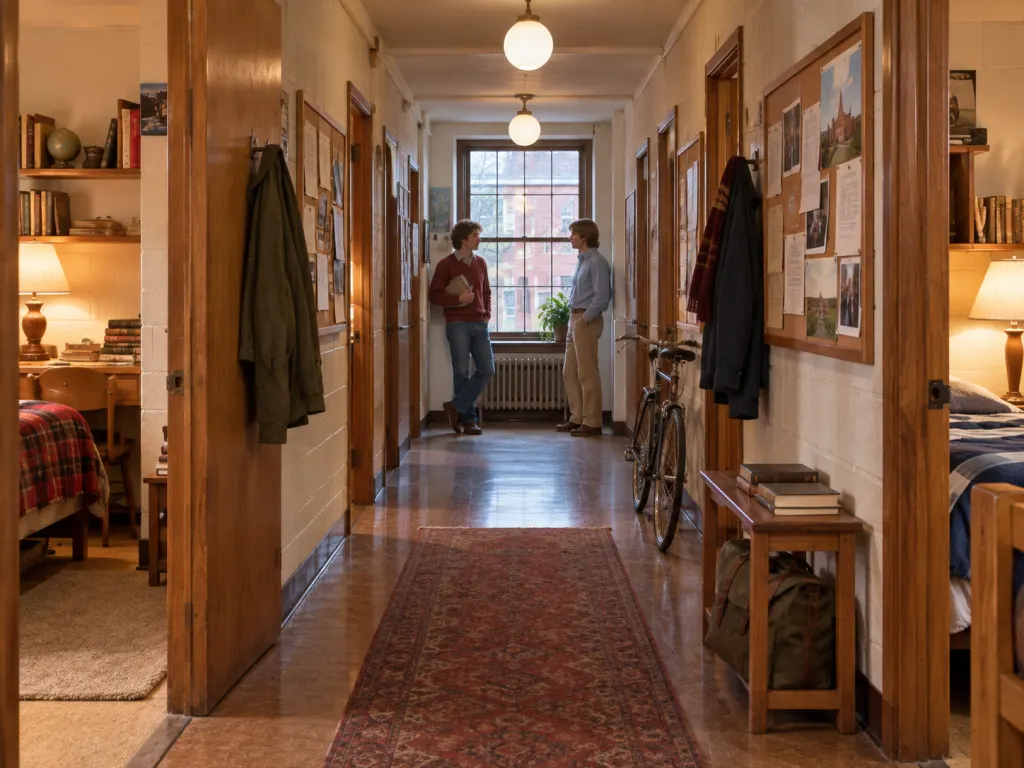
Old photographs of famous people work because they invite hindsight. A casual image can seem loaded with destiny after we know how the story ends. In this case, the strongest match is not just the year 1977 but the setting implied by the caption: a prestigious school in Massachusetts. Gates was associated with Harvard's Class of 1977, and Harvard describes Steve Ballmer as a classmate and future business partner who lived down the hall from him at Currier House. Those details point more specifically to Gates and Ballmer than to a generic pair of technology celebrities.
Still, a viral caption is not the same thing as image provenance. A responsible reading separates two claims. The first claim is identification: the clue likely refers to Gates and Ballmer. The second claim is archival certainty: a particular image was truly taken in 1977, at a specific place, by a known photographer, and preserved through a traceable source. Without that record, the article can explain the history around the clue while avoiding false precision about the photograph itself.
Why Harvard Matters to the Story
Harvard was more than a backdrop in this story. It was where Gates encountered classmates, computing resources, and a social world that sharpened his ambitions. The Harvard Gazette reports that Gates arrived as a freshman in 1973 after already selling programming services with fellow computer devotees from Lakeside School. At Harvard, he pursued programming, teamed with Paul Allen on a version of BASIC for the MITS Altair, and left during his junior year to focus on Microsoft as Harvard summarized in 2007.
Ballmer enters the story through the same campus world but with a different public image. Harvard's longer account of Gates' formative years describes Ballmer as socially forceful, involved in campus organizations, and intensely energetic. The same account says Gates and Ballmer met in a graduate-level economics class, lived near each other at Currier House, talked and argued, watched movies together, and became close friends in Harvard's account of Gates' early years. That friendship is the part of the old-photo clue that matters most: before the boardrooms and public reputations, there was a college relationship built in ordinary student settings.
Why 1977 Sits at an Interesting Turning Point
The year 1977 is not magic, but it sits near a genuine turning point. By then, Gates had already moved from student life toward Microsoft, and the personal computer market was beginning to take a shape that ordinary businesses and households could understand. Harvard's account of the Altair moment describes Paul Allen bringing the Popular Electronics issue to Gates in late 1974, after which Gates and Allen worked intensely on software for the machine. That work helped connect microcomputers with usable programming tools, a key step in making small computers more than hobbyist hardware.
Technology history in the late 1970s was broader than any two people. Hardware makers, software programmers, standards bodies, universities, hobbyist groups, retailers, and early customers all helped define what personal computing would become. Even outside the consumer computer market, 1977 was a year when computing rules were becoming public infrastructure: NIST's timeline notes that the first publicly available Data Encryption Standard was issued in 1977 for federal use and private-sector needs according to NIST. That context helps explain why a small student-era image can feel historically large. It belongs to a period when computing was moving from specialized spaces toward wider public systems.

Two Different Roles in One Company Story
Gates and Ballmer are sometimes reduced to simple types: the programmer-founder and the energetic business operator. That shorthand is useful only up to a point. Gates' early importance came from seeing that software could be the central product of the personal computer age. Ballmer's later importance came from helping Microsoft scale as an organization, sell to customers, and operate across a growing set of products and markets. Their friendship mattered because Microsoft needed more than code. It needed strategy, hiring, sales, discipline, and a way to turn technical possibility into a durable company.
A careful reader should also notice the timing. Gates did not wait until graduation to commit himself fully to Microsoft. Ballmer did finish Harvard, then later joined Microsoft in 1980 after work and business-school experience. That difference matches the common version of the caption: one path moved quickly outside the expected academic route, while the other looked more conventional before turning toward the same software company. The contrast is interesting because both routes eventually converged inside a business that helped define everyday computing.
How to Read a Before-They-Were-Famous Photo
The best way to enjoy an image like this is to resist the easy myth that the future was visible from the start. A student photo does not reveal a person's destiny. It captures a moment before later labels were attached. The young people in the image did not yet carry the public meanings readers now assign to them. That is exactly why these pictures keep circulating: they create a jolt between the ordinary scene and the extraordinary later association.
For readers, the useful habit is not suspicion for its own sake. It is context. A good viral-photo check asks practical questions:
- Does the caption name the people, place, year, and original source?
- Does the date fit the known timeline of each person's life?
- Is there a photographer, archive, yearbook, newspaper, or institutional collection attached?
- Are later reposts all repeating one another, or do they point back to a primary source?
- Does the post use mystery mainly to inform readers, or mainly to win clicks?
What the Photo Actually Teaches
The strongest lesson is not that famous careers are inevitable. It is that important cultural changes often begin in plain settings: dorm rooms, common rooms, late-night conversations, small teams, unfinished products, and uncertain bets. Harvard's account of Gates and Allen working on BASIC for the Altair is a reminder that the personal computer era was assembled through urgency and experimentation, not through a polished master plan. Ballmer's later role shows a second truth: technical revolutions need people who can organize, sell, argue, recruit, and keep a company moving once the first spark has caught.
That is why the Gates-Ballmer reading is more interesting than a simple reveal. The photograph points to a friendship before it became a business-history footnote. It also points to a moment when software was still becoming a commercial category that ordinary people could understand. The two figures did not represent separate worlds so much as two necessary sides of the same emerging industry: invention and execution.
The Better Takeaway Than Guessing the Names
Guessing the faces may be fun, but the better takeaway is humility about beginnings. In 1977, personal computing had not settled into the familiar shape of desktops, laptops, cloud accounts, smartphones, and everyday apps. It was still a field of experiments, arguments, prototypes, standards, and early companies trying to persuade people that computers belonged in offices, schools, and homes. A photograph from that moment feels valuable because it freezes the people before the outcome looked obvious.
So the responsible answer is simple: the clue most likely points to Bill Gates and Steve Ballmer, with Harvard as the key setting. The fuller answer is richer. It asks readers to see an ordinary student-era image as a reminder that history is not only made by finished legends. It is made by friendships, risky decisions, unfinished tools, and the patient work of turning a new idea into something millions of people can use.
Wrap-Up
The 1977 photo clue is best read as a likely reference to Bill Gates and Steve Ballmer, two Harvard-connected figures whose friendship became part of Microsoft history. Verified sources support the Harvard connection, Gates' early software work, his move away from college toward Microsoft, and Ballmer's close campus relationship with him. The exact viral image deserves caution unless its archive record is supplied, but the surrounding story remains useful: before personal computing became ordinary, it was being shaped by young people making uncertain choices in very ordinary rooms.
Frequently Asked Questions
- → Who are the two future icons in the 1977 photo clue?
The clues most plausibly point to Bill Gates and Steve Ballmer. The strongest match is the Harvard setting in Massachusetts, along with Harvard's own accounts of Gates' Class of 1977 connection and his friendship with Ballmer.
- → Can the exact photo be treated as verified?
Only if the image is tied to a reliable archive, photographer credit, publication record, yearbook entry, or institutional collection. Without that trail, it is safer to say the clue likely refers to Gates and Ballmer while treating the image details cautiously.
- → Why is Harvard important in this story?
Harvard is where Gates and Ballmer knew each other as students. Harvard sources describe Ballmer as a classmate and future business partner who lived near Gates at Currier House, making the campus connection central to the clue.
- → Why does 1977 matter for Gates?
Gates was associated with Harvard's Class of 1977, but he left during his junior year to focus on Microsoft, which he and Paul Allen founded in 1975. That timing makes 1977 a meaningful year for a before-fame photo clue.
- → What is the main lesson from the photo?
The image is less about destiny than context. It reminds readers that major technology history began in ordinary student settings, uncertain decisions, and early friendships before the people involved became public symbols.