 Save
Rest after work can mean giving yourself time when you are no longer answering job demands or mentally rehearsing them. Useful downtime might involve quiet, conversation, a hobby, or an unhurried walk. It does not need a score, an ambitious plan, or a whole free day. Psychological detachment, mentally stepping away from work, is one aspect of recovery described in the European Agency for Safety and Health at Work’s overview.
The practical challenge is finding space that fits your actual circumstances. A person finishing a physically demanding shift may want something different from someone who has spent the day in video meetings. Caring responsibilities, money, shared housing, and unpredictable schedules also shape what is possible. The aim is to make room for life beyond work while recognizing that sleep, movement, and workplace conditions each need separate attention.
What detaching from work actually means
Leaving the workplace and leaving work behind mentally are different experiences. You might close your laptop while continuing to replay a difficult conversation. You might also become absorbed in a nonwork activity without leaving home. Detachment concerns that mental distance, rather than a particular location.
The EU-OSHA overview describes four recovery experiences: detachment, relaxation, mastery, and control over leisure time. Its research summary links detachment with outcomes including life satisfaction and emotional exhaustion. These findings do not establish one ideal activity or a universal schedule for everyone.
For everyday purposes, this offers a useful choice. You can spend an evening doing something familiar and undemanding, or choose a hobby that presents an enjoyable challenge. Neither needs to resemble anyone else’s idea of a restful evening. Consider whether the activity gives work less of your attention and whether you actually want to do it.
Give unfinished work somewhere to wait
A brief closing routine is one practical experiment. Before finishing, write down what remains unfinished, the next action, and anything another person needs to know. Keep this in the place where you normally organize work. The purpose is simple: leave a usable starting point for your return.
For example, “finish report” is a broad reminder. “Check the final table, then send the draft to the reviewer” makes the next step clearer. If you are waiting for someone else, record that too. You do not have to resolve every open task before allowing yourself to stop.
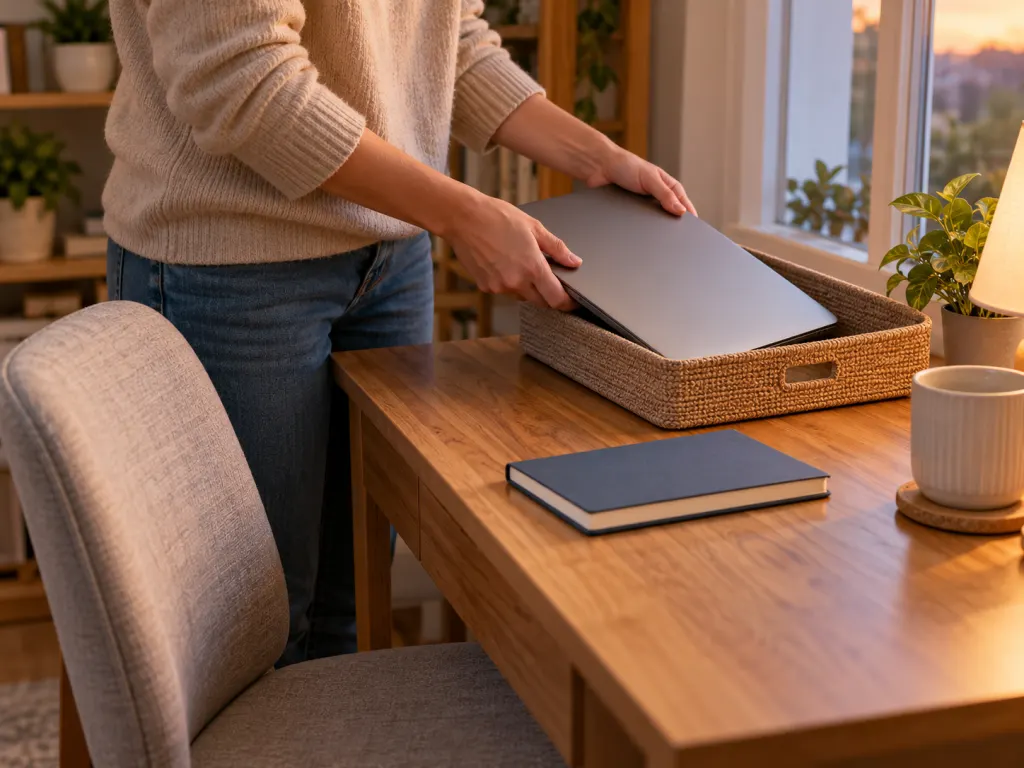
Then choose an ordinary transition: put equipment away, change clothes, wash your work mug, or leave the room where you worked. These are optional cues to try, not a proven formula. If a work thought returns later, you can decide whether it needs a short reminder for tomorrow or whether you are simply revisiting something already recorded. Returning to your evening may take more than one attempt.
Make availability clear enough to use
A boundary is easier to apply when the people involved understand it. Where your role allows, clarify when you finish, when messages will next be checked, and which channel is reserved for genuinely urgent matters. The EU-OSHA overview recommends organizational support for being unavailable outside work and arranging demands so they do not intrude on nonwork time.
An illustrative message could be: “I will review this when my shift starts tomorrow. For an urgent issue tonight, please use the duty contact.” Adapt that wording to your actual responsibilities and agreed arrangements. An on-call worker needs a reliable handover and coverage plan; someone without on-call duties may need a clearer shared understanding of response times.
If boundaries are routinely overridden, identify the recurring situation. Is every request labeled urgent? Is there no cover during leave? A specific example gives a manager something concrete to address.
Choose downtime by preference, not performance
The National Institute of Mental Health includes enjoyable low-stress activities and connection with other people among its self-care suggestions. It also emphasizes that people differ in what works for them. That leaves room for ordinary pleasures without turning them into another improvement project.
Try thinking in terms of choices rather than targets:
- Less input: sit somewhere comfortable, listen to familiar music, or leave a little time unfilled.
- Something absorbing: mend an item, sketch, work on a puzzle, or play an instrument without recording the result.
- Company: share a meal, call someone you enjoy speaking with, or spend time together without an elaborate outing.
- A change of setting: visit a library, spend time outside, or take an accessible route you like.
If tending plants already interests you, our guide to reviving houseplants in autumn offers a practical activity to explore. It is an option for an existing interest, not another task you need to adopt. You can also leave the plants, the puzzle, and the evening entirely alone.
Sleep needs its own protected space
A quiet evening and a night’s sleep serve different purposes. Time spent awake on a sofa is still awake time. The CDC’s sleep guidance recommends at least seven hours for adults aged 18-60, seven to nine hours for those aged 61-64, and seven to eight hours for adults aged 65 and older. It also emphasizes sleep quality.
When choosing evening leisure, notice whether it keeps pushing bedtime later than intended. An absorbing series, game, or conversation may be enjoyable while still taking up the time you meant to leave for sleep. You can value the activity and choose a stopping point.
The CDC suggests consistent bedtimes and waking times and turning off electronic devices at least 30 minutes before bedtime. These are general habits, not a guarantee of easy sleep. If your schedule makes them difficult, consider which practical change is available rather than judging yourself against an ideal routine.

Quiet sitting and enjoyable movement can both belong
Rest is not defined by how still you remain. The World Health Organization defines sedentary behavior as low-energy activity while awake, such as sitting or reclining. Physical activity includes movement during leisure, travel, work, and domestic tasks. WHO identifies walking, cycling, wheeling, and active play as examples.
These definitions help separate two questions: “Am I mentally away from work?” and “How much of my waking day involves sitting?” Reading may answer the first question without changing the second. An enjoyable walk may involve both movement and time away from job demands.
There is no need to make every restful activity physically active. Equally, you do not need to remain motionless to call an afternoon restful. Choose movement that fits your abilities, circumstances, and preferences, and leave room for sitting activities you enjoy. A single label such as “rest day” cannot describe everything that happens within it.
Make room within a crowded life
Advice about downtime can assume resources that many people do not have: a private room, predictable finishing hours, affordable outings, or another adult available to take over household responsibilities. Begin with your actual constraints. An elaborate plan is of little use if it requires support that is unavailable.
For a shared household, one possibility is to agree on a modest period when each person is free from routine requests, with necessary responsibilities covered. A shift worker might place personal time after waking rather than follow advice built around a conventional evening. Someone with very little money may prefer familiar music, a library book, or a conversation at home.
Household tasks need an honest description too. Preparing tomorrow’s lunch may be worthwhile and may make the next day easier, but you do not have to count it as leisure. Where possible, distinguish what must be done from what you would choose for yourself. If everything is essential, the next useful conversation may concern sharing responsibilities rather than selecting a better hobby.
Decide what you want from your phone
A phone can hold a novel, a friend’s voice, a work inbox, and a stream of updates. Instead of treating all screen use as one activity, decide what you want to use it for during this part of the day. Listening to an album and repeatedly checking work messages are different uses of the same device.
You might silence work notifications where your responsibilities allow, move work apps away from the main screen, or charge a work device outside the place where you spend your evening. Choose only changes compatible with essential contact and any agreed duty arrangements.
You can also give yourself permission to leave some updates unread. Our article Out of the Loop? A Calm Guide to Catching Up is a related read if catching up has become another obligation. For tonight, decide whether you want information, entertainment, company, or quiet. You do not need to obtain all four from one device.

Some recovery problems need a workplace response
If work repeatedly takes over personal time, look at the demands themselves. The UK Health and Safety Executive’s Management Standards identify workload, work patterns, and the work environment as relevant issues. Its standard calls for achievable demands within agreed working hours and systems that respond to individual concerns.
For a workload conversation, bring examples rather than a general statement that everything is too much. Explain which tasks compete, what time or resources they require, and what decision you need. You could ask, “Which of these should take priority?” or “What can be reassigned while the team is short staffed?”
If you manage others, examine what happens after you send an evening message. Make expectations explicit, arrange cover, and avoid leaving workers to infer that immediate replies are necessary. Personal downtime is easier to arrange when staffing, deadlines, and communication practices support it. A worker should not have to solve every recurring demand by redesigning their evening.
Notice what suits you without keeping a recovery score
You do not need a device, diary, or streak to decide whether you liked an evening. An occasional informal check is enough: Did I spend any time on something I chose? Was I repeatedly pulled back into work? Did I leave the sleep opportunity I intended? These questions are prompts for practical decisions, not a test.
If a hobby has become another deadline, simplify it or set it aside. If social plans feel like too much organizing, suggest something familiar and easy to arrange. If quiet time is what you want, you can choose it without finding a more impressive description.
Keep expectations modest. A pleasant evening may coexist with an unresolved deadline or a difficult week. Research about recovery experiences does not establish guaranteed health outcomes from a prescribed day off. The useful question is whether your arrangements give you reasonable opportunities to step away, rather than whether each break produces a measurable result.
When persistent difficulties deserve more support
Do not assume that ongoing exhaustion, poor sleep, or loss of enjoyment is simply a failure to rest correctly. The NIMH recommends seeking professional help for severe or distressing symptoms lasting two weeks or more, including difficulty concentrating, loss of interest, and trouble completing usual activities. Seek help sooner if you are struggling to cope; two weeks is not a requirement to wait.
The CDC also advises speaking with a healthcare provider about regular sleep problems. You can describe what you have noticed, how long it has been happening, and how daily life is affected without deciding on a diagnosis yourself.
If you are having thoughts of suicide or feel unable to stay safe, get immediate help. In the United States, call or text 988; call 911 in a life-threatening emergency, as outlined by NIMH. Outside the United States, use your local crisis service or emergency number.
Wrap-Up
Making room for recovery starts with recognizing what is taking up your time and attention. Leave unfinished work with a clear next step, clarify availability, and choose downtime that fits your preferences and circumstances. Keep sleep needs separate from leisure choices, and allow both quiet activities and enjoyable movement. When work regularly overwhelms personal time, discuss the demands and arrangements that need to change. You do not have to turn rest into another project to make space for it.
Frequently Asked Questions
- → Can a hobby still count as downtime if it takes effort?
Yes. The EU-OSHA overview includes mastery, enjoyable challenge or learning, among recovery experiences. A hobby does not have to be effortless. Consider whether you choose it freely and enjoy the experience. If preparation, competition, or deadlines dominate, you can make it simpler or choose something else.
- → What if I enjoy talking about work after finishing?
You do not need to ban the subject. Decide whether you want a brief conversation, practical help with a specific problem, or time focused elsewhere. You might tell someone, “I would like to talk this through, then change the subject.” If discussing work keeps occupying the evening when you would prefer to stop, try recording the unresolved issue for your next working period.
- → Do I need to take an entire day off to rest meaningfully?
There is no universal rest schedule established by the sources discussed here. A full day away may be welcome, but it is not the only opportunity to step away from job demands. Look for workable periods within your schedule while protecting sleep and agreed time off. If demands routinely leave no personal time, raise the workload and coverage problem.
- → How can I try a boundary when I work from the same room where I relax?
Use a change you can actually maintain: close the laptop, put work papers in a folder, or move equipment to one side. Choose a clear place to keep the next task so you can find it when work resumes. These are practical experiments rather than guaranteed techniques. Shared expectations about availability remain relevant even when the physical space cannot change.
References
This content was developed and refined using reliable sources.
- https://oshwiki.osha.europa.eu/en/themes/detachment-and-recovery-after-work-overview
- https://www.cdc.gov/sleep/about
- https://www.who.int/news-room/fact-sheets/detail/physical-activity
- https://www.nimh.nih.gov/health/topics/caring-for-your-mental-health
- https://www.hse.gov.uk/stress/standards/demands.htm