 Save
If you usually sleep on your right side, the main thing to know is this: for most adults, it is not automatically dangerous, and comfort matters. The right side may become less ideal if you have nighttime reflux, because studies of people with reflux have found the left side is linked with shorter esophageal acid exposure and faster acid clearance than the right side PubMed. On the other hand, some people with heart failure appear to prefer or tolerate the right side better than the left, so personal medical context matters PubMed.
If you arrived from a plastic-covered fan image
A fan photograph was mistakenly linked to this sleep article. The matching explanation is now A Plastic Bag Over a Fan. The sleep illustration and guidance below concern sleeping position.
Right-side sleeping is common, but not one-size-fits-all
Sleep position is partly habit, partly comfort, and partly anatomy. A person may favor the right side because of shoulder comfort, room layout, a bed partner, breathing comfort, or simple routine. The American Heart Association notes that sleep position research is still limited for many broad claims, but position can matter in specific situations such as reflux, pregnancy, breathing during sleep, and heart failure symptoms American Heart Association. That means the useful question is not whether the right side is universally good or bad. The useful question is whether your usual position is helping you sleep well without worsening a known symptom.
A practical way to judge your own position is to look at the morning result. If you wake rested, do not have recurring shoulder or hip soreness, and do not notice nighttime reflux, choking, heavy snoring, dizziness, or breathlessness, right-side sleeping may simply be your comfortable default. If you repeatedly wake with symptoms that match a known condition, the position is worth discussing with a clinician instead of forcing yourself through trial and error.
The strongest right-versus-left evidence is about reflux
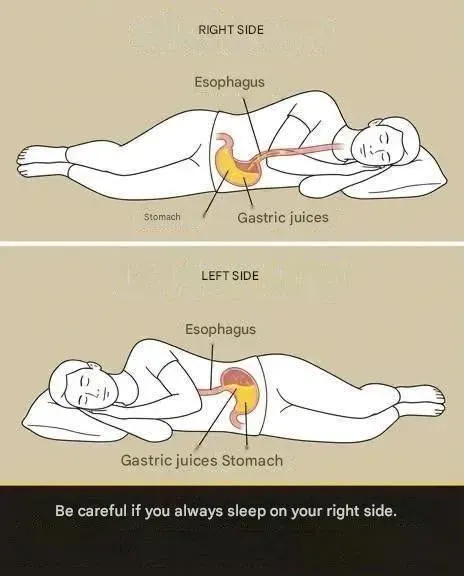
For adults with nighttime gastroesophageal reflux, right-side sleeping can matter more than it does for the general population. A study using sleep position monitoring with esophageal pH and impedance testing found that the left lateral position was associated with shorter acid exposure and faster acid clearance than both the right lateral and supine positions PubMed. This does not mean every person who lies on the right side will have reflux, and it does not mean position is the only factor. Meal timing, alcohol, body size, pregnancy, and individual anatomy can also influence nighttime symptoms.
The reason left-side sleeping is often discussed for reflux is mechanical. The stomach and esophagus do not sit symmetrically in the body. For some people with reflux, lying left-side down may make it harder for stomach contents to move back toward the esophagus while sleeping. If your right-side habit comes with burning in the chest, sour taste, coughing after lying down, or waking soon after a late meal, it may be reasonable to test a left-side start position and earlier evening meals while arranging proper care for persistent symptoms.
Breathing during sleep depends more on side versus back
For snoring and obstructive sleep apnea, the more important distinction is often side sleeping versus back sleeping, not right versus left. NHLBI explains that a provider may recommend side sleeping instead of back sleeping because side positioning can help keep the airway open during sleep NHLBI. This is not a substitute for evaluation if symptoms suggest sleep apnea. Loud snoring, witnessed pauses in breathing, gasping, morning headaches, or strong daytime sleepiness deserve medical attention.
If right-side sleeping reduces snoring compared with lying flat on your back, that may be useful information. Still, position alone should not be used to reassure yourself that a sleep-breathing disorder is handled. MedlinePlus describes healthy sleep as part of how the body restores energy and supports learning and memory, and it advises seeing a health care provider when sleep trouble continues or a sleep disorder may be present MedlinePlus. In other words, use position as one clue, not as the whole answer.
Pregnancy changes the question
Pregnancy is one area where broad internet rules can be confusing. NIH reported that an analysis funded by NICHD found sleeping on the back or side through the 30th week of pregnancy did not appear to increase certain adverse pregnancy outcomes, while also noting that the study did not answer whether back or right-side sleeping late in pregnancy could carry risk NICHD. Many late-pregnancy recommendations focus on avoiding going to sleep flat on the back, while side sleeping is generally preferred.
For a pregnant reader, the safest interpretation is not to panic about waking on the right side. People naturally move during sleep. The more useful step is to ask the prenatal care team what applies to the current trimester, symptoms, and medical history. Pillows behind the back, between the knees, or under the belly can make side sleeping more stable without turning bedtime into a rigid rule-following exercise.
Right side, left side, and the heart
Right-side sleeping sometimes appears in discussions of heart failure because some people with heart failure report discomfort or breathlessness when lying on the left side. In a study comparing patients with congestive heart failure and control participants, people with heart failure spent less time in the left lateral position and more time away from it; the authors suggested this might reflect avoidance of discomfort or other physiologic strain PubMed. This is a narrow finding in a specific group, not a general rule that everyone should sleep on the right side for heart health.
If a person has known heart disease, new breathlessness when lying down, chest discomfort, swelling, fainting, or a major change in exercise tolerance, sleep position should not be treated as the main fix. Those symptoms need prompt clinical guidance. For someone without those symptoms, right-side sleeping is not a proven heart-health strategy; it is simply one position that may feel better or worse depending on the person.
Comfort and alignment still matter
Even when there is no major medical issue, the right side can create ordinary pressure points. The shoulder under the body, the outside of the hip, and the neck are common places to notice morning stiffness. Mayo Clinic recommends that side sleepers draw the legs slightly toward the chest and place a pillow between the knees to help align the spine, pelvis, and hips Mayo Clinic. The goal is a neutral, supported shape rather than a tightly curled position.
Small adjustments can make right-side sleeping more comfortable without changing your whole routine:
- Use a pillow that keeps the neck level with the chest and upper back.
- Place a pillow between the knees so the top leg does not pull the pelvis forward.
- Hug a pillow if the upper shoulder collapses toward the mattress.
- Shift sides sometimes if one shoulder or hip is becoming tender.
- Avoid forcing a position that repeatedly wakes you or causes numbness.
Babies are a major exception to adult side-sleeping advice
Adult sleep-position discussions should not be applied to infants. NICHD Safe to Sleep guidance says babies should be placed on their backs for naps and at night until age 1, and that side sleeping is not recommended because it is unstable and can allow a baby to roll onto the stomach Safe to Sleep. This applies even when a baby has reflux, unless a qualified pediatric clinician gives specific individual instructions.
That distinction matters because advice for adults with reflux can sound opposite to infant safe-sleep advice. Adults can often reposition themselves, report symptoms, and use pillows safely. Babies cannot manage the same risks. For infants, the safest default is a firm, flat, level sleep surface with the baby placed wholly on the back, without using adult side-sleeping tips.
When to consider changing your sleep position
You do not need to overhaul your sleep position just because you prefer your right side. Consider experimenting with a left-side start position, a supported back position, or more pillow support if you notice a consistent pattern. Examples include reflux that is worse after lying on the right side, shoulder pressure on the lower side, hip twisting, snoring that is worse on the back, or waking repeatedly soon after lying down. Keep the experiment simple: try one change for several nights, then compare sleep quality, comfort, and symptoms.
If a symptom is severe, new, or escalating, do not rely on positioning experiments. Sleep position can be part of comfort care, but it cannot identify the cause of chest symptoms, breathing changes, faintness, or persistent sleep disruption. A sleep diary can help a clinician by recording bedtime, meals, position at sleep onset, awakenings, and morning symptoms. The pattern is often more useful than a single night.
A balanced takeaway
Right-side sleeping is best understood as a neutral default with a few important caveats. It may be perfectly comfortable for many adults. It may be less helpful for people with nighttime reflux, where left-side sleeping has better evidence. It may be part of a side-sleeping approach for people whose breathing is worse on the back, but suspected sleep apnea still needs proper evaluation. During pregnancy, individual timing and prenatal guidance matter. For babies, side sleeping is not advised at all. The best position is the one that supports sleep while respecting your health context.
Wrap-Up
Sleeping on your right side is usually not a problem by itself. The clearest reason to reconsider it is recurring nighttime reflux, because left-side sleeping has better evidence for shorter acid exposure in people with reflux. Side sleeping in general may help some people avoid airway narrowing compared with back sleeping, while pregnancy, heart symptoms, infant care, and musculoskeletal comfort all require separate judgment. If your right-side habit feels good and you wake well, it may simply be your preferred position. If it repeatedly lines up with symptoms, use that pattern as a reason to seek individualized guidance.
Frequently Asked Questions
- → Is sleeping on the right side bad for everyone?
No. For many adults, right-side sleeping is simply a comfortable habit. It becomes more important to reassess if it is linked with reflux, breathing symptoms, shoulder or hip discomfort, pregnancy questions, or a known heart condition.
- → Why do people say the left side is better for reflux?
Studies of people with reflux have found shorter esophageal acid exposure and faster acid clearance in the left-side position than in the right-side or back positions. That does not mean every person must sleep on the left, but it is a reasonable position to discuss if nighttime reflux is recurring.
- → Can right-side sleeping help snoring?
Side sleeping may help some people snore less than they do on their backs because the airway may stay more open. However, loud snoring, gasping, pauses in breathing, or daytime sleepiness should be evaluated rather than managed only by changing position.
- → Should pregnant people avoid the right side?
Guidance varies by trimester and individual situation. NIH has reported reassuring findings for early and mid pregnancy through 30 weeks, but late-pregnancy advice often focuses on avoiding going to sleep flat on the back. Pregnant readers should follow their prenatal care team’s guidance.
- → Should babies sleep on their right side?
No. Adult side-sleeping advice does not apply to infants. NICHD Safe to Sleep guidance says babies should be placed on their backs for naps and at night until age 1, because side sleeping is unstable and not recommended.
References
This content was developed and refined using reliable sources.
- https://pubmed.ncbi.nlm.nih.gov/34928874
- https://www.nhlbi.nih.gov/health/sleep-apnea/treatment
- https://www.mayoclinic.org/diseases-conditions/back-pain/in-depth/sleeping-positions/art-20546852
- https://pubmed.ncbi.nlm.nih.gov/12535814
- https://medlineplus.gov/healthysleep.html
- https://www.heart.org/en/news/2025/01/24/can-sleep-position-affect-your-heart-and-brain-health
- https://www.nichd.nih.gov/newsroom/news/092019-pregnancy-sleep-position
- https://safetosleep.nichd.nih.gov/reduce-risk/back-sleeping