 Save
Most indoor orchids, especially moth orchids, need water, air around their roots, and light feeding rather than a strong homemade trick. A small amount of commercial orchid fertilizer added to water can support fuller leaves and future flowers when the plant is actively growing. This guide shows you how to use it without overwatering or leaving salts behind.
Step 1: The brown liquid in this orchid image
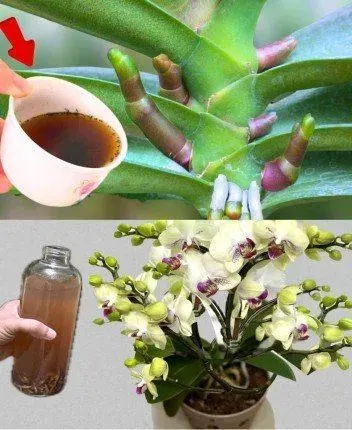
The image does not identify the brown liquid being poured near the orchid. It is not evidence of a particular homemade fertilizer or a tenfold improvement. The guide below uses a labeled orchid fertilizer at the maker’s dilution, not a guessed copy of the pictured mixture. Light, root health, watering and drainage still determine how the plant grows.
Step 2: Check that your orchid is ready for water
Look at the bark mix and the roots before you mix fertilizer. Moth orchids are usually grown in loose, bark-based media, and University of Maryland Extension notes that watering is often needed no more than once a week under normal home conditions. Wait if the pot still feels heavy or the bark is damp.
Step 3: Choose tepid water, preferably rainwater
Use room-temperature or slightly tepid water so the roots are not shocked by cold water. The RHS says many indoor orchids prefer rainwater or boiled water rather than tap water, and rainwater can be useful for ornamental houseplants such as orchids.
Step 4: Dilute orchid fertilizer lightly
Add a small amount of commercial orchid fertilizer to the water, following the label rather than guessing. Colorado State University Extension explains that water-soluble fertilizers are mixed into irrigation water and should be used according to label directions to avoid overfertilizing.
Set the orchid in a sink and pour the diluted fertilizer water through the potting mix and over the visible roots. Water until the bark is evenly moistened and liquid runs freely out of the drainage holes. Try to keep water out of the crown, where the leaves meet.
Step 6: Let the pot drain completely
Leave the orchid in the sink until dripping slows, then empty any saucer or cachepot before putting it back. RHS guidance for moth orchids says excess water should drain away and plants should not sit in water.
Step 7: Use plain water every few waterings
Do not fertilize every single time you water. The RHS recommends feeding lightly during the growing season but using plain water every fourth watering to rinse out salt buildup in the compost. This keeps the routine gentle while still supplying nutrients.
Step 8: Reduce fertilizer in winter or low light
When days are short and the orchid is growing slowly, use plain water more often and feed sparingly. University of Maryland Extension recommends skipping fertilization during cooler temperatures and lower winter light.
Step 9: Adjust the next watering by the roots and leaves
After watering, aerial roots often turn from silvery white to pale green, which shows they have absorbed moisture. If leaves wrinkle or roots look shriveled, the plant may need better watering or humidity; if roots are brown and soft, the bark may be staying wet too long. Illinois Extension recommends watering orchids when the growing media gets dry until water runs out of the pot.
Wrap-Up
The bottom line: use diluted orchid fertilizer only when the plant is ready for water, pour it through the bark, let the pot drain, and switch to plain water often enough to rinse the growing mix. Steady, light care works better for orchids than strong mixtures or kitchen hacks.
Frequently Asked Questions
- → What is the simple ingredient to add when watering orchids?
- Use a commercial orchid fertilizer, diluted according to the product label. University of Maryland Extension recommends light fertilization for Phalaenopsis orchids during active growth and flowering.
- → How often should I water orchids with fertilizer?
- For moth orchids, a practical schedule is fertilizing every third or fourth watering during active growth, then using plain water between feedings. Reduce or pause feeding in cooler, lower-light months unless your orchid is actively growing.
- → Is rainwater better than tap water for orchids?
- Rainwater can be a good choice for ornamental houseplants such as orchids. University of Minnesota Extension notes that some orchids are sensitive to softened tap water and additives such as chloride and fluoride.
- → Can I use rice water, banana water, or coffee on orchids?
- It is better to avoid kitchen mixtures because their strength and residue are hard to control. A labeled orchid fertilizer gives a known nutrient content and can be diluted accurately.
- → Should orchid roots stay wet after watering?
- No. Orchid bark should be moistened, but the pot should drain fully afterward. RHS guidance says moth orchids should not sit in water.
- → Why do orchid roots turn green when I water?
- Many Phalaenopsis roots look silvery or white when dry and turn pale green after they absorb enough water. That color change is a useful sign that the roots have been moistened.
References
This content was developed and refined using reliable sources.
- https://www.rhs.org.uk/plants/phalaenopsis/growing-guide
- https://www.rhs.org.uk/plants/types/orchids/indoor
- https://www.extension.umd.edu/resource/care-phalaenopsis-orchids-moth-orchids
- https://extension.umn.edu/garden-and-home/yard-and-garden/gardening-in-minnesota/rain-barrels
- https://extension.illinois.edu/blogs/good-growing/2025-02-14-caring-valentines-day-flowers-and-plants-tips-keeping-your-gifts
- https://extension.colostate.edu/resource/understanding-fertilizers