 Save
The best natural fertilizer for most houseplants is not a random kitchen powder. It is a mild, plant-appropriate feed used sparingly while the plant is actively growing. For many indoor plants, that means a thin top-dressing of worm castings or screened, well-finished compost, or a diluted organic liquid houseplant fertilizer used according to its label. Indoor pots have limited growing medium, so small amounts matter more than dramatic formulas. University of Maryland Extension notes that the goal is to add enough nutrients to support new growth, not to push fast, oversized growth in a pot https://www.extension.umd.edu/resource/fertilizer-indoor-plants.
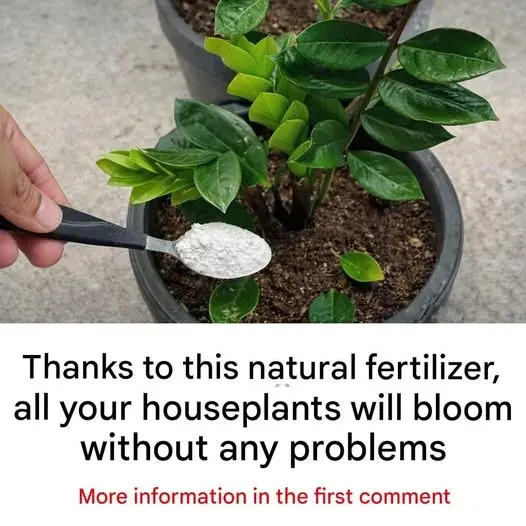
The spoon and plant in the original photo
The plant appears to be a ZZ plant. The white powder on the spoon is not identifiable from appearance. The photo does not establish that all houseplants will bloom after receiving it; ZZ plants are commonly grown for foliage, and different species need different conditions. Do not add an unknown powder to the pot. The measured feeding advice below concerns identified products or materials.
Why houseplants need a lighter touch
Outdoor garden soil is continually influenced by rain, roots, leaf litter, organisms, and seasonal weather. A houseplant pot is a much smaller system. Watering can move nutrients out through the drainage hole, while repeated feeding can leave minerals behind as the pot dries. That is why houseplant feeding is less about finding the strongest natural ingredient and more about matching the plant, potting mix, light level, and season. The University of Minnesota Extension explains that container plants can lose nutrients through repeated watering and that an all-purpose fertilizer supplies major nutrients such as nitrogen, phosphorus, and potassium as well as smaller-amount nutrients like iron, manganese, and zinc https://extension.umn.edu/garden-and-home/yard-and-garden/gardening-in-minnesota/fertilizing-and-watering-container-plants.
For indoor foliage plants, more fertilizer does not automatically mean better leaves. In dim rooms, during short winter days, or after a recent repot into fresh potting mix, the plant may be using nutrients slowly. Illinois Extension advises fertilizing houseplants only when they are actively growing and notes that many houseplants do not need feeding more often than every one to three months between March and September https://extension.illinois.edu/houseplants/care. That slower rhythm is useful for natural products too. Organic and natural-sounding inputs can still be over-applied.
What counts as a natural fertilizer indoors
In practical houseplant care, “natural fertilizer” usually means a plant feed made from once-living material or its by-products, or a mild soil amendment that contributes nutrients slowly. Illinois Extension describes organic materials as coming from living or once-living organisms or their waste, and lists examples such as compost, composted manure, fish emulsion, kelp meal, and earthworm castings https://extension.illinois.edu/news-releases/understanding-three-different-types-organic-based-soil-fertility. For houseplants, the most convenient options are usually castings, finished compost, and packaged organic liquid feeds labeled for indoor or container plants.
Worm castings are often the simplest natural choice for a living room plant shelf because they are mild, easy to portion, and less messy than many liquid by-products. University of Maryland Extension specifically names earthworm castings as an excellent houseplant fertilizer and also says a small amount of well-composted, screened leaf mold or compost can help supply micronutrients https://www.extension.umd.edu/resource/fertilizer-indoor-plants. The key words are “small amount” and “well-composted.” Finished material should look dark and crumbly, without recognizable food scraps, sour odor, or heat from active decomposition.
A simple feeding plan for common houseplants
A good plan starts with observation. If a pothos, philodendron, spider plant, peperomia, or similar foliage plant is producing new leaves in spring or summer, it can usually handle a modest feed. If the plant is sitting in low light, recently stressed from a move, or barely growing, wait. The Royal Horticultural Society says foliage houseplants benefit from a liquid general-purpose or houseplant feed once or twice a month from March to October, while cacti and succulents are generally fed less often and during their own active season https://www.rhs.org.uk/garden-jobs/nutrition-feeding-plants.
- For leafy tropical plants: use a thin layer of worm castings on the pot surface, or use a diluted labeled organic liquid feed during active growth.
- For flowering houseplants: choose a product intended for flowering indoor plants rather than guessing with kitchen leftovers.
- For orchids: use an orchid-specific feed, because bark-based orchid mixes behave differently from regular potting mix.
- For cacti and succulents: feed lightly and less often, and never use fertilizer to compensate for poor light or soggy soil.
- For newly repotted plants: check whether the potting mix already contains slow-release fertilizer before adding anything else.
Why baking soda is not a houseplant fertilizer
Baking soda is often promoted online as a natural plant booster, but it is not a balanced plant food. Fertilizers are useful because they provide nutrients plants can use, especially nitrogen, phosphorus, potassium, and other essential elements. Baking soda is better understood as an alkaline household compound, not as a source of those core fertilizer nutrients. In a pot, where minerals cannot disperse the way they might outdoors, repeated additions of salty or alkaline materials can create problems instead of solving them.
This distinction matters because many houseplant problems have nothing to do with needing more fertilizer. Yellowing leaves may come from overwatering, poor drainage, cold drafts, low light, an old compacted potting mix, or soluble salt buildup. University of Maryland Extension explains that soluble salts can accumulate in potting medium as water evaporates, and symptoms may include reduced growth, brown leaf tips, lower leaf drop, dead root tips, and wilting https://www.extension.umd.edu/resource/watering-indoor-plants. Adding an unneeded kitchen substance can make diagnosis harder.
How to use compost and castings without smothering the pot
For an established houseplant, think of compost or castings as a light top-dressing, not as a thick mulch blanket. Loosen only the very top of the potting mix if you can do so without damaging surface roots, sprinkle on a thin layer, and water normally. For small pots, a teaspoon or two may be enough; for larger floor plants, a modest handful spread evenly is usually more sensible than a deep layer. The surface should still dry at a normal pace, and water should still pass through the container.
Compost quality is the difference between helpful and troublesome. Illinois Extension points out that compost is a soil amendment and that unfinished chunks can tie up nitrogen as they continue decomposing https://extension.illinois.edu/news-releases/understanding-three-different-types-organic-based-soil-fertility. Indoors, unfinished compost may also smell unpleasant or attract small flies. Use fully finished, screened compost only, and keep homemade materials out of pots if they are still identifiable as peelings, grounds, shells, or scraps.
Watering determines whether fertilizer helps or hurts
Fertilizer and watering cannot be separated in houseplant care. If a pot has no drainage hole, fertilizer residue has nowhere to go. If a saucer stays full, the bottom of the potting mix can remain too wet. If water is always added in tiny sips, minerals may collect near the root zone. University of Maryland Extension recommends watering from the top until water drains freely and emptying drainage saucers afterward; it also advises occasional leaching with clear water to reduce mineral buildup https://www.extension.umd.edu/resource/watering-indoor-plants.
A practical rhythm is to water according to the potting mix, not the calendar. Check the top layer and the weight of the pot. Many common houseplants prefer the upper part of the mix to dry somewhat before the next watering, while cacti and succulents usually need a longer dry interval. When you do feed, apply fertilizer to a plant that is already being watered appropriately. Fertilizer cannot fix roots that are sitting in stale, wet mix, and it cannot make up for a pot that has become too compacted for air and drainage.
When to pause natural fertilizer
Pause feeding if the plant is not actively growing, if the room is very dim, if you recently repotted into a fresh mix with built-in fertilizer, or if the plant is showing signs of stress that could come from watering, temperature, or pests. Illinois Extension warns that too much fertilizer can damage plants, especially when growth is slowed in dim light, and says strong mixtures should not exceed label directions https://extension.illinois.edu/houseplants/care. Natural products deserve the same respect: slow-release does not mean impossible to overdo.
Also pause if you see a pale crust on the potting mix or around the drainage hole, brown leaf tips appearing after several feedings, or wilting when the pot is not dry. Those signs can have more than one cause, but they are reasons to reassess before adding more. Leaching the pot with clear water, improving drainage, or repotting into a better mix may help more than another round of fertilizer. For seasonal houseplant timing, the related guide Reviving Houseplants in Autumn can help you think through light and growth changes as days shorten.
Natural does not mean every household leftover belongs in a pot
Coffee grounds, banana peels, eggshells, and vegetable scraps are better suited to a managed compost system than to the surface of an indoor pot. In a small container, raw scraps break down unevenly and do not deliver a predictable nutrient profile. They can also change moisture patterns at the surface. If you like the idea of recycling kitchen material, compost it fully first, then use the finished product sparingly. That gives the plant a stable amendment instead of a miniature waste pile.
Be cautious with acidic or alkaline “hacks” as well. Houseplants differ in what potting mix they prefer, and the right adjustment for one plant can be wrong for another. For example, lemon juice and similar household acids are often discussed online, but they are easy to misuse in a pot. For a closer look at that specific claim, see Should You Use Lemon Juice on a Snake Plant?. A better general rule is to choose the right plant for the light you have, water well, and use a real plant feed at a restrained rate.
A decision guide before you feed
Before you reach for any fertilizer, ask four questions. Is the plant actively making new leaves, stems, roots, or buds? Is the potting mix draining well? Has the plant gone several months without fresh mix or feed? Is the plant in enough light to use what you add? If the answer to all four is yes, a gentle natural feed is reasonable. If not, solve the limiting condition first. A low-light plant usually needs better placement more than more nutrients, and a waterlogged plant needs air around its roots before it needs castings.
For fragrant or flowering indoor plants, feeding is only one part of the story. Light, maturity, plant type, humidity, and rest periods can all influence flowering. If your goal is a more rewarding indoor plant collection, pair this feeding guide with Houseplants That Make Your Home Smell Incredible, then choose plants whose needs fit your rooms. Fertilizer supports growth that the plant is already ready to make; it does not override the basic conditions of the space.
The bottom line
The most dependable natural fertilizer routine for houseplants is modest and boring in the best way: use finished compost or worm castings lightly, choose labeled organic liquid feeds when you need a more controlled option, feed mostly during active growth, and let excess water drain. Avoid treating baking soda or raw kitchen scraps as houseplant fertilizer. In a small indoor pot, restraint is not a lack of care; it is the care.
Wrap-Up
Natural fertilizer can be useful for houseplants, but the safest practical approach is measured feeding during active growth. Worm castings, screened finished compost, and labeled organic liquid feeds are better choices than improvised kitchen powders. Watch the plant, the light, the potting mix, and the drainage before adding anything. If the plant is resting, stressed, newly repotted, or sitting in soggy soil, pause fertilizer and fix the growing conditions first.
Frequently Asked Questions
- → What is the best natural fertilizer for most houseplants?
For many common foliage houseplants, worm castings are a practical first choice because they are mild and easy to apply as a thin top-dressing. A labeled organic liquid houseplant feed is better when you want more predictable application instructions.
- → Can I use baking soda as fertilizer for houseplants?
No. Baking soda is not a balanced plant food and should not be used as a routine fertilizer. Houseplants need actual plant nutrients, and repeated additions of household salts or alkaline materials can create problems in a small pot.
- → How often should I fertilize indoor plants naturally?
Feed mainly while the plant is actively growing, usually spring through early fall for many foliage plants. Many houseplants need only occasional feeding, and low-light or slow-growing plants need less than plants in bright conditions.
- → Are coffee grounds good for houseplants?
Used coffee grounds are better composted first than placed directly into indoor pots. Raw grounds can affect surface moisture and do not provide a controlled plant feed. If you use compost made with coffee grounds, make sure it is fully finished and apply only a thin amount.
- → What signs suggest I used too much fertilizer?
Possible warning signs include brown leaf tips, a pale crust on the potting mix or pot edge, weak stretched growth, lower leaf drop, or wilting when the pot is not dry. These signs can have several causes, so pause feeding and check watering, drainage, light, and potting mix condition.
References
This content was developed and refined using reliable sources.
- https://www.extension.umd.edu/resource/fertilizer-indoor-plants
- https://www.extension.umd.edu/resource/watering-indoor-plants
- https://extension.umn.edu/garden-and-home/yard-and-garden/gardening-in-minnesota/fertilizing-and-watering-container-plants
- https://extension.illinois.edu/news-releases/understanding-three-different-types-organic-based-soil-fertility
- https://extension.illinois.edu/houseplants/care
- https://www.rhs.org.uk/garden-jobs/nutrition-feeding-plants