 Save
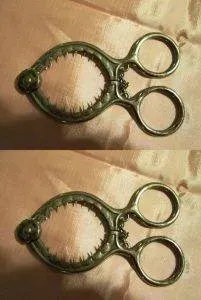
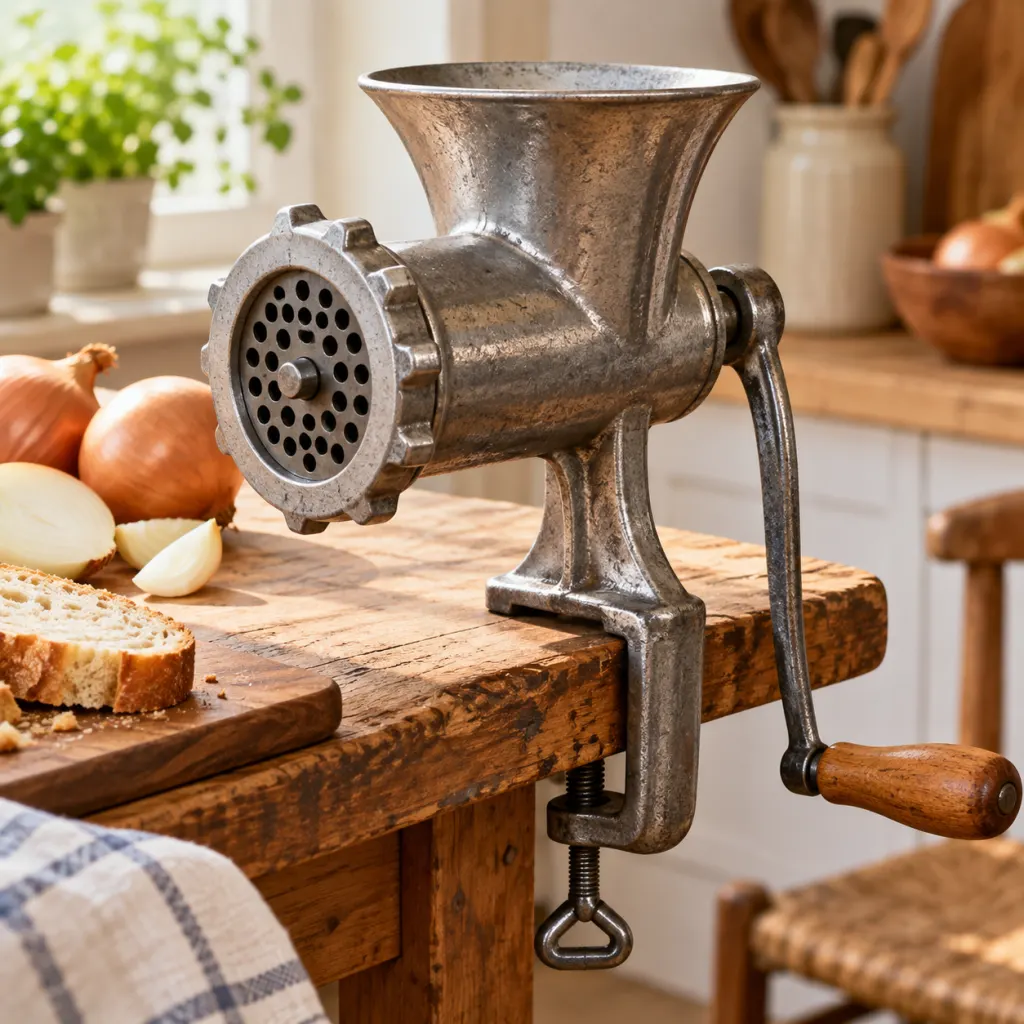
The short answer: that mysterious vintage metal object with a side crank, clamp, hopper, and round opening is usually a hand-cranked food chopper, often called a meat grinder. It was a practical kitchen tool before electric food processors became common, turning scraps, cooked meat, raw meat, vegetables, nuts, bread, and other foods into small, even pieces. One famous version, the Universal Food Chopper, was made by Landers, Frary & Clark and is described by the National Park Service as a late-19th-century tool that ground meat and processed vegetables in American kitchens.
Why the Object Looks More Like Workshop Hardware Than Kitchenware
Part of the puzzle is its shape. A hand-cranked food chopper is heavy, mechanical, and unsentimental: cast metal body, exposed clamp, screw handle, circular front plate, and a wooden or metal grip on the crank. Without a bowl of food nearby, it can look like a small vise, a farm implement, or a machine-shop accessory. That is exactly why these objects do so well in online guessing games. They were designed for leverage and durability, not for the soft visual language of modern countertop appliances.
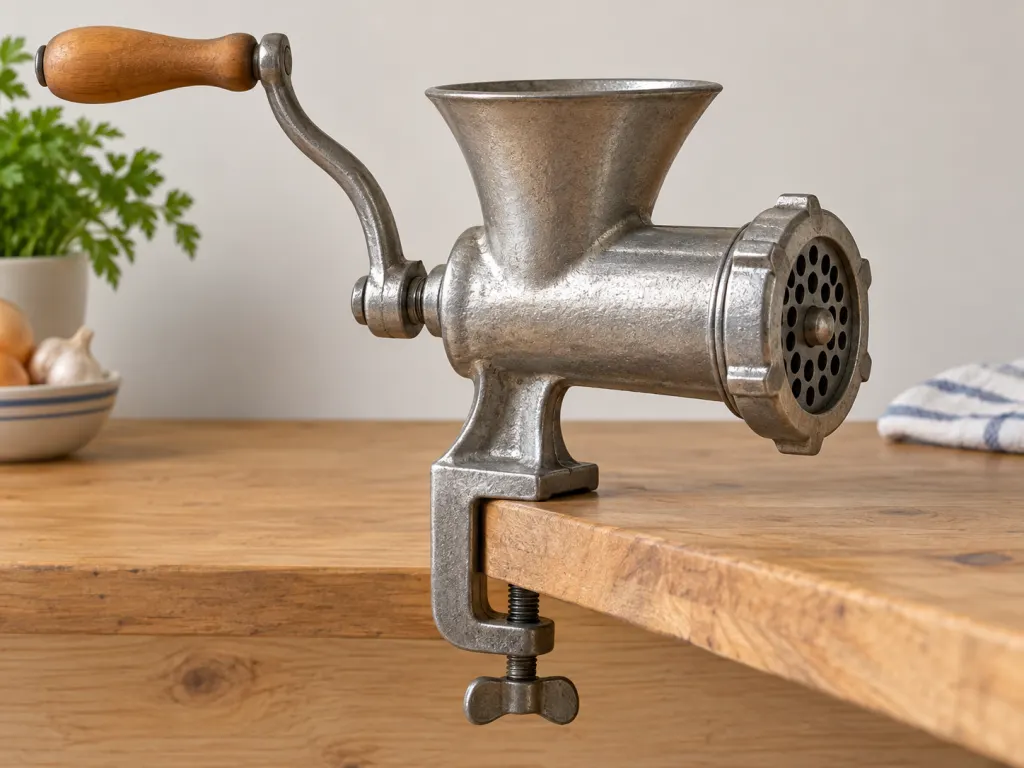
The basic layout is surprisingly easy to read once you know what to look for. Food goes into the top opening, often called the hopper. Turning the crank rotates an internal screw or forcing mechanism that pushes food toward a knife and perforated plate. The food exits through the round front plate in small pieces. The clamp underneath grips the edge of a table or counter so the tool does not walk away from the cook while the crank is turning.
The Universal Food Chopper Connection
The best-known American example is the Universal Food Chopper. The National Park Service notes that the tool was manufactured by Landers, Frary & Clark of New Britain, Connecticut, and that it was first sold in 1897. The same source describes it as popular enough to remain in the company catalog more than sixty years later, with different sizes and blade attachments for fine, medium, or coarse grinding documented in a museum collection note.
That long production life explains why many people recognize the silhouette from grandparents' kitchens, estate sales, antique shops, or farmhouse displays. It was not a novelty item. It was a labor-saving tool for everyday cooking at a time when chopping by hand could mean using a curved chopping knife and bowl, then cleaning up uneven bits from a long prep session. A crank-operated chopper helped turn leftover roast into hash, stale bread into crumbs, vegetables into relish, and meat into a texture ready for patties, sausage mixtures, or casseroles.
How the Tool Changed Home Prep Work
Before small electric appliances, home cooks relied on muscle, sharp edges, and repeatable motion. A hand-cranked chopper did not remove the work completely, but it made the work more consistent. Instead of rocking a knife over a bowl again and again, the cook could feed pieces through the hopper and collect chopped food below. The result was usually more uniform than hand chopping, especially when the tool was assembled with the right plate.
That consistency mattered. A coarse plate could leave texture in cooked meat or vegetables. A finer plate could make a smoother mixture for spreads, fillings, or loaves. Interchangeable parts made one tool serve several jobs, which was important in kitchens where storage space and money were limited. The same clamp-on body could help with weeknight leftovers, holiday pies, pickles, croquettes, or sausage-making.
How to Identify One in the Wild
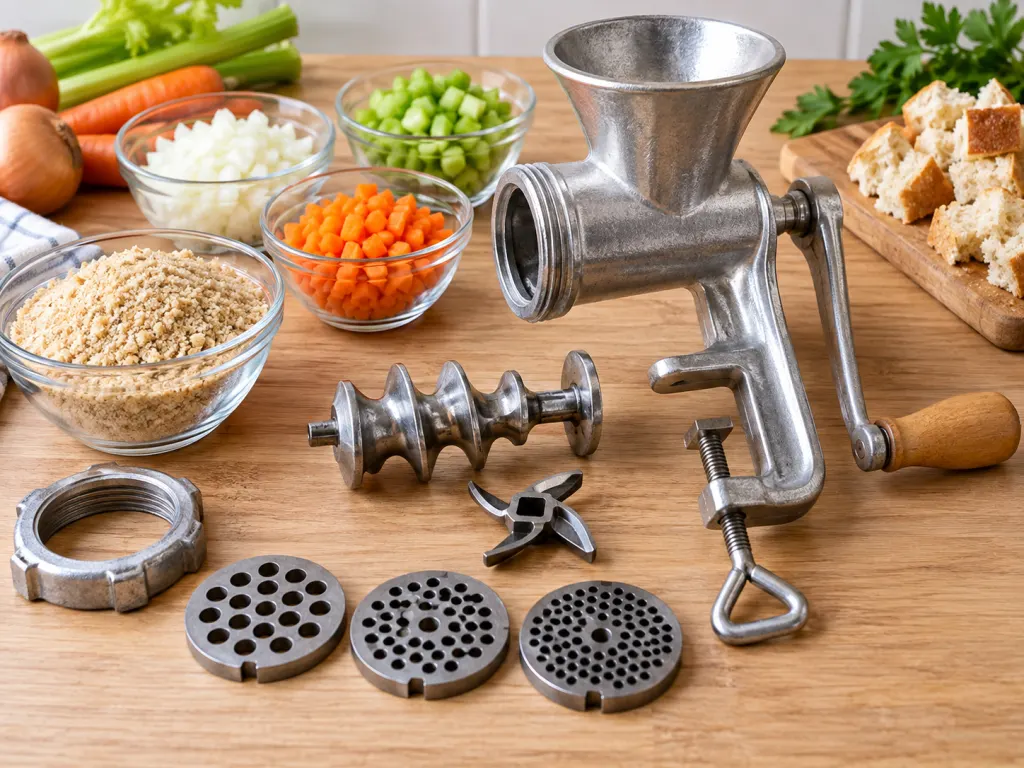
If you find a mystery metal crank tool in a drawer, shed, attic, or flea-market bin, look for the whole pattern rather than one feature. A hand-cranked food chopper usually has several of these clues:
- A hopper or funnel-shaped top: the entry point where food was dropped in.
- A side crank: the handle that turns the internal screw or cutter.
- A round front plate: often perforated, where chopped food exits.
- A retaining ring or nut: the threaded piece that holds the plate and knife in place.
- A clamp or screw base: the part that anchors the tool to a table edge.
- Size numbers or maker marks: marks such as No. 0, No. 1, No. 2, or a brand name can point to model size.
What the Numbers, Plates, and Attachments Mean
Numbers on old choppers usually refer to size, not mystery settings. The National Park Service explains that, on the Universal Food Chopper it describes, the number 2 referred to the grinder size, with other models larger or smaller. Plates and cutting parts controlled texture. A plate with larger holes produced a coarser result; smaller holes produced a finer result. Some sets came with multiple plates, though surviving tools are often missing one or more original pieces.
Could It Still Be Used Today?
Sometimes, yes, but the better question is whether a specific old tool should be used. A vintage chopper may have rust, worn plating, cracked handles, missing washers, dull blades, or metal surfaces that are hard to clean. Some were used for decades and then stored in damp basements or garages. Even if the mechanism turns, that does not automatically make it ready for food.
For display, a dry, gently cleaned tool can be charming on a kitchen shelf. For food contact, inspect every surface that would touch food. Look for flaking metal, deep pitting, loose parts, sharp burrs, and unreachable crevices. If a tool has decorative value but uncertain materials or damage, it is wiser to treat it as a historical object rather than a working appliance.
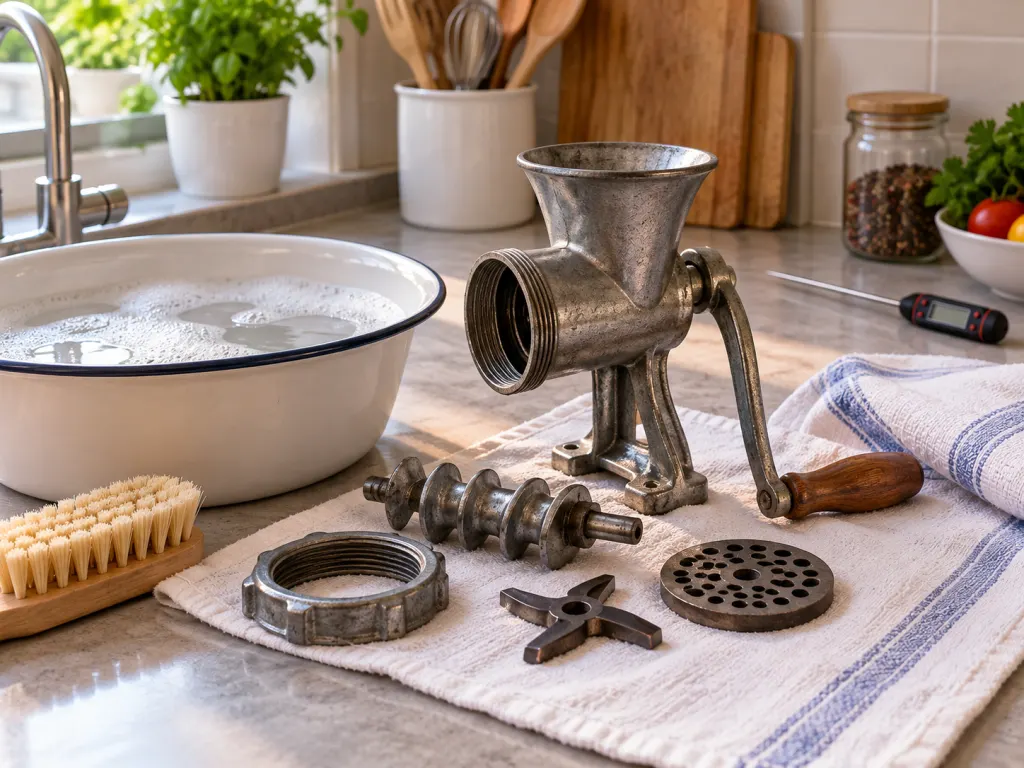
Cleaning, Cross-Contact, and Modern Food Safety
Hand-cranked choppers have many seams, threads, and interior surfaces, which is why cleaning matters if a modern cook uses one. FoodSafety.gov summarizes the core home food safety pattern as clean, separate, cook, and chill, including washing utensils and surfaces with hot, soapy water after contact with raw meat, poultry, seafood, eggs, or flour in its four-step guidance. The CDC similarly advises washing utensils, cutting boards, and countertops after preparing each food item and keeping raw meat and seafood separate from foods that will not be cooked in its food poisoning prevention guidance.
Ground meat deserves special attention because grinding distributes surface bacteria through the mixture. The FDA advises using a food thermometer because color and texture are unreliable indicators, and lists 160°F for ground meat as a safe minimum internal temperature in its safe food handling chart. The CDC's restaurant-focused ground beef page also highlights undercooking and cross contamination as practical risks, while noting that consumer guidance is to cook ground beef to 160°F for a simpler temperature standard.
When Display Is the Better Choice
Display is often the most sensible fate for a century-old kitchen tool. A chopper with its crank, clamp, and plate intact tells a story without needing to process a single onion. Mount it on a shelf, place it beside old recipe cards, or pair it with a wooden cutting board so viewers immediately understand its kitchen setting. Avoid polishing it so aggressively that the age disappears. A little patina helps explain that it belonged to a different working kitchen.
Why People Still Find It Fascinating
The fascination comes from the gap between recognition and uncertainty. Older relatives may see a food chopper immediately; younger viewers may see only a strange metallic object. That split makes the tool feel mysterious, even though its purpose was practical. It also reminds us that kitchen technology changes quietly. Many tools that once felt ordinary become puzzling after a few generations because the movements they required disappear from daily life.
There is also something satisfying about how understandable the mechanism is. You can see where the food enters, where the hand supplies power, where the tool grips the table, and where the chopped food exits. Unlike many sealed modern appliances, a hand-cranked chopper shows its logic. That visible logic is part of its appeal as both an antique and a teaching object.
The Takeaway
If the mystery object has a clamp, crank, hopper, and perforated round front, the best identification is a hand-cranked food chopper or meat grinder. It belonged to the era of durable, repairable kitchen equipment, when one sturdy appliance could help with leftovers, relishes, sausages, crumbs, and everyday chopping. Today, it is just as useful as a conversation piece as it is as a tool, especially when age, materials, or cleanliness are uncertain.
Wrap-Up
A mysterious crank-operated metal kitchen object is usually a hand-cranked food chopper, with the Universal Food Chopper among the most recognizable examples. Its job was to make chopping and grinding faster and more uniform before electric processors became common. If you find one, identify it by the hopper, crank, clamp, front plate, maker marks, and size number. Use caution before putting any antique food-contact tool back into service; many are better preserved as display pieces that tell the story of practical home cooking.
Frequently Asked Questions
- → What was the mysterious vintage kitchen tool used for?
It was most often used to chop or grind food by hand. Common jobs included grinding meat, chopping cooked leftovers, making bread crumbs, preparing vegetables for relish, and creating even textures for fillings or casseroles.
- → Is a hand-cranked food chopper the same thing as a meat grinder?
The terms overlap. Many household food choppers were marketed for meat, but they could also process vegetables, bread, nuts, and other foods. A meat grinder is usually a type of food chopper designed around a screw feed, cutting knife, and perforated plate.
- → Why does it have a clamp on the bottom?
The clamp anchors the tool to the edge of a table or counter. Cranking creates sideways force, so the clamp keeps the chopper steady while food is pushed through the cutter and plate.
- → Can I use an antique food chopper I found at a flea market?
Only after careful inspection and cleaning, and only if all food-contact surfaces are sound. Rust, deep pitting, flaking metal, missing parts, or hard-to-clean crevices are reasons to keep it as a display piece instead.
- → What should I look for if I want to identify the maker?
Check the body, clamp, crank, plate, and retaining ring for raised lettering, stamped numbers, patent dates, or brand names. Photograph those details before cleaning because they can help identify the model and approximate period.
References
This content was developed and refined using reliable sources.
- https://home.nps.gov/articles/000/universal-food-chopper.htm
- https://www.foodsafety.gov/keep-food-safe/4-steps-to-food-safety
- https://www.cdc.gov/food-safety/prevention/index.html
- https://www.fda.gov/food/buy-store-serve-safe-food/safe-food-handling
- https://www.cdc.gov/restaurant-food-safety/php/practices/ground-beef-handling.html