 Save
This is an original work of fiction. The characters, dialogue, and events are invented. The story touches on family pressure, shared money, and leaving a tense household; readers facing real financial or relationship concerns should seek trusted professional guidance. For general background, the Consumer Financial Protection Bureau explains that joint account rules can vary by agreement and state law, and Canada.ca describes economic control as a form of harm that can affect a person’s independence.
1. The Chair at the End of the Table
The roast chicken had been on the table for six minutes when Mara realized no one had touched it. The skin was still shining under the dining room light, crisp at the edges, fragrant with lemon and thyme, resting on the blue platter her mother had given her when she and Daniel first moved into the house. The potatoes steamed beside it. The salad wilted slowly in its bowl. Seven people sat around the table with forks in their hands, all of them waiting for Mara to become smaller.
Daniel’s sister, Tessa, leaned back in the chair at the end of the table as if she were the guest of honor at someone else’s trial. She wore a cream sweater too fine for the heat coming off the oven, her copper hair pinned loosely at the nape of her neck, her mouth folded into a patient little line. Mara had known that expression for eight years. It meant Tessa had already decided what kind of person Mara was, and the evening was only a ceremony for making everyone else agree.
Daniel sat beside Mara, close enough that his knee touched hers under the table. He did not look at her. That was the first real cut of the night, though not the loudest. He looked instead at the platter, at his water glass, at the scratch in the oak table he had once promised to sand out. His silence had weight. It pressed against Mara’s ribs until breathing felt like asking permission.
Across from them, Daniel’s parents watched with the careful helplessness of people who had spent a lifetime calling conflict bad manners. His father, Grant, adjusted his napkin over and over. His mother, Ellen, rubbed her thumb along the stem of her wineglass. Mara’s younger brother, Jonah, had come because it was Mara’s birthday dinner, and his eyes moved from face to face with a growing fury he was trying to keep civilized.
Then Tessa said, softly enough to pretend she had not intended everyone to hear, “I just think families work better when people remember who welcomed them first.”
Mara set down the carving knife. The sound of metal against porcelain was small and final.
“Tessa,” she said, “I have spent all afternoon cooking for this family.”
“Cooking is not the same as gratitude.” Tessa smiled without warmth. “But I know you like things that can be measured.”
Daniel’s jaw tightened. Mara saw it and, for a foolish second, believed he was about to defend her. He had heard the same insinuations for months. That Mara had made Daniel less available. That she had turned the house cold. That she cared more about her promotion, her careful spreadsheets, her locked office drawer, than she cared about the family that had “taken her in.” As if Mara had been a stray thing on a doorstep and not a woman who had brought half the down payment, rebuilt the back garden, and learned Ellen’s soup recipe because Daniel missed it in winter.
Daniel pushed back from the table. His chair legs dragged against the floor.
“Enough,” he said.
Mara looked at him, grateful before she understood.
He turned to her. His face was pale, almost polished clean of feeling. “Apologize to my sister or get out of my house.”
The room changed shape. Mara could feel it happen. The ceiling seemed lower. The hallway behind her seemed longer. Her house, the house whose gutters she had paid to replace, whose kitchen walls she had painted twice until the green stopped looking hospital-sick and started looking alive, suddenly became a place with a gate in the middle of it.
Jonah said, “Daniel.”
But Mara lifted one hand without looking away from her husband. Not to silence her brother. To steady the air.
“Say that again,” she said.
Daniel’s eyes flickered. A good man might have heard himself. A frightened man might have stepped back from the edge. Daniel did neither. “You heard me.”
Mara wiped her hands on the towel beside the platter. Her palms smelled of garlic and lemon zest. She walked slowly around the table, past Ellen’s trembling wineglass, past Grant’s bowed head, until she stood behind Tessa’s chair.
Tessa’s smile sharpened. She expected surrender. Maybe she had planned for tears, a brittle apology, a wounded little speech that Daniel could later call dramatic. Mara placed one hand on the chair back and bent close enough that only Tessa and the people holding their breath could hear her clearly.
“I will apologize,” Mara said, “when you explain why my grandmother’s bracelet was listed under your name at Clifton Pawn.”

2. The Sound After a Secret Lands
No one moved. Not even Tessa, though the color left her face so quickly it seemed to drain into the collar of her sweater. Daniel blinked as if Mara had slapped him, but she had not raised her voice. That was the power of the sentence. It entered the room quietly and sat down among them.
“What bracelet?” Ellen asked.
Mara straightened. The ache in her chest had become something colder and easier to hold. “The gold bracelet with the broken clasp. The one my grandmother wore every Sunday. The one I kept in the cedar box in our bedroom closet.”
“Mara,” Daniel said, warning threaded through her name.
She turned to him then. “No. You do not get to warn me in a room where you just told me I was a guest in my own life.”
Grant coughed once into his fist. Ellen’s eyes filled with tears, though Mara could not tell for whom. Tessa’s husband, Paul, who had arrived late and spent most of dinner answering emails under the table, finally put his phone face down beside his plate.
“Tessa?” Paul said.
Tessa laughed. It was the wrong sound. Too high, too quick. “This is ridiculous. She is making things up because Daniel finally put his foot down.”
Mara felt Jonah stand behind her. He had always been tall, but in that moment his presence felt like a wall built at her back. “My sister doesn’t make things up,” he said.
Mara wished that were completely true. She had made things up for years. She had made up reasons why Daniel forgot her meetings but remembered Tessa’s errands. She had made up explanations for the envelope of cash she once found in his glove compartment, for the way he turned his phone over when she entered the room, for the sudden chill that spread through the family whenever she mentioned selling the lake lot Daniel’s parents had given them as a wedding gift. She had made up entire weather systems of excuse and walked through them without an umbrella.
Two weeks earlier, she had stopped.
It had been a Tuesday morning, raining hard enough that the gutters overflowed. Mara was looking for the car registration before work. Daniel had borrowed her car the night before because his was “making a noise,” though the mechanic later found nothing wrong. In the glove compartment, beneath napkins and a parking receipt, she found a folded paper with her name misspelled in someone else’s handwriting. It was a pawn shop intake copy. The item description was precise: gold bracelet, floral engraving, damaged clasp. The customer name was Tessa Vale.
At first Mara did not feel anger. She felt an absurd embarrassment, as if she had walked in on a private conversation and should apologize for noticing. Then she went upstairs to the cedar box. The bracelet was gone. In its place lay the white tissue she had wrapped around it, folded carefully enough to look undisturbed.
She did not confront Daniel that morning. She took a picture of the pawn slip, drove to work, closed her office door, and sat with both hands flat on her desk until the shaking stopped. By noon, she had called Clifton Pawn. By two, she had learned that the bracelet had already been redeemed in cash by the same person who brought it in. By four, she had printed bank statements Daniel assumed she never checked because he handled the “household side” of things.
The statements did not shout. That almost made them worse. Small withdrawals. Rounded amounts. Transfers labeled with words so ordinary they seemed sleepy: repair, advance, family, materials. Money had been leaving their shared accounts like heat through a cracked window.
For readers facing a real-life version of shared-account confusion, the details can depend on account agreements and local law; the Consumer Financial Protection Bureau notes that, in many circumstances, either owner of a joint checking account may withdraw funds or close the account. This fiction is not legal guidance, but it rests on the very real fact that money and control can become tangled inside close relationships.
Now Daniel stood in the dining room doorway, looking not guilty yet, only furious that Mara had changed the script.
“We can talk about this later,” he said.
“No,” Mara said. “Later is where all your truths go to disappear.”
3. The Drawer Daniel Never Opened
There are moments in a marriage that teach you what kind of silence you have been living inside. Mara had learned many. Daniel’s silence after her first miscarriage, when he went out to mow the lawn because he did not know what else to do. Daniel’s silence when she asked why Tessa had a key to their house and he said, after too long, “It’s just family.” Daniel’s silence the night Mara’s promotion was announced and Tessa told the room that some managers liked “ambitious women who knew how to smile.”
That last silence had rearranged something in Mara, though she pretended it had not. She laughed with everyone else because the alternative was to make the evening difficult. She washed dessert plates. She thanked Ellen for bringing flowers. Later, in bed, she said, “I needed you to say something.”
Daniel stared at the ceiling. “Tessa didn’t mean it like that.”
“She meant it exactly like that.”
“You’re sensitive when it comes to my family.”
After that, Mara began keeping copies. It shamed her at first, the quiet archive of a woman who no longer trusted the person sleeping beside her. Screenshots of messages that changed tone when she entered the room. Photos of receipts. A list of dates when Daniel said he was with Grant but Grant later mentioned being elsewhere. A copy of the pawn slip. Bank statements in a blue folder in the locked drawer of her desk.
The drawer had been Daniel’s joke for months.
“What do you keep in there?” he would ask. “State secrets?”
“Receipts,” she always said.
He never asked which kind.
At the table, Tessa recovered first. “This is disgusting,” she said, pushing her chair back. “You invite us here, then accuse me in front of everyone?”
“You accused me in front of everyone for almost a year,” Mara said. “You just did it with better lighting.”
Daniel stepped toward Mara. Jonah stepped too. The movement was small, but Daniel saw it and stopped.
“Give me your phone,” Daniel said.
Mara almost laughed. “No.”
“You are twisting things.”
“Then untwist them.”
Paul had gone very still. “Tessa, why would your name be on a pawn slip for Mara’s bracelet?”
Tessa looked at Daniel before she answered. That was what ended the room’s last illusion. Not the bracelet. Not the money. That glance. It traveled from sister to brother with the intimacy of people who had spoken about this already, maybe many times, and had not expected anyone else to learn the language.
Ellen covered her mouth.
“It was temporary,” Daniel said.
Mara felt the sentence move through her like winter water. “You knew.”
“I handled it.”
“You handled my grandmother’s bracelet being taken from our closet?”
“Tessa was desperate.” His voice softened, which somehow made it uglier. “Paul’s contract was delayed. There were bills. She was going to put it back.”
Paul rose from his chair. “What bills?”
Tessa whispered, “Paul, please.”
Mara looked at Daniel, trying to find the man who once drove forty minutes through a storm because she had mentioned craving cinnamon rolls. She found his face, his hands, the familiar scar near his thumb. But the man himself seemed to have stepped behind a wall built from excuses.
“Did you give her money from our account?” Mara asked.
Daniel said nothing.
That was answer enough.
4. The House Learns Its Real Owner
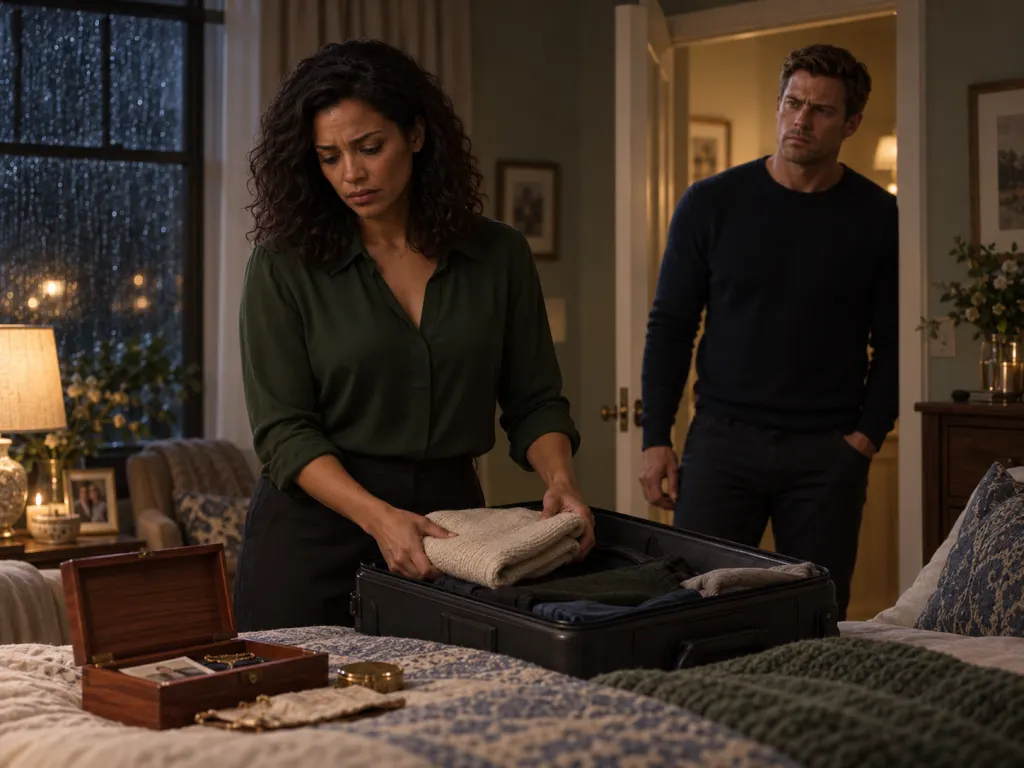
People imagine leaving as a grand gesture. Mara discovered it was mostly logistics. She walked upstairs while voices cracked open below her. She pulled a small suitcase from the closet. Her hands, so steady in the dining room, shook when she folded jeans. She packed three sweaters, two work dresses, her passport, the folder from the locked drawer, the earrings her mother had worn to Mara’s wedding, and the cedar box even though it was empty.
Daniel followed her. He stood in the bedroom doorway, blocking the hall as if the house itself had appointed him guard.
“You embarrassed me,” he said.
Mara put socks into the suitcase. “That is what you noticed?”
“You attacked my sister.”
“Your sister took something from me. You covered for her. Then you told me to apologize.”
“Because you always make everything harder than it has to be.”
She looked up. The bedroom lamp threw warm light across his face, and for one terrible second she wanted him to cry. She wanted him to collapse under the weight of what he had done, not because tears would fix anything, but because remorse would prove she had not loved a locked room.
He did not cry.
“Move,” she said.
“This is our house.”
“Ten minutes ago it was yours.”
He flinched. Good, she thought, then hated that she wanted the words to hurt. But pain was the only language left in the room that both of them seemed to understand.
Downstairs, Paul’s voice rose. “How much?”
Tessa answered too softly to be heard.
Grant said, “Daniel, come down here.”
Mara zipped the suitcase. Daniel reached for it, then stopped himself. That restraint, late and thin as paper, almost undid her.
“Where will you go?” he asked.
“Jonah’s tonight.”
“You hate his couch.”
“I hate being ordered out of my own home more.”
Daniel sank onto the edge of the bed. “I was trying to keep the family together.”
Mara stood with the suitcase handle in her hand. “No. You were keeping the version of the family where I absorb the damage quietly.”
He pressed his palms to his eyes. “Tessa was scared.”
“So was I.”
“Of what?”
The question left her breathless. Not because it was cruel, though it was, but because he truly did not seem to know. How do you explain fear to the person who keeps naming it inconvenience? How do you describe the sensation of checking your own jewelry box in secret, of logging into bank accounts with your heart thudding, of rehearsing normal smiles because the dinner guests are already on their way?
“Of finding out this was who you are,” she said.
Daniel looked at her then. The first crack appeared, but it was not enough to live in.
Mara went downstairs. The dining room smelled of cooling chicken and spilled wine. Tessa was crying now, one hand pressed to her mouth. Paul stood apart from her, his face gray. Ellen clutched a napkin as if it were a letter she could not finish reading.
Jonah took Mara’s suitcase without a word.
At the door, Daniel said, “If you leave tonight, don’t expect me to beg tomorrow.”
Mara turned. “I stopped expecting that a long time ago.”
5. Jonah’s Couch and the Morning After
Jonah’s apartment smelled like coffee, laundry soap, and the basil plant he kept forgetting to water. His couch was indeed terrible. It sagged in the middle and held a permanent chill no blanket could cure. At two in the morning, Mara lay awake under a quilt while the city hummed beyond the windows, her phone lighting up every few minutes on the coffee table.
Daniel called twelve times. He texted apologies that were really negotiations. Come home and we’ll talk. You made your point. I shouldn’t have said it like that. Tessa is a mess. Mom is crying. You’re blowing up everyone’s life.
Mara read each message once and did not answer.
At three, Jonah padded out of his bedroom in socks and handed her a mug of tea.
“I heard your phone,” he said.
“Sorry.”
“Don’t apologize to me either.”
That made her laugh, a small broken sound that surprised them both. Jonah sat on the floor with his back against the couch.
“Do you want advice,” he asked, “or do you want me to hate him quietly?”
“Quietly for now.”
“Great. I’m gifted at that.”
They sat in the half-dark, siblings again in the old way, side by side against a night too big for either of them. Mara told him about the pawn slip. The transfers. The folder. The way Daniel had made her feel unreasonable for asking questions about money she had earned. Jonah did not interrupt. That was his real gift, beneath the jokes. He could let a person tell the whole ugly shape of a thing without trying to fold it into something neat.
“I should have told you sooner,” Mara said.
“Maybe,” Jonah said. “But people tell the truth when they can survive hearing it out loud.”
In the morning, Mara called in sick to work, though she was not sick in any ordinary sense. She was tender and furious and strangely alert, as if every object had acquired a sharp outline. Jonah drove her to the bank first. Then to a lawyer whose office had a ficus tree in the corner and a receptionist with kind eyes.
The lawyer, Priya Sane, listened carefully, asked clear questions, and did not make dramatic promises. Mara appreciated that more than comfort.
“Bring every statement you can access,” Priya said. “Make a timeline. Keep communication written when possible. Do not empty accounts in anger. Do not threaten. Do not guess. We work with proof.”
Proof. The word sounded plain and merciful.
Outside fiction, economic pressure inside families can take many forms. Canada.ca describes economic control as conduct that can limit a person’s financial freedom, including misuse of money or accounts. Mara did not have a government definition in her head as she left the office; she had only a folder under her arm and the dawning knowledge that confusion had served Daniel better than clarity ever would.

6. What Tessa Wanted Back
Tessa came to Jonah’s apartment three days later carrying a bakery box. It was a strange peace offering, not because Mara disliked pastries, but because Tessa had never arrived anywhere holding something she had not first calculated. Jonah opened the door, looked at the box, and said, “We’re not doing frosting diplomacy.”
“I need to talk to Mara.”
“Mara decides that.”
Mara heard them from the kitchen. Her coffee went cold in her hands.
“It’s okay,” she said.
Tessa entered as if stepping into a room where every surface might accuse her. Without the cream sweater and the dinner table, she looked younger. Not innocent. Just tired in a way Mara had never bothered to imagine.
“I brought almond croissants,” Tessa said.
“I’m allergic to almonds.”
Tessa closed her eyes. “Right.”
Jonah muttered something under his breath and took the box away.
They sat at the kitchen table. Tessa kept her hands folded so tightly that her knuckles blanched. Mara waited. She had learned, in the last seventy-two hours, that silence could be a door instead of a trap if she chose where to stand.
“Paul left,” Tessa said.
Mara said nothing.
“He’s staying with his cousin. He says he doesn’t know what else I’ve lied about.”
“Does he?”
Tessa’s mouth trembled. “You’re enjoying this.”
Mara leaned back. “Be careful. That is the kind of sentence you use when you want my pain to look like cruelty.”
Tessa stared at her. Then, slowly, she looked down.
“I took the bracelet,” she said.
The words should have felt satisfying. They did not. They landed like a stone in a dry well.
“Daniel told you where it was?”
“He said you never wore it.”
Mara’s hands curled beneath the table. “So you thought it had no owner?”
“No. I thought...” Tessa wiped under one eye with the heel of her hand, angry at the tear. “I thought Daniel would fix it before you noticed.”
“That is not an apology.”
“I know.”
For the first time since Mara had known her, Tessa seemed to run out of performance. The air left her posture. Her shoulders lowered. “Paul’s business was failing. I didn’t want his parents to know. I didn’t want mine to know. Daniel said he could move money for a few weeks, make it look like invoices, then Paul would close a deal and we’d put everything back.”
“Everything,” Mara repeated. “My savings. My grandmother’s bracelet. My sense that I knew who slept beside me.”
Tessa flinched. Good, Mara thought again, and again did not like herself for needing it.
“I am sorry,” Tessa said.
“For taking it or for being caught?”
Tessa did not answer quickly. That was the only honest thing she had done.
“Both,” she said at last.
Mara looked toward the window. Across the street, a woman in a red coat guided a child through a puddle. The child jumped anyway, water flashing up in a silver burst, and the woman laughed before she remembered to scold. Life, rudely, kept offering ordinary beauty even while Mara’s own had split open.
“I am not the person who can make this easier for you,” Mara said.
“Daniel says you won’t answer him.”
“Daniel can learn to live with unanswered things.”
Tessa nodded. She stood, then paused in the doorway. “The bracelet is gone. I tried to get it back. They sold it.”
Mara had already known. Hearing it still hurt.
After Tessa left, Jonah came in holding the bakery box at arm’s length. “Do I throw these away ceremonially or practically?”
Mara looked at the box, then at her brother. Her laugh came easier this time, though tears followed it. “Practically.”
7. The Inventory of a Marriage
Over the next month, Mara learned the difference between loneliness and quiet. Loneliness was the first week, when every hour carried Daniel’s absence like a bruise. Quiet came later, in Priya’s office, in the bank lobby, in Jonah’s kitchen after he left for work and the apartment settled into its own modest rhythm.
She made lists. Assets. Debts. Questions. Dates. Items missing from the house. Items she did not miss at all. She discovered that grief could be administrative. It could wear reading glasses and highlight account numbers. It could sit on hold with customer service and still be grief.
Daniel’s messages changed shape. At first, he demanded. Then he apologized. Then he accused. Then he sent photographs of the dogwood tree in their front yard, blooming white against the fence, as if beauty were evidence in his favor.
I miss you, he wrote.
Mara typed and deleted twelve answers before sending one.
I miss who I thought we were.
He called immediately. She let it ring.
Paul contacted Priya through his own attorney. Grant admitted he had known about one transfer but not the bracelet. Ellen sent Mara a letter on pale blue stationery, three pages of sorrow that never quite became accountability. Tessa entered an agreement to repay what she could. None of it happened cleanly. There were arguments, revisions, missing documents, sudden bursts of outrage. But the fog thinned.
One afternoon, Mara went back to the house with Jonah and Priya’s assistant to collect her remaining belongings. Daniel was there. He had shaved badly. A strip of stubble ran along his jaw. The house looked staged by someone who knew the objects but not their meaning. The blue platter sat on the counter, washed and empty. Her grandmother’s cedar box was not there, because Mara had taken it. The absence seemed louder than the furniture.
Daniel followed her from room to room.
“We can still come back from this,” he said.
Mara lifted a stack of books from the shelf. “You keep saying this as if ‘this’ is a single event.”
“I made mistakes.”
“You made a system.”
He looked wounded. Once, that would have stopped her. She would have hurried to soften the sentence, to explain herself into forgiveness. Now she let the words stand.
In the bedroom, he touched the wall where their wedding photograph had hung. Mara had taken it down herself. The pale rectangle left behind looked like a window that opened onto nothing.
“I loved you,” he said.
“I believe you.”
That hurt him more than if she had called him a liar. His face crumpled around the truth of it.
“Then why are you doing this?”
Mara zipped the last bag. “Because love was never supposed to require me to disappear.”

8. The Door She Chose
By autumn, Mara lived in a second-floor apartment above a florist. The place was smaller than the house by half, with uneven floors and windows that rattled when buses passed. On Friday mornings, the shop downstairs opened early, and the scent of cut stems and damp leaves rose through the floorboards. Mara grew used to waking before her alarm to the sound of buckets being moved below.
She bought a round table from a thrift store and painted it dark green. She hung no wedding photos. She put the blue platter on an open shelf, not because it no longer hurt, but because it belonged to her history and she refused to exile every object Daniel had touched. Some evenings, Jonah came over with takeout. Some evenings, she cooked for herself and ate by the window, watching people carry flowers home to rooms she would never see.
The divorce did not feel like victory. It felt like weather clearing after weeks of low clouds. There was damage everywhere, but distance made repair imaginable.
Tessa sent one check every month. No notes. No excuses. Mara deposited them and kept copies. Paul filed separately. Ellen called once and cried until Mara gently said she had to go. Grant never called at all. Daniel wrote a letter in November, six pages in a handwriting that grew messier as it went. He said he understood more now. He said shame had made him defensive. He said he had confused loyalty with concealment. He said he knew he had no right to ask, but he hoped someday she might sit across from him and hear the whole apology.
Mara read the letter twice. Then she placed it in the cedar box with the pawn slip, the first bank statement, and a photograph of her grandmother wearing the bracelet at a picnic in 1978. The box had become less a grave than an archive. Proof that something had existed. Proof that something had been lost. Proof that loss had not ended her.
On her next birthday, Jonah organized dinner in her apartment. He burned the first tray of potatoes and blamed the oven with theatrical bitterness. Mara roasted a chicken. The skin crisped beautifully. The blue platter returned to the center of the table, carrying food this time instead of accusation.
Halfway through dinner, Jonah raised his glass.
“To my sister,” he said. “Who has never once overcooked a chicken and has only occasionally made terrifying life choices.”
Mara laughed. “That toast wandered.”
“It found its way home.”
After everyone left, Mara stood barefoot in the kitchen and washed the platter by hand. Warm water ran over her wrists. The apartment was quiet, but not empty. The city moved beyond the glass. Flowers slept in buckets downstairs. Somewhere, in some other house, someone was probably being asked to swallow a truth for the sake of keeping peace.
Mara dried the platter and set it back on the shelf.
She thought of Daniel at the dining room table, his voice hard with borrowed authority. Apologize to my sister or get out of my house. At the time, the sentence had felt like a door slammed in her face. Now she understood it differently. It had been a door opening. Brutally. Publicly. Without kindness. But open all the same.
She had walked through it carrying proof, grief, and one empty cedar box.
She had not apologized for telling the truth. She had not apologized for leaving. She had not apologized for becoming inconvenient to a lie.
And for the first time in years, standing alone in a kitchen that was entirely hers, Mara did not wait for anyone to tell her she was allowed to stay.
Wrap-Up
Mara’s birthday dinner becomes the breaking point when Daniel demands that she apologize to his sister or leave. Instead, Mara reveals the missing bracelet and hidden financial choices that have hollowed out her marriage. The story follows her through confrontation, departure, proof, grief, and the quieter strength of rebuilding a life where truth no longer has to ask permission.
Frequently Asked Questions
- → Is this story based on a verified real event?
No. This is an original fictional story using invented characters and events.
- → Why does the story include references?
The references support general background statements about shared accounts and economic control. They do not verify the fictional plot.
- → What is the central theme of the story?
The story centers on boundaries, family pressure, trust, and the moment a person stops protecting a false peace at the cost of their own dignity.