 Save
This is an original work of fiction about family pressure, money, and personal boundaries. For real-world context, public resources such as MedlinePlus describe economic control as one form of harmful control within families or close relationships, and the Consumer Financial Protection Bureau explains why access to accounts and financial authority should be handled carefully.
Chapter 1: The Calculator On The Table
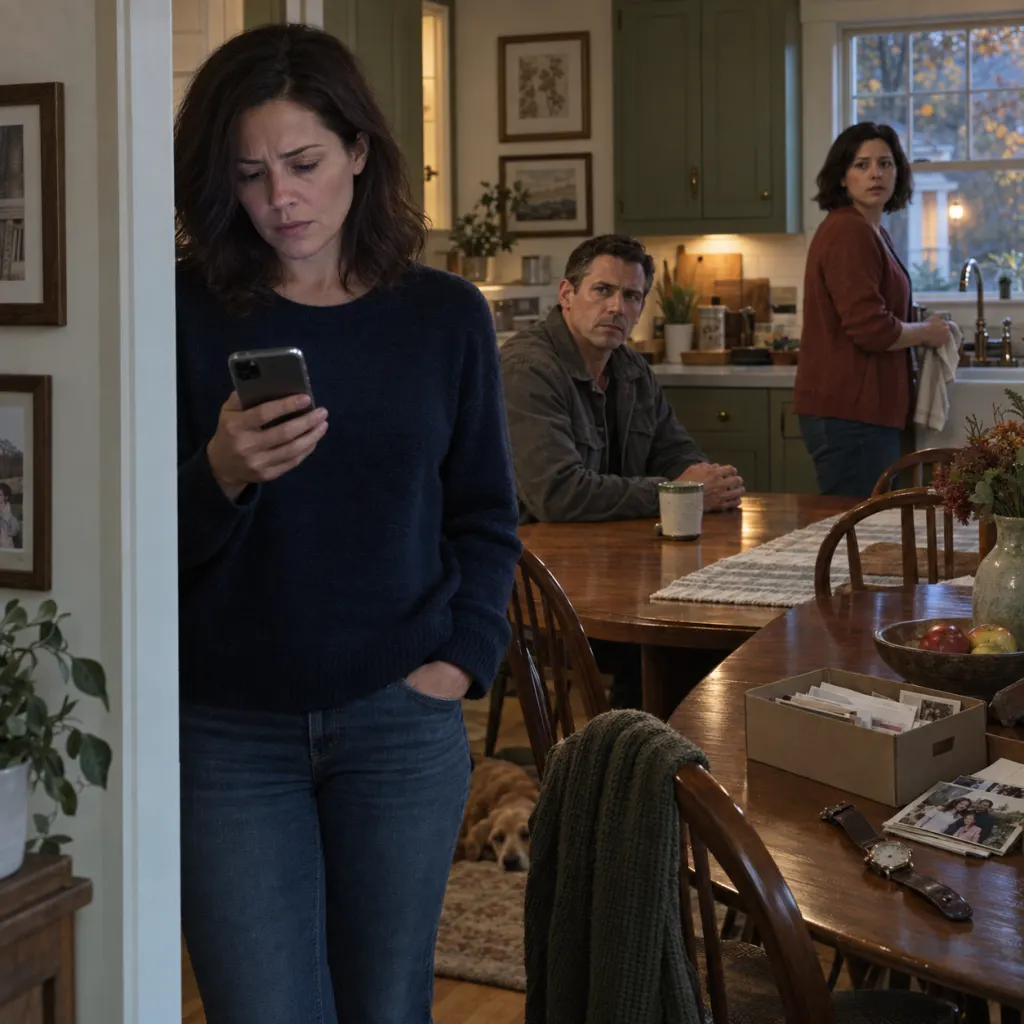
Mara Ellis knew something was wrong when her father arrived carrying a calculator instead of the bakery box he used to bring when he wanted something. It was a small gray calculator with a cracked solar strip and a missing rubber foot, and he set it on her kitchen table as if it were a legal document. Her mother, Celia, did not take off her coat. That was another sign. Celia always took off her coat when she planned to stay long enough to soften a room. Tonight she stood beneath the pendant light with her handbag hooked over one wrist, watching Mara’s apartment with the careful displeasure of someone appraising a stranger’s good fortune.
Mara was still wearing her work badge. The lanyard had left a red mark along the back of her neck. She had come home late from the office, hungry and lightheaded, expecting to reheat soup and water the basil plant on the sill. Instead, her parents had been waiting outside her door, her father tapping one shoe against the hallway tile, her mother holding up her phone with a screenshot already opened.
It was a photograph from Mara’s promotion lunch: four people around a conference table, paper plates, a grocery-store cake, a silver balloon sagging in the corner. Her cousin Tessa had commented beneath it, proud of you, senior analyst money looks good on you. Someone else had joked about the salary range. By noon, family members who had never asked what Mara actually did for a living had suddenly become experts on compensation.
Her father pressed numbers into the calculator with one stiff finger. “We looked it up,” he said. “Even after taxes, you can afford to help us properly now.”
“Properly,” Mara repeated. The word landed between them like a spoon dropped into an empty sink.
Her mother’s smile appeared, practiced and bright. “Half is reasonable. You’re single. No children. No mortgage. We raised you, Mara. It’s time you remembered where you came from.”
Mara looked at the calculator screen. Her father had written the number down, too, on the back of a grocery receipt. Fifty percent of her monthly income. He had circled it twice.
For a second she could not answer. Her apartment seemed to tilt around the table: the thrifted chairs she had sanded herself, the blue dish towel folded over the oven handle, the stack of library books by the window, the little framed print she had bought after her first paycheck at the firm. None of it was extravagant. All of it was hers, which made it feel almost dangerous in their presence.
“I already help,” she said.
Her father snorted. “A couple hundred here and there is not support. That is pocket change.”
Here and there. Mara felt something old and cold open inside her. Here and there was the winter gas bill she paid at seventeen because the house had become so cold her breath showed in the upstairs hallway. Here and there was the rent transfer she sent from a campus computer lab, hands shaking because it was supposed to be her book money. Here and there was her mother’s car insurance, her father’s overdue phone bill, the “temporary” loan that became a family secret before the month was over.
“I’m not giving you half my salary,” Mara said.
Celia’s smile faded by a fraction. “Listen to yourself. Money has made you hard.”
“No,” Mara said, surprising herself with the steadiness of it. “Being used made me careful.”

Chapter 2: What A Daughter Learns To Count
When Mara was sixteen, she learned to count by light bulbs. One in the kitchen, one above the stairs, one in the bathroom if everyone remembered to switch it off quickly. She knew which lamps could stay dark without making the house feel abandoned. She knew how long a carton of eggs could last if nobody asked for breakfast. She knew the exact sound the mailbox made when a final notice slid through the slot.
Her parents had not always seemed helpless. When Mara was small, Celia sold handmade wreaths at holiday markets and told funny stories that made strangers lean closer. Mara’s father, Grant, drove delivery routes and came home smelling like cardboard, gasoline, and peppermint gum. There had been ordinary bad days then. There had also been rent paid on time, school shoes bought before the soles split, birthday candles stuck into homemade cake.
Then Grant hurt his pride more than his back during a warehouse argument and quit before he could be fired. Celia’s wreath orders slowed. Bills arrived with sharper edges. The adults in the house began speaking in unfinished sentences, as if naming the problem might summon it fully into the room.
At first, Mara offered what a child offers: coupons clipped from newspapers, babysitting money, coins from a jar shaped like a strawberry. Celia hugged her and said, “You’re such a good girl.” Grant ruffled her hair and said, “We’ll pay you back when things settle.”
Things did not settle. They rearranged themselves around Mara’s usefulness.
By senior year, she worked three evenings a week at a grocery store. She learned the language of exhausted adults: double shift, overdraft, payment plan, minimum due. She did homework on the bus with her knees braced against a crate of canned goods because the night manager sometimes let her take dented tins home. At school, she smiled when teachers praised her discipline. They did not know discipline sometimes meant choosing between graph paper and dish soap.
Celia called it teamwork. Grant called it pitching in. Mara called it nothing, because naming it would require admitting that the people who were supposed to carry her had handed her the handles instead.
When she left for college, she picked the cheapest state program within commuting distance and told everyone it was because she liked being close to home. The truth was that she could not afford a dorm room, and her parents could not afford to lose her paycheck. She missed orientation to sit on the phone with the electric company. She missed a study group to drive Celia to a shopping center interview Celia decided not to attend because the manager “looked judgmental.”
Even after Mara moved into her first shared apartment, the requests followed. Some were small. Some were dressed as emergencies. Some came with tears. Some came with silence, which was worse. Grant had a way of withholding speech until Mara became the apologetic one.
Years later, when she opened a private spreadsheet, she did not do it out of revenge. She did it because her memory had begun to feel like a room full of smoke. She wanted clear air. Dates. Amounts. Screenshots. Bank memos. Proof that she had not imagined the shape of her own life.
Chapter 3: The Paper They Brought
Back in the apartment, Grant reached inside his jacket and unfolded three stapled pages. He pushed them across the table. “We thought you might overreact,” he said, “so we made this simple.”
Mara did not touch the pages at first. She read them upside down. Family Support Agreement. Monthly Transfer. Recurring Obligation. Her name appeared near the bottom in bold letters, as if the document had been waiting for her obedience before she entered the room.
“You typed my name into this?” she asked.
“It’s not binding until you sign,” Celia said, with the soft little laugh she used when she wanted cruelty to sound practical. “Nobody is trapping you.”
“You came to my home after work with a calculator and a contract.”
“Agreement,” Grant corrected.
Mara finally picked up the pages. The paper was warm from his jacket. That warmth disgusted her more than the words. It made the demand feel alive. She read the clause requiring payment by the fifth of every month. She read the sentence about respect. She read the line about “honoring parental sacrifice” and had to press her tongue to the roof of her mouth to keep from laughing again.
On the bookshelf behind her father, a small brass clock ticked louder than usual. Mara had bought it from an estate sale because she liked its stubborn old face. Now each tick sounded like a nail tapped into place.
“What happens if I don’t sign?” she asked.
Grant folded his hands. “We don’t want ugliness.”
Celia looked away, toward the window. “Families talk. People ask questions. Your grandmother worries about us already. It would break her heart to know you’re doing well and leaving us behind.”
There it was: the old door, opened with the old key. Shame. Mara saw the route they expected her to take. She would picture her grandmother’s face. She would imagine cousins whispering. She would feel twelve years old again, responsible for every empty cabinet and late payment. Then she would sign, because signing would be quieter than explaining.
But Mara had learned something at work that had followed her home in unexpected ways. Numbers did not become cruel because they were precise. A record was not an attack merely because someone disliked what it showed.
She set their agreement down, walked to her desk, and opened the bottom drawer. The envelope was already there, cream-colored and thick, labeled in her own handwriting: For When They Ask For More Than I Can Give.
Celia’s eyes tracked it immediately. Grant leaned back as if satisfied. They thought the envelope held money. Of course they did.
Mara placed it beside the calculator. “Before I answer,” she said, “you should read what I brought.”

Chapter 4: The Invoice Of A Childhood
Grant opened the envelope first. Mara watched his thumb slide beneath the flap and remembered all the envelopes she had opened in secret as a teenager: utility warnings, rent notices, bank letters addressed to adults who let paper become weather. This envelope made no threat. It simply contained pages.
The first sheet was titled Household Transfers Made By Mara Ellis. Beneath it, the entries marched in plain rows. Date. Amount. Purpose. Source. Notes.
Grant’s eyebrows pulled together. “What is this?”
“A record,” Mara said.
Celia took the pages from him. At first she scanned them with irritation. Then her face changed. Not all at once. Line by line.
Rent gap after missed payment. Gas service restoration. Car repair after impound warning. Credit card payoff. Grocery cash. Phone bill. Water bill. Loan repayment to Aunt Ruth made on parents’ behalf. Emergency cash withdrawal, no repayment. Emergency cash withdrawal, no repayment. Emergency cash withdrawal, no repayment.
Mara had not added interest. She had not added the wages lost when she left work early to solve their crises. She had not added the scholarship she declined because moving away would have meant abandoning the house to its own consequences. She had not added the price of fear, though if fear could be invoiced, hers would have filled boxes.
“This is ridiculous,” Grant said. “Children don’t bill their parents.”
“Parents don’t present their adult child with a wage claim at her own kitchen table,” Mara replied.
Celia’s mouth tightened. “We were struggling.”
“I know,” Mara said. “I was there. I was also struggling.”
That was the sentence that made the room shift. Not the total at the end of the packet. Not the highlighted bank transfers. Just that small, unadorned truth. I was also struggling.
For years, Mara’s hardship had been treated as weather: unfortunate, impersonal, expected to pass without anyone apologizing to the sky. Her parents’ hardship had been treated as an emergency requiring immediate attendance. Tonight, for the first time, she placed both facts on the table and refused to let one erase the other.
Grant slapped the packet down. The basil plant trembled on the sill. “You think you’re better than us now.”
Mara felt the familiar flinch rise in her shoulders. She let it rise. Then she let it pass. “No. I think I’m separate from you now.”
Celia’s eyes shone, though Mara could not tell whether from hurt or fury. “Separate? That’s a cold word for your mother.”
“It is a necessary word for my bank account.”
Chapter 5: Witnesses
The phone rang before anyone could answer. Mara looked down and saw her grandmother’s name. Ruth Ellis rarely called after eight unless someone had frightened her, and Mara suddenly understood that Celia had already prepared the battlefield. There would be a story circulating somewhere, soft around the edges, about a daughter who had become successful and selfish.
Mara answered. “Hi, Grandma.”
“Are your parents there?” Ruth asked. Her voice was low, clipped, and wide awake.
Celia’s chin lifted. “Tell her we’re here having a private conversation.”
Mara put the phone on speaker. “They’re here.”
A pause. Then Ruth said, “Grant, Celia, did you ask Mara for half her paycheck?”
Celia closed her eyes. Grant stared at the phone as if it had betrayed him personally.
“We asked for support,” he said.
“How much?” Ruth asked.
Grant said nothing.
Mara looked at the calculator, then at the contract, then at the envelope that had emptied twelve years onto her table. “Fifty percent every month,” she said.
The silence that followed was not empty. It was full of rearranging. Mara could almost hear her grandmother moving pieces of old family belief from one shelf to another.
“Mara,” Ruth said at last, “did you send me a file?”
Mara’s stomach tightened. “Yes.”
That had been the part she debated all day. At lunch she had scanned the packet and sent it to Ruth with one sentence: If they come to you with a story about money, please read this before answering. She had not sent it to cousins. She had not posted it. She had not thrown the family open to spectators. She had chosen one person who still believed truth mattered more than comfort.
Ruth exhaled. “I read enough.”
Celia whispered, “Mom.”
“No,” Ruth said. The word cracked through the phone. “You don’t get to make me your shield tonight.”

Grant stood, scraping the chair legs against the floor. “This is none of your business.”
“It became my business,” Ruth said, “when you used my name to shame her.”
Mara gripped the edge of the counter. She had imagined victory would feel hot, triumphant, maybe even satisfying. Instead she felt painfully sober. Her grandmother’s defense did not undo anything. It only confirmed that undoing would have to begin now, with everyone awake.
“Leave her apartment,” Ruth said. “And do not ask that girl for another dollar.”
Celia picked up her handbag. For one second, her face softened into something Mara recognized from childhood, a tired woman at a stove, humming under her breath. Then the look hardened again. “You’ll regret making us look like this.”
Mara opened the door. Her hand did not shake until the latch clicked under her palm. “I already regretted hiding it.”
They left without the agreement. Grant forgot the calculator. It remained on the table, screen blank now, stripped of authority.
Chapter 6: Locks
The next morning, Mara woke before dawn on the couch. She had not meant to sleep there. The apartment was gray and still, the city outside making its early delivery sounds. For a moment, before memory returned, she felt peaceful. Then the whole evening came back: the contract, the packet, her grandmother’s voice, her mother’s last look.
She made coffee too strong and opened her laptop. The practical tasks steadied her. New passwords. Account alerts. A call to the bank. A note to building management that her spare key should no longer be released to family. An email to her supervisor, brief and factual, explaining that relatives might attempt to contact her at work and should not be given access. She felt embarrassed while writing it, then angry at the embarrassment. She had done nothing wrong by protecting the life she had built.
The bank representative was kind in a brisk way. She explained account notices, contact preferences, and the difference between allowing someone to help with bills and giving someone access to funds. Mara took notes even when her hand cramped. The CFPB notes that financial help arrangements can carry real risks when another person is allowed to withdraw money, and Mara understood that risk with the clarity of lived experience.
At noon, Tessa called. Mara almost let it go to voicemail. Then she remembered the photograph, the careless caption, and answered with her jaw tight.
“I am so sorry,” Tessa said before Mara could speak. “I didn’t know they would use it like that.”
The apology was so immediate that Mara’s anger had nowhere dramatic to go. It sat down, still present, no longer driving.
“I know,” Mara said. “But don’t post about my work again. Not salary jokes. Not promotion details. Nothing.”
“Done,” Tessa said. “Already deleted. And Mara? Aunt Celia told everyone you never helped. Grandma corrected that. Very loudly.”
Mara closed her eyes. She pictured Ruth in her yellow kitchen, phone pressed to her ear, voice steady enough to make grown people sit up straighter. “I didn’t want a family trial.”
“Maybe not,” Tessa said. “But you were already being sentenced.”
After the call, Mara sat by the window with her coffee cooling between her hands. She did not feel free yet. Freedom, she suspected, was not a door swinging open. It was a set of habits built after the door was unlocked.
Chapter 7: The Return Of The Key
Three days passed. Celia sent one message: You hurt us deeply. Grant sent none. Mara did not reply. She wrote drafts, deleted them, wrote sharper ones, deleted those too. At night, she walked around her apartment touching ordinary things: the mug from her first conference, the plant stakes, the stack of folded towels. Mine, she thought, not with greed but with wonder.
On Saturday morning, someone knocked.
Mara looked through the peephole and found her grandmother standing in the hallway, small and upright in a navy coat, holding a brown paper bag. Mara opened the door, and Ruth stepped inside without ceremony.
“I brought oranges,” Ruth said. “You look like someone who forgets fruit exists when upset.”
Mara laughed for the first time in days. The sound surprised her. Ruth set the bag on the counter and surveyed the apartment. Her gaze paused on the abandoned calculator.
“Ugly little thing,” Ruth said.
“I keep meaning to throw it away.”
“Not yet.” Ruth removed something from her purse: a house key on a faded plastic ring. “This is yours, I believe.”
Mara stared. “They gave you my spare?”
“Your mother asked me to hold it years ago. Said it was for emergencies. I should have asked more questions.” Ruth’s face folded with regret, not theatrical, not asking to be comforted. “I am asking them now.”
Mara took the key. It was warm from Ruth’s palm.
They sat at the kitchen table. Ruth peeled an orange in one long spiral and placed half in front of Mara. For a while they ate in silence. Then Ruth said, “I knew your parents borrowed from you. I did not know how much. That is my failure too.”
Mara wanted to say it wasn’t. Habit rose first, generous and automatic. She stopped it at her teeth. “I needed someone to notice.”
Ruth nodded once. Her eyes filled, but she did not look away. “Yes.”
That yes did something no defense could have done. It gave Mara the dignity of not having to prove the hurt again. The packet had shown the money. Ruth’s yes named the loneliness.
Before leaving, Ruth picked up the calculator and dropped it into the trash. The clatter was small. The meaning was not.

Chapter 8: The First Full Deposit
Payday arrived on a Friday with rain streaking the office windows. Mara saw the deposit notification during a budget meeting and turned her phone facedown so no one would see her expression. Full amount. No immediate subtraction. No urgent message waiting beneath it. No familiar pull in her chest telling her someone else’s panic had already spent what she had earned.
After work, she walked home instead of taking the train. The rain had slowed to mist. Storefront lights smeared gold across the sidewalk. She stopped at a market and bought ordinary luxuries: cherries even though they were expensive, fresh bread, good butter, a small bunch of tulips with rain caught in their leaves. At the register, she felt the old guilt stir. Then she paid anyway.
At home, she put the tulips in a jar because she did not own a vase. She transferred money into savings and renamed the account Future Without Apology. The name was too dramatic, maybe, but she kept it. Some truths deserved ceremony.
Celia eventually wrote again, longer this time. The message did not contain the apology Mara wanted. It contained explanations, old griefs, complaints about embarrassment, one sentence that almost became honest before turning back: Maybe we leaned too much. Mara read it twice and put the phone down.
Grant found work through a neighbor. Ruth reported this without triumph. Celia took weekend shifts at a reception desk and told relatives she was “getting back on her feet.” Mara did not correct the phrase. If her mother needed a softer story to begin doing harder things, Mara could allow that from a distance.
Distance became the shape of love she could manage. She met Ruth for lunch. She answered Tessa’s texts. She did not open every message from her parents the moment it arrived. When Celia asked for money again, Mara replied with one sentence: I am not available for financial support. Her hands shook afterward. Then they stopped.
One month after the calculator appeared, Mara invited no one over. She cooked dinner for herself, bread toasted in a pan, cherries rinsed in a chipped bowl, tulips opening on the counter. The apartment was quiet in a way that no longer felt like punishment.
She thought of the girl she had been at sixteen, counting light bulbs, making herself small enough to fit inside everyone else’s need. She wished she could reach back and tell that girl the truth: survival is not a debt you owe forever. Love that requires your disappearance is not love in its healthiest form. A family can be real and still require a locked door.
Mara did not hate her parents. That was the complicated part, the part no one put neatly into stories. She loved them in fragments: her mother singing off-key while frosting cupcakes, her father teaching her to patch a bicycle tire, the three of them laughing once in a car wash while blue soap covered the windshield. Those memories were real. So were the bills, the pressure, the years of being useful before she was allowed to be young.
She did not need one truth to destroy the other. She only needed both truths to stand where she could see them.
Before bed, Mara took the spare key from her desk and placed it in a small ceramic dish by the door. One key. One apartment. One paycheck arriving whole. It was not a grand ending. It was better than that. It was a beginning quiet enough to live inside.
Wrap-Up
Mara’s parents demand half her salary after learning about her promotion, but their pressure forces a reckoning they did not expect. By showing the record of what she has already carried, Mara begins to separate love from obligation and builds a future that belongs to her.
Frequently Asked Questions
- → Is this story based on a verified real event?
No. This is an original fictional story inspired by a family conflict premise, with fictional characters and events.
- → Why does the story focus on records and boundaries?
The story uses records, account safeguards, and clear limits as narrative tools because money pressure inside families can become confusing when guilt and obligation are mixed together.