 Save
She carried the cake as if the box already held the answer to something no child should have to solve alone.
Chapter One: The Cake in Both Hands
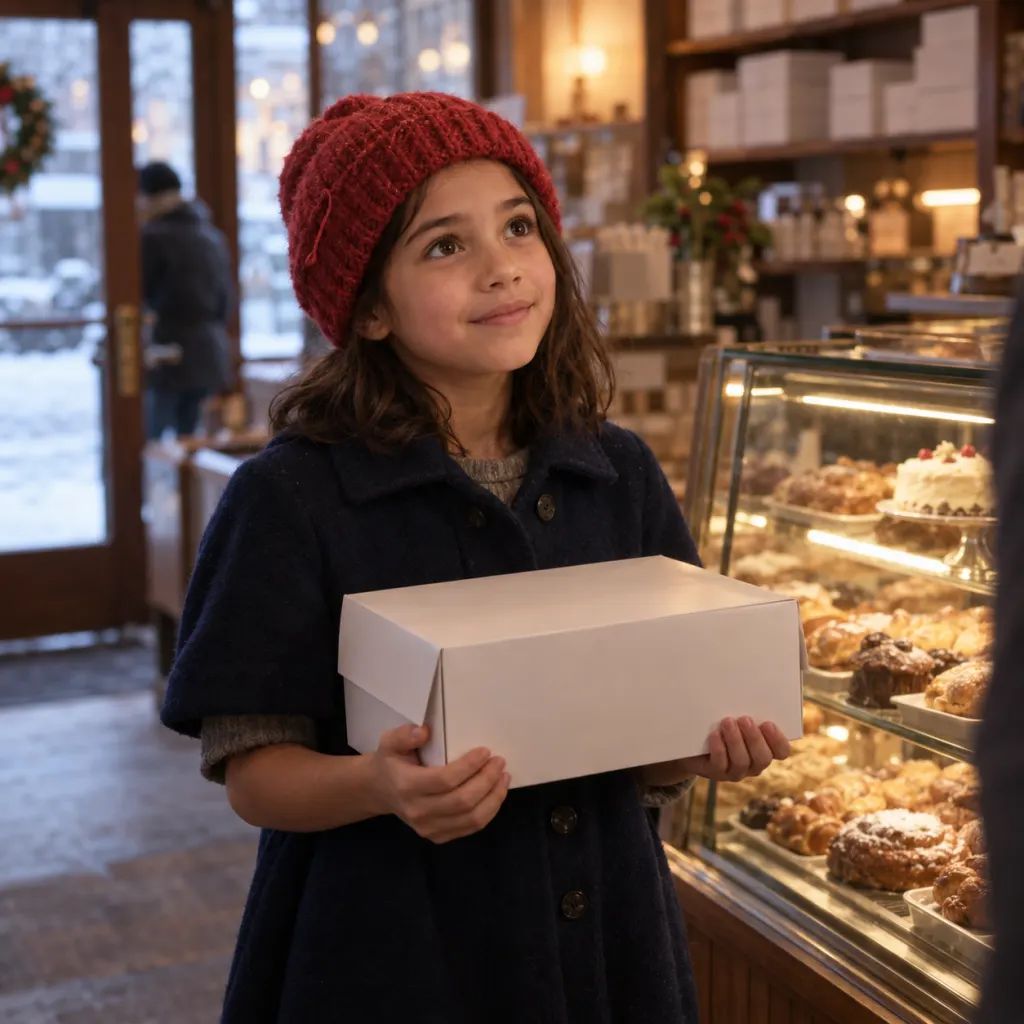
The bell over the bakery door gave a thin silver ring when the girl pushed inside with her shoulder. She was small enough that the door seemed to argue with her first, pressing back in the winter wind, and for a second only one brown eye appeared through the gap. Then she slipped in, breathless, cheeks bright from the cold, both hands clamped around an old glass jar wrapped in a dish towel.
The bakery was warm in the way certain places are warm before anyone says a kind word. Heat came from the ovens at the back. Butter softened the air. Sugar dust floated in the light above the pastry case. Behind the counter, the cakes sat beneath glass like small, careful celebrations waiting for names, candles, and rooms full of voices.
The girl stood still long enough for the door to sigh closed behind her. She looked at the cakes, then at the handwritten prices, then down at the jar. Inside it, coins lay against one another with a dull, crowded shine. She gave the jar a tiny shake, not to count it but to reassure herself it was still real.
Her name was Lina, though no one in the bakery knew it yet. She wore a red knit hat with one loose thread at the crown, a navy coat with sleeves just a little too short, and sneakers that had dried salt along the edges. Tucked beneath her elbow was a folded paper napkin covered in careful pencil marks: a list, a number, and the words chocolate if possible.
At the far end of the counter, a woman in a gray wool coat was choosing rolls. A man with a tired face stood near the register, checking his phone, tapping one thumb against the case. The baker, a broad-shouldered woman with flour on her forearm, came from the back carrying a tray of glazed buns.
“Can I help you, sweetheart?” the baker asked.
Lina stepped forward. The jar knocked softly against the counter. “I need a cake,” she said. Her voice was polite, practiced, almost formal. “A small one. For my mother.”
The baker smiled, because children buying cakes alone often came in with secret missions. “Is it her birthday?”
Lina hesitated. Her fingers tightened around the dish towel. “No. It used to be last month.” Then, realizing how that sounded, she shook her head quickly. “I mean, her birthday was last month. We did not have cake then.”
The baker’s smile changed. It did not disappear. It simply grew quieter.
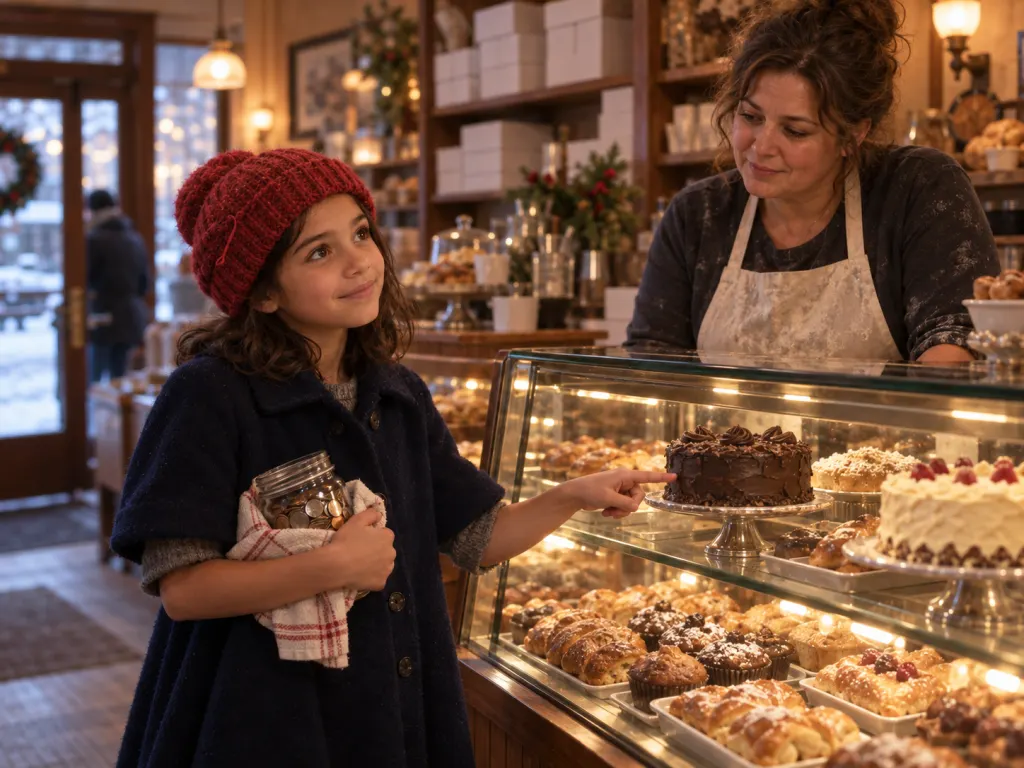
Lina pointed to the smallest chocolate cake in the case. It was round, no bigger than a dinner plate, with curls of chocolate on top and a border piped like little waves. There was a white sugar flower at the center. Not too grand. Not showy. But to Lina it looked like a holiday that had learned to fit inside a box.
“That one,” she said. “Please.”
Chapter Two: Coins from the Blue Jar
All morning, Lina had moved through the apartment without turning on the television. It was not a rule. Her mother had never made many rules about noise. But lately the apartment seemed to have become a place where sound had weight. Cabinet doors had to be closed with two hands. Spoons had to be set down gently. Even water running in the sink felt too loud if it went on too long.
Her mother had been unwell for weeks. Lina knew the shape of those weeks by objects: the blanket that stayed on the couch, the mug with tea gone cold at the bottom, the stack of unopened envelopes near the fruit bowl, the chair pulled close to the window because the afternoon sun reached it there.
She also knew it by her mother’s face. Some days, her mother smiled with her whole mouth but not her whole self. Some days, she closed her eyes while Lina talked, nodding to show she was listening. Some days, she asked Lina to bring the blue jar from the top shelf and count what was inside.
The jar had once been for summer. That was what her mother called it. Summer meant bus fare to the public pool, peaches from the market, maybe one night at the pier where the lights came on over the water and everyone seemed richer than they were. Lina had dropped coins into it after errands. Her mother added what she could. The jar grew slowly, with the honest patience of small money.
That morning, Lina had climbed on a chair and taken it down. She did not do it secretly, exactly. Her mother was sleeping in the other room, one hand open on the blanket. Lina had watched her for a moment from the doorway.
“You said cake makes a room happier,” Lina whispered, though her mother could not hear.
Then she sat cross-legged on the kitchen floor and counted. Quarters in one pile. Dimes in another. Nickels, pennies, a folded bill from her coat pocket, two bus tokens she knew the bakery would not take but could not bring herself to leave behind. She counted twice, then a third time because the number had to become friendly if she looked at it long enough.
It did not become friendly. It became exact.
Still, she wrote the total on the napkin and underlined it. She added small cake, then chocolate if possible, because chocolate was the flavor her mother chose whenever she wanted to pretend choosing did not matter.
Before leaving, Lina placed the apartment key on a shoelace and tied it around her neck. She put on her hat. She checked that her mother’s water glass was near the couch. At the door, she turned back.
Her mother stirred. “School?” she murmured.
“It is Saturday,” Lina said softly.
Her mother opened her eyes halfway and tried to focus. “Stay warm, little bird.”
Lina smiled because the name belonged to better mornings. “I will.”
She did not say where she was going. Not because she wanted to lie. Because surprise was the one beautiful thing she could still afford.
Chapter Three: The Price of Something Beautiful
In the bakery, the small chocolate cake was lifted from the case and set inside a white cardboard box. Lina watched every movement. The baker folded the sides up, tucked the tabs, and slid a square of thin paper beneath the box so the bottom would not grow damp from the cold outside. She worked with a ceremony Lina understood immediately.
“Would you like writing on it?” the baker asked.
Lina’s eyes widened. “Can it say something?”
“If it is short.”
Lina looked down at her napkin. There was no plan for words. The cake itself had been the plan. She pressed one finger against the counter, thinking hard.
“Can it say, ‘For Mama’?”
“Of course.”
The baker disappeared to the back with the cake. Lina waited without leaning on the glass. She had been taught not to put fingerprints where people had to clean them. The woman in the gray coat glanced over once, then away. The man at the register put his phone in his pocket and studied Lina with the guarded curiosity adults sometimes have when a child is alone in a place designed for adults with wallets.
When the baker returned, the box remained closed, but Lina imagined the words inside. For Mama, written in white icing on chocolate. A sentence short enough to fit. A sentence large enough to hold everything she could not say: I noticed. I remember. I am scared. Please smile today.
The baker tapped the register. The numbers appeared in green.
Lina’s face changed before anyone spoke. She looked at the display, then at the napkin, then back again. The difference was not huge to an adult. It was a coffee. A parking meter. The kind of amount people lost in couch cushions and forgot. To Lina, it was a locked gate.
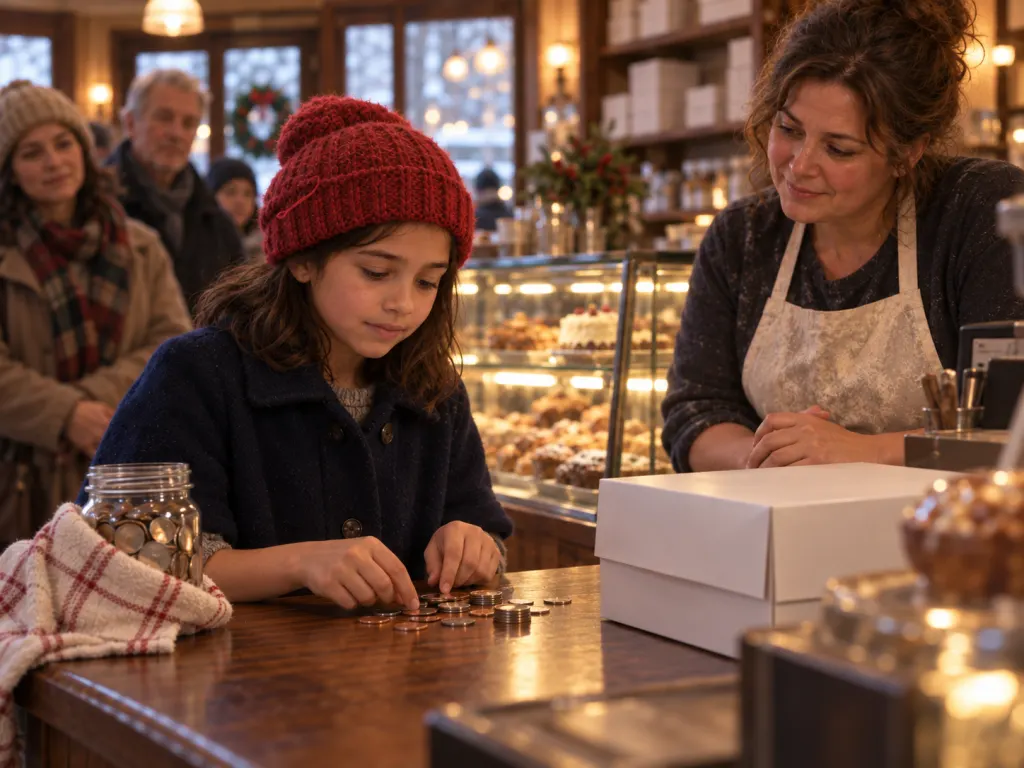
“I have this much,” she said, and unfolded the towel around the jar.
The coins came out slowly. They clinked across the counter in little uneven circles. Lina counted them in a whisper, moving each one with her fingertip. The man behind her shifted his weight. The line had grown by two people. Outside, someone pulled at the door and cold air pressed briefly through the room.
The baker did not interrupt.
Lina reached the final penny. She looked at the register again. Her lips parted, then closed. She pushed the coins together into a neater pile, as if tidiness might add value.
“I am short,” she said.
The words were quiet, but the whole bakery heard them.
Chapter Four: The Checkout Line
No one enjoys witnessing a child’s dignity being tested. It asks too much too quickly. People prefer problems they can understand from a distance, problems with doors they are not standing beside.
The woman in the gray coat lowered her bag of rolls. The man near the register looked toward the ceiling, then at the cake box, then at the child. Another customer began searching inside a purse, moving items around with small clicks and rustles.
Lina mistook the silence for impatience. Her ears flushed red beneath her hat.
“I can put it back,” she said quickly. “I did not touch the cake. Only the box.”
The baker’s hand rested on top of the register. Her name tag read Mara, though the letters were half-covered in flour. She looked at the coins, then at Lina. There were rules for a business. There were costs behind every cake: butter, chocolate, rent, the morning’s labor, the light bill, the quiet arithmetic that kept warm places open. Mara knew those rules. She had lived by them long enough to respect them.
But she also knew another kind of arithmetic.
She knew the weight of a child trying not to cry in public. She knew the particular bravery of counting pennies under adult eyes. She knew that some purchases were not purchases at all, but messages being carried across a hard day.
“Tell me something,” Mara said gently. “Is your mother home nearby?”
Lina nodded. Then, because she had been taught to answer properly, she added, “Three blocks. The building with the green door.”
“And you came all this way by yourself for her?”
“She is tired,” Lina said. “She was sad about missing her birthday. I thought if I brought one home before she woke up all the way, it would feel like we did not miss it. Just moved it.”
The woman in the gray coat turned her face toward the window. The man with the phone swallowed and looked at his shoes.
Mara opened the register drawer. Lina stiffened.
“I can choose a cookie,” Lina offered. “If there is a broken one.”
It was the sentence that undid the room.
Not loudly. Nothing dramatic happened. No one gasped. No music rose. But the air changed. The customers stopped being a line and became, for one suspended moment, witnesses.
The woman in the gray coat stepped forward first. “May I?” she asked Mara, already holding out a bill.
The man behind Lina reached into his pocket. “I have the rest.”
“No,” Lina said, alarmed. She pulled her coins closer. “It is for my mother. I should buy it.”
Mara raised one hand, and the adults stopped moving. She understood before they did. Charity, if handled carelessly, could feel like having something taken away.
“You are buying it,” Mara told Lina. “Every penny here says so.”
Lina searched her face.
“But I am short.”
“Then we have a problem for the bakery,” Mara said, and her voice took on the brisk firmness of someone solving a normal matter. “The bakery forgot to put up the Saturday kindness discount.”
Lina blinked. “There is a discount?”
“Today there is.”
Chapter Five: The Saturday Kindness Discount
Mara took a small card from beside the register and wrote on it with a black marker. Her handwriting was fast and square.
Saturday Kindness Discount: For anyone carrying love carefully.
She taped it near the pastry case as if it had always belonged there. The man with the phone let out a breath that might have been a laugh if it had not caught in his throat. The woman in gray smiled at Lina, not with pity, but with the respect people give someone who has arrived after a long walk.
Mara counted Lina’s coins, accepted the folded bill, and pressed the register keys. The drawer opened. A receipt printed with a small mechanical chatter.
“Paid,” Mara said.
Lina stared at the receipt. “Really?”
“Really.”
The man with the phone cleared his throat. “Could I buy a candle?” he asked. “Just one. For the cake.”
Lina turned toward him, uncertain.
“Not because you need it,” he added quickly. “Because birthdays should have a candle, even late ones.”
Lina considered this. “My mother likes blue.”
Mara reached beneath the counter and placed a single blue candle beside the box. “That one is from the drawer where we keep almost-birthday things.”
The woman in gray added a small packet of matches, then looked at Mara for permission. Mara nodded and slipped them into a paper sleeve. Lina watched the adults coordinate around her without making her smaller. It was new, this kind of help. It did not rush at her. It waited to be accepted.
“Thank you,” Lina said. She looked at each person because her mother always said gratitude should not be thrown into the air like confetti. It should be handed to someone.
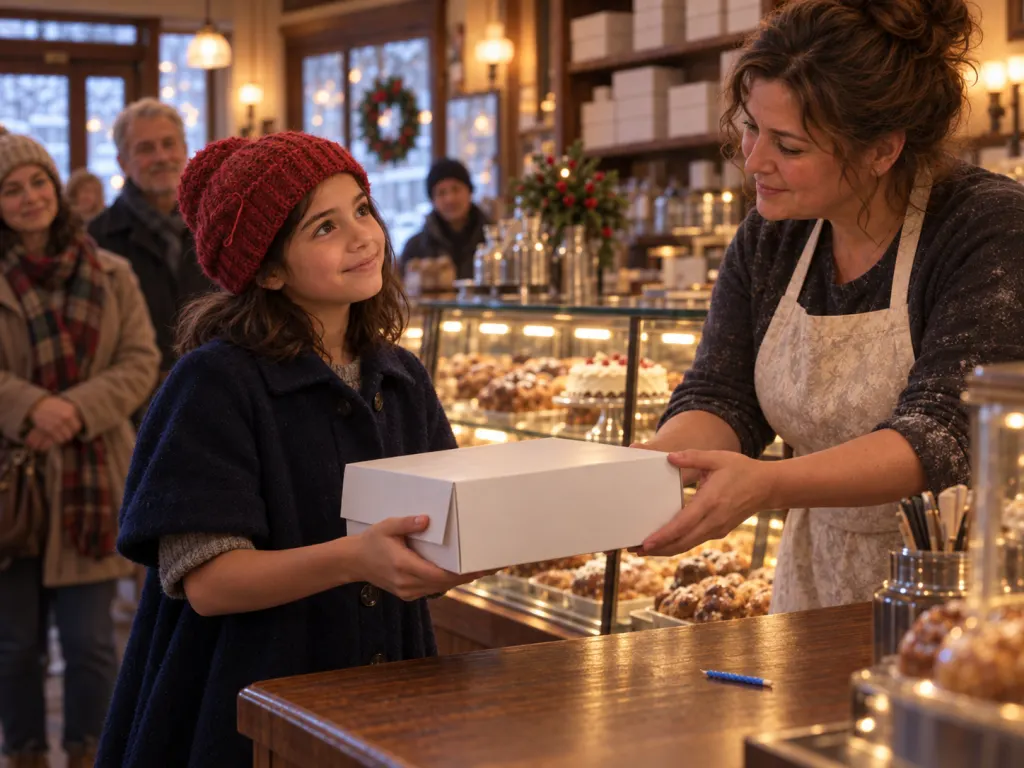
Mara came around the counter with the boxed cake. She placed it in Lina’s hands, adjusting her grip so the bottom was supported. “Flat palms. Elbows close. Walk slowly.”
Lina nodded with great seriousness.
“And one more thing.” Mara tucked the receipt into Lina’s coat pocket. “If your mother asks, you tell her you bought it.”
“I did,” Lina said, standing taller.
“Yes,” Mara replied. “You did.”
Chapter Six: Three Blocks Home
The walk home took longer with the cake. Lina moved as if the sidewalk had become a narrow bridge. She avoided cracks, patches of old snow, and a place where tree roots had lifted the pavement. The bakery bag swung from Mara’s careful knot around the box, but Lina did not trust the handles. She kept both hands beneath it.
Every smell from the bakery followed her for half a block: chocolate, vanilla, warm bread. Then the city returned. Bus exhaust. Wet wool. Someone’s laundry vent breathing soft air into the cold. A dog barking behind a fence. The click of a traffic signal changing for nobody.
At the corner, she stopped and looked through the bakery window. Mara was serving the next customer. The handmade sign remained beside the register. The man with the phone had not left. He was standing near the door, speaking to the woman in gray, and both of them looked different than they had before, as if the room had handed them back to themselves with a question.
Lina did not know that after she left, the woman in gray would buy two extra loaves and ask Mara to pass them along quietly. She did not know the man would stand outside for several minutes before calling his own mother, letting the phone ring longer than usual. She did not know that Mara would leave the discount sign up for the rest of the day and that three other customers would add money to a jar she placed beside it without naming the reason.
Children rarely see the full distance traveled by their courage. They only know the next curb, the next door, the next breath held carefully so the cake does not tilt.
At the green door, Lina had to set the cake on the mail ledge while she found the key on the shoelace. This was the most dangerous part. The box sat alone above the chipped metal mailboxes, vulnerable to gravity and disaster. Lina unlocked the door with one eye on it.
Inside, the hallway smelled of floor cleaner and old radiator heat. Mrs. Alvarez from the second floor opened her door a crack.
“Lina? You all right?”
“Yes, ma’am.”
Mrs. Alvarez saw the cake and softened. “Careful on the stairs.”
“I am being very careful.”
“I can see that.”
By the time Lina reached the apartment, her arms ached. She nudged the door open with her hip and stepped into the quiet. The couch blanket was empty.
For one sharp second, fear moved through her.
Then she heard water running in the bathroom sink and her mother’s soft cough. Lina placed the cake on the kitchen table and exhaled so hard the candle rolled against the box.
Chapter Seven: For Mama
Her mother came down the short hallway in slippers, one hand on the wall, hair pinned back unevenly. She stopped when she saw Lina at the table.
“What did you do?” she asked.
It could have sounded angry from someone else. From her mother, it sounded afraid of the answer.
Lina stood between her and the cake, suddenly shy. The apartment looked different around the box. The scratched table became a celebration table. The two mismatched chairs became a party. The morning light, thin and pale through the window, became enough.
“You missed your birthday,” Lina said. “So I moved it.”
Her mother looked at the cake box. Then at Lina’s coat, still buttoned to the throat. Then at the red hat with the loose thread. “Where did you get money?”
“The blue jar.”
Her mother closed her eyes.
Lina hurried on. “Not all of it. Some. And I bought the cake. There was a discount.”
“A discount?”
“A Saturday one.”
Her mother opened her eyes again, and now there was something in them Lina could not read. It was not sadness exactly. It was what happens when sadness meets love too directly and has nowhere to hide.
Lina lifted the lid.
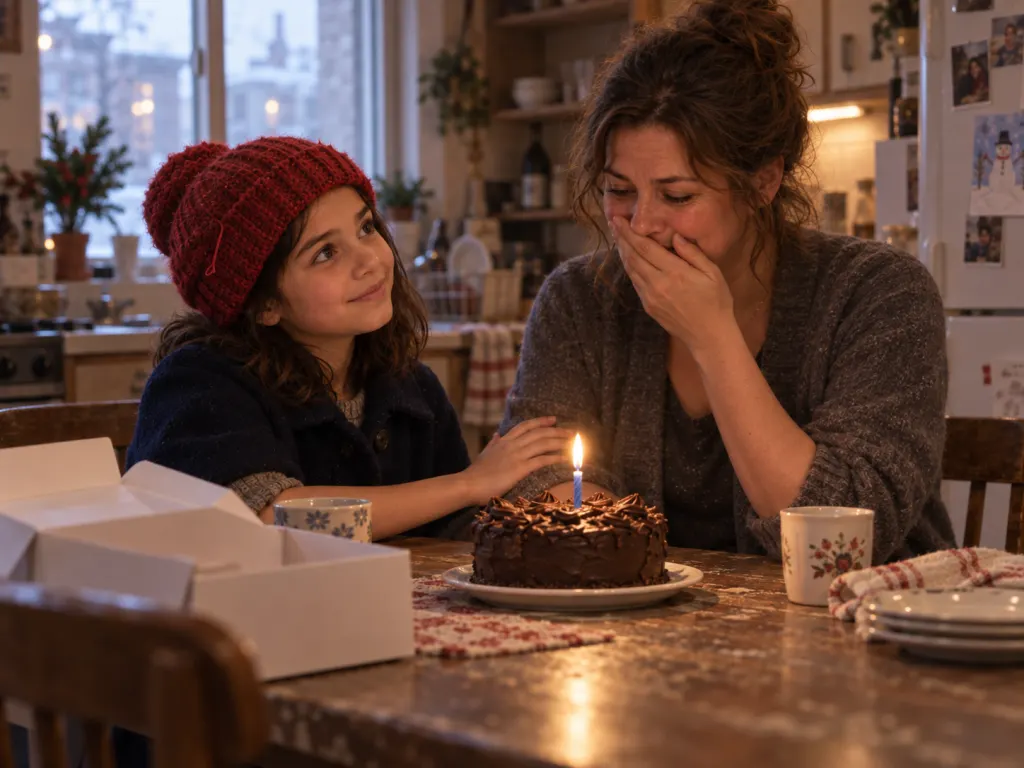
The cake was perfect. The white sugar flower sat at the center. The blue candle lay beside it. Across the top, in careful icing, were the words For Mama.
Her mother covered her mouth. She did not cry loudly. She was not that kind of woman. She cried the way she did most difficult things: quietly, with one hand trying to keep the rest of her steady.
Lina’s own eyes filled at once. “I wanted you to be happy.”
Her mother reached for her. Lina went into her arms carefully at first because she had learned the new gentleness of the house. Then her mother held her tighter than she had in days.
“I am happy,” her mother whispered into her hat. “And I am sorry you had to think about things like jars and prices.”
Lina shook her head against her. “I like counting.”
Her mother gave a small laugh, wet and surprised. “No, you do not.”
“Not always,” Lina admitted.
They sat at the table. Lina pushed the candle into the cake. Her mother struck the match, and the flame trembled blue at the base, gold at the tip. For a moment neither of them spoke. The apartment held its breath with them.
“Make a wish,” Lina said.
Her mother looked at her daughter across the little flame. “I already know mine.”
She blew out the candle.
Chapter Eight: What the Bakery Remembered
The cake lasted three days because Lina cut the slices thin. Her mother objected on the first day, then understood by the second and let her do it. They ate it after soup, after toast, once for breakfast when rain tapped the window and the apartment felt less heavy than it had in weeks.
On Monday, Lina returned to school with the blue jar back on the shelf, lighter but not empty. She did not tell anyone about the bakery. Not at first. It felt private, like holding a warm stone in her pocket.
But stories have a way of traveling when they are needed. Mrs. Alvarez mentioned to Mara that the cake had made the apartment smell like a holiday. The man with the phone came back the next Saturday and bought a dozen muffins for the front desk at his office, saying only that people there had been having a hard month. The woman in the gray coat began stopping at the bakery every Thursday for rolls and left coins in the kindness jar each time.
Mara kept the handwritten sign by the register. The tape yellowed at the corners. Customers asked about it, and she gave different answers depending on what they seemed ready to hear.
“It started with a girl,” she would say sometimes.
Other times: “It started because we forgot how many people are carrying something.”
She never used Lina’s name. She never turned the child into a lesson for strangers to admire. The story belonged first to the girl who had counted coins on a kitchen floor and walked three blocks with love balanced in both hands.
Weeks later, Lina and her mother came in together. Her mother moved slowly, but she was laughing at something Lina had said, and that was what Mara noticed before anything else. Lina pointed to the sign.
“Mama,” she said, “that is the discount.”
Her mother read it. Then she looked at Mara for a long moment. There are thank-yous too large for a counter, too layered for a single sentence. Mara gave her a small nod, saving them both from the burden of saying everything aloud.
Lina chose two rolls this time. Her mother paid. Before leaving, Lina took three coins from her pocket and placed them in the jar beneath the sign.
“For someone carrying love carefully,” she said.
Mara pressed one hand to her apron. “Exactly.”
Reflection: Small Money, Large Love
There are days when the world changes in public, but quietly. No speeches. No applause. Just a child at a checkout counter, a pile of coins, and a room of adults remembering that dignity matters as much as help.
Lina did not buy a miracle. She bought a cake. Flour, sugar, chocolate, a blue candle, four words in icing. But love often chooses ordinary containers because ordinary things can be carried home. A box. A jar. A receipt in a coat pocket. A sign taped beside a register.
And sometimes, when someone is brave enough to bring their small offering into the open, the rest of us are given a chance to become gentler than we were a moment before.
Wrap-Up
A young girl’s attempt to buy a cake for her unwell mother becomes a quiet lesson in dignity, family love, and the kind of help that lets a person remain proud.