 Save
The attic smelled like cold dust, cardboard, and the green bar of soap I had carried up there like a tiny charm against everything I could not control.
Chapter 1: The Sound Above the Ceiling
The first scratch came at 2:13 in the morning, thin and deliberate, right above the corner of my bedroom where the ceiling sloped toward the window. I lay still under the quilt and told myself it was the house settling. Old houses liked to perform at night. Pipes clicked. Wood sighed. The furnace made a soft metal groan before it woke. But then the sound came again, a quick frantic scrabble, followed by silence so complete it felt arranged.
I held my breath until my ribs hurt. Down the hall, my mother coughed once in her sleep. The house returned to its ordinary dark, but I had already crossed some invisible line. A sound above the ceiling is never only a sound. It becomes an idea. It grows legs. It travels through insulation and memory and every neglected corner of your life.
By morning, I had decided not to mention it. My mother had enough to worry about. Since my father died, every small repair in the house seemed to arrive carrying his absence. The porch step dipped where he had once promised to replace the board. The basement door stuck in damp weather. The attic pull cord dangled from the hallway ceiling like a question no one wanted to answer.
But while I was rinsing my coffee mug, the sound returned in daylight: three quick taps above the kitchen, too quick for a branch, too purposeful for imagination. My mother looked up from the table. She did not ask what it was. She only pressed her palm flat against the newspaper and said, Mice.
I wanted to disagree because disagreement felt cheaper than an exterminator. Instead, I listened. Somewhere above us, something moved through the private dark of our house as if it had always belonged there.

Chapter 2: The Green Bar
The idea came from Mrs. Callahan next door, who had an opinion for every hinge, stain, weed, and appliance within a three-house radius. She came over that afternoon with a loaf pan wrapped in foil, because in our neighborhood worry still arrived disguised as banana bread.
My mother told her about the scratching before I could stop her. Mrs. Callahan nodded with the grave satisfaction of someone whose world had just confirmed itself. Irish Spring,
she said. Cut it up and put it around the attic. They hate the smell.
I did not ask who they
were or how she knew what they hated. I had spent the morning searching for practical advice, which mostly told me to seal holes, remove food sources, check for droppings, and call a professional if there were signs of a larger problem. All of that sounded sensible. It also sounded expensive and humiliating. Soap sounded like something a person could do before admitting defeat.
At the grocery store, I stood in the personal care aisle with a basket over my arm and stared at a three-pack of Irish Spring. The green packaging looked almost cheerful, aggressively clean. I bought it along with steel wool, peanut butter, snap traps I hoped I would not need, and a bag of flour because my mother had written it on the list in her careful hand. The cashier slid everything across the scanner without comment. I wondered if she could tell which items belonged to ordinary life and which belonged to panic.
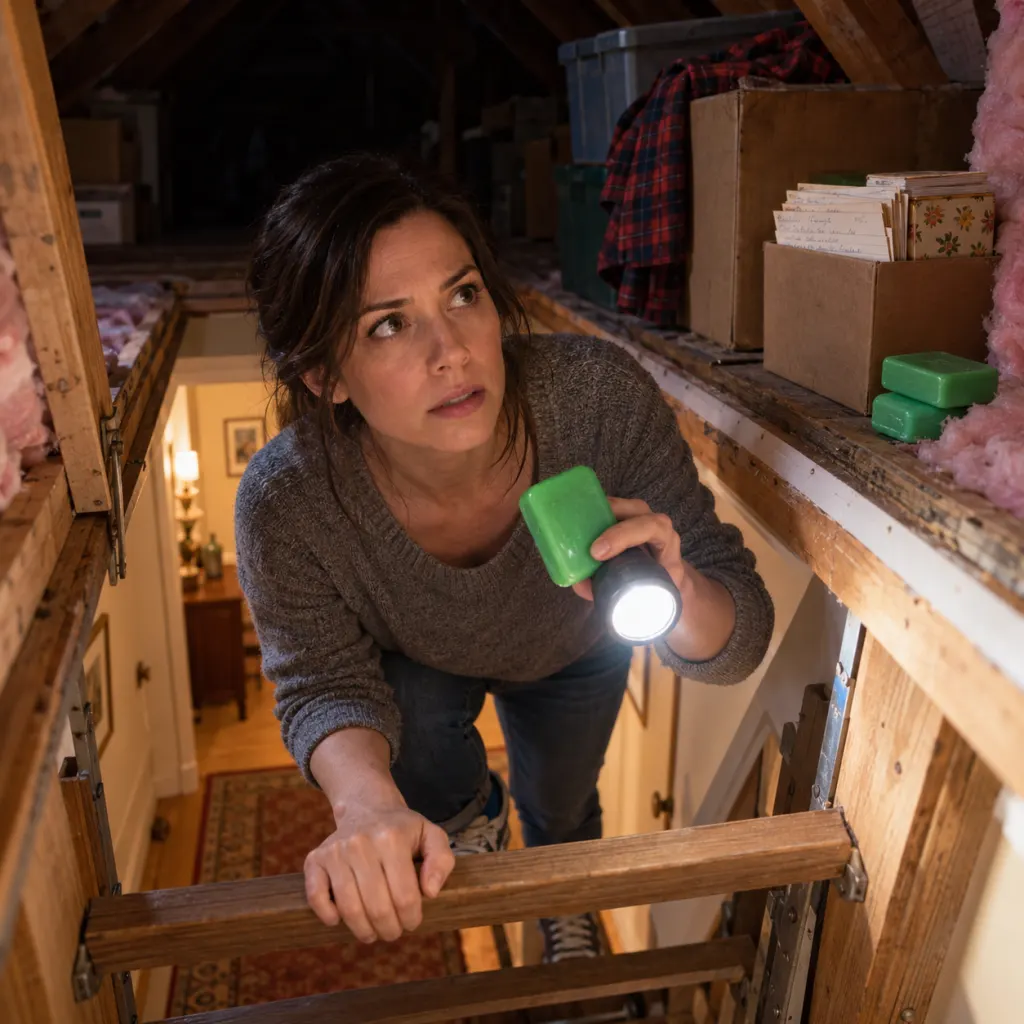
That evening, I climbed the folding attic ladder while my mother held the bottom rung, though I was thirty-four and did not need holding. The attic opened in a breath of stale air. My flashlight beam moved over boxes labeled Christmas, College, Taxes, Baby Clothes, Dad Work Shirts. The rafters made ribs above me. The insulation lay pink and uneven between joists. I could see, near the far wall, small dark pellets scattered beneath a gap where daylight needled through.
My mother saw them too. She looked away first.
I unwrapped the soap. Its scent hit hard, bright and sharp, like a locker room after mopping. I shaved curls from one bar with an old kitchen knife and placed chunks along the edges of the attic, near vents, beside boxes, close to the thin places where the outside seemed to have found its way in. It felt both ridiculous and solemn. A ritual for the practical-minded.
Chapter 3: Thirty Days
I wrote the date on a piece of masking tape and stuck it to the attic ladder: Day 1. I did this partly as a joke and partly because structure calms me. If I was going to believe in a bar of soap, I wanted at least to believe in it with documentation.
The first night, I slept badly. Every old noise became evidence. The radiator ticked and I sat upright. The wind pressed a branch against the siding and I pictured teeth. Around three, I heard one brief rustle above the hallway, then nothing. In the morning, I wrote it down in a notebook: one sound, uncertain.
My mother watched me make notes while she buttered toast. Your father used to do that,
she said.
Write down mouse noises?
Write down things he was afraid of, so they looked smaller.
I did not know what to do with that, so I rinsed my plate. Since the funeral, she had developed a habit of placing my father into ordinary conversations like a cup set gently on a table. Sometimes I could bear to look. Sometimes I could not.
For a week, the attic seemed quieter. I wanted to celebrate, but I did not trust silence. I checked the soap every other day and found the green pieces where I had left them, drying at the edges, their scent still fierce. I checked the flour I had dusted lightly near the far wall and saw faint tracks crossing it by Day 6. The discovery made my stomach drop, not because a mouse had passed through, but because I had hoped so intensely not to know.
On Day 8, I set traps. I hated doing it. I hated the little mechanical snap, the careful smear of peanut butter, the way a household problem could turn you into someone making decisions about life and death under a bare bulb. My mother stayed downstairs. She said she could not watch, and I said she did not have to.

Chapter 4: The Boxes We Avoid
The attic had always belonged to my father. Not officially, not in any grand way, but he had been the one who went up there. He carried fans down in June and storm windows up in October. He knew which box held the tree stand and which corner leaked if rain came sideways. When I was little, he would disappear into the attic and return with some forgotten object as if he had traveled to another country inside our ceiling.
Now it belonged to me, which is to say it belonged to no one. I moved through it crouched and awkward, touching the joists with one hand, trying not to put a foot through the ceiling. The soap pieces looked absurd among my family’s stored years. A green chunk beside my kindergarten drawings. Another near my mother’s wedding dress, boxed in tissue. Another beside my father’s work shirts, which I had refused to open since he died.
On Day 12, I found shredded paper inside a cardboard box marked Kitchen Misc. Something had chewed the corner and pulled strips from an old manual for a blender we no longer owned. Beneath it was a stack of recipe cards in my grandmother’s handwriting. I sat back on my heels and held them carefully, as though the attic air itself might damage them.
My mother called up from below, Everything all right?
Yes,
I said, though I was looking at the delicate bite marks along the edge of a card for lemon cake.
That was the moment the problem stopped being funny in even a nervous way. It was not only scratching. It was not only droppings or insulation or a smell I imagined growing stronger in hidden corners. It was the possibility that what we stored without protecting could be lost quietly, piece by piece, while we congratulated ourselves for not looking.
I brought the recipe cards downstairs. My mother sat at the table and spread them out with two fingers, reading each one. Her face changed, softened and tightened at once. I thought these were gone,
she said.
They were in the attic.
She nodded as if that explained everything: not gone, only placed where grief could mistake neglect for safekeeping.
Chapter 5: What the Soap Could Not Do
By the middle of the month, the attic smelled mostly of old dust again. The soap had not vanished, and neither had the signs. Some nights were quiet. Others brought a faint, maddening skittering above the bathroom, followed by my mother’s bedroom light clicking on. In the morning, she would pretend she had slept fine. I would pretend I believed her.
I began to understand the difference between a gesture and a repair. The soap was a gesture. It made me feel less helpless for a little while. It gave the problem a border and a scent. But the house had openings. The far gable vent had a torn corner. A cable line entered through a gap larger than it should have been. Near the back roofline, I found a place where daylight showed through around old trim.
I called a local pest control company and felt, irrationally, as though I had failed a test of adulthood. The man who came out was named Daniel. He wore boot covers without being asked and spoke softly to my mother, which made me trust him faster than I wanted to. He inspected the attic, the basement, the foundation, the garage. He pointed with a flashlight instead of dramatizing anything.
You’ve got a few entry points,
he said. Nothing unusual for a house this age. The important thing is closing them and cleaning up what they’ve left behind.
I asked about the Irish Spring, embarrassed before I finished the sentence.
He smiled, not unkindly. People try a lot of scent-based things. Sometimes it seems quieter for a while. But if there’s shelter and access, scent usually isn’t the whole answer.
There it was: the whole answer. Not the one I wanted, because the whole answer cost money and effort and required us to open boxes, move stored things, admit the attic was part of the house and not a sealed chamber for everything we did not want to feel.

Chapter 6: My Mother’s Chair
The estimate sat on the kitchen table between us. Exclusion work. Cleanup. Sanitizing the affected areas. Replacing contaminated insulation in one section. It was not ruinous, but it was enough to make my mother fold and unfold the corner of the paper until it weakened.
I can use some savings,
I said.
No.
Mom.
Your father and I kept money for the house.
She said it with a firmness I had not heard in months. I realized then that I had been treating her as fragile in a way that had slowly become disrespectful. I had been trying to lift every hard thing before it reached her, as if grief made her unable to hold weight. But she had lived in that house for thirty-nine years. She knew every draft. She had heard every argument, every birthday song, every slammed teenage door. The house was not my burden alone. It was her history.
We spent the next Saturday sorting attic boxes before the repair work began. My mother insisted on coming up, so I placed a chair on the attic landing where the floor was safest. She sat there in a cardigan, handing me instructions with the authority of a queen overseeing a dusty province.
Christmas ornaments stay. Your father’s magazines can go. Not the train set. The curtains can go. The blue suitcase stays.
When I opened the box of work shirts, the smell of him rose faintly and then disappeared before I could decide whether to breathe it in. My mother closed her eyes. I waited.
Keep two,
she said. The rest can be donated if they’re still good.
I wanted to ask if she was sure, but the question felt like a way of making her prove her grief. So I folded two shirts and set them aside: one blue chambray, one red flannel with a worn collar. The attic seemed to loosen around us.
Chapter 7: The Quiet After Work
By Day 24, the entry points were sealed. The damaged insulation had been removed. The traps stayed for monitoring. The soap remained too, though now it seemed less like a defense and more like a record of where we had begun. Its edges had hardened. Dust clung to the corners. The famous green scent had faded into the larger smell of old wood and new metal mesh.
That night, I woke once around two and listened. The house made its usual noises. A pipe clicked. The refrigerator hummed downstairs. Wind moved along the eaves. But the frantic scratching did not come.
I did not trust the quiet immediately. Trusting quiet takes practice after you have spent weeks listening for trouble. For several nights, I woke at the same hour out of habit and lay there like a guard after the danger had passed. Slowly, my body learned what my mind would not accept all at once: the house was calmer.
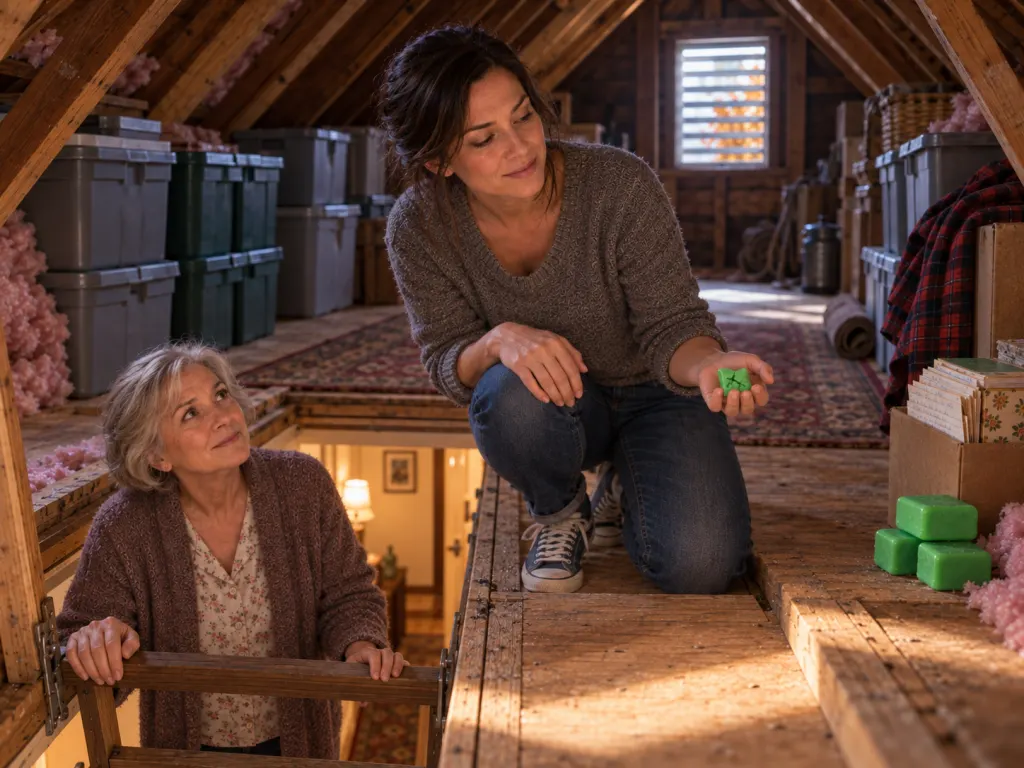
On Day 30, I climbed into the attic with a trash bag, a marker, and a stack of clear plastic bins. My mother passed items up from below. We repacked the recipe cards in a sealed container. We labeled photographs. We threw away three boxes of things no one could identify and no one wanted badly enough to name. I gathered the old soap pieces last.
For a moment, I held one in my palm. It was smaller than I remembered. A little cracked. Still stubbornly green.
Did it work?
my mother asked from the ladder.
I looked around the attic: the repaired vent, the sealed gap, the swept boards, the bins lined against the wall. I thought about all the nights I had wanted one simple object to stand between us and disorder.
It helped me start,
I said.
Chapter 8: What I Tell People Now
When people ask me about Irish Spring in the attic, I do not laugh at them. I understand the appeal too well. A bar of soap is cheap. It is bright. It smells like action. It lets you do something on a day when the problem feels larger than your courage.
I tell them what happened in our house. For a few days, maybe a week, the attic seemed quieter. Maybe the scent mattered. Maybe the mice were somewhere else. Maybe I was listening differently because hope had changed the room. But the lasting quiet came from finding the openings, sealing them, cleaning what needed cleaning, and being honest about what we had left untended.
That is the part I remember most, not the soap. I remember my mother on the attic landing, small but unyielding in her chair. I remember my father’s shirts folded in a square of winter light. I remember the recipe cards rescued from a chewed box, my grandmother’s handwriting looping across paper that had almost become nesting material. I remember the shame I felt calling for help, and how quickly it faded once help arrived.
The attic is still not beautiful. It is an attic. It holds holiday bins, old photographs, a suitcase with a broken zipper, and two shirts my mother cannot yet decide where to keep. But now it also holds evidence that we can look directly at a problem without being swallowed by it.
Sometimes, when I pull down the ladder, I still catch a faint clean scent from some forgotten sliver of soap lodged behind a beam. It no longer feels like a promise. It feels like a beginning.
The house did not become safe because I placed a green bar in the dark. It became steadier because that small, foolish, hopeful act led me up the ladder. Once I was there, I finally saw what needed care. And in an old house, as in a grieving family, seeing clearly is often the first repair.
Wrap-Up
A thirty-day attic experiment with Irish Spring soap begins as a nervous attempt to handle mice cheaply and quietly, but it becomes a family reckoning with grief, neglected repairs, and the emotional weight stored above the ceiling. The lasting change comes not from the soap alone, but from facing the house honestly and doing the work.