 Save
The direct answer: the five most useful foods to know are soy foods, ground flaxseed, sesame seeds or tahini, legumes such as beans and chickpeas, and fruits such as strawberries or apricots. They are often described as estrogen-rich, but that phrase is misleading. These foods do not supply human estrogen. They contain phytoestrogens, plant compounds that resemble estrogen in some ways but behave more weakly and less predictably in the body. The Linus Pauling Institute explains that lignans and isoflavones are major dietary phytoestrogens, while the USDA maintains a database focused on isoflavones in selected foods. Those distinctions matter because a meal is not a hormone product, and evidence about supplements should not be treated as the same thing as eating tofu, flaxseed, or beans as part of a normal food pattern.
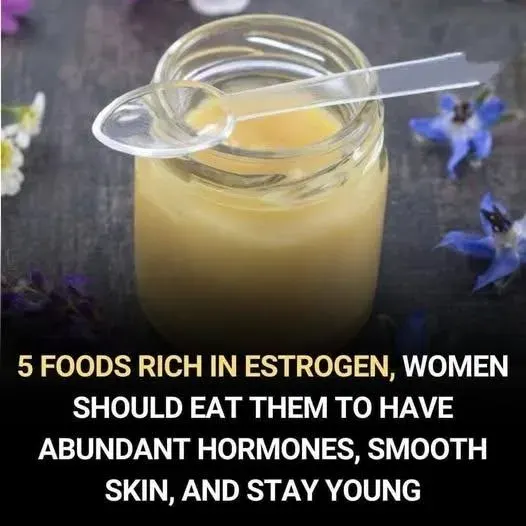
The jar in the accompanying image
The photograph shows an unidentified pale, thick substance in a jar. Its appearance cannot establish that it is a particular food, royal jelly, a hormone product or one of the five foods discussed below. The text promising abundant hormones, smooth skin and youth is not verified by that image. The list below concerns dietary plant compounds, not a recipe or dose for the jar’s contents.
First, the Wording Matters
People often search for foods rich in estrogen because they want a simple food list. A more accurate list is foods with estrogen-like plant compounds. The Linus Pauling Institute describes lignan precursors as plant compounds found in seeds, whole grains, legumes, fruit, and vegetables; after eating them, the body can convert some lignans into enterolignans with weak estrogenic activity. The same source notes that phytoestrogens may also act through non-estrogen pathways, so it is too simple to say that a food raises estrogen in a direct way. Oregon State University's Linus Pauling Institute is especially useful here because it separates food sources from stronger claims about outcomes.
Isoflavones are the other major group most readers encounter. The USDA's special interest database lists isoflavones such as daidzein, genistein, glycitein, and total isoflavones in hundreds of foods, with soy foods standing out compared with most other everyday foods. The USDA Agricultural Research Service database page is a practical reminder that the amount varies by food type and preparation. A serving of edamame, tofu, or tempeh is not interchangeable with a sprinkle of beans or a berry bowl. The foods below are best understood as categories of plant compounds, not as a ranked promise of hormone effects.
1. Soy Foods: Tofu, Tempeh, Edamame, Miso, and Soy Milk
Soy is the clearest starting point because soybeans are a major dietary source of isoflavones. The National Center for Complementary and Integrative Health lists tofu, miso, tempeh, edamame, and soy milk among common soy foods and explains that soy products may contain isoflavones, compounds similar in structure to estrogen. NCCIH's soy fact sheet also cautions that research findings vary by product and population. For a kitchen-minded reader, that means whole soy foods deserve a different mental category than concentrated extracts or capsules.
In practical cooking, soy foods are flexible: edamame can be added to grain bowls, tofu can be baked or simmered, tempeh can be sliced into a skillet meal, and unsweetened soy milk can stand in for dairy milk where its flavor works. Fermented options such as miso and tempeh add savoriness, while tofu and soy milk are milder. The important point is consistency of food identity, not chasing a special preparation. If you are comparing labels, look for the food itself, added sugars where relevant, and sodium in salty products like miso or seasoned tofu.
2. Ground Flaxseed
Flaxseed belongs on the list because it is one of the richest common food sources of lignans. The Linus Pauling Institute notes that flaxseeds are far richer in lignan precursors than the other foods in its selected table, and that crushing or milling can improve availability. NCCIH's flaxseed page treats flaxseed and flaxseed oil separately, which is important because the lignans are associated with the seed portion rather than plain oil. NCCIH's flaxseed overview also notes that raw or unripe flaxseeds should not be eaten.
For everyday use, ground flaxseed fits best as a small food addition rather than the center of a meal. It can be stirred into oatmeal, blended into a smoothie, folded into pancake batter, or sprinkled over yogurt. The flavor is nutty and mild, but it can become noticeable if too much is added to a delicate dish. Whole flaxseeds are attractive on bread, but ground flaxseed is the more relevant form when the goal is to make the seed's components accessible. Store it tightly closed, preferably cool, because ground seeds have more exposed surface area.
3. Sesame Seeds and Tahini
Sesame seeds are another useful lignan source. In the Linus Pauling Institute's selected lignan table, sesame seeds rank well below flaxseed but well above many fruits and vegetables by serving. That makes sesame a good example of a food that is not usually marketed around hormones, yet still contributes plant compounds in a normal kitchen pattern. Tahini, the paste made from sesame seeds, makes sesame easier to use in sauces, dressings, and dips than loose seeds alone.
Sesame also teaches a helpful lesson about serving size. A garnish of seeds on top of a bun is not the same as a spoonful of tahini in a dressing. Neither needs to be treated as a special health project, but the food form changes how much sesame a person actually eats. Try tahini thinned with lemon juice and water as a sauce for roasted vegetables, stir sesame seeds into rice, or add a small amount to slaw. These are culinary uses first, with phytoestrogen content as background context rather than the whole reason to eat them.
4. Beans, Chickpeas, Lentils, and Other Legumes
Legumes are a broader group than soy, and their phytoestrogen profile is usually less concentrated than soybeans. Still, reviews and food-composition sources commonly place legumes among sources of isoflavones, lignans, or related compounds. A PubMed-indexed review in Annual Review of Nutrition summarizes phytoestrogens as including isoflavones, coumestans, and lignans, and names soybeans, clover and alfalfa sprouts, and oilseeds such as flaxseed as significant sources within those groups. The PubMed record is also useful because it notes that there are no formal dietary recommendations for individual phytoestrogens.
For home meals, legumes are valuable because they are easy to repeat without making the plate feel unusual. Chickpeas, black beans, lentils, kidney beans, and split peas all work in different cooking styles. Instead of trying to make them act like soy, use them as sturdy plant foods that add variety to the pattern.
- Chickpeas: use in hummus, soups, salads, or roasted snacks.
- Lentils: simmer into stews, spoon over rice, or use in warm salads.
- Black or kidney beans: add to tacos, grain bowls, chili-style dishes, or vegetable soups.
- Split peas: cook into a thick soup with herbs and vegetables.
5. Strawberries, Apricots, and Other Fruit Sources
Fruit sources are more modest, but they make the list because lignans are found across a wide range of plant foods, including fruit. The Linus Pauling Institute's selected table lists strawberries and apricots among lignan-containing foods, though at much lower levels than flaxseed or sesame. That makes fruit a supporting source, not the strongest source. It is still worth naming because people often eat fruit more regularly than specialty foods, and repeated ordinary choices can matter to the overall food pattern.
Use fruit in the role it already plays well: breakfast, snacks, salads, and desserts with a lighter touch. Strawberries with yogurt, apricots with oatmeal, berries over whole-grain toast, or chopped fruit with nuts and seeds can bring several plant-food categories together. The goal is not to turn fruit into a hormone food. It is to understand that phytoestrogens are part of a larger plant-food picture that includes seeds, legumes, whole grains, fruit, and vegetables.
How to Use This List Without Overreading It
A helpful way to use the list is to divide it into stronger, moderate, and supporting sources. Soy foods are the clearest isoflavone-rich category. Ground flaxseed is the standout lignan source. Sesame seeds and tahini are moderate lignan-rich foods that fit easily into savory meals. Beans and chickpeas contribute smaller amounts while adding variety. Fruit sources are usually lower, but they are familiar and easy to include. This framing is more useful than treating every item as equally powerful.
It also helps to keep food and concentrated products separate. NCCIH's discussion of menopausal symptoms explains that phytoestrogens are plant substances with chemical structures similar to estrogen, but research on symptom-focused supplement use has produced mixed results, and long-term safety questions are treated differently for supplements than for ordinary foods. NCCIH's menopause overview is not a reason to avoid soy foods or flaxseed in normal meals; it is a reason to avoid turning a grocery list into a personal hormone strategy.
What This List Cannot Tell You
This list cannot tell you what your hormone levels are, whether a symptom has a hormone-related cause, or whether a particular food is right for your situation. It also cannot predict how a person will respond, because phytoestrogens differ by compound, food form, amount eaten, and individual biology. The Linus Pauling Institute notes that phytoestrogens can bind to estrogen receptors but are much weaker than the body's own estrogens and may have different effects in different tissues. That is exactly why broad promises about a food category are not careful.
For most readers, the sensible takeaway is simple: soy foods, ground flaxseed, sesame, legumes, and fruit can all be part of varied meals. The strongest evidence in this article supports what these foods contain and how they are categorized, not a guaranteed body response. If you like these foods, use them because they fit your cooking, taste good, and add plant-food variety. If you do not like one category, you do not need to force it; another plant-food pattern may be more sustainable.
A Practical Plate Example
One simple day might include oatmeal with ground flaxseed and strawberries, a lunch bowl with chickpeas and tahini dressing, and a dinner stir-fry with tofu or edamame. Another person might prefer soy milk in coffee, sesame sprinkled over vegetables, and lentil soup with fruit afterward. These examples are not rules. They show how the five categories can appear as normal foods across a week without making the menu feel clinical or repetitive.
Wrap-Up
The phrase estrogen-rich foods usually points to phytoestrogens, not human estrogen. Soy foods are the most notable everyday isoflavone source; ground flaxseed is the standout lignan source; sesame seeds, tahini, legumes, strawberries, and apricots add smaller or supporting amounts. The safest editorial framing is food composition, not hormone promises. Use these ingredients as ordinary plant foods, keep concentrated products in a separate category, and seek qualified guidance for personal health decisions.
Frequently Asked Questions
- → Are these foods actually high in estrogen?
No. They are better described as foods that contain phytoestrogens, which are plant compounds with estrogen-like structure or activity. They are not the same as the body's own estrogen.
- → Which food on the list is the strongest everyday source?
Soy foods are the clearest everyday isoflavone source, while ground flaxseed is the standout lignan source. Sesame seeds and tahini are also useful lignan sources, but usually in smaller amounts than flaxseed.
- → Is flaxseed oil the same as ground flaxseed for lignans?
No. Lignans are associated with the seed portion, so plain flaxseed oil is not the same as ground flaxseed for this purpose. Ground flaxseed is the more relevant form when discussing lignans.
- → Should I use supplements instead of food?
This article focuses on foods. Concentrated products are a different category, and evidence from supplement studies should not be treated as the same thing as eating tofu, beans, seeds, or fruit in normal meals.
- → Can men eat phytoestrogen-containing foods?
Yes, these are common plant foods. The article is about food composition, not a gender-specific plan. Anyone with personal medical questions should talk with a qualified health professional.
References
This content was developed and refined using reliable sources.
- https://lpi.oregonstate.edu/mic/dietary-factors/phytochemicals/lignans
- https://www.ars.usda.gov/northeast-area/beltsville-md-bhnrc/beltsville-human-nutrition-research-center/methods-and-application-of-food-composition-laboratory/mafcl-site-pages/isoflavone
- https://www.nccih.nih.gov/health/soy
- https://www.nccih.nih.gov/health/flaxseed-and-flaxseed-oil
- https://www.nccih.nih.gov/health/menopausal-symptoms-in-depth
- https://pubmed.ncbi.nlm.nih.gov/9240932