 Save
Your place at the table changes connection because it changes what is effortless: who you can see, how loudly you need to speak, whether eye contact feels natural, and whether joining in requires interrupting. Researchers call this kind of space use proxemics, the study of how people use distance and orientation in social interaction https://oecs.mit.edu/pub/1cafk2cg/release/1/. A seat is not a personality test. It is a small design choice that can make warmth, privacy, listening, leadership, or retreat more available.
A Seat Is a Social Tool, Not a Label
It is tempting to turn seating into a tidy code: the head of the table is the leader, the far end is the loner, the seat beside someone means closeness, and the corner means caution. Real life is more interesting than that. A person may sit near the kitchen because they are helping serve, near the door because they expect a call, beside a quiet relative because they want to include them, or across from someone because the only open chair happens to be there. The useful question is not, “What does this chair prove about me?” The useful question is, “What does this position make easier or harder?”
Communication scholars describe nonverbal communication as part of the same system as words, not as a separate hidden language. The University of Minnesota’s open communication text notes that nonverbal cues can influence relational meaning, conversational flow, and the sense of connection between people https://manifold.open.umn.edu/read/chapter-16a-nonverbal-communication/section/7d37afd4-33d9-4940-bad4-b3cd9a7257e3. At a table, the chair quietly changes the cues available to you. It can give you a clean line of sight, place you beside an ally, shield you from too much attention, or make you visible to everyone before you have said a word.
Distance Sets the Volume of an Interaction
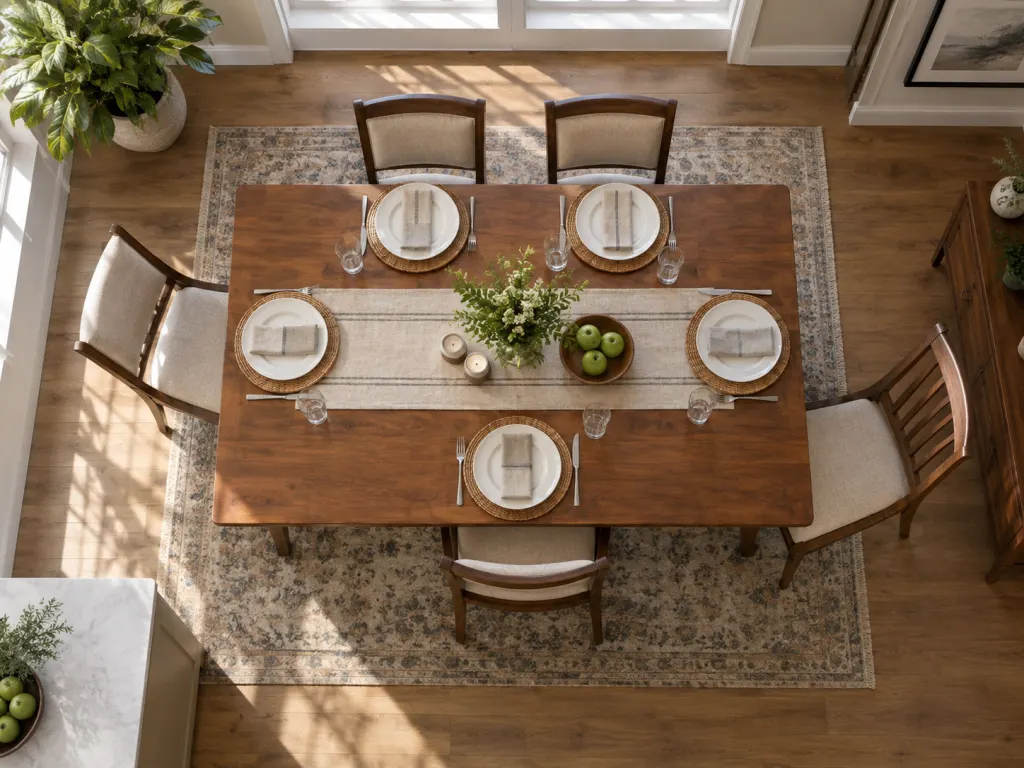
Distance is one of the clearest ways seating affects connection. Sitting close to someone makes small comments easier: a quick aside, a shared laugh, a low question about whether they want more bread. Sitting farther away often moves the exchange into a more public register. You may need to raise your voice, wait for a pause, or speak to the group rather than one person. Neither distance is better. Close seats are good for rapport and quick coordination. Farther seats can be useful when a conversation needs breathing room or when a group should feel less clustered.
Proxemics research examines interpersonal distance, orientation, and gaze as connected parts of an interaction. The Open Encyclopedia of Cognitive Science summarizes that people use and experience physical space in ways tied to cultural norms, attitudes, relationships, and the immediate setting https://oecs.mit.edu/pub/1cafk2cg/release/1/. That is why the same chair can feel different at Thanksgiving, a first dinner with in-laws, a team lunch, or a quiet breakfast with a friend. A close seat beside a sibling may feel ordinary; the same closeness beside a new acquaintance may feel rushed.
Eye Contact Changes the Energy of a Seat
Across-the-table seating invites eye contact. That can be wonderful when two people want focused conversation: a parent checking in with a teenager, two friends catching up, or a host making sure a guest feels included. It can also feel too direct if the relationship is new or the topic is delicate. Angled seating often softens the exchange. You can look at the person while speaking, then naturally glance toward the plate, the room, or another speaker without making the pause feel like withdrawal.
In small group teaching, researchers describe seating as part of the learning environment because different layouts change participation and discussion. A paper hosted by the National Library of Medicine explains that seating arrangements can alter class discussion and interaction, and that a discussion-table format can encourage relaxed exchange while still leaving some people less included if sight lines are poor https://pmc.ncbi.nlm.nih.gov/articles/PMC7712596/. The lesson applies beyond classrooms: the seat with the best view of everyone often carries more opportunity to guide the conversation, while a seat with a blocked view can make participation feel like work.

Side-by-Side Seats Encourage Cooperation
Side-by-side seating often changes the mood from interview to partnership. Two people looking in roughly the same direction can compare notes, serve food together, review a menu, help a child cut something on a plate, or share a private comment without turning the whole table toward them. This is why a bench, banquette, or corner booth can feel intimate without requiring constant direct gaze. The arrangement says, in effect, “We are looking at the same scene.”
Research on vehicle seating gives a practical example of how orientation affects conversation. In one PubMed-indexed study, participants spoke in several seat configurations at the same distance; arrangements closer to angled or nearly opposite positions scored better for conversation quality than straight side-by-side seating, which often required more turning https://pubmed.ncbi.nlm.nih.gov/31368416/. Around a dining table, the takeaway is not that one angle always wins. It is that easy conversation depends on more than distance. The direction people face matters too.
The Head, End, and Middle of the Table Send Different Signals
The head of a rectangular table is often treated as a position of authority because it offers visibility. From there, a person can see more faces, begin a toast, direct serving, or settle the pace of a meal. But in many homes, that seat may simply belong to the person nearest the kitchen, the oldest family member, or whoever arrived first. The middle seats are often more socially busy. They receive comments from both sides and can bridge separate conversations. End seats can be quieter, especially when the table is long, but they can also give a person a broad view of the room.
Corners and Edges Can Make Joining Easier
Corner seats are underrated. At a corner, two people can talk at an angle without the intensity of a direct face-off. The corner also makes it easy to pivot between one person and the larger group. For a quieter guest, that can be a generous place: close enough to be included, protected enough not to feel placed on display. Edge seats serve a similar purpose. They can offer an exit from a crowded exchange while still keeping the person at the table.
This matters when hosting. If every confident talker is placed in the center and every reserved person is left at the far end, the table may split into islands. A more thoughtful arrangement mixes social roles. Put a warm conversationalist near someone new. Keep people who need to coordinate food or childcare within easy reach. Give a guest who is not ready for the spotlight an angled seat beside someone kind rather than a central seat that demands constant performance.
Culture, Family Habit, and Occasion Matter
There is no universal table code. Some families have assigned places that carry affection rather than rank. Some cultures treat seating order as a way to honor elders or guests. In some households, children gather wherever space opens; in others, the host carefully arranges every chair. A business dinner, a holiday meal, a first date, and a casual pizza night all create different expectations. The same seat can mean respect in one setting, convenience in another, and nothing special in a third.
That is why seating advice should stay flexible. A round table distributes attention more evenly than a long table, but it may make side conversations harder. A rectangular table creates clear ends and sides, but it can also support several small exchanges at once. A kitchen island can feel relaxed because people stand, lean, move, and help. A formal dining table can slow everyone down in a useful way. The furniture does not determine connection by itself; it shapes the paths connection can take.
How to Choose a Seat for the Conversation You Want
If you want a better exchange, choose the chair that supports the kind of attention you hope to give. For a serious but kind conversation, an angled seat is often easier than a direct face-off. For catching up with someone you love, sitting beside or diagonally across from them can allow closeness without making every silence heavy. For a group meal, a central side seat helps you include people on both ends. For listening more than speaking, an edge seat can let you observe without disappearing.
- To invite one-on-one connection: sit beside someone or diagonally across from them.
- To guide a group: choose a seat with clear sight lines, not necessarily the most dramatic chair.
- To reduce tension: avoid a rigid face-to-face setup and use an angle when possible.
- To include a quiet person: seat them near a gentle conversational partner, not at an isolated end.
- To keep a meal lively: spread frequent talkers around the table instead of clustering them together.
What Your Favorite Seat Might Suggest
A repeated preference can still be worth noticing. If you always choose the nearest chair to another person, you may value quick warmth and easy exchange. If you prefer an end seat, you may like seeing the whole scene before entering it. If you choose a corner, you may enjoy connection with a little control over intensity. If you sit opposite someone, you may be ready for direct attention. These are possibilities, not diagnoses. The most honest reading includes the setting: who else is present, what the occasion is, how loud the room is, and what the table asks of you.
For Hosts, Seating Is Quiet Hospitality
Hosts often focus on food, timing, and place settings, but seating is one of the most practical forms of hospitality. A thoughtful seat can help a guest feel noticed without being exposed. It can keep a strained pair from being forced into a long, direct exchange. It can help a newcomer find an easy first conversation. It can also support the host’s own evening by placing helpers nearby and giving children, elders, or late arrivals a workable path in and out.
The goal is not to control everyone. It is to remove unnecessary friction. People connect more easily when they can hear, see, pause, and rejoin without struggle. A good seating plan lets the meal breathe: direct enough for conversation, loose enough for movement, and balanced enough that no one is stranded outside the circle.
Wrap-Up
Your place at the table changes connection by changing distance, gaze, orientation, access, and ease of participation. A seat can make you more visible, more private, more cooperative, or more central to the group. The most useful approach is to treat seating as a gentle design choice rather than a personality verdict. Choose the chair that supports the conversation you want, and when hosting, arrange people so connection has fewer obstacles.
Frequently Asked Questions
- → Does where I sit reveal my personality?
Not by itself. A seat can hint at what feels useful in that moment, such as closeness, visibility, privacy, or an easy exit from the center of attention. But it cannot prove a stable trait. Context matters more than a single choice.
- → What is the best seat for a meaningful conversation?
A diagonal or slightly angled seat is often helpful because it allows eye contact without making every moment feel direct. It also gives both people natural places to look during pauses, which can make serious conversation feel calmer.
- → Why do some people prefer the end of the table?
The end can offer a wider view, less interruption from both sides, and a clearer sense of the whole group. For some people it feels central; for others it feels quieter. The meaning depends on the person and the occasion.
- → How should I seat guests who do not know each other well?
Place newcomers near warm, steady conversational partners and avoid isolating them at the far end. Angled seats or middle-side seats can help them join naturally without having to command the table.
- → Are round tables better for connection?
Round tables can make attention feel more evenly shared because there is no obvious head seat. Long tables are better for several small conversations at once. The better choice depends on whether you want one shared discussion or many smaller exchanges.