 Save
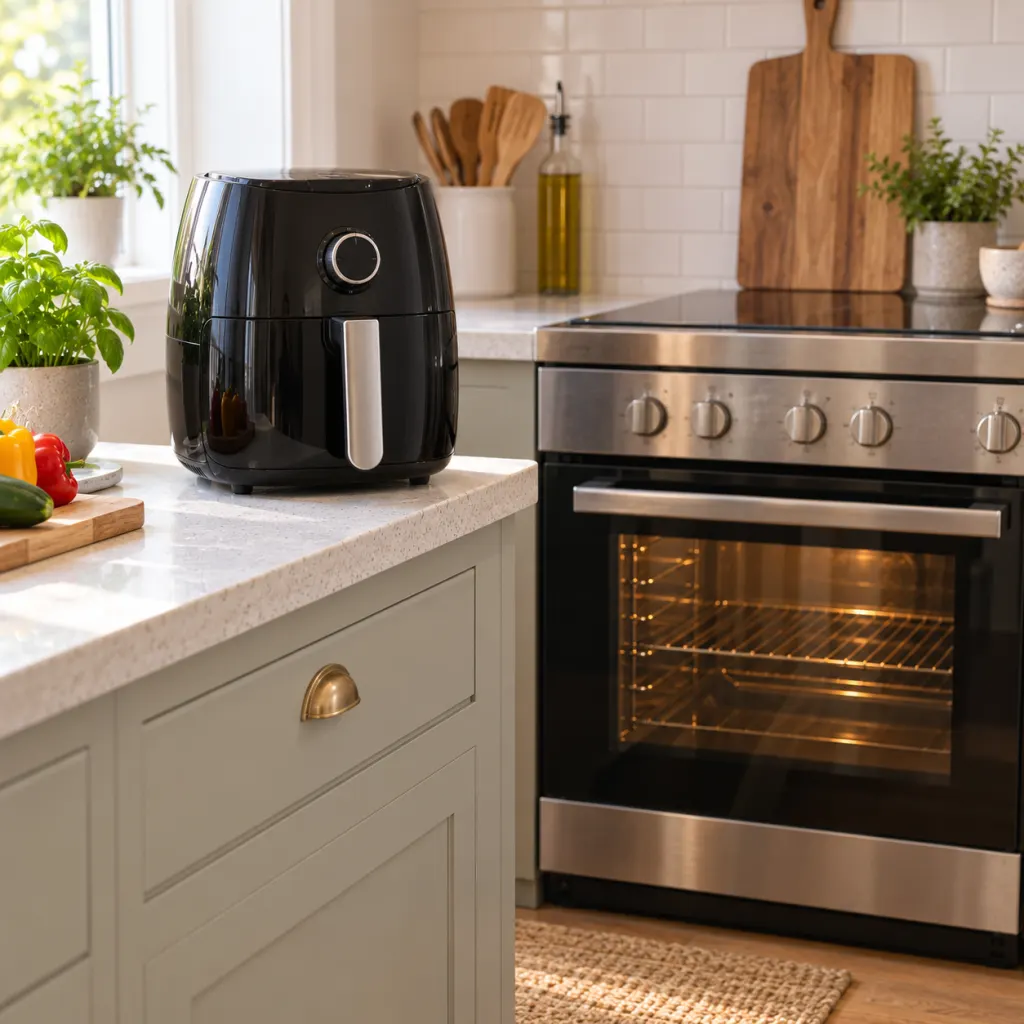
If you own an air fryer, you know how useful it can be for weeknight cooking, quick, crispy results and a fast preheat time make it a popular countertop fixture. But a growing body of cooking research and practical guidance from food scientists points to a clear pattern: air fryers are excellent tools within their design range, and poor substitutes outside it.
The direct answer is this: an air fryer works as a compact, high-speed convection device, and its strengths are real. Its limitations are equally real and are rooted in basic physics. It cannot hold large cuts of meat, cannot replicate the heat environment of a full-size oven, and research published in peer-reviewed journals shows meaningful differences in texture and compound formation when baked goods are prepared in an air fryer versus a conventional oven. Understanding those differences helps you decide which appliance to reach for, and when keeping both makes practical sense.
This article examines how air fryers work, where they genuinely outperform a conventional oven, where they fall short, what food safety research says about each method, and how to build a practical approach to using both tools well.
How an Air Fryer Actually Works
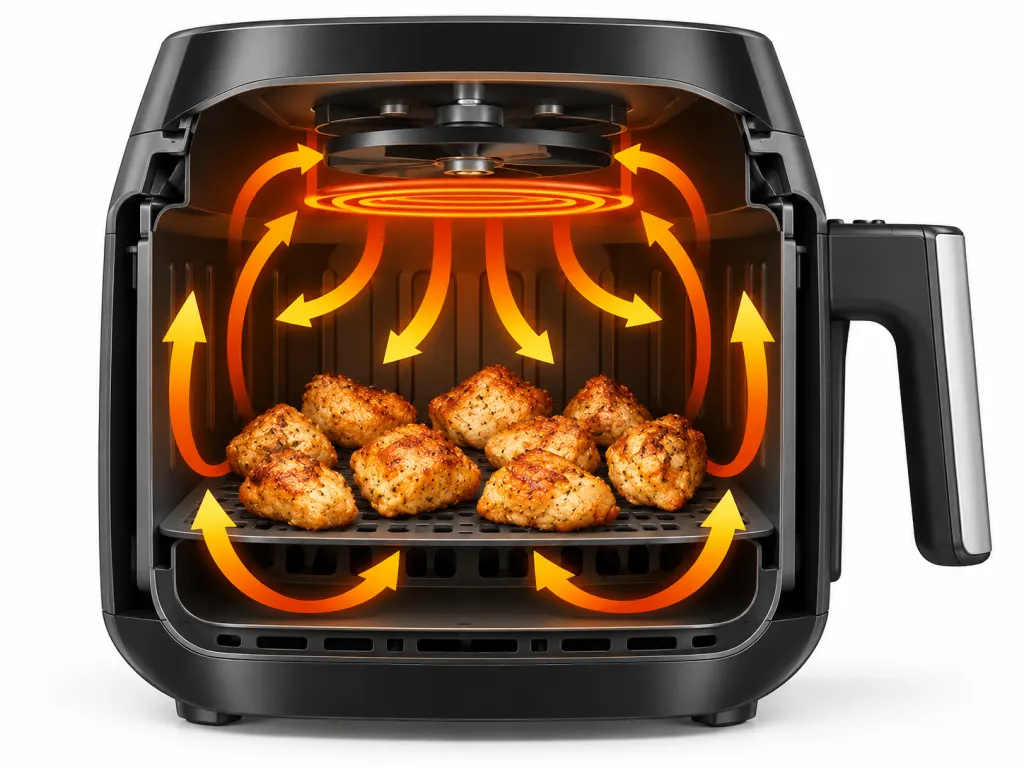
An air fryer is not a fundamentally new cooking technology. It is a compact countertop convection oven in which a powerful fan circulates hot air at high speed around a small cooking chamber. The rapid airflow strips away the thin layer of steam that forms on the surface of food as it heats, allowing the outer surface to dry and brown quickly, producing the characteristic crisp texture associated with the appliance. The core difference between an air fryer and a full-size convection oven lies in scale and airflow intensity, not in fundamental cooking physics.
Because the chamber is small and the fan is powerful, an air fryer preheats in two to five minutes compared to the ten to twenty minutes a conventional oven typically requires. Food also cooks faster: manufacturers often recommend reducing temperature by about 20°F (11°C) and checking food earlier when adapting oven recipes to an air fryer. This speed advantage is real and useful, but it comes directly from the small volume of air that needs to be heated, an advantage that changes significantly when you need to cook a larger quantity of food.
Where Air Fryers Genuinely Excel
Within their design range, air fryers are effective and efficient. For small-portion cooking, a few servings of chicken tenders, potato wedges, or reheated leftovers, they deliver reliably crispy results in less time and with less energy than heating a full-size oven. They are particularly well suited to foods that benefit from surface drying and browning but do not require the moisture-retaining environment of a covered roasting pan or the structural support of a baking sheet in a large oven cavity.
The following tasks represent the air fryer's strongest use cases:
- Reheating pizza, pastry, or fried foods where you want to restore crispiness rather than add moisture
- Cooking single or double servings of proteins like chicken pieces, fish fillets, or beef skewers
- Preparing vegetable sides, broccoli, Brussels sprouts, potato wedges, in small batches
- Making snack-sized portions of breaded or frozen foods quickly on busy nights
- Crisping flatbreads and pita where high surface heat matters
For these tasks, an air fryer often uses less energy than a full-size oven because it heats a much smaller volume of air. When cooking for one or two people on a regular basis, this efficiency advantage is meaningful over time. Recipes like Crispy Air Fryer Chicken Tenders and Air Fryer Potato Wedges illustrate the kinds of tasks where the appliance performs at its best.
Capacity: The Most Immediate Limitation
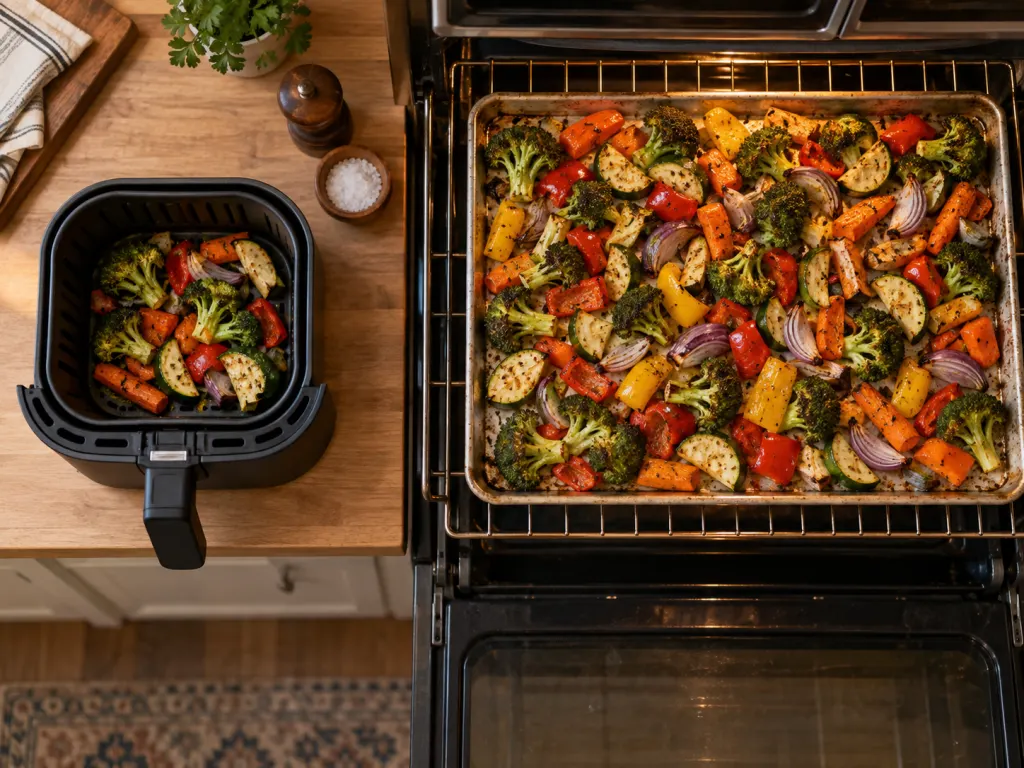
The most straightforward limitation of an air fryer is its size. Consumer air fryer baskets typically hold between two and five liters of food, enough for two to four servings of a single item, provided food is not stacked too deeply. When food is piled in layers, the airflow that creates crispy results is blocked, and food in the center steams rather than browns. The practical implication is that cooking in batches becomes necessary whenever you are preparing food for more than a small household.
Batch cooking introduces a compounding problem: the first batch cools while the second batch cooks, and the total time for the meal may approach or exceed the time a full-size oven would have taken. For families of four or more, weekend meal preparation, or any occasion requiring a larger output, the speed advantage an air fryer holds for small batches largely disappears. A whole roasting chicken, a large brisket, a rack of ribs, a full casserole dish, or a sheet pan of roasted vegetables for a crowd simply does not fit. These tasks remain the practical domain of a full-size oven.
Why Baking Is Particularly Challenging in an Air Fryer
Baked goods present a different and more fundamental challenge for air fryers than savory foods do. The intense forced-air environment that creates crispy surfaces on proteins and vegetables is poorly matched to the needs of cakes, muffins, quick breads, and similar items that require gentle, even heat and controlled moisture retention during the early stages of baking.
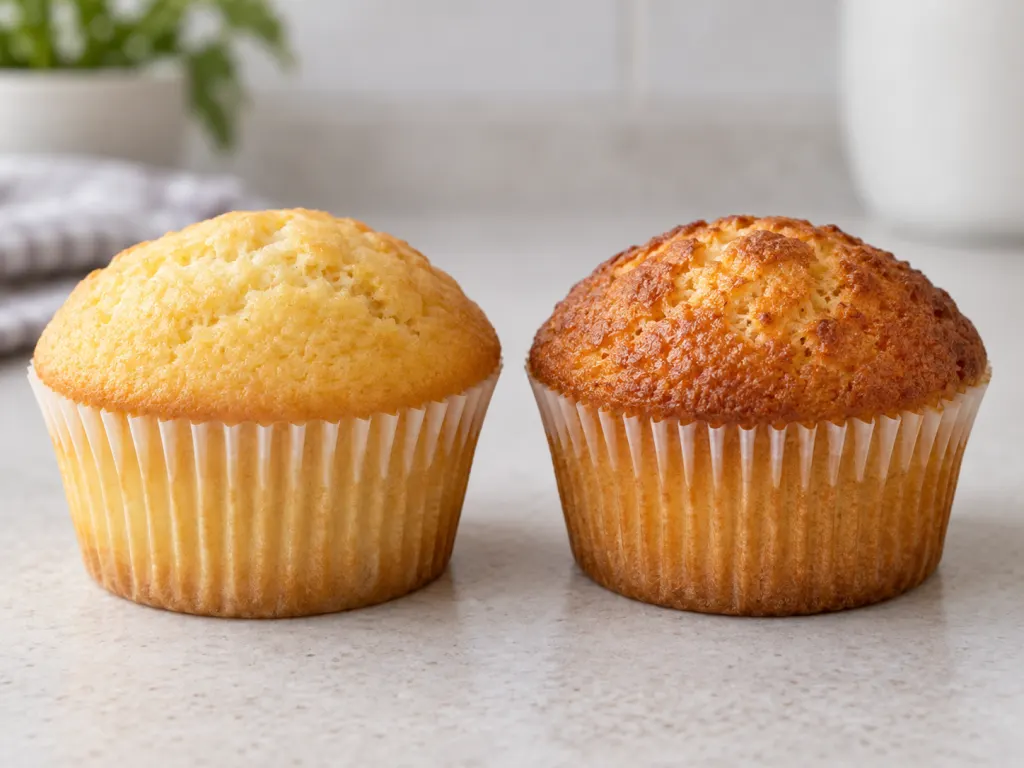
A peer-reviewed study published in Foods comparing air-fried and oven-baked cupcakes found that air frying produced cupcakes that were approximately 6.78 times firmer in texture than their oven-baked counterparts. Air-fried cupcakes also showed approximately 22.2% weight loss during cooking versus 20.5% for oven-baked samples, indicating greater moisture loss under the high-airflow conditions of the air fryer. The researchers concluded that oven baking produced superior sensory results for starch-based baked goods and recommended it as the preferred method for that category of food.
Beyond texture and moisture, the same study identified differences in advanced glycation end product (AGE) formation, compounds that develop during thermal processing of foods. Air-fried cupcakes showed approximately 13.3% higher fluorescent AGE formation than oven-baked samples under equivalent conditions. These findings add a measurable dimension to the quality argument: for baked goods specifically, the oven is not just a matter of preference but of documented outcome differences rooted in how each appliance transfers heat.
Large roasts, whole birds, multi-rack baking sessions, and dishes that use the oven's ambient environment, such as custards, soufflés, or covered braises, similarly cannot be replicated in the small, turbulent environment of an air fryer basket. These dishes are designed for the thermal characteristics of a full-size oven and perform poorly or are simply impossible to prepare properly in a compact countertop unit.
Food Safety Applies Equally to Both Appliances
A common assumption is that the high temperatures and fast cooking of air fryers make them inherently safer than conventional ovens for cooking proteins. The reality is more nuanced. Food safety depends on reaching and maintaining adequate internal temperatures in the food itself, not on the cooking method used. A food thermometer remains the essential tool for verifying doneness in either appliance.
Research published in the Journal of Food Protection examined the cooking of breaded stuffed chicken products in both basket-type and oven-type air fryers and found that both appliance types successfully achieved the recommended 7-log reduction of Salmonella and reached the critical internal temperature of 74°C (165°F) required for poultry. However, the study found that product thickness significantly affected heating time. Thicker products required substantially longer cooking times to reach safe internal temperatures, and cooking conditions that worked for standard portions could result in undercooking for thicker cuts. The practical takeaway: always use a calibrated food thermometer to verify that food has reached a safe internal temperature, regardless of whether you are using an air fryer or a conventional oven.
For more on keeping your air fryer in safe working condition, see A Quick, Safe Way to Clean Your Air Fryer, which covers maintenance practices that help preserve both appliance performance and hygiene over time.
What Research Shows About High-Heat Compounds in Both Methods
Cooking at high temperatures, whether in an air fryer or a conventional oven, produces chemical compounds through normal thermal reactions in food. Two compounds that appear in the research literature on this topic are acrylamide and benzo[a]pyrene (BaP).
Acrylamide forms through a natural chemical reaction between sugars and the amino acid asparagine in plant-based foods during high-temperature cooking, including frying, roasting, and baking, according to the U.S. Food and Drug Administration. The FDA monitors acrylamide levels in food and has provided guidance to industry on reduction strategies. A commentary published in a peer-reviewed journal noted significant methodological challenges in directly comparing acrylamide levels across cooking methods, cautioning against overgeneralizing from individual studies. Both air fryers and conventional ovens produce acrylamide in susceptible plant-based foods under high-heat conditions.
For BaP, a study published in Food Quality and Safety found that beef cooked in an air fryer had substantially lower BaP concentrations than beef cooked in a conventional oven under comparable conditions. The difference was especially pronounced in oil-free preparation: when beef was cooked in the air fryer without added oil, BaP was below the detection limit. The researchers noted that oil applied to the surface of meat before cooking contributed significantly to BaP formation in both methods. This finding suggests that preparation practices, such as limiting added surface fats when cooking meat at high heat, matter alongside the choice of appliance. Important
This article is general information only and is not medical advice. Talk to a doctor or qualified health professional about your own situation.
Making an Informed Choice for Each Cooking Task
The clearest practical framework for using both appliances well is to match the task to the tool's design. Air fryers are purpose-built for small-batch, high-surface-heat cooking where speed and crispiness are the priorities. Conventional ovens are designed for volume, baking, large-format roasting, and controlled-environment cooking where moisture management and even heat distribution matter.
For a household that cooks primarily small portions of crispy foods, an air fryer alone may cover most needs most of the time, while the oven handles the remaining tasks for which it is irreplaceable. For households that bake regularly, cook for larger groups, or rely on sheet-pan or roasting recipes, the conventional oven remains the primary tool, with the air fryer in a supporting role for snacks, reheating, and quick weeknight proteins.
Neither appliance is categorically superior. Each excels within its design range. The practical decision is not which one to own, but which one to reach for on any given cooking occasion, a question that becomes easier to answer once you understand the physical and culinary differences between them.
Wrap-Up
Air fryers are compact, high-speed convection devices that deliver genuine value for small-batch crispy cooking, fast preheating, and energy-efficient preparation of single or double portions. They are not, however, designed to replace a full-size oven. Their capacity limits rule out large roasts, whole birds, and multi-batch meals without significant time trade-offs. Research demonstrates that baked goods produced in air fryers are notably firmer and drier than oven-baked equivalents, with differences in compound formation documented across methods. Food safety depends on proper internal temperatures in both appliances, not on the appliance itself. The most effective approach is to understand what each tool does well and assign cooking tasks accordingly, rather than assuming one can fully substitute for the other.
Frequently Asked Questions
- → Can I use my air fryer for all the same tasks as a conventional oven?
No. Air fryers perform well for small-batch crispy foods and quick protein cooking, but they lack the capacity and heat environment needed for baking, large roasts, multi-dish meals, and dishes that rely on controlled moisture, such as casseroles, braises, or custards. Research shows baked goods produced in air fryers are significantly firmer and drier than oven-baked equivalents.
- → Does an air fryer cook food more safely than a conventional oven?
Food safety in both appliances depends on reaching adequate internal temperatures in the food itself, not on which appliance you use. Both air fryers and conventional ovens can produce safe, fully cooked food when used correctly. Always use a calibrated food thermometer to confirm that meat, poultry, and other proteins have reached the recommended internal temperature before serving.
- → Why doesn't baking work as well in an air fryer?
The high-speed airflow that gives air fryers their crispy-food advantage is poorly matched to baking. It strips moisture from the surface of baked goods during the critical early phase of cooking, resulting in firmer, drier textures. Research comparing oven-baked and air-fried cupcakes found air-fried samples were nearly seven times firmer in texture than their oven-baked counterparts under the same conditions.
- → How much food can a typical air fryer hold?
Most consumer air fryer baskets hold between two and five liters. In practical terms, this is enough for two to four servings of a single food item when not overfilled. Overcrowding the basket blocks the airflow that creates crispy results, so foods that exceed the single-layer capacity typically need to be cooked in batches, which extends total cooking time significantly.
- → What do studies say about chemical compounds formed during air frying versus oven cooking?
The evidence varies by compound and food type. For BaP in beef, research found substantially lower concentrations in air-fried samples than in oven-cooked samples, especially when no oil was added. For advanced glycation end products in baked goods, air frying produced higher levels than oven baking. Acrylamide forms in both methods in susceptible plant-based foods; researchers have noted methodological challenges in making direct comparisons across studies.
- → Should I replace my oven with an air fryer?
No. Each appliance covers tasks the other handles poorly. An air fryer is an effective tool for small-batch crispy cooking and fast weeknight proteins; a conventional oven is necessary for baking, large-format roasting, and multi-dish preparation. Most households find both appliances useful, with the right choice depending on what and how much is being cooked on any given occasion.