 Save
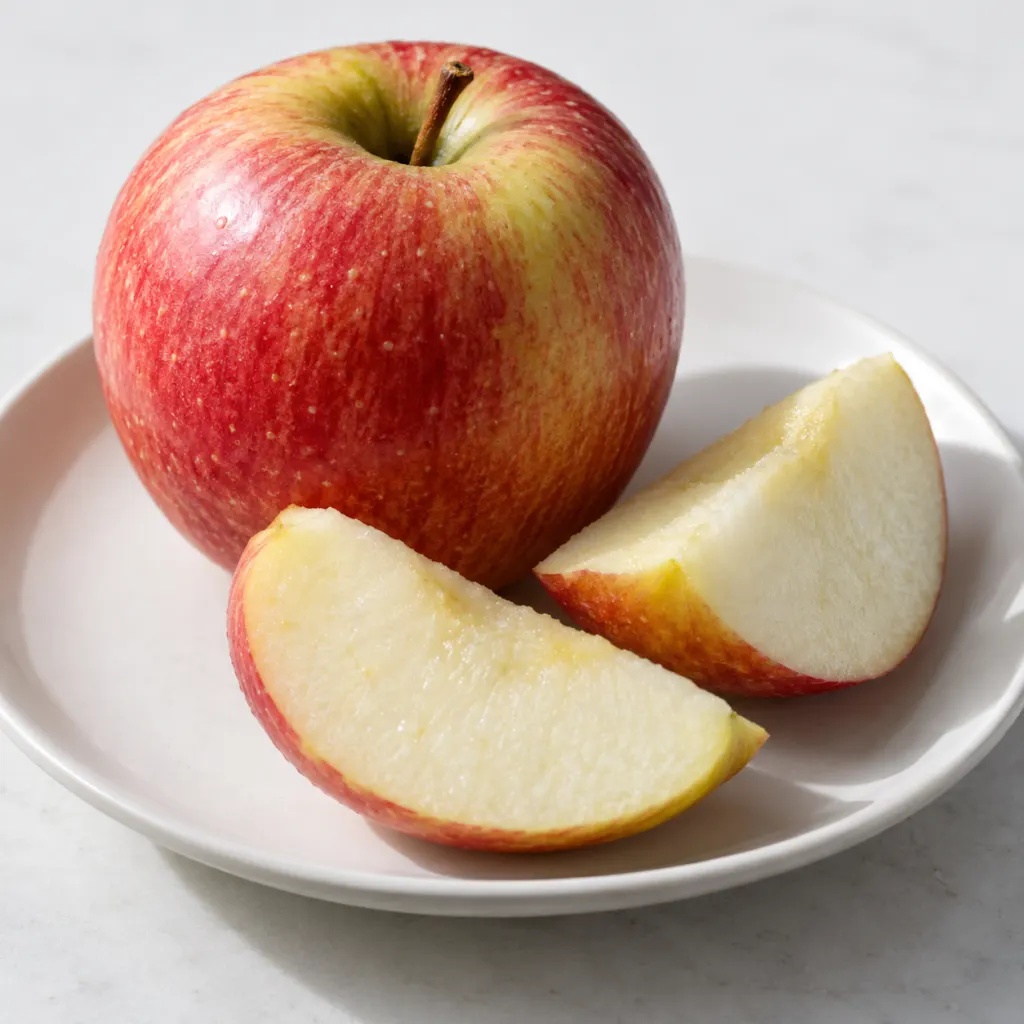
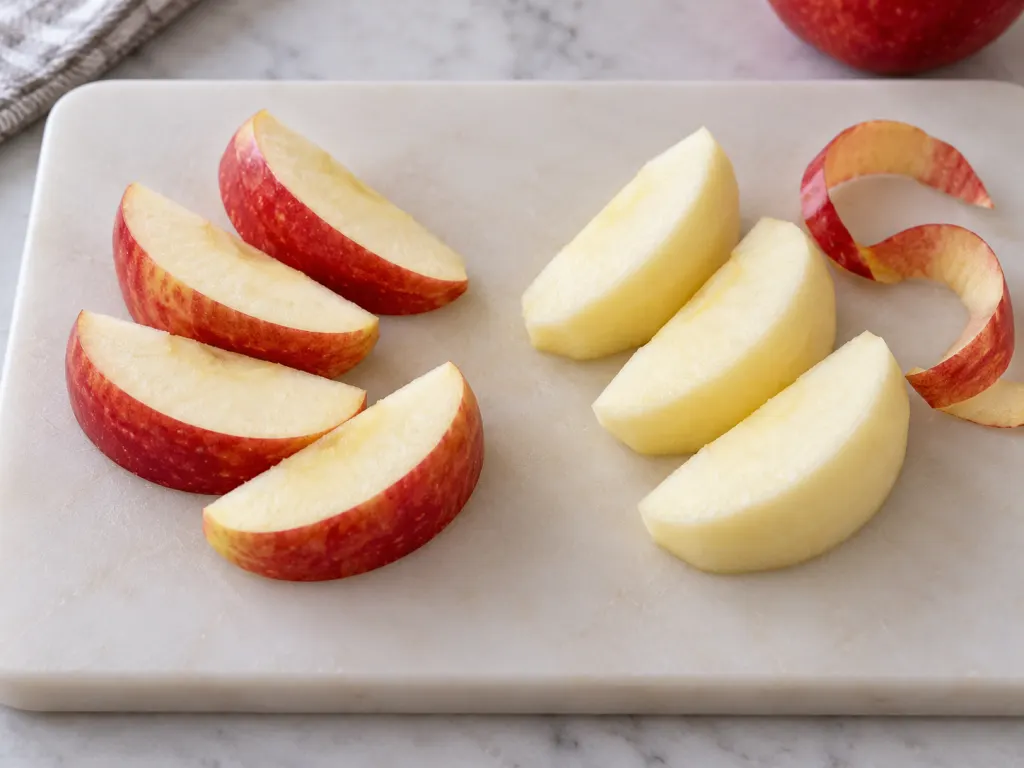
Peel or no peel? Keep the skin to keep more fiber, when that preparation suits you. Apple skin contributes fiber, so removing it takes some away. Peeled apple still has nutritional value: Harvard notes that vitamin C is predominantly in the flesh. The choice is therefore about what peeling changes, rather than whether the remaining fruit is worthwhile. See Harvard's apple overview.
For everyday eating, consider three separate questions: which texture you enjoy, what form of apple you are choosing, and how you prepare it. A crisp wedge, smooth applesauce, and a glass of juice serve different purposes. Understanding those differences makes the peel decision more useful than a rigid rule.
What the skin contributes, and what remains underneath
The skin is part of the apple's edible structure. Harvard identifies apples as sources of soluble and insoluble fiber and explains that discarding the skin removes fiber and many flavonoids, a group of naturally occurring plant compounds. Its overview also identifies vitamin C in the flesh. These details explain why keeping the peel preserves more of the fruit's composition, while peeling leaves something worth eating. Source: Harvard Nutrition Source.
There is no need to turn that comparison into a contest between two plates. For a lunchbox, you might prefer wedges with their colored edges intact. For a smooth purée, you might choose peeled pieces. Decide what you are making first, then consider whether the skin belongs in that particular texture.
Soluble pectin is one part of the fiber picture
Fiber is a type of carbohydrate found in plant foods. Unlike sugars and starches, dietary fiber is not digested and absorbed in the same way. Soluble fiber dissolves in water and can form a gel-like material; insoluble fiber does not dissolve in water. Many plant foods contain both types, in differing proportions. Mayo Clinic explains these distinctions.
Pectin is a soluble fiber present in apples. That identifies a component of the fruit, rather than a separate ingredient you need to add to an apple snack. Source: Harvard Nutrition Source.
Pectin also has a familiar culinary role. University of Minnesota Extension explains that it helps give structure to plant cell walls and forms a network that gels in fruit spreads. Apples are among the fruits it lists as naturally high in pectin. A jam's setting behavior, however, is a cooking property; it should not be used to predict what eating an apple will do for an individual. Source: University of Minnesota Extension.
Compare like with like when reading nutrition figures
Before comparing two apple entries in an app or on a package, check the description and the amount. Does each entry refer to raw fruit, peeled fruit, cooked fruit, or a drink? Is the figure for one item, a weighed quantity, or the package's stated serving? A comparison only answers your question when those details line up.
For example, comparing a small peeled apple with a large unpeeled apple mixes two questions: the effect of peeling and the effect of eating a different amount. If you want to examine peeling, use entries with the same stated weight. If you want to plan your actual snack, use the quantity you expect to eat. Neither comparison needs an elaborate calculation, but the description matters as much as the number.
Whole apple and apple juice are different choices
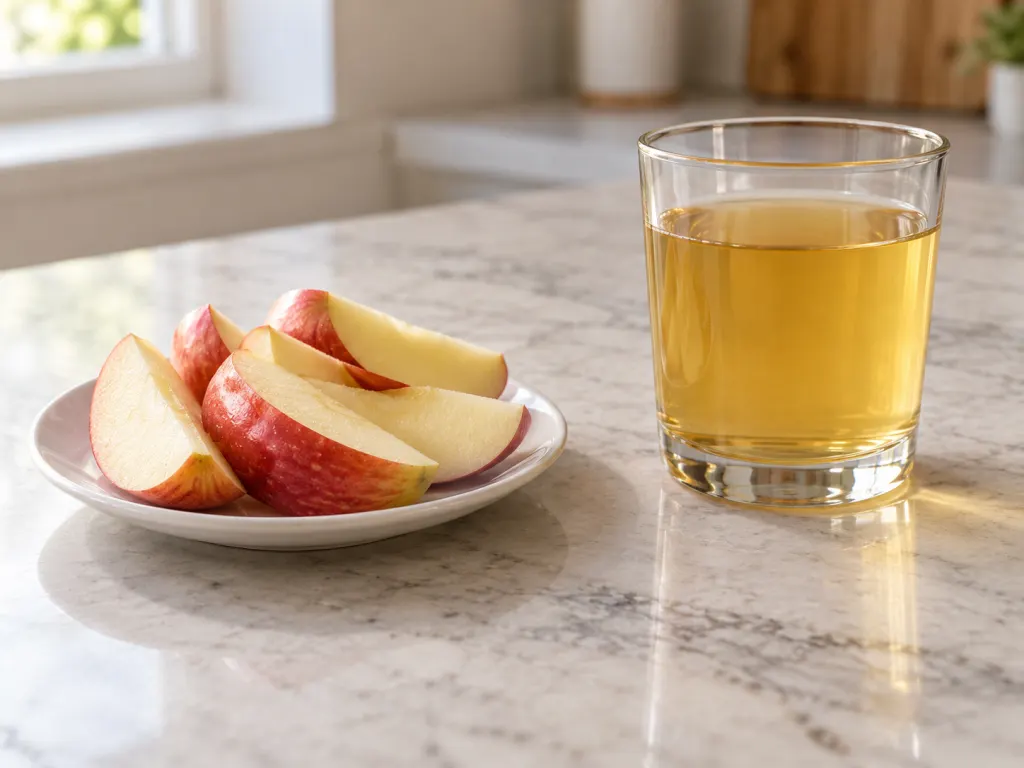
Apple juice should not be treated as a fiber-equivalent substitute for whole apple. USDA's Food Buying Guide explains that fruit juice is lower in dietary fiber than whole fruit and encourages obtaining at least half of fruit intake from whole fruits. Although the guide serves child nutrition programs, this composition distinction helps explain why a piece of fruit and its juice are not interchangeable. Source: USDA Food Buying Guide.
When shopping, read both the product name and the Nutrition Facts panel. Compare the stated serving sizes before comparing fiber. A photograph of apples on the front does not tell you whether the product is sliced fruit, purée, juice, or a mixed beverage. Choose according to what you want it to contribute to the meal, rather than assuming that every apple product is nutritionally identical.
A practical portion starts with an ordinary apple
The NHS gives one medium apple as a practical example of a fruit portion within its 5 A Day guidance. It also describes an adult fruit or vegetable portion as 80 grams. These are everyday planning references, rather than instructions to find an apple of one exact weight. The same guidance emphasizes a variety of fruit and vegetables across the day. Source: NHS portion guide.
You can use that example when packing lunch: choose an apple you expect to finish, or prepare a suitable amount of slices. If a recipe calls for chopped apple by weight, follow the recipe's measurement instead. A cooking quantity and a public-health portion example answer different questions.
For juice and smoothies combined, the NHS recommends no more than 150 milliliters daily and counts them as a maximum of one 5 A Day portion. This is a separate convention from its whole-fruit examples. Source: NHS.
Make room for variety across the week
Apples can be a convenient regular choice without becoming the only fruit in your shopping basket. USDA recommends variety because fruits differ in their nutrient content. Its guidance also recognizes fresh, frozen, canned, and dried forms; when choosing canned fruit, it recommends fruit packed in water or 100% juice rather than heavy syrup. Source: USDA Food Buying Guide.
A useful shopping approach is to buy apples for the occasions when you enjoy their crunch, then choose another fruit for a different meal or snack. Consider cost, availability, and what your household will actually use. Our guides to banana nutrition and kiwi nutrition and portions offer further reading about other familiar choices.
Choose apples you will enjoy using
Iowa State University Extension recommends selecting firm apples with smooth skin and avoiding bruised or soft fruit. Its storage advice is to refrigerate apples in a sealed plastic bag, away from strong-smelling foods such as onions, for up to three weeks. Check the fruit's condition as you use it rather than treating a storage estimate as a guarantee. Source: Iowa State University Extension.
Plan purchases around their destination. A few apples for eating out of hand may be more useful than a large bag bought without a plan. If you are preparing a dish, put it on the week's menu before shopping. The peel decision becomes easier when you already know whether the apples are intended for crisp slices, a chunky filling, or a smooth sauce.
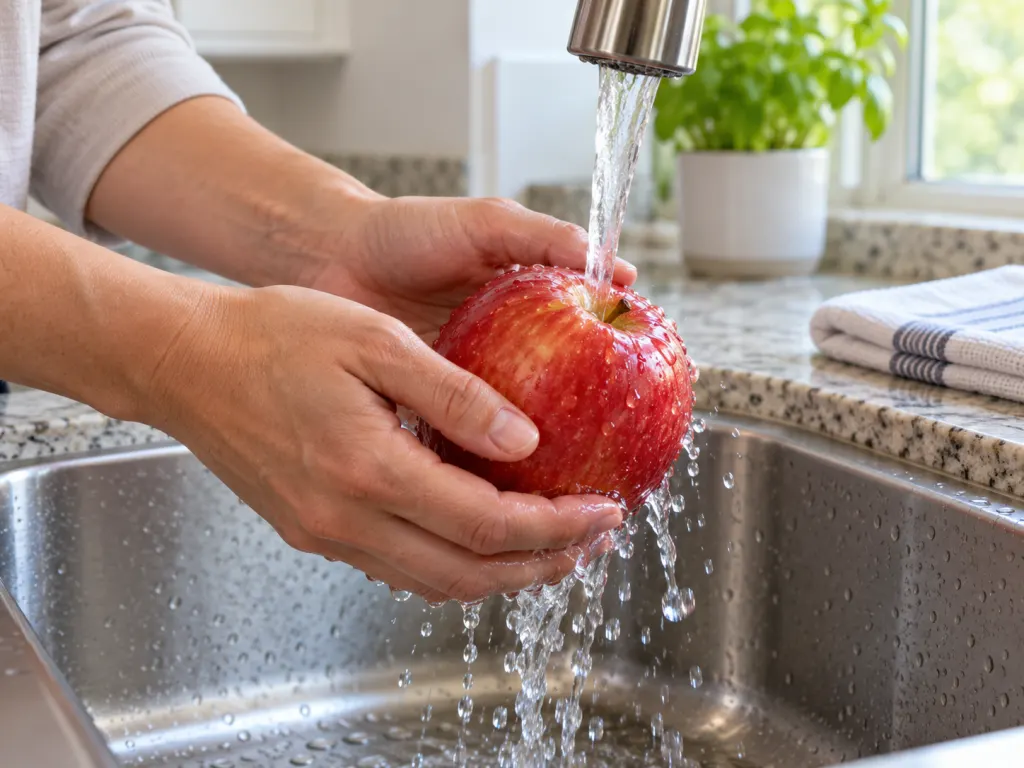
Wash before eating, cutting, or peeling
The FDA recommends washing produce thoroughly under running water before preparation or eating. Do this even when you intend to remove the skin, because cutting or peeling can transfer material from the surface. Washing reduces bacteria but does not eliminate them. Dry washed fruit with a clean cloth or paper towel. Source: FDA produce guidance.
- Wash your hands with soap and warm water for at least 20 seconds before preparation.
- Use running water for the apple; do not wash it with soap, detergent, or commercial produce wash.
- Cut away bruised or damaged areas and discard fruit that looks rotten.
- Keep fruit and its preparation utensils separate from raw meat, poultry, and seafood.
- Refrigerate produce purchased pre-cut or packaged.
These handling recommendations come from the FDA. The distinction is straightforward: soap is for washing your hands and cleaning equipment appropriately; the fruit itself is washed under running water.
Use the peel where it suits the dish
For a simple serving idea, arrange washed, cored apple wedges on a plate. For breakfast, try small pieces over porridge, or tuck thin slices into a sandwich or wrap. These are optional ways to serve the fruit, not a formula with required quantities. Start with a preparation you like and adjust the cut to the dish.
If you dislike large pieces of peel, experiment with smaller cuts before deciding whether to remove it. You could try thin slices in one meal and finely diced apple in another, then keep whichever version you prefer. There is no obligation to enjoy every texture.
When cooking from a recipe, consider its intended finish. A smooth sauce and a visibly chunky filling call for different decisions. For another culinary use, see our apple cinnamon breakfast quesadillas. Follow the recipe's preparation directions rather than assuming that every apple dish needs the same treatment.
Think about fiber across meals
Apple peel is one small part of a broader food pattern. MedlinePlus lists whole grains, nuts, seeds, fruits, and vegetables among sources of dietary fiber. That gives you several places to look when planning meals, rather than asking one apple to supply everything. Source: MedlinePlus.
For a practical review, look at what you already eat for breakfast, lunch, dinner, and snacks. Perhaps fruit is easy to include at breakfast, while beans or a whole grain fit another meal. Pick an ordinary change you can repeat, rather than rebuilding the whole menu at once.
MedlinePlus advises increasing fiber gradually, since a sudden increase can cause gas, bloating, and cramps. Mayo Clinic also notes that some people receive individual advice to eat less fiber. If you already have such guidance, discuss changes with your qualified health professional instead of using the general preference for skin-on apples as a personal instruction. Sources: MedlinePlus and Mayo Clinic.
Keep the conclusion proportional to the evidence
A composition fact answers a narrow question: what remains in a food when you keep or remove a part of it? It does not, by itself, predict a particular person's future health. That distinction matters when a simple food comparison is turned into a sweeping recommendation.
For this decision, the practical questions are enough: Do you enjoy the peel? Does it suit the dish? Have you prepared the fruit appropriately? Are you following any individual dietary guidance? Those questions help you choose a version you will use. You do not need to assign apples a special status or make the same preparation choice at every meal.
Wrap-Up
Keeping apple skin is a straightforward way to retain fiber that peeling removes, as explained by Mayo Clinic. Let texture, culinary purpose, and individual guidance shape the final choice. Consider the whole meal, compare product descriptions carefully, and choose preparations you enjoy using regularly.
Frequently Asked Questions
- → Does peeling an apple remove all its nutritional value?
No. Peeling removes some components, but the flesh remains useful food. Harvard identifies vitamin C as predominantly present in the flesh. For a smooth preparation, peeled apple is still a reasonable culinary choice. Source: Harvard Nutrition Source.
- → Are pectin and total dietary fiber the same thing?
No. Pectin is one type of soluble fiber. Total dietary fiber includes different fiber components, so the terms should not be used interchangeably when reading about apples. Harvard discusses apple pectin, while Mayo Clinic explains the broader fiber categories.
- → Does cutting an apple into slices make it equivalent to juice?
No. Slicing leaves the fruit pieces available to eat, whereas juice is a different product. USDA explains that fruit juice contains less dietary fiber than whole fruit. Choose slices or a drink according to their actual composition and your meal, rather than treating them as identical. Source: USDA Food Buying Guide.
- → Can I count several glasses of apple juice as several fruit portions?
Under the NHS 5 A Day system, juice and smoothies together count as a maximum of one portion, regardless of how many glasses you drink. Its recommended combined limit is 150 milliliters daily. Whole-fruit examples are listed separately in the same guide. Source: NHS.
- → Do I have to get all my fiber from fruit?
No. MedlinePlus also lists whole grains, nuts, seeds, and vegetables as fiber sources. Think across meals and choose a range of foods that fits your preferences and any individual guidance. Apples can be one option within that range. Source: MedlinePlus.
References
This content was developed and refined using reliable sources.
- https://nutritionsource.hsph.harvard.edu/food-features/apples
- https://medlineplus.gov/dietaryfiber.html
- https://www.nhs.uk/live-well/eat-well/5-a-day/portion-sizes
- https://www.fda.gov/food/buy-store-serve-safe-food/selecting-and-serving-produce-safely
- https://www.mayoclinic.org/healthy-lifestyle/nutrition-and-healthy-eating/in-depth/fiber/art-20043983
- https://foodbuyingguide.fns.usda.gov/FoodComponents/ResourceFruits
- https://spendsmart.extension.iastate.edu/produce-item/apples
- https://extension.umn.edu/food/preparing/cooking-at-home/food-preservation/fruit-spreads