 Save
Legs can hurt after short walks because the working muscles, nerves, joints, tendons, or feet are not tolerating the demand of walking. One important pattern is pain, aching, heaviness, or cramping that starts during walking or stair climbing and improves after rest, which health authorities describe as a common symptom of peripheral artery disease, or PAD NHLBI. Another pattern is leg pain, numbness, or cramping that worsens with standing or walking but feels better when sitting or leaning forward, which can occur with spinal stenosis NIAMS. The pattern matters because the next step is not the same for every cause.
First, Notice The Pattern Rather Than Guessing
A short walk is a useful stress test for the body. Walking asks the arteries to deliver more blood, the nerves to carry clear signals, the joints to absorb load, and the calf, thigh, hip, ankle, and foot muscles to coordinate repeatedly. When pain arrives after a predictable distance, write down the distance, the location, the feeling, and the recovery time. Pain in the calf that appears at nearly the same point on a walk means something different from stabbing heel pain on the first steps of the morning, and both differ from burning or tingling that continues after the walk is over.

When Circulation Is The Main Concern
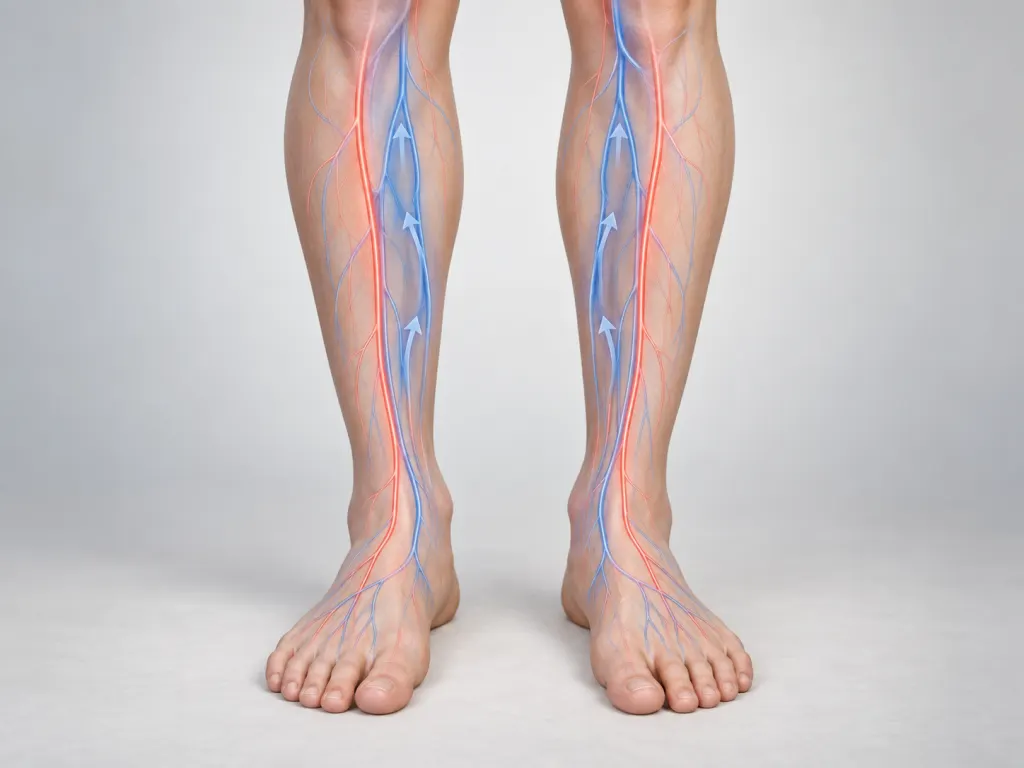
Peripheral artery disease happens when narrowed arteries reduce blood flow to the arms or legs. In the legs, PAD may cause muscle pain, aching, heaviness, fatigue, burning, or cramping with walking, exercise, or stairs. The pain often improves after stopping, though it may take a few minutes American Heart Association. The discomfort is often felt in the calf, but it can also be felt in the thigh, buttock, ankle, or foot depending on where blood flow is limited.
PAD deserves attention because it is not only a leg issue. NHLBI notes that people with PAD share a higher cardiovascular risk, and PAD can also cause slow-healing sores, color or temperature changes, and worsening symptoms when blood flow is severely reduced NHLBI. Risk factors include a history of smoking, diabetes, high blood pressure, high cholesterol, heart disease, kidney disease, stroke, and older age. A person does not need to have every risk factor for PAD to be worth checking.
How PAD Is Usually Checked
A clinician may ask about your walking distance, symptoms, personal health history, family history, smoking history, and any leg or foot wounds. An exam may include checking leg pulses, looking for skin or foot changes, and listening for abnormal blood-flow sounds. The ankle-brachial index, or ABI, is commonly used to compare blood pressure at the ankle with blood pressure in the arm; NHLBI describes it as the usual first test for PAD NHLBI. Mayo Clinic also notes that ABI testing may be done before and after treadmill walking when symptoms appear with exertion Mayo Clinic.
When The Spine Or Nerves Are Involved
Not all walking-related leg pain comes from blood flow. Lumbar spinal stenosis can narrow spaces in the lower spine and put pressure on nerve roots. NIAMS describes lower-back spinal stenosis as causing lower-back pain, burning or aching that can travel into the buttocks and legs, numbness, tingling, cramping, or leg weakness. Symptoms often become more noticeable with standing or walking and may ease with sitting or bending forward NIAMS. A common clue is feeling better when leaning over a shopping cart, sitting briefly, or flexing the lower back.
Peripheral neuropathy is another nerve-related possibility. NIDDK describes peripheral neuropathy as nerve damage that usually affects the feet and legs first and may cause burning, tingling, numbness, pain, weakness, changes in walking, and balance problems NIDDK. Diabetes is a common cause, but nerve symptoms can have other causes too. Burning or numb pain that is present even before walking, appears in both feet, worsens at night, or makes the ground feel hard to sense is a different pattern from classic exertional calf cramping.
Foot, Tendon, Muscle, And Fitness Clues
Foot and tendon problems can make a short distance feel much longer. Plantar fasciitis often causes stabbing pain near the heel, especially with the first steps after getting out of bed or after sitting; the pain may ease as you move but return after prolonged standing Mayo Clinic. Achilles tendinitis may cause soreness or stiffness at the back of the leg or above the heel, especially after running, stair climbing, sprinting, or a sudden increase in activity Mayo Clinic.
Muscle cramps can also interrupt walking. MedlinePlus describes cramps as involuntary tightening that may be linked with overuse, injury, not enough fluids, low levels of certain minerals, some health conditions, or some medicines MedlinePlus. If your main issue is cramping that happens at night rather than during walking, this related guide on why feet cramp at night may help you separate bedtime cramping patterns from exertional leg pain. Deconditioning can add another layer: after illness, long sitting, or a long break from activity, muscles may fatigue quickly even without a single named condition.
Useful Details To Bring To An Appointment
Because several conditions can overlap, a clear symptom history is often more useful than a broad statement like “my legs hurt.” Before an appointment, try to record:
- Where the pain begins: calf, thigh, buttock, shin, ankle, heel, arch, toes, or back.
- What it feels like: cramping, heaviness, fatigue, burning, tingling, stabbing, weakness, numbness, or joint ache.
- How far you can walk before it starts and whether stairs or hills bring it on sooner.
- What helps: standing still, sitting, leaning forward, stretching, changing shoes, or stopping the walk entirely.
- How long it takes to ease and whether symptoms now appear with shorter distances.
- Whether you see swelling, redness, a cooler foot, color change, slow-healing sores, balance problems, or new weakness.
When To Seek Care Quickly
Prompt medical attention is important when leg pain is new, worsening, limiting ordinary activity, appearing at rest, or accompanied by changes in the foot or leg. CDC notes that deep vein thrombosis can cause swelling, pain or tenderness, warmth, and redness or discoloration in an affected leg or arm, and that pulmonary embolism symptoms such as trouble breathing, chest pain or discomfort, coughing blood, fainting, or a very fast or irregular heartbeat require immediate medical help CDC. Sudden one-sided leg swelling, severe pain, sudden weakness, trouble walking, chest symptoms, or shortness of breath should not be handled as a routine walking problem.
What Helps The Conversation Become Practical
The goal is to match the pain pattern with the right evaluation. If the story sounds vascular, testing may focus on pulses, ABI, blood pressure, cholesterol, blood sugar, and imaging when needed. If the story sounds spinal or nerve-related, the exam may focus on strength, reflexes, sensation, walking pattern, posture, and back-related symptoms. If the pain points to the heel, Achilles tendon, arch, or calf strain, the conversation may turn toward footwear, training changes, stretching, gradual loading, and whether a referral to physical therapy, podiatry, orthopedics, vascular medicine, or another specialist makes sense.
Wrap-Up
Leg pain after short walks is worth taking seriously, especially when it repeats at a predictable distance, worsens over time, or comes with swelling, color change, coolness, wounds, numbness, weakness, chest symptoms, or shortness of breath. Circulation-related pain often appears during walking and improves with rest. Spine-related nerve pain may improve with sitting or leaning forward. Neuropathy may feel burning, tingling, numb, or balance-related. Foot, tendon, cramp, and conditioning problems have their own clues. A careful description of the pattern helps a clinician choose the most appropriate next step.
Frequently Asked Questions
- → Is leg pain after a short walk just normal aging?
Not necessarily. Fitness changes, footwear, arthritis, cramps, and tendon strain can play a role, but repeated pain after a short, predictable distance can also reflect circulation or nerve problems. It is especially worth discussing with a health professional if the distance is getting shorter, the pain is new, or you notice foot or skin changes.
- → What does circulation-related walking pain usually feel like?
It often feels like aching, heaviness, fatigue, burning, or cramping in a working muscle during walking, stair climbing, or hills. It commonly eases after stopping for a few minutes. The calf is a common location, but symptoms can also appear in the thigh, buttock, ankle, or foot.
- → Why do my legs feel better when I sit or lean forward?
That pattern can happen when nerves in the lower spine are irritated or compressed, such as with lumbar spinal stenosis. Sitting or bending forward may ease pressure for some people. A clinician can compare this pattern with circulation, hip, foot, and nerve findings.
- → Should I keep walking through the pain?
Do not force through severe, sudden, or unusual pain. If you already have a diagnosis and a clinician has given you a walking plan, follow that guidance. If the cause is unknown, repeated walking pain, new weakness, swelling, color change, or pain at rest should be assessed before you increase activity.
- → What signs make leg pain more urgent?
Seek prompt help for sudden one-sided swelling, warmth, redness, a cold or pale foot, slow-healing wounds, sudden weakness, severe pain, pain at rest, chest pain, trouble breathing, fainting, or coughing blood. Those signs can point to problems that need timely medical evaluation.
References
This content was developed and refined using reliable sources.
- https://www.nhlbi.nih.gov/health/peripheral-artery-disease/symptoms
- https://www.heart.org/en/health-topics/peripheral-artery-disease/symptoms-of-pad
- https://www.nhlbi.nih.gov/health/peripheral-artery-disease/diagnosis
- https://www.mayoclinic.org/tests-procedures/ankle-brachial-index/about/pac-20392934
- https://www.niams.nih.gov/health-topics/spinal-stenosis
- https://www.niddk.nih.gov/health-information/diabetes/overview/preventing-problems/nerve-damage-diabetic-neuropathies/peripheral-neuropathy
- https://www.mayoclinic.org/diseases-conditions/plantar-fasciitis/symptoms-causes/syc-20354846
- https://www.mayoclinic.org/diseases-conditions/achilles-tendinitis/symptoms-causes/syc-20369020
- https://www.medlineplus.gov/ency/article/003193.htm
- https://www.cdc.gov/blood-clots/about